จำนวน Repository ( 64 )

Technical specification and Agreement for the map system of RMUTK
The development and update a map in Rajamangala University of Technology Krungthep in geographic information system with the measurement map system in a large scale map by use theoretical surveying all basic such as ground surveying aerial photogrammetry remote sensing theory Processing and the accuracy validation survey. These are part of a map system. Methodology or procedures all a map system will out technical specification and agreement to implementation a map system for the definition purposes. This Technical specification and agreement are under the standards of the organization and institution in a field survey. Those standards or rules taken improve the application to modify the Technical specification and agreement of Rajamangala University of Technology Krungthep only. The results of the study can be divided into main data 9 groups and 30 groups of data from geography at Rajamangala University of Technology Krungthep and standards or rules of organization institution together with the criteria processing and the criteria acceptance tolerances of the measure survey. The results of testing the system map by this the frame of technical specification and agreement. The engineering student survey of Rajamangala University of Technology Krungthep study technical specification and agreement and provides map system. By study used south bangkok area. Student group has set up a system to map the technical specification and agreement created. Plan defined
Geo-informatics for ecotourism: ban mae klang luang model
Geo-Informatics for Ecotourism: Ban Mae Klang Luang Model is participatory action research (PAR) conducing to share knowledge together. Furthermore Ban Mae Klang Luang Model is important mechanism for management of natural resources and environment for ecotourism. Example local resource landmark natural trail firebreaks landuse etc. Community can create that on model by themselves. Creating a website to show information of Ban Mae Klang Luang. Klang Luang; for example : general information home stay economic community knowledge’s philosopher and experiences ideas of living and lead to graduate desirable. The results show that Ban Mae Klang Luang Model can manage natural resources and environment for ecotourism which can be implemented by local communities for sustainable and efficient. However the experience between students and the community is the practical work for learning.
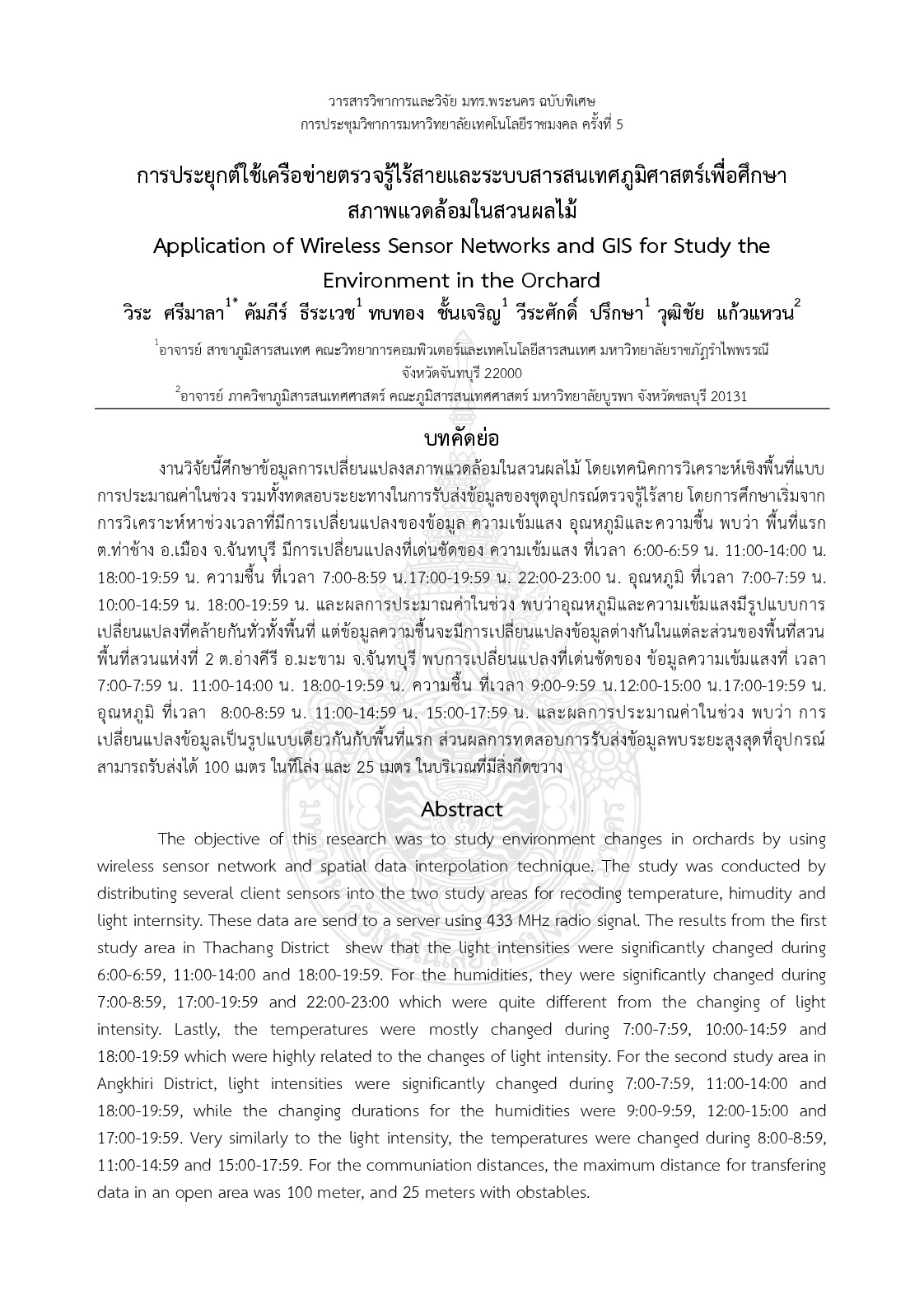
Application of wireless sensor networks and gis for study the environment in the orchard
The objective of this research was to study environment changes in orchards by using wireless sensor network and spatial data interpolation technique. The study was conducted by distributing several client sensors into the two study areas for recoding temperature himudity and light internsity. These data are send to a server using 433 MHz radio signal. The results from the first study area in Thachang District shew that the light intensities were significantly changed during 6:00-6:59 11:00-14:00 and 18:00-19:59. For the humidities they were significantly changed during 7:00-8:59 17:00-19:59 and 22:00-23:00 which were quite different from the changing of light intensity. Lastly the temperatures were mostly changed during 7:00-7:59 10:00-14:59 and 18:00-19:59 which were highly related to the changes of light intensity. For the second study area in Angkhiri District light intensities were significantly changed during 7:00-7:59 11:00-14:00 and 18:00-19:59 while the changing durations for the humidities were 9:00-9:59 12:00-15:00 and 17:00-19:59. Very similarly to the light intensity the temperatures were changed during 8:00-8:59 11:00-14:59 and 15:00-17:59. For the communiation distances the maximum distance for transfering data in an open area was 100 meter and 25 meters with obstables.
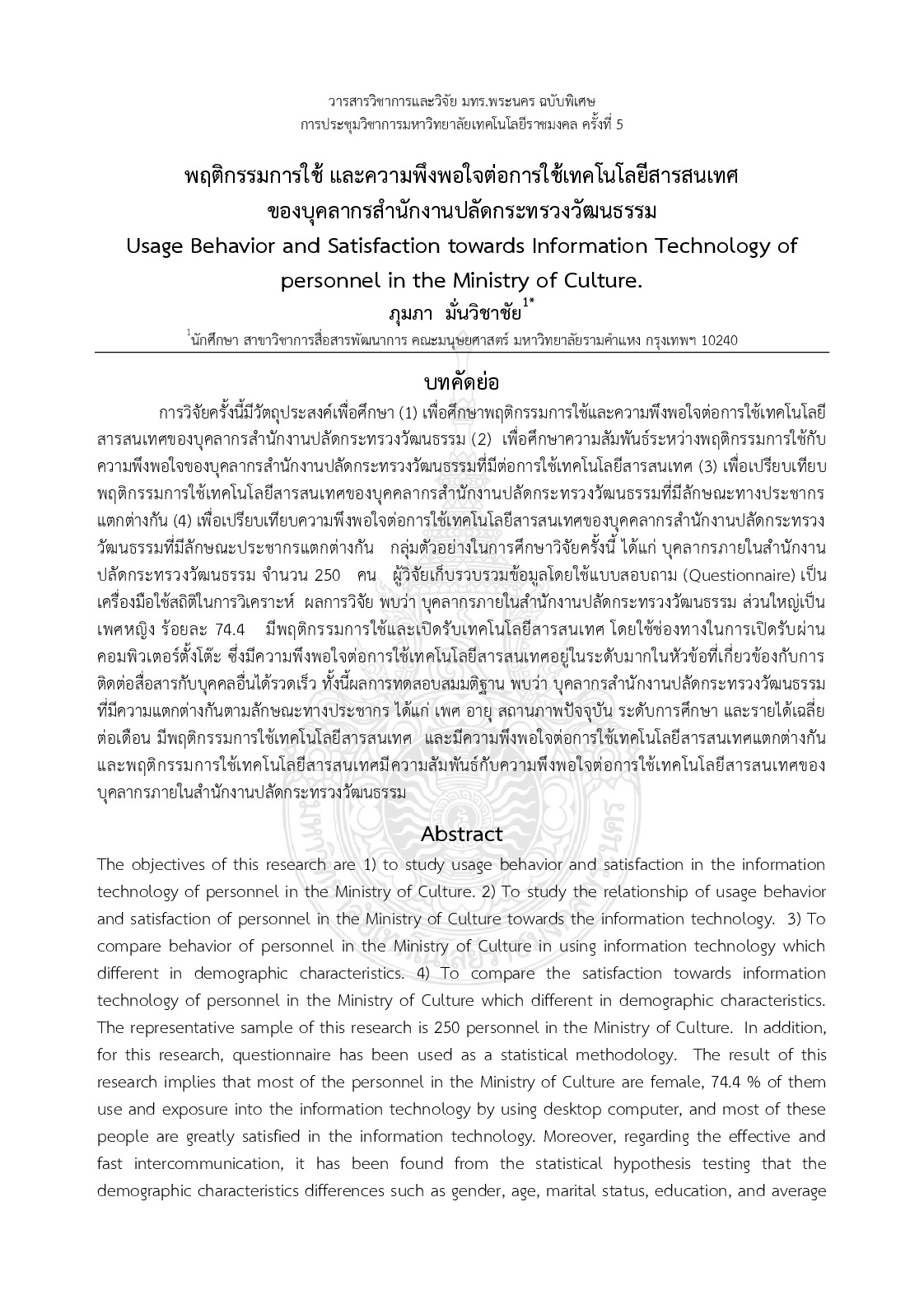
Usage behavior and satisfaction towards information technology of personnel in the ministry of culture.
The objectives of this research are 1) to study usage behavior and satisfaction in the information technology of personnel in the Ministry of Culture. 2) To study the relationship of usage behavior and satisfaction of personnel in the Ministry of Culture towards the information technology. 3) To compare behavior of personnel in the Ministry of Culture in using information technology which different in demographic characteristics. 4) To compare the satisfaction towards information technology of personnel in the Ministry of Culture which different in demographic characteristics. The representative sample of this research is 250 personnel in the Ministry of Culture. In addition for this research questionnaire has been used as a statistical methodology. The result of this research implies that most of the personnel in the Ministry of Culture are female 74.4 % of them use and exposure into the information technology by using desktop computer and most of these people are greatly satisfied in the information technology. Moreover regarding the effective and fast intercommunication it has been found from the statistical hypothesis testing that the demographic characteristics differences such as gender age marital status education and average income per month have the differences in the usage behavior and satisfaction of the information technology and the usage behavior of the information technology has a relationship with satisfaction in using information technology of personnel in the Ministry of Culture.
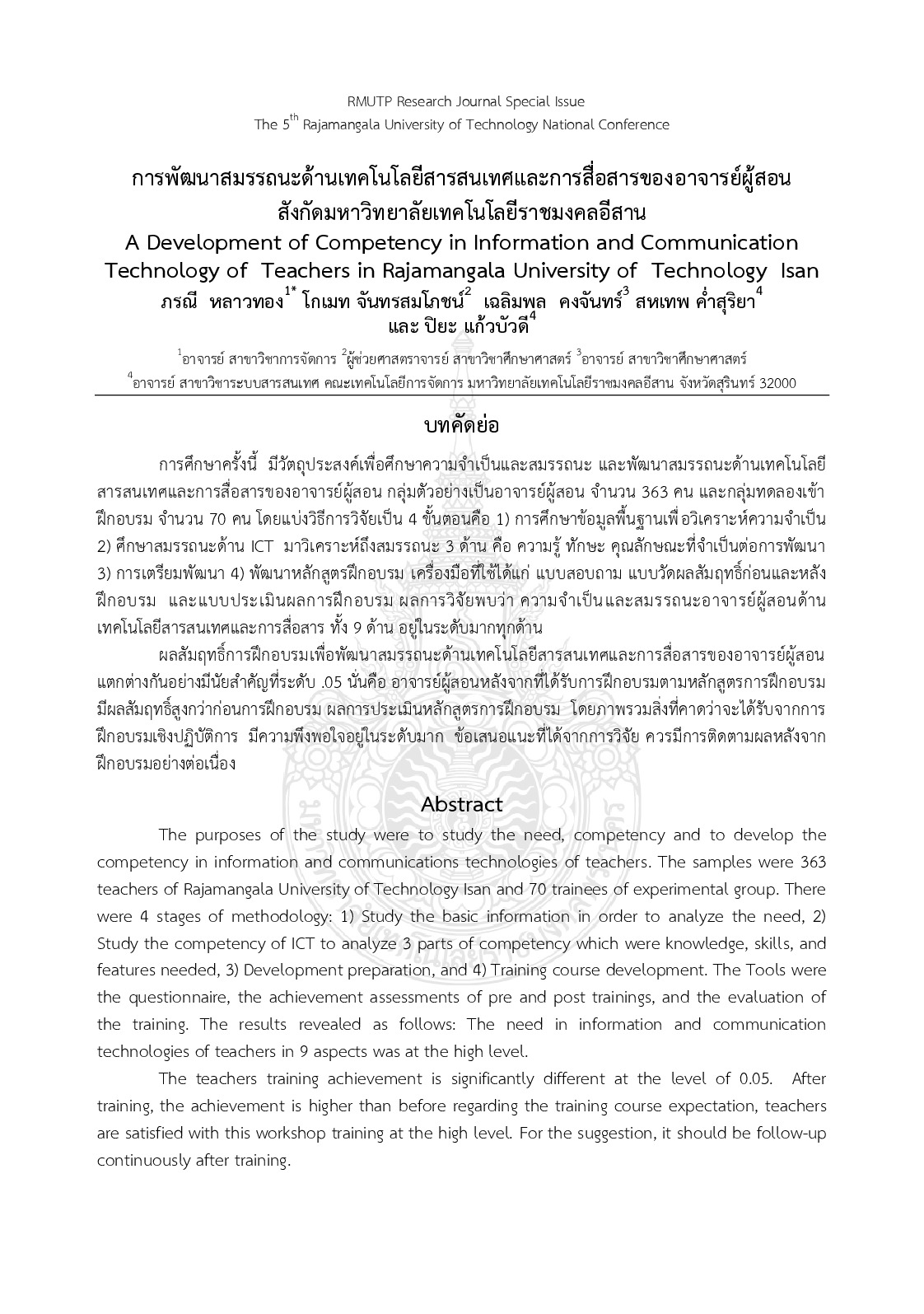
A development of competency in information and communication technology of teachers in Rajamangala University of Technology isan
The purposes of the study were to study the need competency and to develop the competency in information and communications technologies of teachers. The samples were 363 teachers of Rajamangala University of Technology Isan and 70 trainees of experimental group. There were 4 stages of methodology: 1) Study the basic information in order to analyze the need 2) Study the competency of ICT to analyze 3 parts of competency which were knowledge skills and features needed 3) Development preparation and 4) Training course development. The Tools were the questionnaire the achievement assessments of pre and post trainings and the evaluation of the training. The results revealed as follows: The need in information and communication technologies of teachers in 9 aspects was at the high level. The teachers training achievement is significantly different at the level of 0.05. After training the achievement is higher than before regarding the training course expectation teachers are satisfied with this workshop training at the high level. For the suggestion it should be follow-up continuously after training.