จำนวน Repository ( 70 )

Development of Process for Recovery Metal Carbide Powder from Cemented Tungsten Carbide Scraps
The recycling of materials is the recovered process and the important approach for sustainable development. This research is to study recycling tungsten carbides from cemented carbide scraps by extracting the dissolved of binder phase and to study the un-dissolved substrate which stayed condition and size in WC particles. The experiment of this research starts in laboratory with electrolysis is found that the appropriate operating potential is 0.20-1.40 volts at 30-80 oc treated in 1N-7N HCl concentrations aqueous solution as well as the movement of solution and specimens had an effect on capacity of dissolution. Additionally these factors are affected to purity and passivation of WC particles. According to the above experiment it leads to design and create the semi-automatic cemented dissolution machine with electrolysis. This machine can contain the scraps up to 2.5 kilograms in rev 0-25 rpm (revolutions per minute) at electric current 0-50 ampere in electric voltage 0-15 volts. Its flowing process can be 15 lpm (litre per minute) and minute) and temperature is up to 90 oc. Furthermore there are the relative WC power invention processes included residues washing leaching ball milling drying screening and quality examination. The result of developed machine is capacity of tungsten carbide production is in the range 16-50 gram/hour the obtained powder is 97.49% of tungsten carbide (WC powder) which contained a few amount of cobalt. However the dissolution of cemented carbides with this machine can be selected the optimized factors to produce tungsten carbide (WC) to purify more than 99% ball milled them in the most suitable size and particle sized distribution between 0.30-20.00 μm. Afterwards combining cobalt 15% (WC-15%Co) and producing to cemented carbides insert tools rectangle as SNMG standard 120408 it appears that insert tools has a hardness not less than 1430 HV density not less than 14.10 g/cm³. In the other hands the production of tungsten carbides with advanced technology of dissolution machine and manufacturing machine to produce purely tungsten carbides powder has been required an investment charge of new research and development more than 9481888 baht.
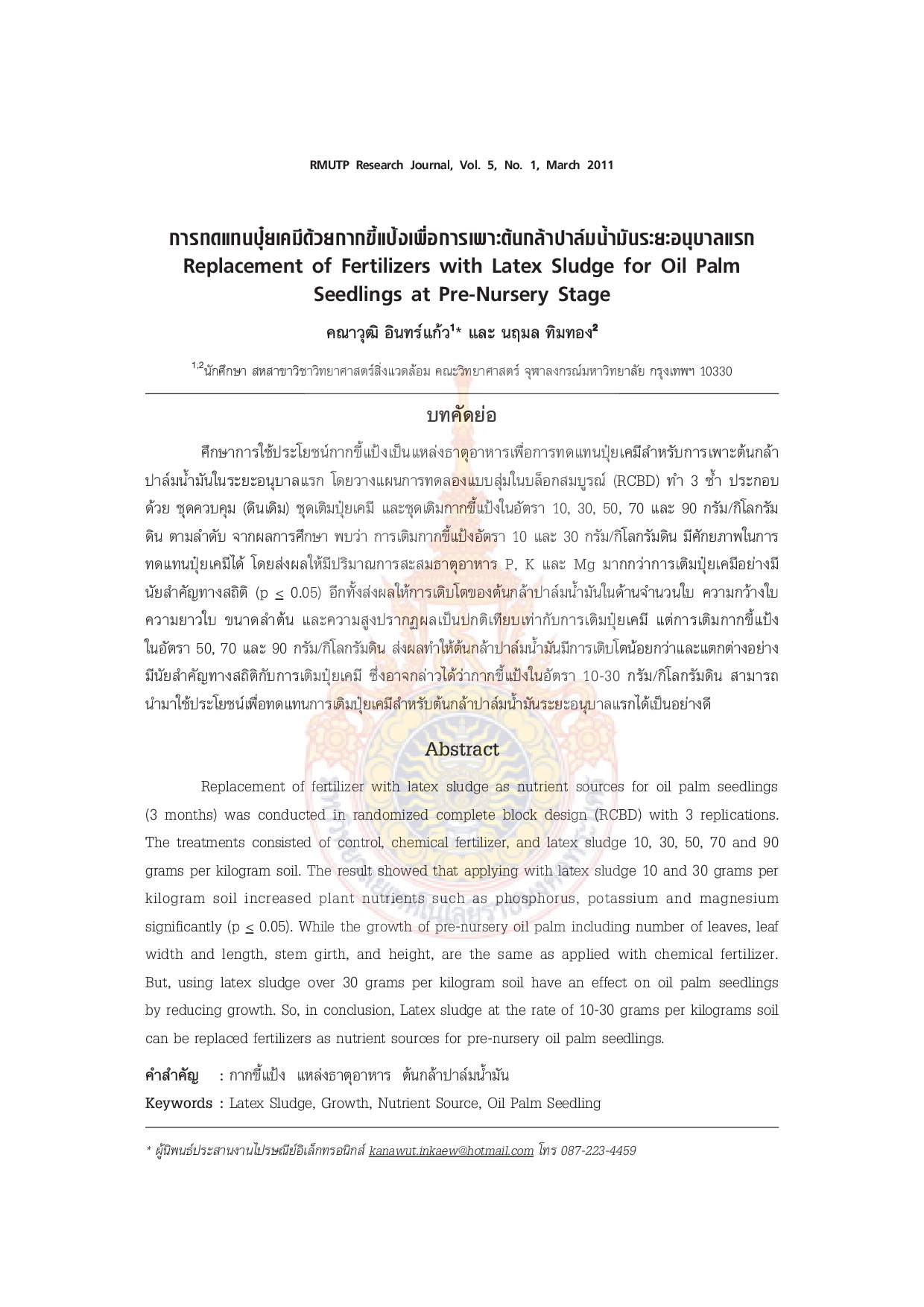
Replacement of Fertilizers with Latex Sludge for Oil Palm Seedlings at Pre-Nursery Stage
Replacement of fertilizer with latex sludge as nutrient sources for oil palm seedlings (3 months) was conducted in randomized complete block design (RCBD) with 3 replications. The treatments consisted of control chemical fertilizer and latex sludge 10 30 50 70 and 90 grams per kilogram soil. The result showed that applying with latex sludge 10 and 30 grams per kilogram soil increased plant nutrients such as phosphorus potassium and magnesium significantly (p <≤ 0.05). While the growth of pre-nursery oil palm including number of leaves leaf width and length stem girth and height are the same as applied with chemical fertilizer. But using latex sludge over 30 grams per kilogram soil have an effect on oil palm seedlings by reducing growth. So in conclusion Latex sludge at the rate of 10-30 grams per kilograms soil can be replaced fertilizers as nutrient sources for pre-nursery oil palm seedlings
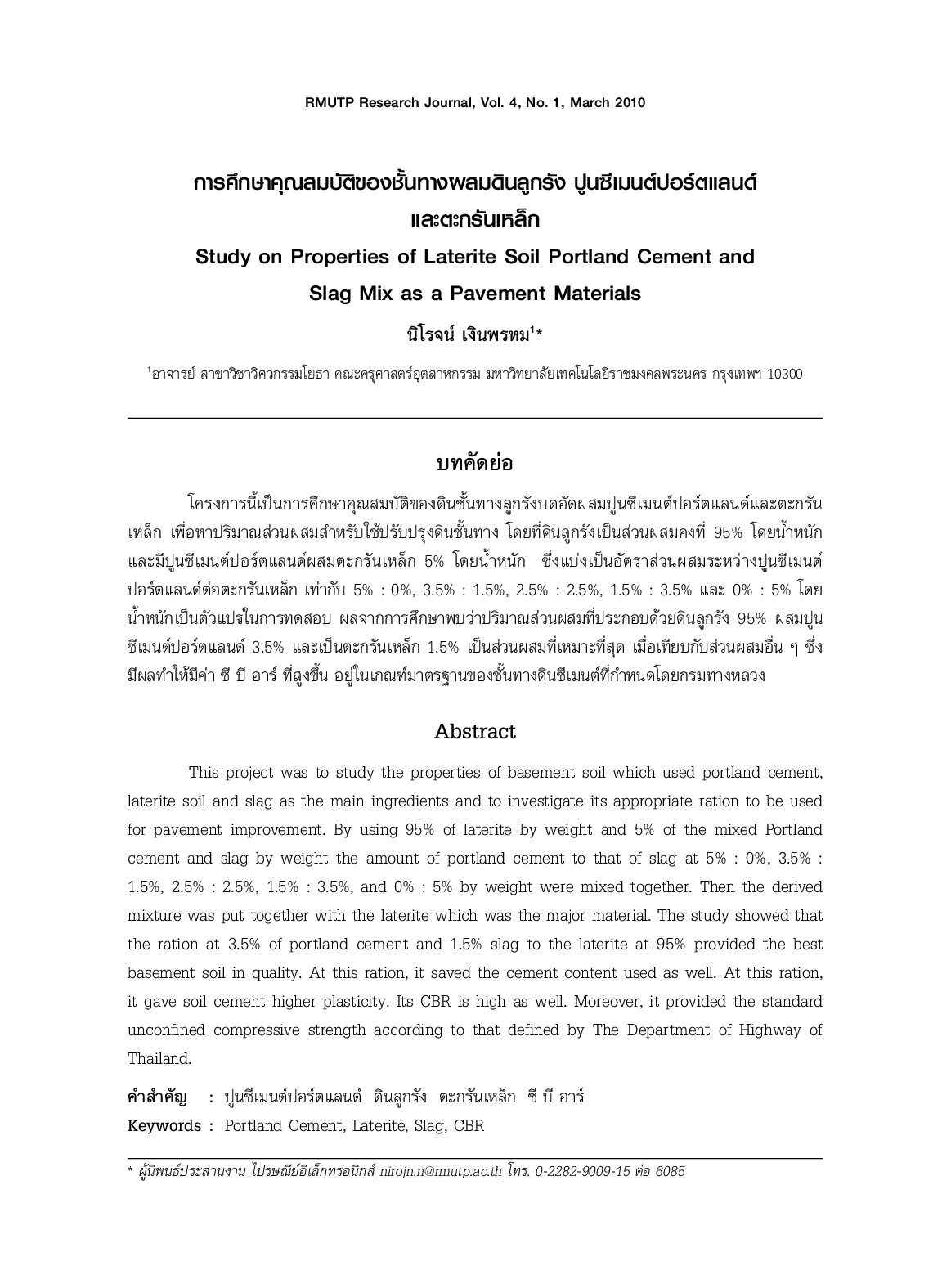
Study on Properties of Laterite Soil Portland Cement and Slag Mix as a Pavement Materials
This project was to study the properties of basement soil which used portland cement laterite soil and slag as the main ingredients and to investigate its appropriate ration to be used for pavement improvement. By using 95% of laterite by weight and 5% of the mixed Portland cement and slag by weight the amount of portland cement to that of slag at 5% : 0% 3.5% : 1.5% 2.5% : 2.5% 1.5% : 3.5% and 0% : 5% by weight were mixed together. Then the derived mixture was put together with the laterite which was the major material. The study showed that the ration at 3.5% of portland cement and 1.5% slag to the laterite at 95% provided the best basement soil in quality. At this ration it saved the cement content used as well. At this ration it gave soil cement higher plasticity. Its CBR is high as well. Moreover it provided the standard unconfined compressive strength according to that defined by The Department of Highway of Thailand.
An Experimental investigation of the carbonation of blended portland cement palm oil fuel ash mortar in an indoor environment
In this research palm oil fuel ash was utilized as a pozzolanic material in blended Portland cement mortar. The mortar was tested on the normal compressive strength and the negative effect of carbonation in indoor environment using the accelerated carbonation test of 5% CO2 in 50% relative humidity. Three palm oil fuel ash fractions of different fineness viz. coarse original palm oil fuel ash (CPOA) medium palm oil fuel ash (MPOA) and fine palm oil fuel ash (FPOA) were used for the study. Ordinary Portland cement (OPC) was partially replaced by these palm oil fuel ashes at the dosages of 20% and 40% by weight of binder. The results showed that the incorporation of the ashes affected the strength and the carbonation depths of mortars. The strengths of mortar slightly decreased with the increases in the dosage of the ash. The fineness of ash on the other hand improved the strength and the carbonation of the mortars. The mortars containing FPOA exhibited high strength and relatively low carbonation in comparison to those using coarser MPOA and CPOA. The use of FPOA resulted in a strong and dense mortar owing to the increased packing effect and pozzolanic reaction. It was therefore demonstrated that the FPOA could be used as a pozzolanic material to replace part of Portland cement for use in the indoor environment.
Pore structure changes of blended cement pastes containing fly ash, rice husk ash, and palm oil fuel ash caused by carbonation
In this paper the effects of carbonation on pore structure of blended pozzolan cement pastes were investigated. Ordinary Portland cement _OPC_ was partially replaced with ground palm oil fuel ash _POA_ ground rice husk ash _RHA_ and classified fine fly ash _FA_. The strength total porosity specific surface area and pore size distribution were tested. In general incorporation of pozzolans increased the total porosity of blended cement pastes in comparison to that of OPC paste. Carbonation of pastes under 5% CO2 and 50% relative humidity _RH_ for 28 days resulted in filling of the pore voids and possible attack on calcium silicate hydrate _CSH_ depending on the type of pozzolan used. After carbonation total porosity decreased and specific surface areas of the blended pozzolan cement pastes reduced indicating the infilling of voids. Pore size distributions of POA and RHA pastes were different to those of FA pastes. Large pores of the POA and RHA pastes were increased indicating coarsening of pores owing to possible attack on CSH. It is possible that POA and RHA were highly reactive and hence their uses resulting in severe carbonation compared to use of FA.