จำนวน Repository ( 67 )

Effects of water content and cooking time on chemical composition structureand properties of germinated purple rice (oryza sativa var. glutinosa) flour
The purpose of this research is to estimate the affects of water content (27 37 and 47 % wet basis) cooking time (1 3 and 5 hr) at 110oC and germinating time (24 36 and 48 hr) on chemical composition structure and properties of germinated purple rice flour. A Box-Behnken design under the response surface methodology was performed to optimize their composition. Rajamangala University of Technology Lanna Nan was research place. Results demonstrated that germinating time had no significantly effect on protein and lipid content but resulted in increasing crude fiber and decreasing carbohydrate and amylose content with increase in germinating time. Scanning electron micrographs (SEM) revealed the presence of polyhedral shape and agglomerations. Birefringence was evidenced. Pasting properties of germinated purple rice flour showed an increase in the pasting temperature but a decrease the peak viscosity breakdown final viscosity and setback (p<0.05) as germinating time increased. Modified rice flour were increase in carbohydrate and amylose content and decrease in protein lipid ash and fiber as water content and cooking time at 110oC increased. Change in birefringence of starch granule after heating at 110oC was examined by a polarized light microscope. SEM showed the presence of creak surfaces and agglomerations. The swelling power of germinated purple rice flour decreased with increase in cooking time. The solubility at 85oC of germinated purple rice flour was increased in each level of water content.
การพัฒนารูปแบบผลิตภัณฑ์ของขวัญของที่ระลึกจากแป้งเปลือกทุเรียน
The purposes of the research were 1) to develop the formula of Durian rind dough for proper molding 2) to develop the pattern of souvenir product made from Durian rind dough representing Thai identity and 3) to transfer the knowledge of the development of souvenir product from Durian rind dough to Art and Craft Cooperative Group Muslim Community in Koh Kred Nonthaburi province.
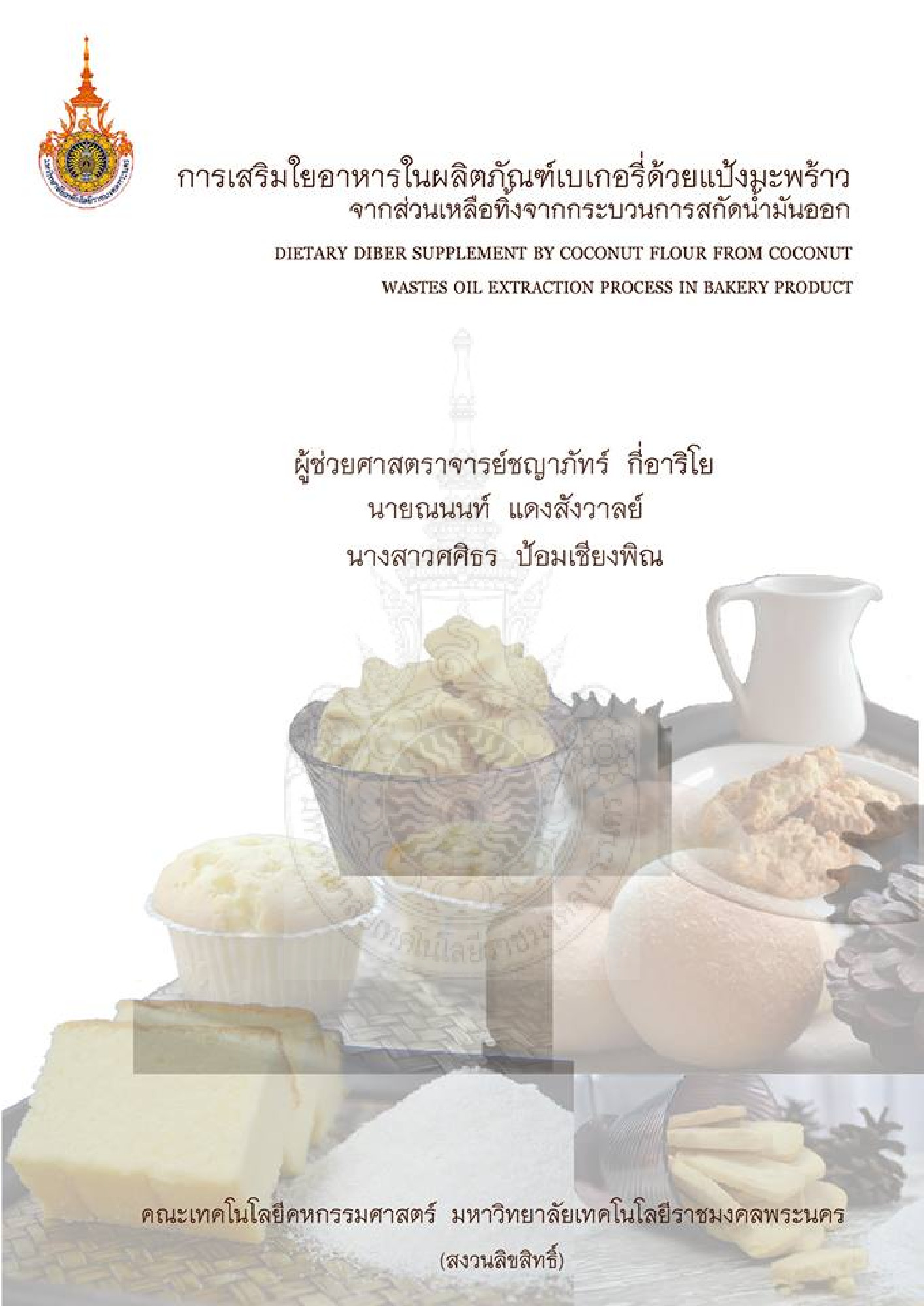
การเสริมใยอาหารในผลิตภัณฑ์เบเกอรี่ด้วยแป้งมะพร้าวจากส่วนเหลือทิ้งจากกระบวนการสกัดน้ำมันออก
The studies of Dietary Fiber Supplement by coconut flour from coconut Wastes Oil Extraction process in Bakery Product was investigated Production of coconut flour from coconut wastes oil extraction drying at 55 ° C for 12 hours and then grinding to powder gave the off-white fine powder. The chemical compositions of coconut flour were 57.70 % carbohydrate 29.4 % fat 6.23 % moisture 5.20 % protein and 1.48 % ash by dye weigh. Butter cake making experiment by substitution of wheat flour with coconut flour at 5 % of wheat flour weigh which has the highest sensory scores comparing butter cake with the control found that increase dietary fiber 1.34 g. /100 g. The majority of the tested consumers (92%) accepted butter cake with 5 % of coconut flour substitution. Muffin making experiment by substitution of wheat flour with coconut flour at 15 % of wheat flour weigh which has the highest sensory scores comparing muffin with the control found that increase dietary fiber 2.34 g /100 g. The majority of the tested consumers (81%) accepted muffin with 15 % of coconut flour substitution. Cornflake cookie making experiment by substitution of wheat flour with coconut flour at 20 % of wheat flour weigh which has the highest sensory scores comparing cornflake cookie with the control found that increase dietary fiber 3.54 g. /100 g. The majority of the tested consumers (94 %) accepted cornflake cookie with 20 % of coconut flour substitution. Butter cookie making experiment by substitution of wheat flour with coconut flour at 10 % of wheat flour weigh which has the highest sensory scorescomparing butter cookie with the control found that increase dietary fiber 3.04 g. /100 g. The majority of the tested consumers (94 %) accepted Butter cookie with 10 % of coconut flour substitution. Frozen cookie making experiment by substitution of wheat flour with coconut flour at 20 % of wheat flour weigh which has the highest sensory scores comparing cookie with the control found that increase dietary fiber 4.02g. /100 g. The majority of the tested consumers (93 %) accepted 20 % of coconut flour substitution. Butter bread making experiment by substitution of wheat flour with coconut flour at 15 % of wheat flour weigh which has the highest sensory scores comparing butter bread with the control found that increase dietary fiber 2.22 g. /100 g. The majority of the tested consumers (75 %) accepted 15% of coconut flour substitution. Whole wheat bread making experiment by substitution of wheat flour with coconut flour at 15 % of wheat flour weigh which has the highest sensory scores comparing whole wheat bread with the control found that increase dietary fiber 2.09 g. /100 g. The majority of the tested consumers (79 %) accepted 15 % of coconut flour substitution. Pie crust making experiment by substitution of wheat flour with coconut flour at 15 % of wheat flour weigh which has the highest sensory scores comparing pie crust with the control found that increase dietary fiber 2.91 g. /100 g. The majority of the tested consumers (82 %) accepted 15 % of coconut flour substitution.
การพัฒนาสารกั้นสีจากแป้งที่ได้จากหัวบอนเพื่อใช้ในการพิมพ์ย้อมผ้าแบบรีซีสต์
The purpose of this research was to study the white resist printing with colour resistant material from flour of wild taro (Colocasia Esculenta (L.) Schott) and using reactive pigment and natural dyes as dyestuffs. Five formulas of printing pastes were applied to light cotton thick cotton and silk fabrics by the use three techniques nauely Silk screen (White resist and colour resist methods)stencil and batik. The optimal ratio of colour resistant materials from flour of wild taro were compose of 20 grams flour of wild taro 32-36 ml. water 30-34 ml. sodium chloride 10-13 ml. calcium hydroxide and 1-4% vegetable oil. The viscosities of printing paste from five recipes were shown in the rage between 559.9-671.9 Centipoise. All five recipes can resist dyestuffs and also easy to remove the flour of wild taro. The pattern at resist printing area of fabrics shows sharpness and whiteness. The colour fastness to washing water and perspiration on cotton and silk fabric results were ranging between poor to fair level when using reactive and natural dyes as dyestuff. However the fastness property of pigment dye shows medium to good level. The colour fastness to rubbing is shown to be in range of 4 to 4-5 for all recipes. The ratings of colour fastness to light in terms of colour change are fair to good (4 to >6).
เครื่องบดถั่วเหลืองเป็นผงแป้งแบบจานร่วมกับลูกกลิ้ง
Soybeans are a crop that can be utilized especially in terms of food rich in protein and fat as the human and animal needs. For using the soybeans must be processed to obtain the desired physical characteristics. The process is mostly a grinding and extraction. However these two processes are completely different applications. This research aims to study and create the soybeans grinder machine become to flour the quantity of grinding the variable that affect to the amount of grinding and economic analysis for guiding to investment. The researchers have designed the grinder unit by the coarse grinding and mill grinding unit. For the coarse grinding unit is similar to a disc and in case of grinding mill will be used the roller set. Base on the power train of bolt grinding unit the electric motor with 2 HP. at 1450 RPM are used for the experiment. For the grinding mil process the rough material is feed into grinding mil chamber for reduce the size of material become to the flour. The results of the research found that the suitable speed of the coarse grinding and mill grinding unit was 480 and 725 RPM respectively. In case of these relationships the average quantity of grinding for the coarse grinding and mill grinding unit was 271.8 and 150 kglhr respectively. Furthermore the results of experiment discover the materials that are not accounted of the coarse grinding for 13.9 percent. For the economic analysis for guiding to investment found that the breakeven point and pay-back period was 110378 kg and 0.0067 year respectively.