จำนวน Repository ( 1087 )
การวิเคราห์ความน่าเชื่อถือได้ในการทำงานของเครื่องจักร และหาสาเหตุของเครื่องจักรเสีย: กรณีศึกษาโรงงานผลิตชิ้นส่วนรถยนต์
This research proposes reliability analysis in order to find the probability that a machine will work properly the failure rates of a machine and the factors related to the failure rates. The data were collected from 8 types of machines in an autoparts manufacturing factory. They consist of the times measured from the first day of the study until the machine produces defective product workers and production steps. The study duration is 90 days. The results show that the probability that the machine type 4 will work properly more than days is 0.40 machine type 5 more than 68 days is 0.32 machine type 6 more than 72 days is 0.31 machine type 8 more than 85 days is 0.26 machine type 9 more than 109 days is 0.80 machine type 10 at more than 52 days is 0.38 machine type 11 more than 71 days is 0.32 and the probability that the machine type 12 will work properly more than 85 days is 0.26. The failure rate of the machine type 4 at day 51 is 6.61 machine type 5 at day 68 is 1.61 machine type 6 at day 72 is 0.77 machine type 8 at day 85 is 1.26 machine type 9 at day 109 is 1.31 machine type 10 at day 52 is 0.92 machine type 11 at day 71 is 1.24 and the failure rate of the machine type 12 at day 85 is 2.15. The factors influencing on the failure rates are worker group 2 and production step 3 at the significance of 0.05.
การศึกษาวิเคราะห์อิทธิพลของธาตุเจือทองแดงและดีบุกที่มีผลต่อสมบัติทางกายภาพ (ความแตกต่างของค่าระดับสี) และพฤติกรรมความด้านทานการหมองของโลหะเงินเจือต่ำ 58.33 wt% AgCuSn
การวิจัยนี้เป็นการศึกษาสมบัติของโลหะเงินเจือต่ำ 58.33% ที่มีธาตุทองแดง (Cu) และดีบุก (Sn) เป็นธาตุผสม ซึ่งมีปริมาณการผสมอยู่ในช่วงระหว่าง 36.66-41.57%Cu และ 0.10-5.01%Sn ตามล่าดับ โดยท่าการเปรียบเทียบกับสมบัติของโลหะเงินสเตอร์ลิง 925 และโลหะเงินเจือต่ำ 58.33%เพื่อ ศึกษาวิเคราะห์อิทธิพลของธาตุเจือทองแดงและดีบุกที่มีผลต่อสมบัติเคมีและสมบัติทางกายภาพที่ เหมาะสมในการผลิตเครื่องประดับเงินเจือต่ำ 58.33% ผลจากการศึกษาโลหะเงินเจือต่ำ 58.33 % ที่ประกอบด้วยเงิน (Ag) และทองแดง (Cu) เมื่อน่ามา เปรียบเทียบกับโลหะเงินสเตอร์ลิง 925 จากการศึกษาเปรียบเทียบพบว่าโลหะเงินผสมเจือต่ำ ต่ำ 58.33Ag + 41.16Cu +0.51Sn มีค่า มีค่า L* = 92.18 a* = 4.64 b* = 10.71 และ ΔE = 28.32 เป็น ส่วนผสมที่เหมาะที่สุดจากการวิเคราะห์ค่าระดับสีและค่าความแตกต่างของสี และมีพฤติกรรมความ ต้านทานการหมองของโลหะเงินเจือต่ำมากที่สุด เนื่องจากอิทธิพลของธาตุดีบุก (Sn) ที่ผสมเข้าไปใน อัตราส่วนที่เหมาะสม ผลจากการวิเคราะห์ส่วนผสมทางเคมีของโลหะเงินเจือต่ำ 58.33% พบว่าส่วนผสมทางเคมีของ โลหะเงินเจือต่ำในแต่ละอัตราส่วนผสมมีสัดส่วนของธาตุใกล้เคียงกับอัตราส่วนผสมจริง จึงท่าให้โลหะเงิน เจือต่ำที่ได้ท่าการทดลองมีค่าระดับสีและพฤติกรรมความต้านทานการหมองที่สูงไม่แตกต่างกันมากนัก เป็นไปตามมาตรฐานของเครื่องประดับเงินตามมาตรฐานอุตสาหกรรมการผลิตเครื่องประดับทั้งของใน ประเทศและต่างประเทศ
การถ่ายทอดเทคโนโลยีการสร้างตราสินค้าและบรรจุภัณฑ์เพื่อเพิ่มมูลค่าผลิตภัณฑ์จากเศษวัสดุสิ่งทอเหลือทิ้ง
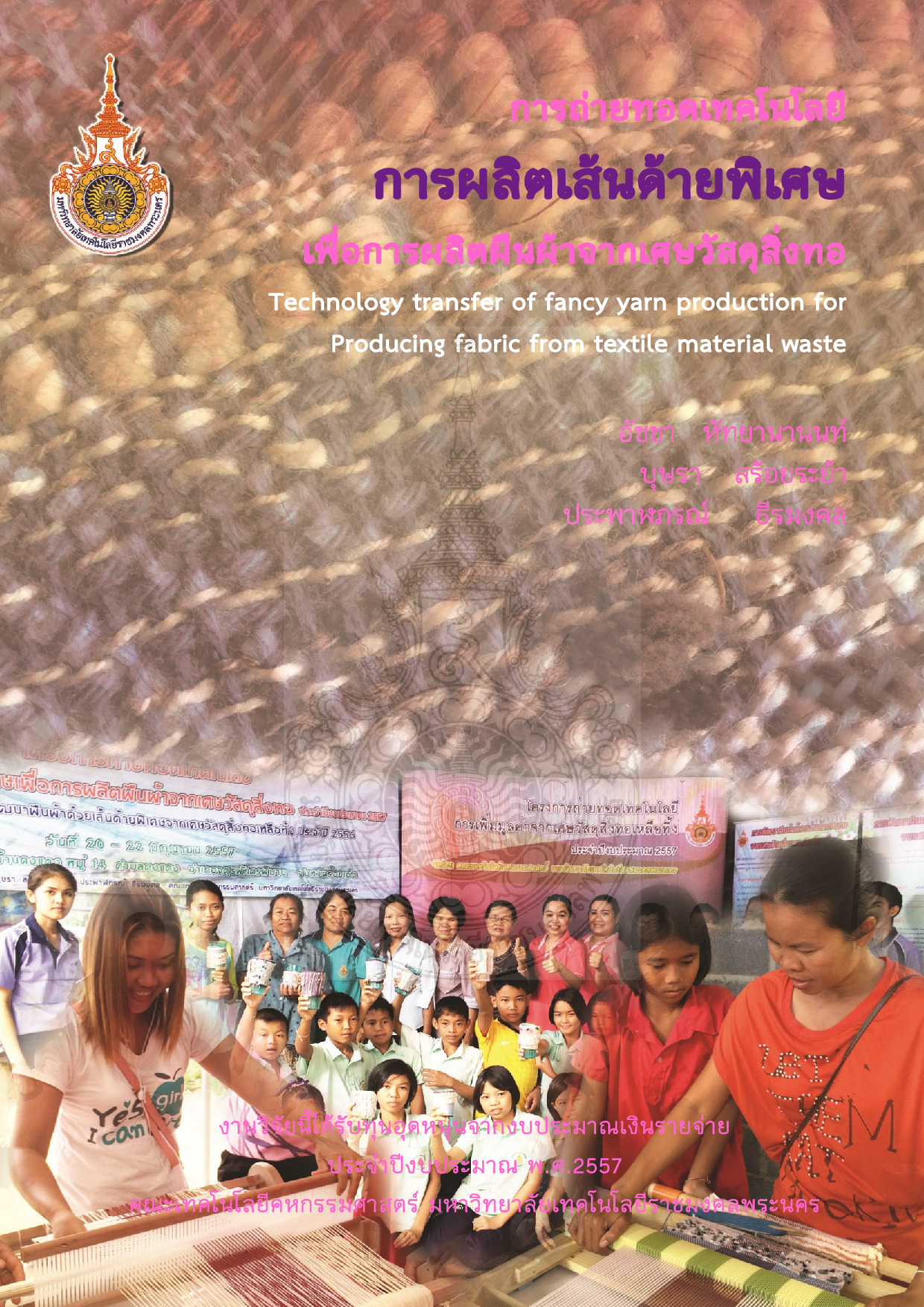
The research aimed to Technology transfer of fancy yarn production for producing fabric from textile material waste. The purpose is to technology transfer of fancy yarn production for producing fabric to people and community and to evaluate of technology transfer of fancy yarn production for producing fabric. The procedures were as follows target population for the transfer of knowledge and technology as Small and Micro community Enterprise--SMCE and individuals interested in Dang Dong sub-district Bang Bon district at Roi-Ed province. A total of 34 peoples and two days on 20 - 21 June 2557 and a satisfaction survey with a questionnaire after training. The data were analyzed using frequency percentage and mean. The results that general Information are female and younger than 21 years of education in elementary education as a student. A question that asking about their satisfaction with the course and to divide into three aspects: the purpose of the project The course structure and the contents of the course. The majority were satisfied with the very best. The purpose and the content are high level of satisfaction. In relation to technology transfer of fancy yarn production for producing fabric from textile material waste divided into three aspects: the process provides trainers and facilities was found that were satisfied at all of the 3 parts. The participants are mainly used to provide benefits to themselves for one month to apply the knowledge gained after the training. The participants modified using a new material and used local materials applied accordingly. Moreover a focus will be capped by the school to take courses and workshops and to teach another one for working out or as part of the courses taught at the school. Satisfaction with the benefits of technology transfer and utilization. Satisfaction at the highest level. The comments and suggestions of the participants found that they need for re-training again. They would like to have a longer period of training in order to gain more knowledge. All lecturer can transfer knowledge during the training as well.
การถ่ายทอดเทคโนโลยีการสร้างตราสินค้าและบรรจุภัณฑ์เพื่อเพิ่มมูลค่าผลิตภัณฑ์จากเศษวัสดุสิ่งทอเหลือทิ้ง
The research’s purpose is the knowledge transfer of the technology about branding and packaging to increase product’s value from waste textiles for the community groups and interested person. The assessment method for evaluation is studying the local product’s information the processing rag’s group in Ban Dongdang Tambon Dongdeang Jaturapakpiman Roy-ed. The researcher selected the brand and packaging prototypes and the product from the research about branding and packaging to increase product’s value from waste textiles (Fiscal year in 2013) which are appropriate to the product being sold. Because that research has the heart shape petal’s brand label for packaging the winner from 25 styles that selected from 5 experts. And has been applied to a prototype of 8 products. The 8 products are The packaging for bag The packaging for hat The packaging for lamp The packaging for shoe The packaging for textile’s box The packaging for bedspread The packaging for carpet The packaging for Cushions The packaging for Scatter cushion The packaging for tablecloth The packaging for fabric wall and frame. The goal of knowledge transfer are 30 persons. The survey of the participants’ satisfaction by the questionnaires data collection the data from the frequency statistic percentage and median. The result is the participants 25 persons (50 %) were mostly female 13 persons (43.34%) with secondary education 15 persons (50%) between the ages of 31- 40 years old 10 persons (33.33%) a farmer and seamstress 18 persons (60%) with monthly income less than 5000 bath. Satisfaction is divided into 3 topics the purpose of project the structure of the course the content of the course.The purpose of project is the most satisfied (4.68%). The structure of the course is satisfactory (3.97%). The content of the course is satisfactory (4.45%). And the satisfaction to the reproductive technology about branding and packaging to increase product’s value from waste textiles project in the service processes is satisfactory (4.50%) Lecturer team is the most satisfied (4.68%) The facilities is the most satisfied (4.68%). Ban Dong deang’s rag and processing group has a satisfaction’s average of the project is the most satisfied (4.48%).

การสร้างหลักสูตรผู้สูงอายุวัยหลังเกษียณ : กรณีศึกษา มหาวิทยาลัยเทคโนโลยีราชมงคล จังหวัดกรุงเทพมหานคร
This study a knowledge formation research had objections to study (1) the basic information about the demand in occupational training by the retired of Rajamangala University of Technology in Bangkok and its vicinity and (2) the occupational training curriculum for the retired. The elderly that retired for Fiscal Year B.E. 2555 be affiliated with Rajamangala University of Technology in Bangkok and its vicinity such as Rajamangala University of Technology Thanyaburi Rajamangala University of Technology Krungthep Rajamangala University of Technology Tawan-ok Rajamangala University of Technology Phra Nakhon Rajamangala University of Technology Rattanakosin and Rajamangala University of Technology Suvarnabhumi Nontraburi Center were the population of this research. Sample consisted of 65. A questionnaire was used to collect data and statistical software was used to compute the percentage. The experimental results showed that the most of the respondents were not self- employed after retirement (9.385 %) but they wanted to be self- employed (69.25 %). The aims of training were adding new experience real-life applications and self- employment respectively. The training courses which the retired needed were “Dim sums” “Cookies” and “Thai crafts” respectively. The most of subjects wanted to make field trips at the interesting business (58.33 %) and take training courses about E-commerce (31.25 %) and marketing knowledge (10.41 %). The training courses would operate four days between 8.30 am and 16.30 pm and take three days for training activities and one day for field trip. Training locations were the faculty of Home Economics Technology Rajamangala University of Technology Phra Nakhon and the business respectively. For expense factors it would charge the cost of materials but not training fee. For the factors promoting to achievement the most of respondents wanted to have the distributors (39.85 %) the source of investment funds (22.91 %) and the counseling agencies (10.41 %). The retired of six universities were interested in 3 occupational training courses namely the culinary job training courses for “Dim sums” “Cookies” and “Flower works and Banana Leaf Crafting for business” respectively. The complete training curriculum was organized by developing structures and elements of the training curriculum which comprised principles objectives aims duration structures explanation of each subject training guidelines devices result measurement and evaluation model and curriculum application guidelines.