จำนวน Repository ( 2131 )
Production and characterization of carboxymethyl cellulose from orange rind
It is known that orange rind is often discarded as garbage. This research examines the production of carboxymethyl cellulose (CMC) from orange rind. Cellulose was extracted from orange rind (2.0 g) through alkalization. The cellulose was extracted using 1.0 M NaOH at 80 ± 5oC for 60 min. The maximum yield of cellulose was obtained under this condition. The extracted cellulose was then alkalized and etherified to CMC using NaOH and chloroacetic acid after bleaching with H2O2. The resulting CMC was characterized through Infrared spectroscopy to determine the functional group of CMC. The presence of carboxyl group (COO-) at a wavenumber of 1586 cm-1 in the IR spectrum confirmed the conversion of cellulose to CMC. The surface morphology was also carried out through the SEM technique and the elemental analysis was performed using an EDX method. In addition the resulting CMC product was coated as a film on banana to observe for various reactions.
คุณค่าทางโภชนาการ คุณภาพทางกายภาย และประสาทสัมผัสของเค้กเนยสดที่มีการทดแทนแป้งข้าวสาลีด้วยเปลือกทุเรียนผง
Durian has been very popular not only local people but also tourists. As a result there are many durian peels wasted so this research is explored the utilization of durian peels. Durian rind is a biological waste but contains high amount of crude fiber. This research aims to study using durian rind powder to replace wheat flour in butter cakes at 5 10 and 15 % (w/w) (DRB-5 DRB-10 and DRB-15). Physical properties chemical composition and sensory evaluation of the butter cakes were analyzed. The results showed that durian rind powder contained 51.43 % of crude fiber. Increasing of durian rind powder in butter cakes showed significant decreasing of lightness (L*) blue–yellow component (b*) springiness and cohesiveness values while green–red component (a*) hardness and gumminess values were significantly higher than the control sample (BC) (p≤0.05). Dietary fiber content of the products shown significantly increased by 13.98% for DRB-5 48.92 % for DRB-10 and 54.84% for DRB-15 as compared with BC (p≤0.05). The acceptance scores of DRB-5 including appearance odor taste texture and overall liking scores were highest. There are 300.28 kcal for 1 serving of butter cake which contain 1.70 gram of dietary fiber. However durian rind powder can be used as a food ingredient and source of dietary fiber in other food recipes for further studies.
เทคนิคการสกัดน้ำมันและการผลิตไบโอดีเซลจากน้ำมันเมล็ดกระบก
This paper presents the experimental results of the oil extraction process from wild almond seeds by mechanical and chemical methods. The optimum conditions for the biodiesel production from the extracted oil via transesterification reaction using methanol and potassium hydroxide (KOH) are reported. Chemical extraction was found to be an effective technique for wild almond oil extraction. Simple distillation was used as oil extraction unit applying 140 ml of n-hexane as solvent at 70ºC for 20 min. The oil yield was 43.11±0.98%. This extracted oil was used as raw material for biodiesel production with the maximum yield of 83.20±1.11%. The optimum conditions for biodiesel production were the catalyst loading of 0.5 wt% and 9:1 molar ratio of methanol to oil in a controlled reaction temperature of 70ºC for 60 min. Finally the properties of biodiesel were analyzed and most properties met the requirements of the department of energy business standard.
การห่อหุ้มเซลล์ยีสต์ที่ถูกตรึงบนชานอ้อยที่ผ่านการปรับสภาพและการประยุกต์ใช้เพื่อการผลิตเอทานอล
Most of ethanol production processes are limited by low ethanol production rate and recyclable problem of ethanologenic organisms. In the present study Saccharomyces cerevisiae TISTR 5339 entrapped in an aqueous mixture of alginate and pretreated-bagasse was used for ethanol production of immobilization parameter of yeast cells consisting of amount of bagasse and alginate concentration on ethanol production were investigated. The results showed that increase in alginate concentration and the amount of bagasse can increase structural strength and reduce deterioration of bead. The optimal condition of immobilization was 1.0% (w/v) bagasse and 2.5% alginate. Ethanol yield (Yp/s) ethanol production rate (Qp) and efficiency of fermentation (Ey) obtained from the bagasse-alginate immobilized yeast cell was 3.39±0.72 g/l0.14±0.03 g/l/h and 70.98±14.08% respectively. The ultrastructure obtained from SEM illustrated that S. cerevisiae TISTR 5339 was well incorporated within the bagasse-alginate matrix. Moreover the bagasse-alginate immobilized yeast cells were reusable at least 5 times with Ey higher than 50% of 1st round of fermentation. Therefore the pretreated bagasse-alginate immobilized yeast cells is an alternatively interesting techniques with effiiciency for ethanol production in the future.
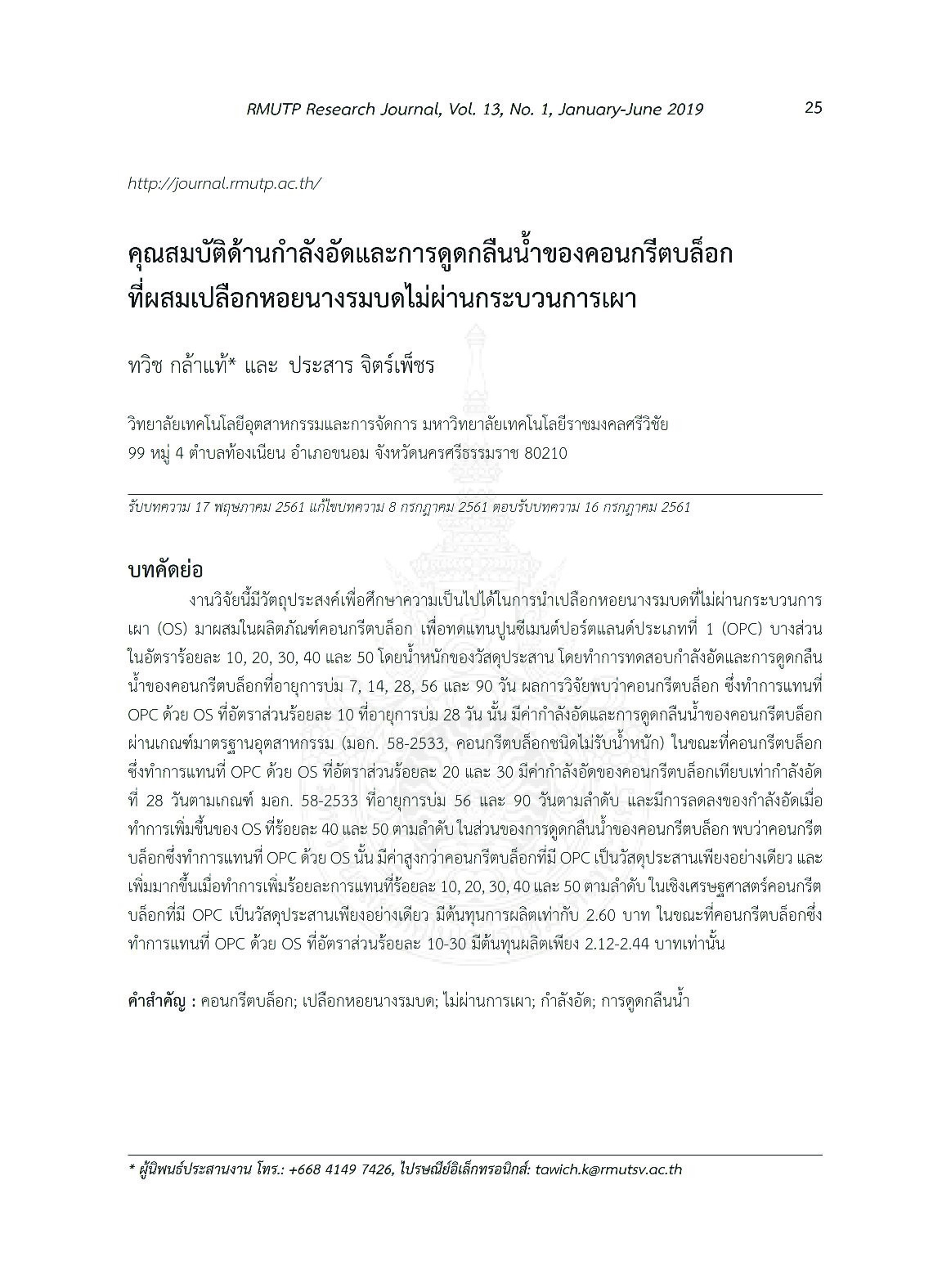
คุณสมบัติด้านกำลังอัดและการดูดกลืนน้ำของคอนกรีตบล็อกที่ผสมเปลือกหอยนางรมบดไม่ผ่านกระบวนการเผา
The research aims to investigate the possibilities of crushed oyster shell (OS) not have to go through the process of burning as a substitution cement for concrete blocks. The cement was replaced with crushed oyster shell not process burning (OS) at 0% 10203040 and 50% by the weight of the binder. After that the concrete blocks were tested to determine the compressive strength and moisture absorbed of the concrete blocks cured for 7 142856 and 90 days The result showed that the compressive strength of the concrete blocks which replaced cement with OS (at the proportion of 10% by the weight of the binder) at 28 days had the compressive strength and water absorbed accordance with the TIS 58-2533 on non-load bearing concrete blocks.Moreover the concrete blocks which replaced cement with OS at the proportion of 20 % and 30 % had the compressive strength equivalent to 28 days compressive strength of TIS 58-2533 standard at 56 and 90 days respectively and decreased when the percentage in addition to OS in concrete blocks of 40 and 50 %. Tested results also showed that the water absorbed of concrete blocks increased when the percentage of replacement of OS in binder increased at 10 20 30 40 and 50%. The economical of concrete blocks it has manufactured unit cost is 2.60 baht. Whereas the concrete block containing crushed oyster shell at 10-30% it has manufactured unit cost at 2.12-2.44 baht respectively.