จำนวน Repository ( 2131 )
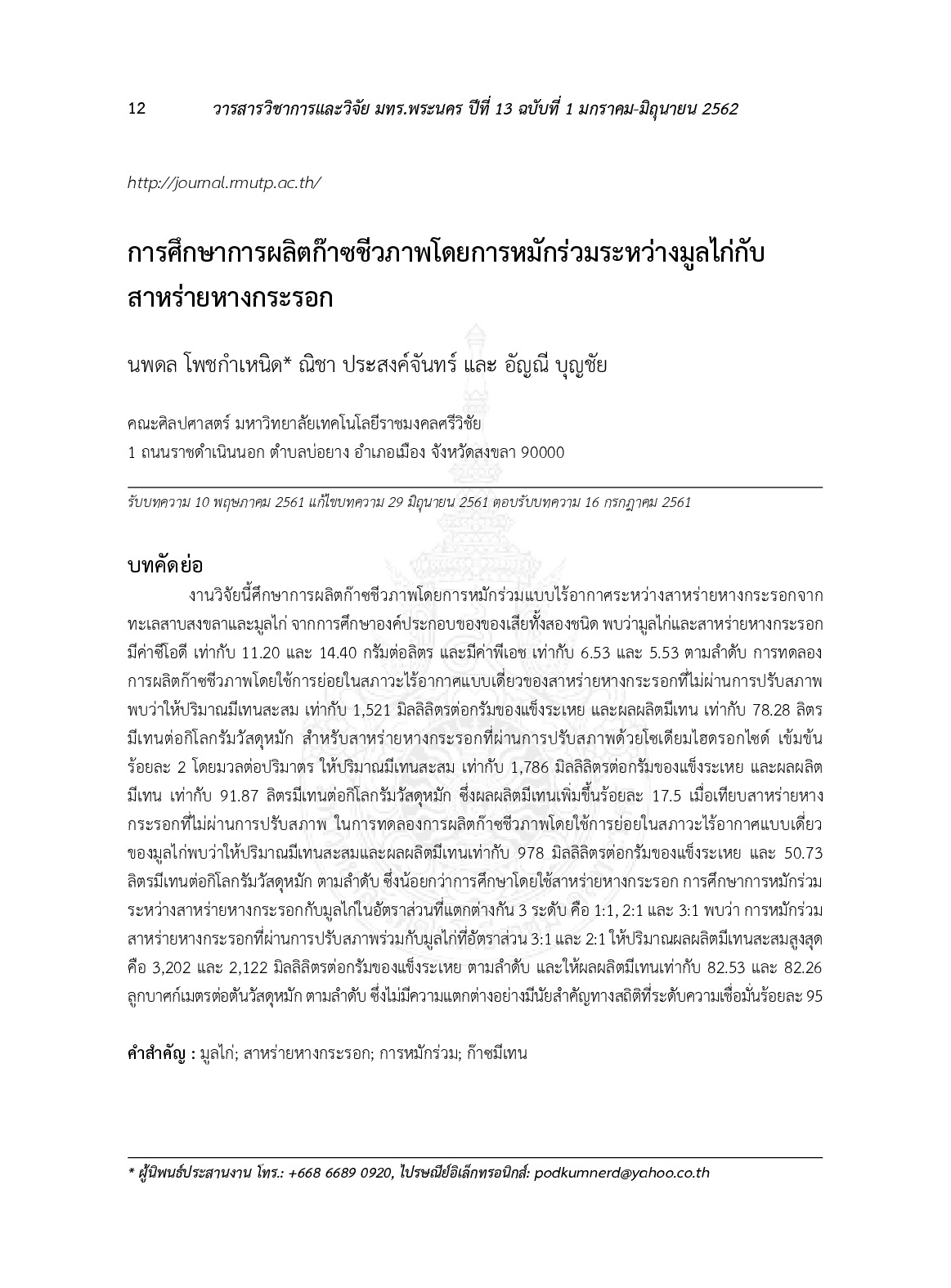
การศึกษาการผลิตก๊าซชีวภาพโดยการหมักร่วมระหว่างมูลไก่กับสาหร่ายหางกระรอก
This work presented the production of biogas using anaerobic co-digestion between hydrilla verticillata (HV) from Songkhla Lake Basin and chicken manure (CM). From the study of compositions of both wastes it was found that the COD of CM and HV were 11200 and 14400 mg/l and pH were 6.5 and 5.5 respectively. The biogas production using anaerobic single-digestion of untreated hydrilla verticillata (UHV) gave accumulative methane of 1251 ml-CH4/g-VS and methane production of 78.28 L-CH4/kg-substrate was obtained. For hydrilla treated with 2% w/v NaOH (THV) the accumulative methane was 1786 ml-CH4/g-VS and the obtained methane production was 91.87 L- CH4/kg-substrate which was 17.5 % increase when compared to the UHV. For the biogas production using anaerobic single-digestion of CM it was found that the accumulative methane and methane production were 978 ml-CH4/g-VS and 78.28 L- CH4/kgsubstrate respectively. These were lower than the studies using HV. The study of anaerobic co-digestion of HV and CM at three different ratios; 1:1 2:1 and 3:1 was studied. It was found that the anaerobic co-digestion using THV and CM at ratio 3:1 and 2:1 gave the highest potential for biogas production. The accumulate methane of 3202.20 and 2079.19 ml- CH4/g-VS were obtained respectively. The methane productions were 2.53 and 82.26 L-CH4/ton-substrate for ratio 3:1 and 2:1 respectively which is no significant different at 95 % confidence interval.
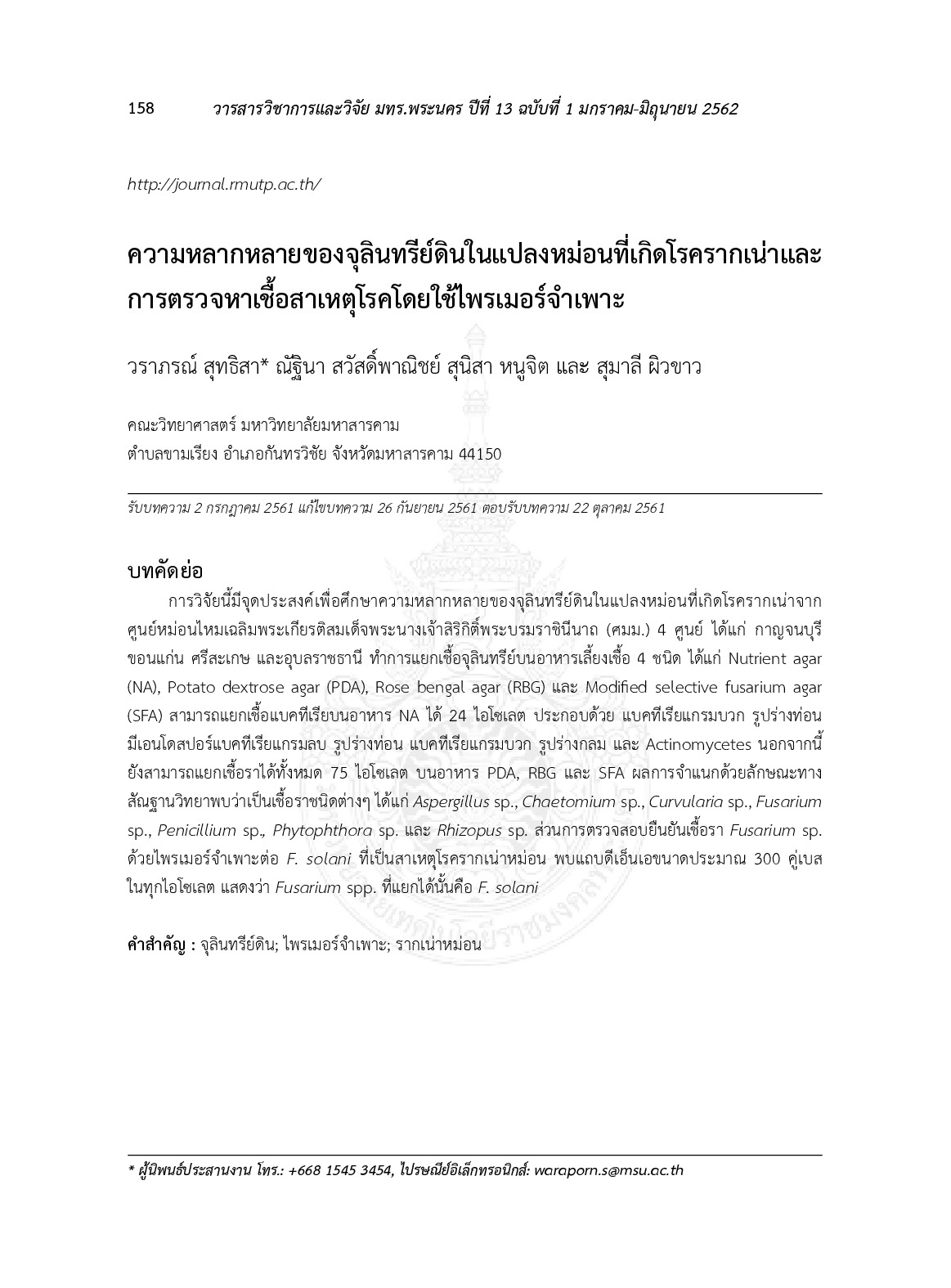
ความหลากหลายของจุลินทรีย์ดินในแปลงหม่อนที่เกิดโรครากเน่าและการตรวจหาเชื้อสาเหตุโรคโดยใช้ไพรเมอร์จำเพาะ
The diversity of soil microorganisms in mulberry root rot disease infesting fields was investigated from The Queen Sirikit Sericulture Center at Kanchanaburi Khon Kaen Sisaket and Ubon Ratchathani provinces. Isolation of the soil microorganisms was performed on four media as nutrient agar (NA) potato dextrose agar (PDA) rose bengal agar (RBG) and modified selective fusarium agar (SFA). Twenty-four bacterial isolates were arisen from NA including gram positive endospore forming rod gram negative rod gram positive cocci and Actinomycetes. Similarly 75 isolates of fungi were gained from PDA RBG and SFA and could be defined to be Aspergillus sp. Chaetomium sp. Curvularia sp. Fusarium sp. Penicillium sp. Phytophthora sp. and Rhizopus sp. by their morphological characteristics. Verification of the causal pathogen of mulberry root rot disease could be accomplished using specific primers for F. solani in which a DNA band at approximately 300 bp was revealed.
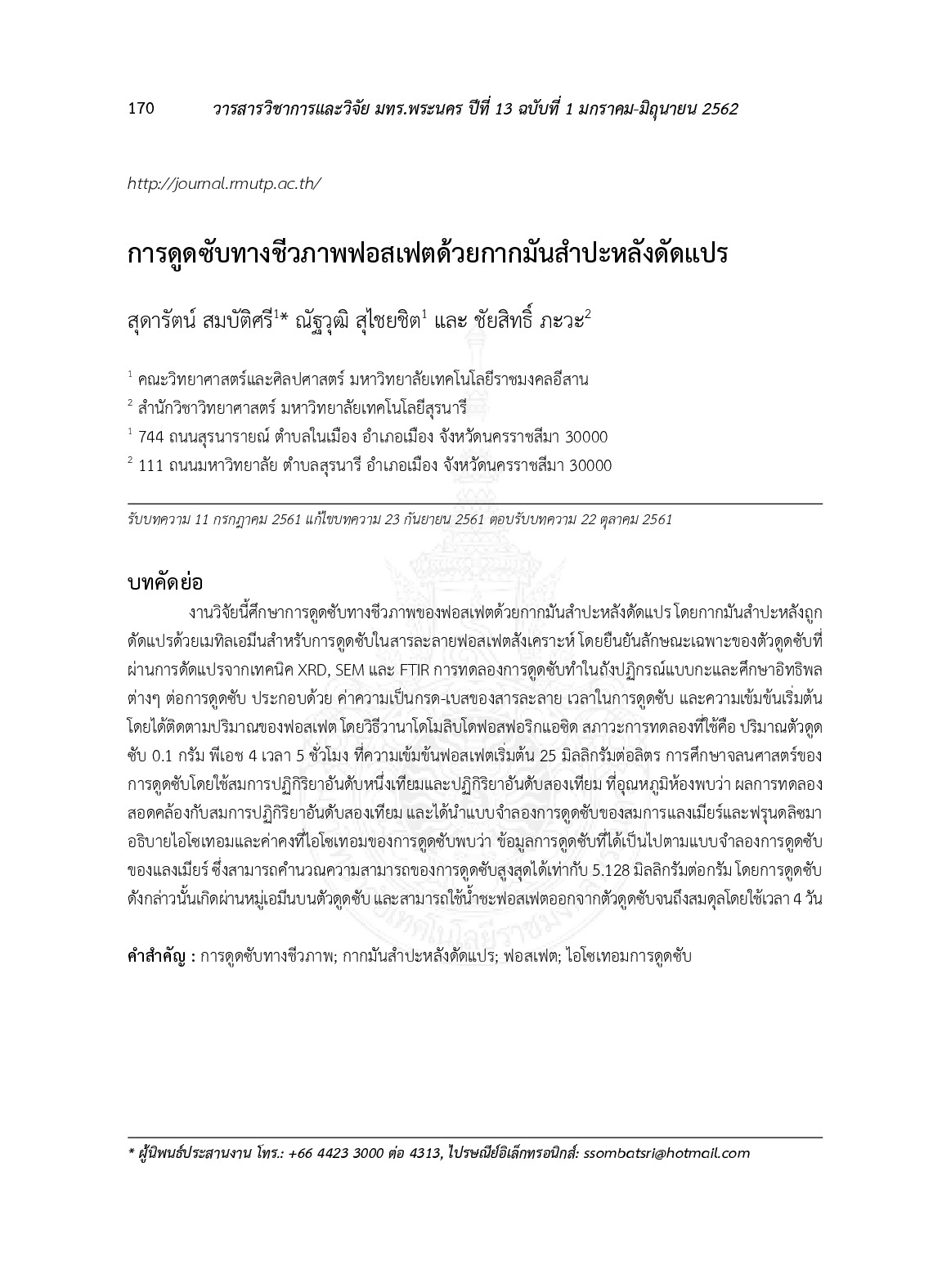
การดูดซับทางชีวภาพฟอสเฟตด้วยกากมันสำปะหลังดัดแปร
The biosorption of phosphate using modified cassava waste were studied. Cassava pulp was modified in methylamine for the adsorption of phosphate ion in aqueous solution. XRD SEM and FTIR result confirmed the surface modification of modified cassava waste. The adsorption experiments were conducted in a batch reactor. The studied parameters included pH contact time and initial concentrations. The amount of phosphate in the solution was measured by Vanadomolybdophosphoric acid method. Optimum conditions of adsorption were 0.10 g of modified cassava waste pH 4 and 5 hour of contact time at 25 mg/L of initial phosphate concentration. Kinetic of adsorption were studied by using the pseudo-first and pseudo-secondorder models at room temperature. The results indicated that the pseudo-second-order model best described adsorption kinetic data. The Langmuir and Freundlich adsorption models were applied to describe the isotherms and isotherm constants. The adsorption of modified cassava fitted well with the Langmuir model and the maximum adsorption capacity of 5.128 mg/g; and the active site of adsorption was amine functional group. Phosphate released in water reach equilibrium within 4 days.
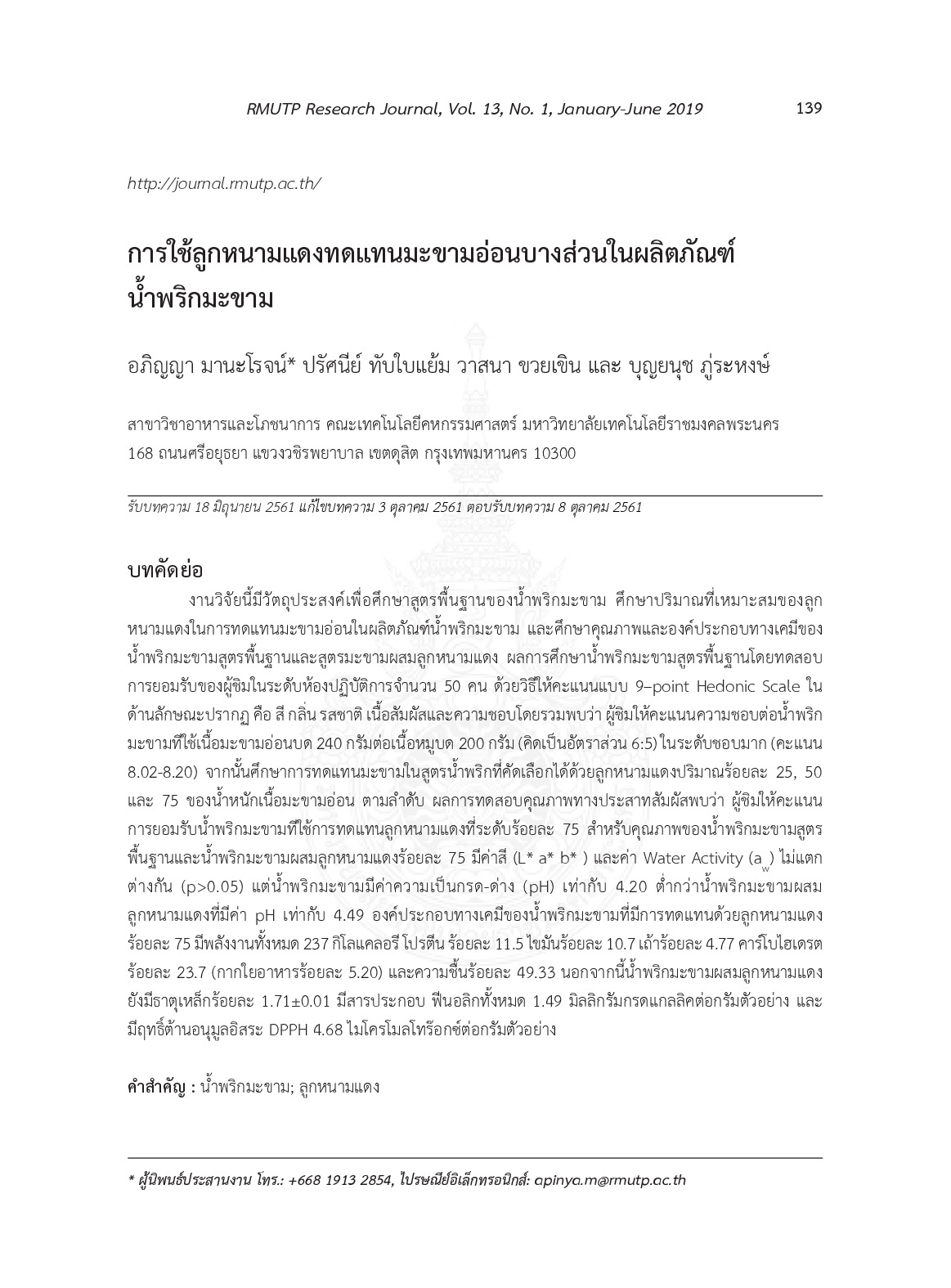
การใช้ลูกหนามแดงทดแทนมะขามอ่อนบางส่วนในผลิตภัณฑ์น้ำพริกมะขาม
This study was to investigate: the basic recipe of tamarind chili paste the suitable proportion of karonda fruit that used instead of young tamarind in the product of tamarind chili paste the quality and the chemical properties of tamarind chili paste and the basic recipe and recipe of tamarind mixed with karonda fruit. The result of the basic recipe of tamarind chili paste was acceptable by 50 samples and the 9-point hedonic scale was used in this study. For the appearance color smell flavor texture and overall taste the respondents rated the taste for tamarind chili paste that 240 gram of young tamarind ground per 200 gram pork ground (6:5 ratio) with the very high level score (8.02-8.20). Then study the substitutions of tamarind with karonda fruit that used 25% 50% and 75% of the young tamarind weight respectively. The result of sensory test found that respondents acceptably rate was 75% of using karonda fruit instead of tamarind in tamarind chili paste. For the quality of the basic tamarind chili paste recipe and the use karonda fruit instead of tamarind chili paste 75% color values (L * a * b *) and water activity (aw) were not significantly different (p>0.05). But tamarind chili paste shows that pH 4.20 that is lower than tamarind chili paste mixed with karonda fruit pH 4.49. The chemical composition of tamarind chili paste that substituted with karonda fruit 75% provides energy 237 kcal protein 11.5% fat 10.5% ash 4.47% carbohydrate 23.7% (fiber 5.20%) and moisture content 49.33%. Moreover tamarind chili paste mixed with karonda fruit contents iron 1.71±0.01% Phenolic content 1.49 mg GAE/g extract and it has antioxidant activity DPPH 4.68 umole Trolox/g extract.
การออกแบบตัวควบคุมพีไอดีอย่างเหมาะสมสำหรับระบบควบคุมความเร็วของมอเตอร์ไฟฟ้ากระแสตรงแบบไร้แปรงถ่านกับการหาค่าเหมาะที่สุดแบบมีเงื่อนไขในการเฝ้าติดตามอินพุตและการคุมค่าโหลดด้วยการค้นหาแบบนกกาเหว่า
Metaheuristic optimization approach has become the new framework for control synthesis. The main purposed of the control design are input (command) tracking and load (disturbance) regulating. This research proposes an optimal proportional-derivative (PID) controller design for the brushless dc (BLDC) motor speed control system with input tracking and load regulating constrained optimization by using the cuckoo search (CuS) one of the most efficient population-based metaheuristic optimization techniques. The sum-squared error between population-based metaheuristic optimization techniques. The sum-squared error between the referent input and the controlled output is set as the objective function to be minimized. The rise time the maximum overshoot settling time and steady-state error are set as inequality constraints for tracking purpose while the regulating time and the maximum overshoot of load regulation are set as inequality constraints for regulating purpose. Results obtained by the CuS will be compared with those obtained by the particle swarm optimization (PSO) and genetic algorithm (GA). From simulation results it was found that the parameters of CuS were optimal than both PSO and GA for BLDC motor speed control system satisfying the preset input tracking and load regulating constraints. In addition the simulation results are confirmed by the experimental ones from the BLDC motor speed control system developed in the laboratory.