จำนวน Repository ( 1174 )
การศึกษาวิเคราะห์อิทธิพลของธาตุเจือทองแดงและดีบุกที่มีผลต่อสมบัติทางกายภาพ (ความแตกต่างของค่าระดับสี) และพฤติกรรมความด้านทานการหมองของโลหะเงินเจือต่ำ 58.33 wt% AgCuSn
การวิจัยนี้เป็นการศึกษาสมบัติของโลหะเงินเจือต่ำ 58.33% ที่มีธาตุทองแดง (Cu) และดีบุก (Sn) เป็นธาตุผสม ซึ่งมีปริมาณการผสมอยู่ในช่วงระหว่าง 36.66-41.57%Cu และ 0.10-5.01%Sn ตามล่าดับ โดยท่าการเปรียบเทียบกับสมบัติของโลหะเงินสเตอร์ลิง 925 และโลหะเงินเจือต่ำ 58.33%เพื่อ ศึกษาวิเคราะห์อิทธิพลของธาตุเจือทองแดงและดีบุกที่มีผลต่อสมบัติเคมีและสมบัติทางกายภาพที่ เหมาะสมในการผลิตเครื่องประดับเงินเจือต่ำ 58.33% ผลจากการศึกษาโลหะเงินเจือต่ำ 58.33 % ที่ประกอบด้วยเงิน (Ag) และทองแดง (Cu) เมื่อน่ามา เปรียบเทียบกับโลหะเงินสเตอร์ลิง 925 จากการศึกษาเปรียบเทียบพบว่าโลหะเงินผสมเจือต่ำ ต่ำ 58.33Ag + 41.16Cu +0.51Sn มีค่า มีค่า L* = 92.18 a* = 4.64 b* = 10.71 และ ΔE = 28.32 เป็น ส่วนผสมที่เหมาะที่สุดจากการวิเคราะห์ค่าระดับสีและค่าความแตกต่างของสี และมีพฤติกรรมความ ต้านทานการหมองของโลหะเงินเจือต่ำมากที่สุด เนื่องจากอิทธิพลของธาตุดีบุก (Sn) ที่ผสมเข้าไปใน อัตราส่วนที่เหมาะสม ผลจากการวิเคราะห์ส่วนผสมทางเคมีของโลหะเงินเจือต่ำ 58.33% พบว่าส่วนผสมทางเคมีของ โลหะเงินเจือต่ำในแต่ละอัตราส่วนผสมมีสัดส่วนของธาตุใกล้เคียงกับอัตราส่วนผสมจริง จึงท่าให้โลหะเงิน เจือต่ำที่ได้ท่าการทดลองมีค่าระดับสีและพฤติกรรมความต้านทานการหมองที่สูงไม่แตกต่างกันมากนัก เป็นไปตามมาตรฐานของเครื่องประดับเงินตามมาตรฐานอุตสาหกรรมการผลิตเครื่องประดับทั้งของใน ประเทศและต่างประเทศ
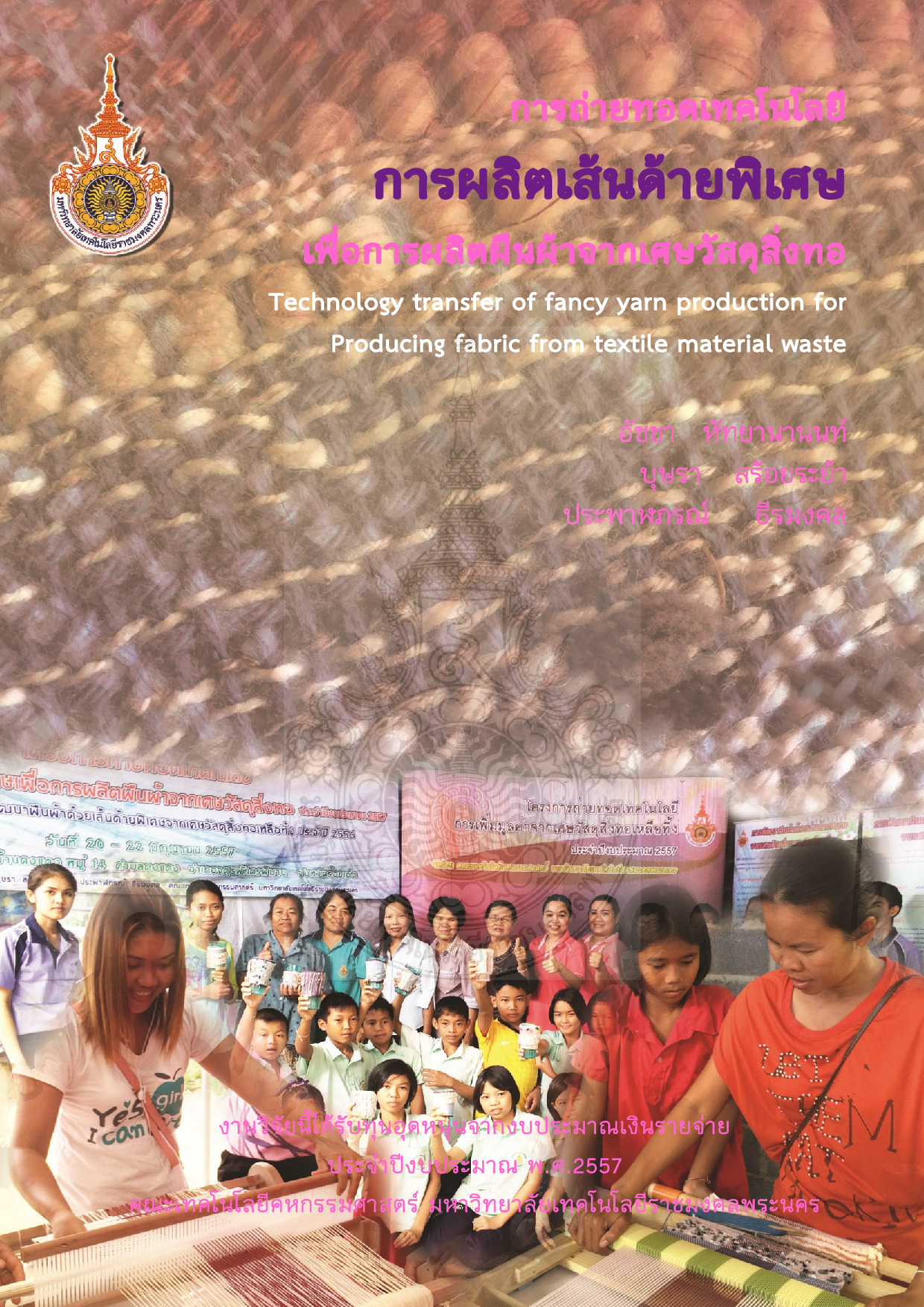
การถ่ายทอดเทคโนโลยีการสร้างตราสินค้าและบรรจุภัณฑ์เพื่อเพิ่มมูลค่าผลิตภัณฑ์จากเศษวัสดุสิ่งทอเหลือทิ้ง
The research aimed to Technology transfer of fancy yarn production for producing fabric from textile material waste. The purpose is to technology transfer of fancy yarn production for producing fabric to people and community and to evaluate of technology transfer of fancy yarn production for producing fabric. The procedures were as follows target population for the transfer of knowledge and technology as Small and Micro community Enterprise--SMCE and individuals interested in Dang Dong sub-district Bang Bon district at Roi-Ed province. A total of 34 peoples and two days on 20 - 21 June 2557 and a satisfaction survey with a questionnaire after training. The data were analyzed using frequency percentage and mean. The results that general Information are female and younger than 21 years of education in elementary education as a student. A question that asking about their satisfaction with the course and to divide into three aspects: the purpose of the project The course structure and the contents of the course. The majority were satisfied with the very best. The purpose and the content are high level of satisfaction. In relation to technology transfer of fancy yarn production for producing fabric from textile material waste divided into three aspects: the process provides trainers and facilities was found that were satisfied at all of the 3 parts. The participants are mainly used to provide benefits to themselves for one month to apply the knowledge gained after the training. The participants modified using a new material and used local materials applied accordingly. Moreover a focus will be capped by the school to take courses and workshops and to teach another one for working out or as part of the courses taught at the school. Satisfaction with the benefits of technology transfer and utilization. Satisfaction at the highest level. The comments and suggestions of the participants found that they need for re-training again. They would like to have a longer period of training in order to gain more knowledge. All lecturer can transfer knowledge during the training as well.
การถ่ายทอดเทคโนโลยีการสร้างตราสินค้าและบรรจุภัณฑ์เพื่อเพิ่มมูลค่าผลิตภัณฑ์จากเศษวัสดุสิ่งทอเหลือทิ้ง
The research’s purpose is the knowledge transfer of the technology about branding and packaging to increase product’s value from waste textiles for the community groups and interested person. The assessment method for evaluation is studying the local product’s information the processing rag’s group in Ban Dongdang Tambon Dongdeang Jaturapakpiman Roy-ed. The researcher selected the brand and packaging prototypes and the product from the research about branding and packaging to increase product’s value from waste textiles (Fiscal year in 2013) which are appropriate to the product being sold. Because that research has the heart shape petal’s brand label for packaging the winner from 25 styles that selected from 5 experts. And has been applied to a prototype of 8 products. The 8 products are The packaging for bag The packaging for hat The packaging for lamp The packaging for shoe The packaging for textile’s box The packaging for bedspread The packaging for carpet The packaging for Cushions The packaging for Scatter cushion The packaging for tablecloth The packaging for fabric wall and frame. The goal of knowledge transfer are 30 persons. The survey of the participants’ satisfaction by the questionnaires data collection the data from the frequency statistic percentage and median. The result is the participants 25 persons (50 %) were mostly female 13 persons (43.34%) with secondary education 15 persons (50%) between the ages of 31- 40 years old 10 persons (33.33%) a farmer and seamstress 18 persons (60%) with monthly income less than 5000 bath. Satisfaction is divided into 3 topics the purpose of project the structure of the course the content of the course.The purpose of project is the most satisfied (4.68%). The structure of the course is satisfactory (3.97%). The content of the course is satisfactory (4.45%). And the satisfaction to the reproductive technology about branding and packaging to increase product’s value from waste textiles project in the service processes is satisfactory (4.50%) Lecturer team is the most satisfied (4.68%) The facilities is the most satisfied (4.68%). Ban Dong deang’s rag and processing group has a satisfaction’s average of the project is the most satisfied (4.48%).
การเพิ่มมูลค่าเศษวัสดุสิ่งทอเหลือทิ้งเป็นผลิตภัณฑ์เครื่องใช้ในบ้านและของที่ระลึก
The objectives of the research were : firstly to increase value of textile waste for household products : one set made from rags and the other from rag’s thread and to make the first model of the household products and souvenirs secondly to survey the satisfaction of the target group towards those products. To launch the research 5 styles of 11 products of each set were designed and made .The products were lamps cushions seats tablecloths mats wall-hangings bed sheets multi -purpose boxes shoes hats and handbags. Afterwards all of those products 110 pieces were brought to 5 experts for their 3 styles optimal selections of each set. Therefore 66 pieces of the selected products from the experts was brought to ask for the satisfaction from 100 persons of the target group that obtained by accidental sampling of statistically method. And the data was analyzed by frequency percentage mean and standard deviation. And the results of the study found that the target group satisfied all of the products in the utility of textile waste increasing value at the highest level. And their contentment were at high level to very high level in products from rags were handbags multi -purpose boxes bed sheets hats mats and seats and the other from rag’s thread were cushions handbags lamps bed sheets hats mats and seats.

ตัวแปรที่ส่งผลต่อพฤติกรรมการบริโภคอาหารของกลุ่มเสี่ยงโรคอ้วนลงพุง กรณีศึกษา : โรงพยาบาลส่งเสริมสุขภาพตำบลไผ่งาม อำเภอ โคกสูง จังหวัด สระแก้ว
The objectives of this research are; 1) To study the food consumption behavior of metabolic syndrome risk group PhaiNgam Health Promotion Hospital Khok Sung District Sakaeo Province; 2) To study variables affecting food consumption behavior of metabolic syndrome risk group; 3) Propose alteration food consumption behavior of metabolicsyndrome risk group to executive of PhaiNgam Health Promotion Hospital. A group of 190 Metabolic syndrome risk group was sample with purposive sampling. Data were gathered through questionnaire. Data analysis used the number percentage mean standard deviation and Chi-square test (𝜒2). The food consumption behavior of the group was at a moderate level good. Variables affecting food consumption behavior. Found that body mass index waistnumber of children monthly income exertion or physical activity affect food consumption behavior of the group at the statistical significance of 0.05. Propose alteration foodcunsumption behavior. 1) Using red orange green 3 feeding model. 2) Establishing the principle of eating to control energy. 3) Collaboration with public health officials group activities centered around the relationship achieved a rong. For to executive ofPhaiNgam Health Promotion Hospital.