จำนวน Repository ( 795 )
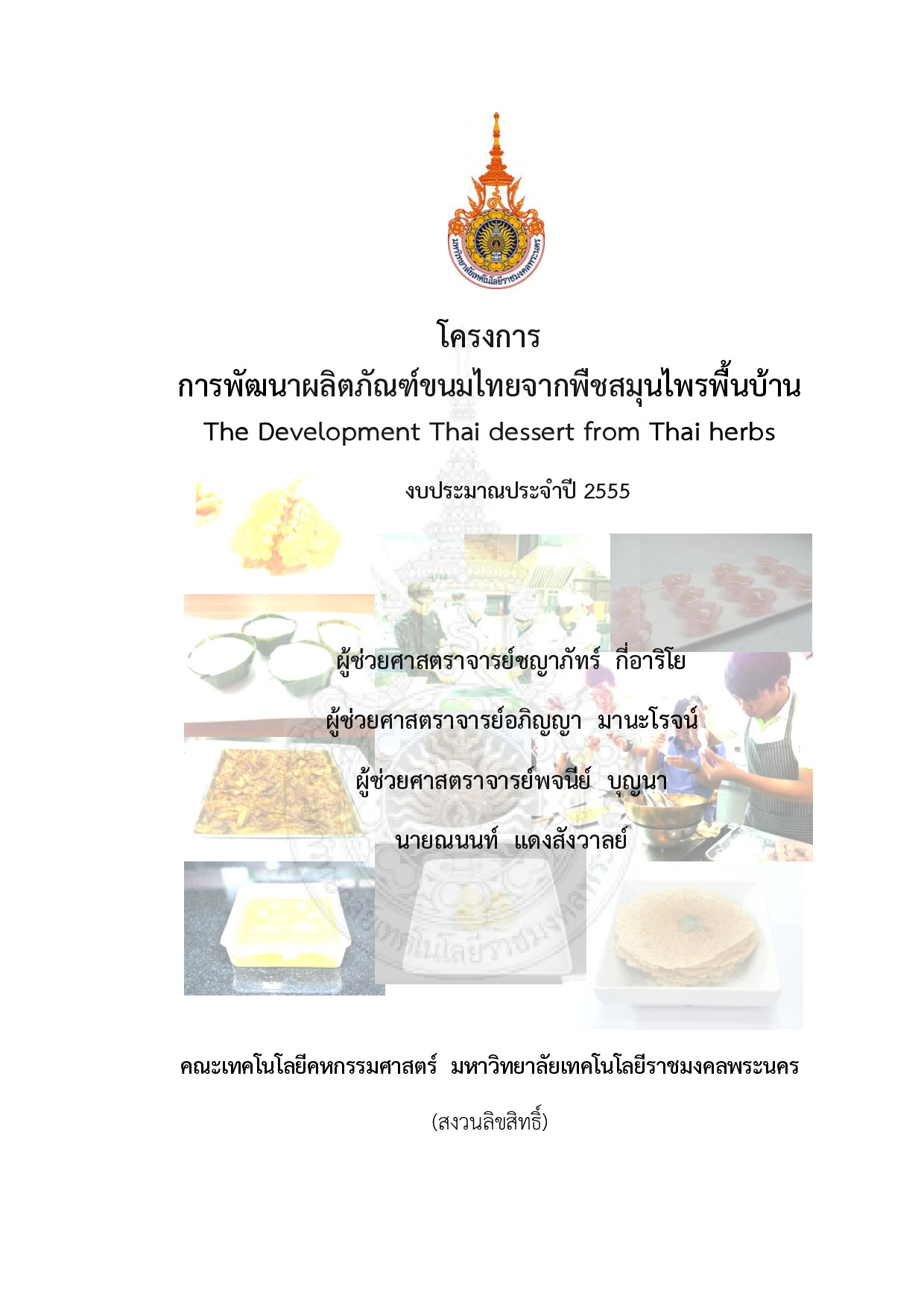
การพัฒนาผลิตภัณฑ์ขนมไทยจากพืชสมุนไพรพื้นบ้าน
The studies of original recipes of Thai desserts were modified and developed by local Thai herb. There are eight kinds of Thai dessert were selected such as Ta – Ko Mao-Kang (Thai baked custard) Shung–Ha-Ya (Thai streamed custard) Toa-Pap Krob-Kim Ka-Nom-Tom Ka-Nom-Tein-Kaew and Kaow-Tung-Sa-Wey which were developed by dried sweet bael fruit Curcuma powder Mashed lemongrass and Mashed ginger. A result was found that Ta – ko substitution water chestnut from dried sweet bael fruit (marmelos) in level of bael fruit was 100 125 and 150 % by weight of water chestnut. The food expertises like substitution dried sweet bael fruit with 125 % in moderate level. The majority of consumer 85% accepted Ta –ko with 125% of dried sweet bael fruit. Mao-kang was added dried sweet bael fruit in levels of bael fruit was 10 20 and 30% by total weight. The food expertises like added sweet bael fruit with 20% in moderate level. The majority of consumer 95% accepted Maokang with 20 % of dried sweet bael fruit. Shung–ha-ya was added curcuma powder in levels of curcuma powder was 0.5 0.75 and 1% by total weight. The food expertises like added curcuma powder with 0.5% in moderate level. The majority of consumer 81% accepted shung–ha-ya with 0.5% of curcuma powder. Ka-nom-Toa-pap was added curcuma powder in levels of curcuma powder was 1 2 and 3% by total weight. The food expertises like added curcuma powder with 2% in moderate level. The majority of consumer 84% accepted ka-nom-Toa-papwith 2% of curcuma powder. Krob-kim was added mashed lemongrass in levels of mashed lemongrass was 6 8 and 10% by total weight. The food expertises like added mashed lemongrass with 10% in moderate level. The majority of consumer 94% accepted Krob-kim with 10% of mashed lemongrass. Ka-nom-Tom was added mashed lemongrass in levels of mashed lemongrass was 10 15 and 20% by total weight. The food expertises like added mashed lemongrass with 15% in moderate level. The majority of consumer 87% accepted Ka-nom-Tom with 15% of mashed lemongrass. Ka-nom-tein-kaew and kaow-tung-sa-wey was added mashed ginger in levels of mashed ginger was 4 8 and 12% by total weight. The food expertises like added mashed ginger 4% in two products. They like in moderate level. The majority of consumer 79 % accepted Ka-nom-tein-kaew and 93% accepted kaowtung-sa-wey with 4% mashed ginger.
การพัฒนาผลิตภัณฑ์อาหารเสริมเส้นใยอาหารจากกากมะพร้าวเหลือใช
The purpose of the development of dietary fiber supplement food from used coconut residue is to study an appropriate amount of used coconut residue from oil distillation in three food products such as steamed stuff bun deep-fried dough stick and roti. The research was planned in accordance with “Randomized Complete Block Design RCBD”. Sense test by tasting method by giving favorite scores of 9 levels (9 – Point Hedonic Scale) quality test of chemical composition and physical composition including acceptance test of 100 people towards the products were performed.
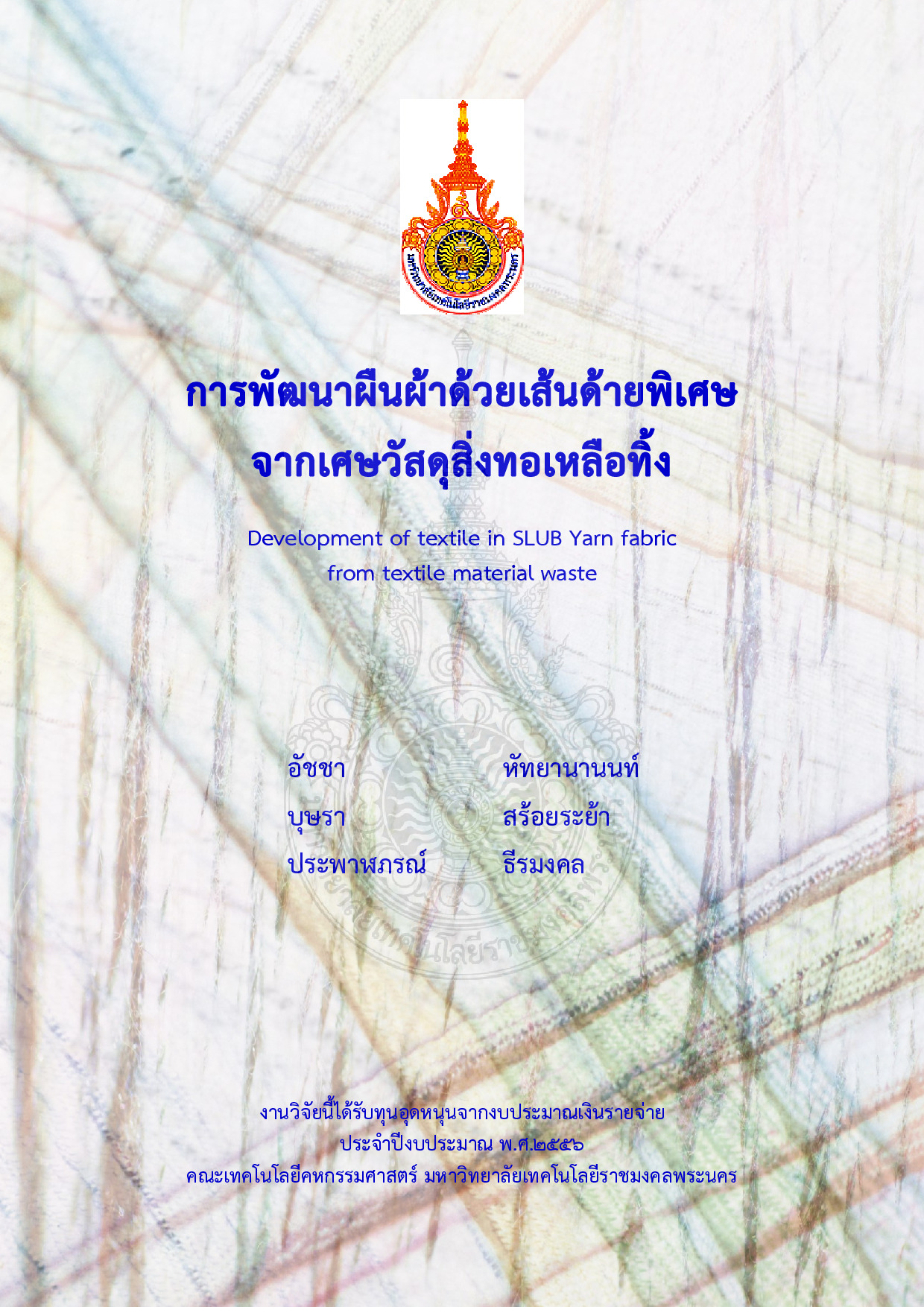
การพัฒนาผืนผ้าด้วยเส้นด้ายพิเศษจากเศษวัสดุสิ่งทอเหลือทิ้ง
The research aimed to Develop of textile in SLUB Yarn fabric from textile material waste. The purpose is to develop Fancy yarn (SLUB Yarn) from textile material waste. To develop woven with Fancy yarn (SLUB Yarn) textile material waste. To study Fancy yarn (SLUB Yarn) properties and woven with Fancy yarn (SLUB Yarn) from textile material waste. The First step is sorting and scouring textile material waste from silk yarn and to spin 2 types of Fancy yarn SLUB Yarn as 50 percent silk fiber blended with 50 percent Cotton and other type as 100 percent Silk. The Second steps is to testing of physical properties in the textile testing laboratory. The testing results are Silk Fancy yarn (SLUB Yarn) from textile material waste have twisted more than Silk blended with Cotton. It make textile material waste from Silk yarn smaller and stronger than Silk blended with Cotton and also more tenacity meanwhile it has highest tensile strength and elongation than Silk blended with Cotton. The Third steps to produce woven fabrics with plain weave structure. The weaving results have 2 fabrics the first types from Fancy yarn (SLUB Yarn) weaved by 50 percent Silk fiber blended with 50 percent Cotton in Industrial woven system and the second types from Fancy yarn (SLUB Yarn) weaved by 100 percent silk in hand woven system or with traditional weaving loom. The Last steps are to test the 8 topics physical properties of 2 woven in the textile testing laboratory. First Colorfastness to washing testing was found that Silk fabrics of Fancy yarn (SLUB Yarn) from textile material waste is durable to washing than 4.58 percent. Second Water absorbency Testing was found that both of two fabric types are equal to 60 (seconds). Third Moistures Management testing was found that the moisture absorption and wet textile as follows at 6 parts : the duration of the wet cloth was found that Silk fabrics of Fancy yarn (SLUB Yarn) from textile material waste is more absorbed than Silk fiber blended with Cotton and the duration of adsorption rate was found that Silk fiber blended with Cotton fabrics of Fancy yarn (SLUB Yarn) from textile material waste is better than Silk fabrics. The radial distribution of moisture on the both side of fabric surface was found that Silk fiber blended with Cotton fabrics of Fancy yarn (SLUB Yarn) from textile material waste is better and more effective and also there are the distribution and direction of motion better than Silk fabrics of Fancy yarn (SLUB Yarn) from textile material waste. MoreoverIt was humidity control overall properties. Forth Pilling Resistance Testing was found that both of 2 fabrics are Pilling Resistance fur and beads up on the surface slightly. Fifth Fabrics Thickness testing was found that Silk fabrics of Fancy yarn (SLUB Yarn) from textile material waste more over was 0.10 mm. Sixth Dimensional stability to washing after 5 times Testing (changes size after washing) was found that Silk fiber blended with Cotton fabrics of Fancy yarn (SLUB Yarn) from textile material waste was shrinkage after washing in the warp yarn more than -7.6 and shrinkage after washing in the weft yarn more than -7.0. Seventh pH-Acid Value Testing was found that Silk fiber blended with Cotton fabrics of Fancy yarn (SLUB Yarn) from textile material waste has pH-Acid less than 0.07. Eighth Heavy Metal Testing was found that Silk fiber blended with Cotton fabrics of Fancy yarn (SLUB Yarn) from textile material waste has 3 Heavy Metals such as chromium lead and copper while Silk fabrics of Fancy yarn (SLUB Yarn) from textile material waste has 2 Heavy Metals such as copper and lead.

การออกแบบและพัฒนาชุดทำงานสตรี ด้วยเทคนิคการจับจีบ จากผ้าทอลายดอกปีก จังหวัดพิษณุโลก
The objectives of this study were 1) to design and develop woman’s work uniform for by using pleating technique and woven fabrics in Dok-Peeb pattern in Phitsanulok province 2) to explore the working women’ satisfactions towards the design and development of woman’s work uniform for by using pleating technique and woven fabrics in Dok-Peeb pattern in Phitsanulok province. The sample of this study was 250 working women from government agencies in Phitsanulok province. The research instrument was the questionnaire and 12 prototype sets of woman’s work uniform by using pleating technique consisting of dresses coats skirts and pants. In this study the method to distribute the questionnaire was non-specific. Data were analyzed using percentage mean and standard deviation. From the study it is found that most of the respondents are of above 45 years old married master-degree-graduated office women with average income of more than 35001 baht. Most of them had ever bought/worn fabric clothing with Dork Peep pattern. The reason for buying such cloths is “buy when they would like to”. The frequency of buying the cloth is”every month”. Furthermore the prices of their working cloths are around 500-1000 baht each. From the study of respondents’ satisfaction on the working-woman cloth it is found that the most satisfactory dress is that of the second kind more than the first and the third kind with the average score of 4.25 4.11 and 4.05 respectively. The most satisfactory coat is the coat of the third kind more than the second and the first kind with the average score of 4.16 3.97 and 3.85 respectively. For the skirts the most satisfactory one is of the first kind more than the third and the second kind with the average score of 4.20 4.17 and 4.15 respectively. Finally the most satisfactory trousers are of the third kind more than the second and the first kind with the average score of 4.28 4.17 and 4.15 respectively. Last but not least it is found that every kind of cloths has highly satisfactory responds.
การพัฒนาเว็บไซต์การจัดการองค์ความรู้ของคณะเทคโนโลยีราชมงคลพระนคร
The objectives of the research to gain an understanding of satisfaction feedbacks and needs of the users of knowledge management website of the Faculty of Mass Communication Technology Rajamangala University of Technology Phra Nakhon as well as to develop a proper knowledge management website. This research is a survey-based research which questionnaires are used as research tools. The research sampling consists of 256 lecturers students and staffs of the Faculty of Mass Communication Technology. Statistical methods used are average percentage standard deviation t-test Oneway ANOVA LSD chi-square and multiple regression analysis. The research findings are as follow: 1. Different demographics of the target group do not make much difference in satisfaction level. Factors such as sex status within the faculty age education monthly income and communication devices used do not effect user satisfaction. This fact does not correspond with our assumption. However there are some aspects that coincide statistically with our other assumptions for example age effects satisfaction level of website design while education effects satisfaction level of data utilization. 2. The access of knowledge management website is related to the utilization satisfaction. The relationship can be explained as follow: The access frequency of the Faculty of Mass Communication Technology’s knowledge management website has the maximum correlations of 10 while picture has 4 correlations which are device used for website access internet usage location usage time and access frequency of the website. Feedbacks and needs for website development has the maximum correlations of 4 in term of access frequency. In-depth knowledge has the maximum correlations of 2 in term of website development which are internet usage experience and access of knowledge management website. 3. Knowledge of the target group relates to the satisfaction feedbacks and needs of the knowledge management website development which can be explained as follow: Opinions and satisfaction in knowledge management site • Best Equation y = 1.457 +0.332 (faculty knowledge) +0.259 (knowledge attention) • Standard Equation ZY = 0.346 Z(faculty knowledge) + 0.264 Z(knowledge attention) Opinions and needs in the development of knowledge management site • Best Equation y = 1.391 +0.379 (faculty Knowledge) +0.235 (knowledge attention) • Standard Equation ZY = 0.386 Z(faculty knowledge) + 0.234 Z(knowledge attention)