จำนวน Repository ( 891 )
Development of concentrated formula of thai perfume
Objectives of this research are to select concentrated Thai fragrance formula for evaluation by sensory test and quality test using Thai Community Products standard for fragrance and to study consumers’ acceptance. This experimental research used 2 groups of population: 25 specialists and 300 personnel of Rajamangala University of Technology PhraNakhon. Methods used for analysis in this research were sensory test products standard test and questionnaires. Statistical analysis included Percentage Mean and Standard Deviation. Results found Thai fragrance formula 2 received the highest satisfaction when compared with formula 1 3. The evaporation method got higher satisfaction than dried powder method both before and after mixing with water. Overall satisfaction of dissolving 50 g of products in 600 ml of water had the best satisfaction level. The product passed the standard test at very good level Most respondents were female with Bachelor’s degree with civil servant career. The product which had been diluted with water received better acceptance in all aspects than the product which had not been diluted with water. Satisfaction in concentrated Thai fragrance formula had high score because it was easy to use and keep If this product was sold. Most respondents thought that Thai perfume can be used in all Thai ceremonies at the best price of 30 Bath.
The development of pants patterns for women in particular figures
The purpose of this research was to study Thailand British and German cutting patterns and sewing pants for women with particular figures. The processes were composed of the developmental drafting paper pattern sewing pants and determining the satisfaction surveys. The studies were focused on women having particular pear and round shaped figures as well as the minimum amount of time to develop the cutting pants pattern design. The statistics used were mean and the tested method was performed in randomized complete 3 cutting and sewing ways for 3 types of fabrics including 95/5 polyester & wool blend 100% cotton and 100% linen. These fabrics were applied for developing 9 pants particularly for 5 pear and 5 sphere shaped women and then surveyed for their satisfactions. The results revealed that the designed pants patterns of British style was be able to be made at a short time with the average value of 44.16 minutes. Moreover 5 pear shaped women satisfied the 2nd developing type with the averaged value of 4.82 minutes whereas the other 5 sphere shaped women preferred the 1st developing type having the averaged value of 4.77 minutes. Besides both these two woman groups mostly satisfied 100% cotton pants type with the averaged value of 4.6 and 4.44.
Development of small plasma system for surface modification and cleaning
A small plasma system using microwave oven was developed for the application of surface modification and cleaning in thin films research. The microwave oven with 800-Watt power generates 2.45-GHz frequency. The vacuum chamber was inserted into the microwave oven from the top of oven wall and it was evacuated by a rotary pump to less than 7 x 10⁻³ Torr. This system can generate argon and oxygen plasma at a pressure of 0.2 – 3.0 Torr. This small plasma system was applied to clean a surface of microscope glass slide using argon and oxygen plasma. To reveal the effects of argon and oxygen plasma on material surface the glass slide was measured by contact angle tensiometer. The results show that the contact angle between a water droplet and glass surface decreases with increasing the exposure time. This result indicates that the cleanness of material surface was improved by using the small plasma system.
The development of web based instruction CAI course using project-based learning model
The purposes of this research were: 1) to develop web-based instruction (WBI) on CAI course using project-based learning technique; 2) to evaluate if the WBI meets an 80/80 efficiency criterion; 3) to compare the students’ learning achievements by pre-test and post-test; and 4) to examine student satisfaction towards the WBI. The sampling group selected by purposive sampling was 30 grade 12 students who registered in the 2nd semester of academic year 2012 at Sarasas Witaed Bangbon School. The research instruments consisted of ten units of WBI; a learning achievement test administered before and after the instruction; and the evaluation form of the student projects. The statistical tests employed to verify the efficiency of the WBI were the E1/E2 efficiency index and t-test. The result of this research found that the efficiency of WBI was 84.56/82.33 which was higher than standard criterion 80/80. There was significantly higher learning achievement of the students in the post-test than in the pre-test at .05 levels. The learners’ opinion after using the WBI was very satisfactory.
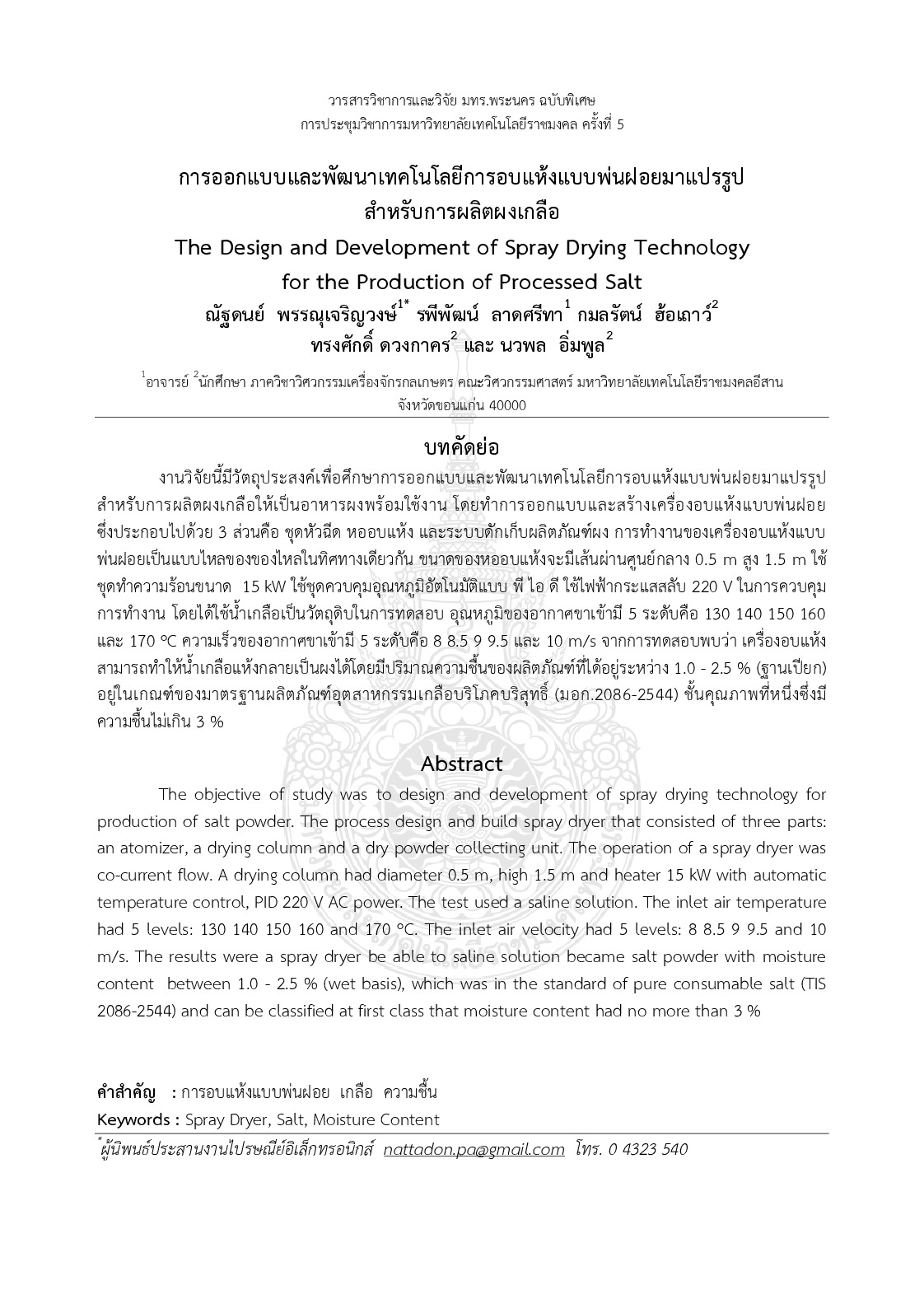
The design and development of spray drying technology for the production of processed salt
The objective of study was to design and development of spray drying technology for production of salt powder. The process design and build spray dryer that consisted of three parts: an atomizer a drying column and a dry powder collecting unit. The operation of a spray dryer was co-current flow. A drying column had diameter 0.5 m high 1.5 m and heater 15 kW with automatic temperature control PID 220 V AC power. The test used a saline solution. The inlet air temperature had 5 levels: 130 140 150 160 and 170 ?C. The inlet air velocity had 5 levels: 8 8.5 9 9.5 and 10 m/s. The results were a spray dryer be able to saline solution became salt powder with moisture content between 1.0 - 2.5 % (wet basis) which was in the standard of pure consumable salt (TIS 2086-2544) and can be classified at first class that moisture content had no more than 3 %