จำนวน Repository ( 1574 )
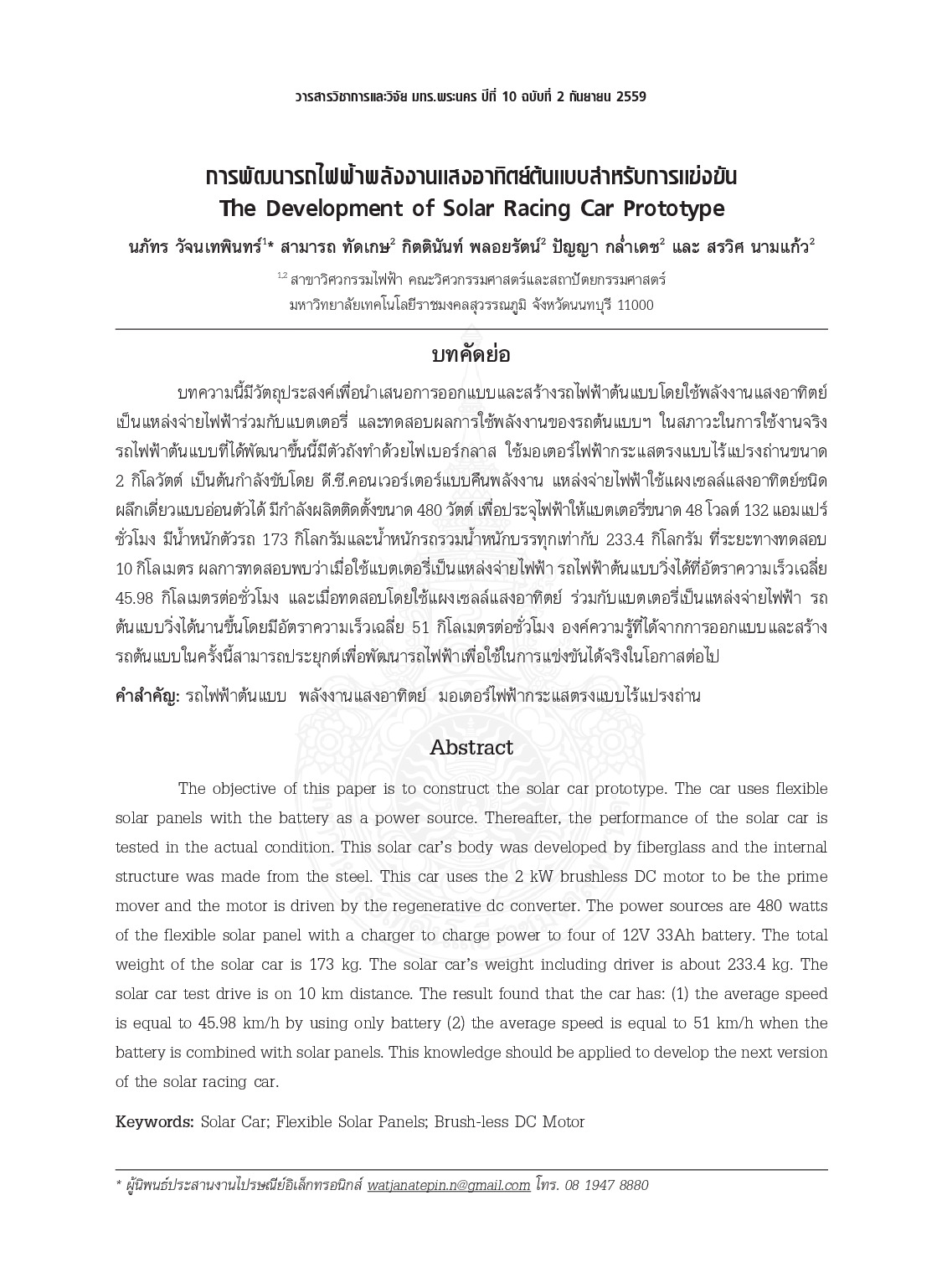
การพัฒนารถไฟฟ้าพลังงานแสงอาทิตย์ต้นแบบสำหรับการแข่งขัน
The objective of this paper is to construct the solar car prototype. The car uses flexible solar panels with the battery as a power source. Thereafter the performance of the solar car is tested in the actual condition. This solar car’s body was developed by fiberglass and the internal structure was made from the steel. This car uses the 2 kW brushless DC motor to be the prime mover and the motor is driven by the regenerative dc converter. The power sources are 480 watts of the flexible solar panel with a charger to charge power to four of 12V 33Ah battery. The total weight of the solar car is 173 kg. The solar car’s weight including driver is about 233.4 kg. The solar car test drive is on 10 km distance. The result found that the car has: (1) the average speed is equal to 45.98km/h by using only battery (2) the average speed is equal to 51 km/h when the battery is combined with solar panels. This knowledge should be applied to develop the next version of the solar racing car.
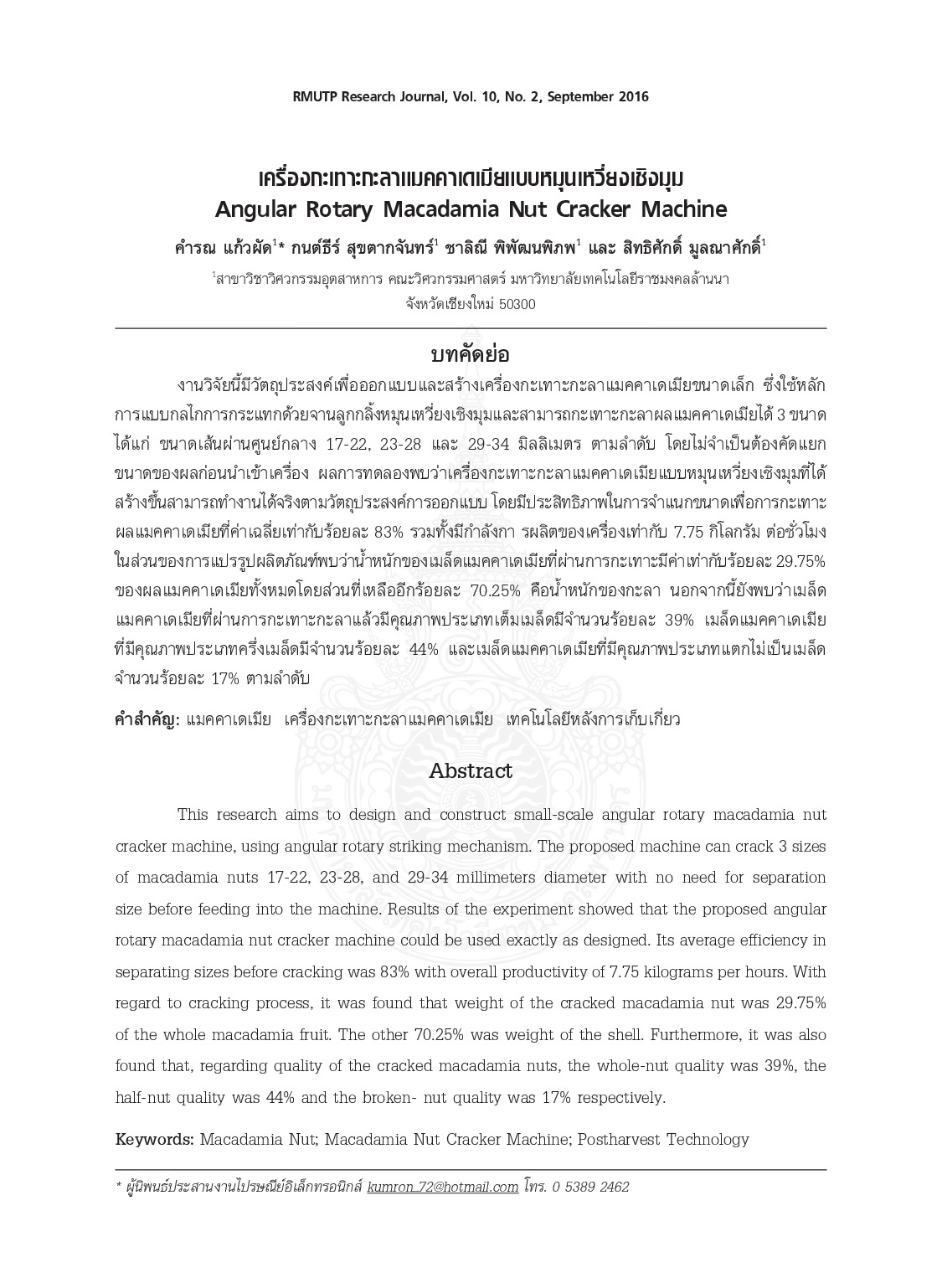
เครื่องกะเทาะกะลาแมคคาเดเมียแบบหมุนเหวี่ยงเชิงมุม
This research aims to design and construct small-scale angular rotary macadamia nut cracker machine using angular rotary striking mechanism. The proposed machine can crack 3 sizes of macadamia nuts - 17-22 mm 23-28 mm and 29-34 mm diameter with no need for separation size before feeding into the machine. Results of the experiment showed that the proposed angular rotary macadamia nut cracker machine could be used exactly as designed. Its average efficiency in separating sizes before cracking was 83% with overall productivity of 7.75 kilograms per hours. With regard to cracking process it was found that weight of the cracked macadamia nut was 29.75% of the whole macadamia fruit. The other 70.25% was weight of the shell. Furthermore it was also found that regarding quality of the cracked macadamia nuts the whole-nut quality was 39% the half-nut quality was 44% and the broken- nut quality was 17% respectively.

Screening and identification of lactic acid bacteria with antimicrobial activity against food-borne pathogen
This study focused on screening and identification of lactic acid bacteria with antimicrobial activity against Escherichia coli from milk samples. There were 250 isolates showing different antimicrobial activities. Five isolates with predominant anti-E. coli efficiency were chosen for the study of bacteria identification bacterial growth as well as the stability in pH change heating and proteolytic treatment. The sequences of 16s rDNA indicated that selected isolates were Lactobacillus sp.. The antimicrobial efficiency described in the term of Antimicrobial Index (AI) ranged from 0.63 to 0.84. However the anti-E coli activity did not change when performing the test under proteinase-treated condition and high temperature-treated condition. Conversely the pH adjustment of cell-free bacterial culture to 7.0 demolished their antimicrobial activity. This data implied that their antimicrobial activities were results of acidic condition produced by lactic acid bacteria. From this study the selected lactic acid bacteria showed their potential as a starter culture for fermented foods.
A simple method of system response compensation of a near infrared instrument for determining brix value of peaches
A system response of a near infrared (NIR) instrument sometimes changes depending on measuring conditions such as warming up time room temperature and the others. In the last peach experiment we measured NIR spectra over 3 days and spectral differences were observed between spectra measured at the first day and those at the second and third days. Therefore a simple method of system response compensation was examined. As a result of principle component analysis (PCA) of second derivative (2D) spectra of peaches samples were separated into two groups the first-day measured samples and the second and third-day measured ones on the plane consisted of PC1 and PC2. On the hypothesis that average 2D spectrum of each group should be almost the same the difference of the average 2D spectra (2D spectrum) was calculated. Using 2D spectrum 2D spectra of the first-day samples were adjusted to those of the other samples. The data set including the adjusted one is called “compensated 2D data set” hereafter as compared with “original 2D data set”. As results of partial least square (PLS) regressions based on the original and compensated 2D data sets and Brix value of peaches good SEPs of 0.98 °Brix for both cases could be obtained. The number of factors for the calibration model in case of compensated 2D data set was smaller than that in case of original one. It was concluded that the method using 2D spectrum could be used to compensate the difference of system response of an NIR instrument.
การติดตั้งแหล่งผลิตไฟฟ้าแบบกระจายตัวเพื่อเพิ่มความเชื่อถือได้ในระบบจำหน่ายไฟฟ้า
This paper presents reliability evaluation in distribution system with distributed generation. The main objective is to minimize the customer interruption cost subject to given number of distributed generation. The minimization problem for customer interruption cost in solved by the developed tabu search algorithm together with reliability worth analysis that provide an indirect measure for cost implication associated with power outages. The developed methodology is tested with a distribution system of Roy Billinton Test System (RBTS) bus 2 consist of 15 buses and 22 load points. Numerical results from the tests demonstrate that the optimal distributed generation placement can be used to promote reliability of the distribution systems.