จำนวน Repository ( 72 )
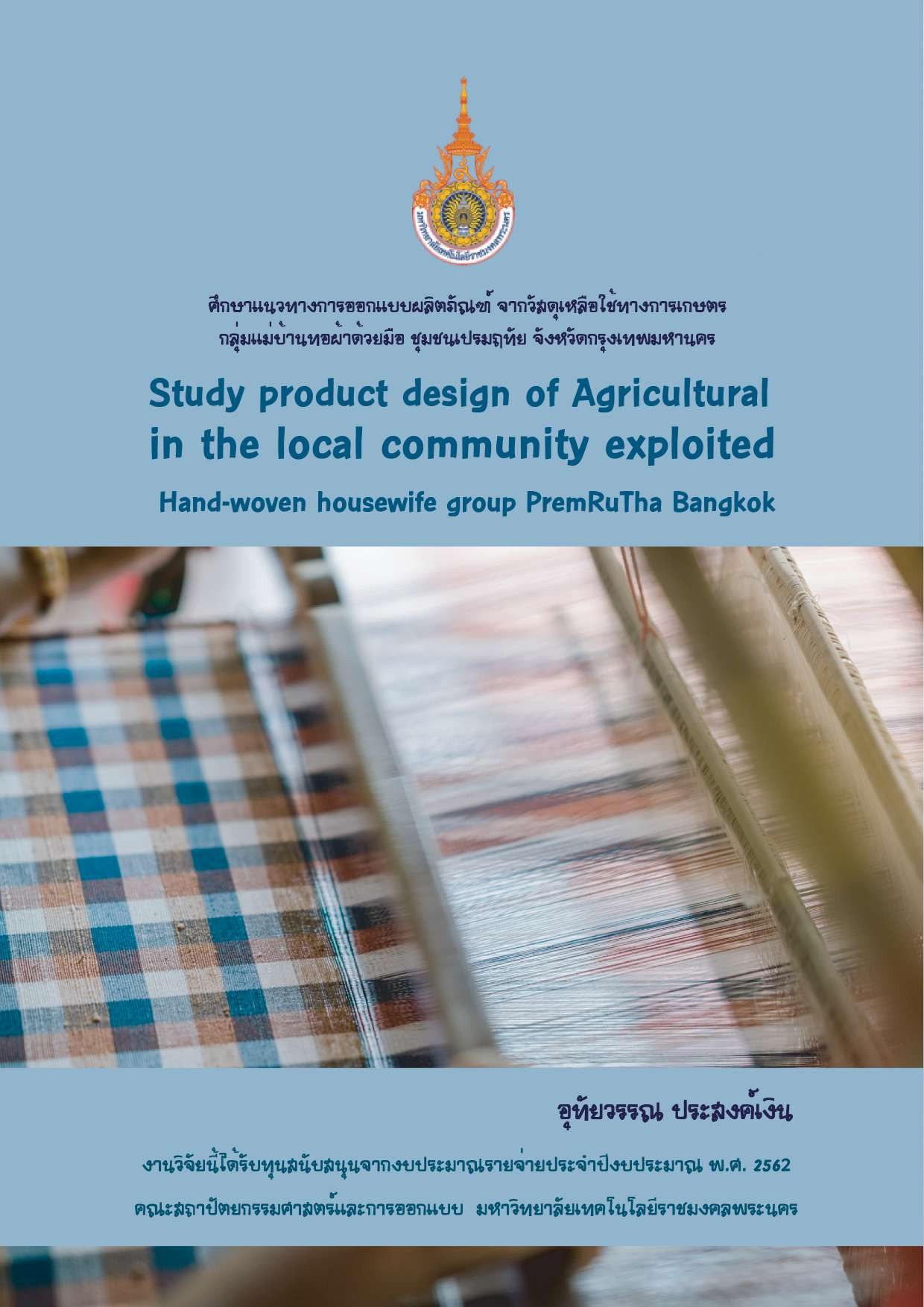
ศึกษาแนวทางการออกแบบผลิตภัณฑ์ จากวัสดุเหลือใช้ทางการเกษตร กลุ่มแม่บ้านทอผ้าด้วยมือชุมชนเปรมฤทัย จังหวัดกรุงเทพมหานคร
This research is Study the product design guidelines from agricultural waste materials. Weaving Housewife Group Premruethai Community Bangkok And in order to use waste materials to develop to add value With the following steps. (1) Surveying types amount of agricultural waste materials. (2) Study the physical structure and chemical properties of plant fibers. (3) Study the methods of preparing suitable fibers for textile materials. (4) Develop and study the suitable mixture ratio of blended fiber yarn. (5) Manufacture of hand-woven fabrics from agricultural waste materials. (6) Design and prototype of products from hand-woven fabrics from fibers agricultural waste And study from testing methods comparing the opinions of users / users and evaluators Assessed in the test Bring the results to analyze find conclusions analyze and suggest the research results to study. And analyze find conclusions study product design guidelines from agricultural waste materials Weaving Housewife Group Premruethai Community Bangkok Expect It was found that different methods of fiber content were obtained. And found that the amount of fiber varies according to the size of the material Analysis results of all chemical composition of fibers Found that the moisture content of 1.82% Water content 1.00% ashes 0.7 % and the fiber has the same amount of 0.97 mg kg at a normal level that can be found in general plants And meet the standard criteria Physical property test results of fibers The shape according to the cross-section of the fiber Looks like an oval almost round shape with a noticeable lumen. For the strength it was found that the fibers had an average elongation at break of 7.54% the toughness equal to 57.32% the fiber size was 16.45 deniers and the strength was 26.85 grams. Yarn production results The most suitable hand-woven (plant fiber and cotton) is 60% plant fiber mixed with 40% cotton. The yarn has an average toughness or strength of 4.86 newtons and the yarn is equal to 2.8 Ne and the result of Testing fabric peach mixed fiber fabric with handicraft pattern Found that the weaving of the fabric on the surface of the fabric and / or some grain on the fabric. And there is no hair and grain on the fabric medium Woven fabric has a lack of testing value from the number of abrasion cycles in the range of 1780 - 2100 and the color fastness to washing is in the level of 4-5 (the color has slightly changed And there is no color leakage) By the test streaking of yarn streaks (Plant fiber yarn) has the strength to withstand the pulling force in the range 577.30 - 610.22 newton the tear strength is in the range 37.26 - 53.89 newton and the size change after washing is in the range - 3.77 to - 6.59 should be developed into various home decoration products such as tableware sets curtains shoes bags etc. The assessor has the opinion that the use The beauty of various products Satisfied (1) Beauty pattern (2) color (3) Durability (4) Suitable proportion (5) Career promotion to local communities The assessors have the highest level of satisfaction respectively.

ความเป็นพิษร่วมของเอทิลีนไดเอมีนเตตระอะซิติกแอซิดและสารลดแรงตึงผิวสังเคราะห์ต่อแหนเป็ดใหญ่และแหนเป็ดเล็ก
Using of ethylenediaminetetraacetic acid (EDTA) and synthetic surfactant increase the chemical contamination in water. The co-phytotoxicity of EDTA (0-20 mg/l) and 3 synthetic surfactants; Triton X-100 (0-10xCMC) Tween 80 (0-10xCMC) and sodium dodecyl sulfate (SDS) (0-2 x CMC) on the growth of 2 duckweeds spirodela polyrrhiza and Lemma perpusilla were studied for 3 days. The results showed that the surfactant were phytotoxic on the growth of both plants while EDTA was not. SDS was the most toxic to plant especially on all chlorophyll content. Triton X-100 was only toxic to the growth of L. perpusilla and weight of S. polyrrhiza. Tween 80 was less or the least toxic to both plants. This surfactant only decreased chlorophyll a and total chlorophyll content of S.polyrrhiza and L. perpusilla. There was not any interaction between EDTA and surfactant on most toxicity tests. With these results synthetic surfactant contamination should be more concerned than co-contamination with EDTA.
การผลิตกระดาษทำมือจากหญ้าชันกาด
Panicum repens is a species of grass. The paper has been made from non-wood materials for long times. This research was used Panicum repens for made grass pulp as non-wood fiber. The influence of alkaline concentrations on properties of pulp from Panicum repens was investigated under room temperature. Alkaline concentration levels were varied at 0% 5% 10% 15% and 20% respectively. Moreover Paper pulp from Panicum repens was observed by scanning electron microscope (SEM). This research has controlled the length of fiber approximately 0.5- 2.5 cm before soaked with alkaline concentration at 1 hour and soak with water for controlled pH value at 7-8. Paper pulp was formed on a sieve. The result showed that color of paper pulp made from Panicum repens was light brown and green. SEM showed that alkaline concentration affects the physical properties of paper pulp. Moreover true density of paper pulp was also investigated in this research.
การศึกษาประสิทธิภาพของน้ำหมักและทำนองเพลงที่มีผลต่อการเจริญเติบโตของต้นกุหลาบหนู
The objectives of this research were to study the growth rate of microbial sludge in the fermented juice and to study the efficiencies of fermented juice and melodies on Fairy Rose growth. In the experiments the growth rate of microbial sludge was analyzed with 10 parameters for 4 weeks. Moreover the Fairy Rose was divided into 2 groups used and non-used the fermented juice. Each experimental group was tested with 3 types of melodies including jazz classical and Mozart. All experiments were set 3 replications by the total number of 24 Fairy Roses. The growth of the Fairy rose was analyzed by considering the number of leaf Height length of root and mass. The experimental results showed that the growth of microbial sludge in fermented juice was good and produced microbial sludge in fermented juice approximately 1063 ±158 mg/L on average. The Fairy Rose more growing with water and fermented juice. The number of leaves was 144±11 leaves in average Height was 30±1 cm in average Length of root was 38±8 cm in average and weight of Fairy Rose at the end of experimentation was found 400 g in average. In the case of melody affected Fairy Roses growth was classical. The growth of fairy roses found that the number of leaves was 143±6 leaves in average height was 29±1 cm in average Length of root was 34±1 cm in average and weight of Fairy Roses at the end of experimentation was 93 g in average
การพัฒนาผลิตภัณฑ์สารสกัดจากผลกล้วยและเปลือกมะละกอทดแทนสารเคมีเพื่อยับยั้งเชื้อจุลินทรีย์ในครีมทาส้นเท้า
At present most human-related products contain a mixture of chemicals for inhibiting microorganisms polluting the environments and harming the users. The purpose of this research was to develop a product using banana and papaya peel extracts as replacers for the chemicals inhibiting microorganisms in heel cream. By extracting raw bananas and papaya peels with coconut oil the studying the efficacy of inhibition on E. coli S. aureus Aspergillus sp. and S. cerevisiae with Disk Diffusion method at the protein concentration were performed as follows: 25 50 100 and 150 micrograms per milliliter. The observation of clear zone to observer clear zone of inhibition. and the Turbidity method using light absorption at a length of 600 nm was also were shown the corresponding results of microbial inhibition. observed and showed the consistent results. Especially the papaya extract having the protein concentration at least of 150 micrograms per milliliter could inhibit all 4 microbe species but could not inhibit S. cerevisiae that indicated a good trend of no harm on human. When mixing the extract in the heel cream it was found that Heel cream containing banana extract papaya and both mixtures displayed the density of 0.9674 0.9103 and 0.8057 gram per cubic meter respectively. They could be stored at room temperature for more than 45 days and still maintained the properties of microbial inhibition by up to 80 percentages. When studying the satisfaction of consumers collected randomly from teenagers to elders at both sexes of 40 people more than 80 percentages of the customers were satisfied with the heel cream from all extracts. These all creams could make the feet soft and moisturized within 1 week. More suggestions were to improve the smell of heel cream products to be suitable for all age of consumers. Therefore this research could be concluded that banana and papaya peel extracts inhibiting microorganisms could be used as a heel cream for further continuously developing at the industrial level.