จำนวน Repository ( 87 )
การออกแบบจานเบรกเชิงการสะสมความร้อนเพื่อความปลอดภัย
Admittedly a disc brake plays an important role in the auto part industry since it concerns directly with safety. Therefore the wide range of disc brake has been designed in order to develop its heat ventilation. Thus this project has designed a back-vented brake disc which is difference the current one (front-vented) and tried to create the test to find out the temperature diffusion of the disc brake with the hope to evaluate the coefficient of the heat convection varied by the temperature changing in both kinds of brakes under the forced heat convection in the steady condition. However the steady heat conduction and radiation value will not be counted because it is insignificant. The JASO C406: 2000 Standard is adopted as a guideline in the test. The outcome coefficient of heat conduction will be used in the simulation via the Finite Element Method (FEM) in order to study the temperature diffusion and heat ventilation of both kinds of brakes at each temperature level. Consequently the experimental work reveals then the heat convection coefficients of both kinds are unidirectional. The heat convection coefficient of the front-vented disc brake is 4.40 % in average higher than that of the back-vented disc brake. From the simulation the front-vented disc brake can ventilate the heat better than the back-vented disc brake at 3.02 % in average. It can be summarized that the front-vented disc brake has more temperature difference than the back-vented disc brake. Hence the front-vented disc brake likely gets more stress from the temperature than the back-vented disc brake and might be damaged during the operation more than the another type. Therefore this is tendency that the back-vented is safer than the front-vented brake disc for usage.
การศึกษาวิเคราะห์พฤติกรรมการอบชุบด้วยกระบวนการทางความร้อนของโลหะเงินเจือต่ำ 58.33 wt% AgCuSn
การวิจัยนี้เป็นการศึกษาพฤติกรรมการอบชุบด้วยกระบวนการทางความร้อนของโลหะเงิน เจือต่ำ58.45wt%Ag +41.55wt%Cu โดยทำการเปรียบเทียบกับสมบัติของโลหะเงินสเตอร์ลิง 925 และโลหะเงินเจือต่ำ 58.33% เพื่อศึกษาสภาวะที่เหมาะในหาการปรับปรุงคุณสมบัติเชิงกลและโครงสร้าง จุลภาคของโลหะเงินเจือต่ำที่เป็นไปตามมาตรฐานผลิตเครื่องประดับ ผลจากการศึกษาโลหะเงิน 58.33 % ที่อัตราส่วนผสม 58.33Ag+36.66Cu+5.01Sn ซึ่งมี ค่าคุณสมบัติเชิงกลจากการทดสอบเบื้องต้นมีค่าเหมาะสมที่สุด จากนั้นท่าการศึกษาค่าความแข็งแรงดึง สูงสุดแบบเส้นลวดพบว่ามีค่าความต้านทานแรงดึงสูงสุดเท่ากับ 0.36 MPa ค่าเปอร์เซ็นต์การยืดตัว 0.11% เมื่อท่าการอบที่อุณหภูมิ 650 °C เวลาในการอบ 10 นาที ซึ่งปล่อยให้ชิ้นงานเย็นตัวในอากาศที่ อุณหภูมิห้องปกติ และค่าความแข็งจากการทดสอบมีค่าสูงสุดเท่ากับ 105.12 HV อบที่อุณหภูมิ 600 °C เวลาในการอบ 10 นาที ซึ่งปล่อยให้ชิ้นงานเย็นตัวในอากาศที่อุณหภูมิห้องปกติ ศึกษาโครงสร้างจุลภาค ของโลหะเงินเจือต่ำ 58.33Ag+41.57Cu+0.10Sn เมื่อท่าการอบปรับปรุงคุณสมบัติทางความร้อนและการ ชุบแข็งแบต่างๆ พบว่าโครงสร้างจุลภาคของชิ้นงานทดสอบหลังปล่อยให้เย็นตัวในอากาศ เกิดการ เปลี่ยนแปลงจาก β phase ที่มีขนาดเล็กลงเป็นโครงสร้าง Eutectic phase ที่มี α -phase และ β - phase ขนาดเล็กและละเอียด ซึ่งมีลักษณะสอดคล้องกับโครงสร้างจุลภาคของเฟสไดอะแกรมสมดุลโลหะ เงิน-ทองแดง ผลจากการทดลองและวิเคราะห์หาค่าคุณสมบัติเชิงกลของชิ้นงานทดสอบและโครงสร้างจุลภาค ที่ได้จากการทดลองในสภาวะต่างๆ มีค่าที่เป็นไปตามมาตรฐานของเครื่องประดับเงินตามมาตรฐาน อุตสาหกรรมการผลิตเครื่องประดับ ทั้งของในประเทศและต่างประเทศ
Sensitivity analysis in efficiency of the solar water heater system self-circulated by a steam power
The sensitivity analysis in efficiency of solar water heater system self-circulated by a stream power was performed in this study. The mathematical model of the system was developed based on the experimental results to predict the available amount of water pumped temperature and pressure in main devices. This system was operated by using a simple flat plate solar collector with an exposed area of 1.58 m2 and a storage tank of 30 liters. The results of systematic performance which performed by math model was compared to the experimental results. It was found that the values of were 5.876% 3.583% and 1.361% for vapor pressure and temperature in the flat plate solar collector and temperature in the storage tank respectively. The system was workable when the solar energy input values were equal to or greater than 584 W/m2 607 W/m2 632 W/m2 and 662 W/m2 for discharge head 1 m 1.5 m 2 m and 2.5 m respectively. From system simulation the system could have the daily average thermal efficiency was between 2.94 – 11.47% and the daily average pump efficiency 0.00057 – 0.0026% depending on the intensity of incident solar radiation and the discharge head of the system.
The application of kaolin with coconut meal, plywood from corncobs and durian peel in concrete masonry unit wall for increasing effective heat protection and lightweight
This research aims to study the application of kaolin with coconut fiber corncobs fiber and durian peel in concrete masonry unit wall for increasing effective heat protection and lightweight. The ratio of cement type 1: kaolin is equal to 1: 60 by weight. The kaolin is replaced by fiber include coconut fiber corncob fiber durian peel fiber with 1.67% 3.33% and 5% by weight of kaolin. The kaolin concrete block mixed with fiber sample size is formed to 6.9 x 39 x 19 centimeter with the hydraulic compactor. The samples tested in physical and mechanical properties follow the TIS 58-2533 standard. Resulting their fibers can reduce the density thermal conductivity and compressive strength and increase the changing length and water absorption of kaolin concrete blocks. The kaolin concrete block without fiber has highest compressive strength followed by the kaolin concrete block mixed with corn cob fiber the kaolin concrete block mixed with coconut meal fiber and the kaolin concrete block mixed with durian peel fiber has lowest compressive strength respectively. However their fibers have possibility to be composite materials to reduce weight of kaolin concrete blocks
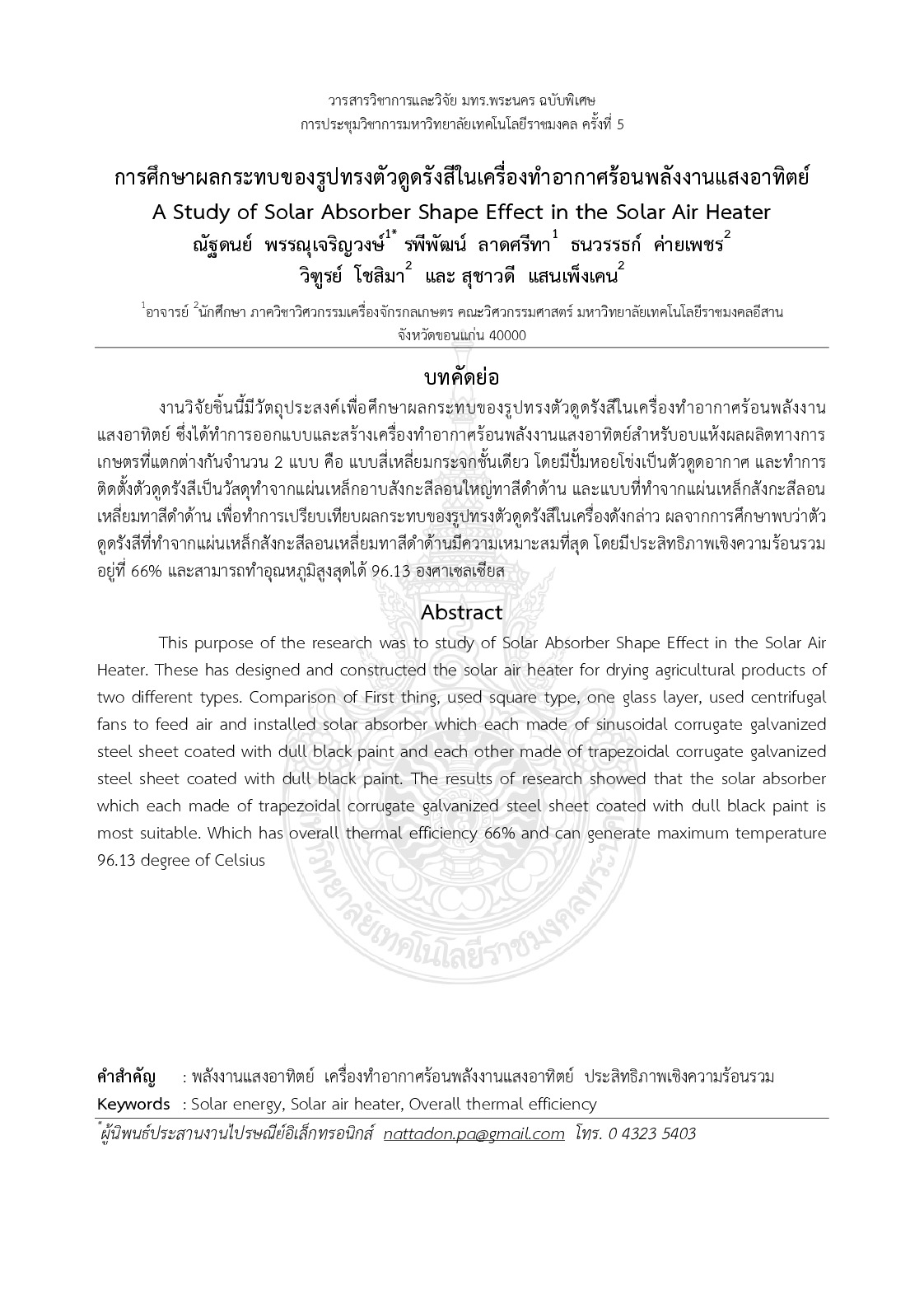
A study of solar absorber shape effect in the solar Air heater
This purpose of the research was to study of Solar Absorber Shape Effect in the Solar Air Heater. These has designed and constructed the solar air heater for drying agricultural products of two different types. Comparison of First thing used square type one glass layer used centrifugal fans to feed air and installed solar absorber which each made of sinusoidal corrugate galvanized steel sheet coated with dull black paint and each other made of trapezoidal corrugate galvanized steel sheet coated with dull black paint. The results of research showed that the solar absorber which each made of trapezoidal corrugate galvanized steel sheet coated with dull black paint is most suitable. Which has overall thermal efficiency 66% and can generate maximum temperature 96.13 degree of Celsius