จำนวน Repository ( 231 )
การพัฒนาผลิตภัณฑ์เบเกอรี่จากหยวกกล้วยและส่วนเหลือทิ้งใน การผลิตกล้วยตากของกลุ่มวิสาหกิจชุมชนแม่บ้านบางตาโฉม จังหวัดสิงห์บุรีสู่เชิงพาณิชย์อย่างยั่งยืน
Bakery Products Development from the Banana Pseudo-stems and Waste from Dried Banana Production at Ban Bang Ta Chom Community Enterprise Sing Buri Province for Sustainable Commerce. Research on bakery product development from paprika and bananas in Production of Dried Banana of Bang Ta Chom Housewife Community Enterprise Group Sing Buri province for sustainable commercialization in order to: 1. Develop bakery products from 4 types of Banana Pseudo-stems and Waste 2. study the formulas and production processes of bakery products from Banana Pseudo-stems and Waste 3. study the consumer test of bakery products from 4 types of Banana Pseudo-stems and Waste and 4. To transfer technology Little Bakery products from Banana Pseudo-stems and Waste then bring the shelf life in conditions ranging from 0-10 days and compare the physical properties. Chemical and microorganisms such as pH value color measurement and total number of microorganisms found that Khanom Jeen noodles stored in modified atmosphere conditions have longer shelf life than those stored. At normal atmospheric conditions and vacuum conditions. Chemical analysis results showed that the bakery products decreased their pH over time. With values between 4.31 ± 0.00 and 2.99 ± 0.01 and bakery products Stored at 100% carbon dioxide (CO2) modified atmosphere packed in a sealed nylon / PET vacuum plastic bag. Store at room temperature. Can be stored for up to 10 days and found that the total number of microbes increased when the storage life is longer But not over the standard of community products so the products are safe and not harmful to consumers. Consumer test results show that consumers like and are interested in buying bakery products that use 100 percent carbon dioxide (CO2) at 75 percent.
การพัฒนาศักยภาพมันสำปะหลังในการผลิต ผลิตภัณฑ์น้ำพริก
The purpose of this research to study the process of destruction of cyanide in cassava. Prior to use in product of Thai pastes and study use of cassava in Thai pastes production of 4 types in tha dang pastes roasted chili paste lohng reuua paste Tamarind chili paste. study physical properties and chemical properties of product and consumer test studies in cassava products affective. in order that transfer technology of development products to the community. The study process to destroy cyanide in cassava before to use in products of pastes. The steaming process in cassava is the low dose of cyanide 18.9 ppm. Studies using cassava to produce 4 types of pastes. The average score of tha dang pastes supplement of cassava 15 percentage in terms of appearance color taste texture and overall liking. The average score was 7.20.7.30.7.00.7.20 and 7.50. This is a preference at a moderate level. Sensory evaluation of roasted paste supplement of cassava 40 percent in terms of appearance color taste texture and overall liking. The average score was 7.86 8.05 7.79 7.86 7.71 and 7.79 This is a preference at a moderate level. Sensory evaluation of lohng reuua paste supplement of cassava 10 percent in terms of appearance color aroma taste texture and overall liking. The average score was 7.30 6.70 7.00 7.50 7.30 and 7.25. This is a preference small and medium-like. Sensory evaluation of tamarind paste supplement of cassava 20 percent in terms of appearance color aroma taste texture and overall liking. The average score was 7.40 7.15 7.15 7.20 7.20 and 7.50. there is a preference moderate inclination. When all 4 types of products were tested for physical chemical and microbiological. we found increasing the amount of cassava in products has affect the color of the products and increase of fat and fiber in the products. All 4 types of cassava products of biomass are no harmful by Thai Industrial Standards Institute. The study on consumer acceptance of the products cassava paste the 4 types. The consumers test responded to the questionnaire were female. The age of the respondents is 21-30year and occupation of the respondents are students. Most of the revenue will be at 10001-15000 baht. The consumers liking the product in rate like very much to like most and accept all 4 types of cassava products. Most consumers buy for storing themselves including buying as souvenirs. The price of products in consumers agree on the price of 35 baht.
การพัฒนาผลิตภัณฑ์เบเกอรี่จากราข้าวและส่วนเหลือทิ้งในการแปรรูปข้าว
Development of Bakery Products from Rice Bran and Rice Processing Wastes to 1. Develop bakery products from rice bran and wastes amount 4 types 2. Study the formulas and processes of food production from rice bran and wastes for the appropriate 4 types 3. Study consumer acceptance of food products from rice bran and wastes in 4 types and 4. Transfer technology of bakery products from rice bran and wastes in 4 types to the community After that the storage life of each condition will be studied from 0-10 days and the physical properties are compared. Chemical and microorganisms such as pH value color measurement and total number of microorganisms found that Khanom Jeen noodles stored in modified atmosphere conditions have longer shelf life than those stored. At normal atmospheric conditions and vacuum conditions. Chemical analysis results showed that the bakery products decreased their pH over time. With values between 4.31 ± 0.00 and 2.99 ± 0.01 and bakery products Stored at 100% carbon dioxide (CO2) modified atmosphere packed in a sealed nylon / PET vacuum plastic bag. Store at room temperature. Can be stored for up to 10 days and found that the total number of microbes increased when the storage life is longer But not over the standard of community products (PhorChor. 500/2547 Knmhin) so the products are safe and not harmful to consumers. Consumer test results show that consumers like and are interested in buying bakery products that use 100 percent carbon dioxide (CO2) at 75 percent.
การออกแบบรูปทรงแม่แบบเครื่องจักสานผักตบชวาสู่ผลิตภัณฑ์สร้างสรรค์แนวคิดเอกลักษณ์ท้องถิ่น
The objective of this study 1) To study the shape of the template from the process of making basketry 2) To design a template hyacinth wicker products creative products 3) To test the woven pattern of water hyacinth wicker 4) To create a unique product that is more valuable to the local wisdom and value. Consumerism toward the development of water hyacinth wicker patterns. By specifying a sample group of 57 people. The tools used in the research consisted of the satisfaction questionnaire on the template pattern water hyacinth weave basketry to local creative concept product. The results of the design of the water hyacinth wicker pattern design to the product of local identity concept found that the design shape can be a shape that has a concept as a creative product. Form 1 wicker-shaped pattern template from water hyacinth leaves The product is a chair with an average of 4.58 Form 2 template oval shaped wicker basket shape. The product was a basket of legs with an average of 4.48 Form 3 basket shaped shape from the bowl shape the product received the basket has a value of 4.22. All 3 forms that can be developed in the form of products that can satisfy level most satisfactory shape is the molds for Basketry 1. The product is a chair that is beautiful the proportion of products is suitable for use and strong products are local and creative in the process of water hyacinth wicker requires a template for forming. The original material used to make the wicker template is plywood or foam material. During the study phase the researcher invented the material for making water hyacinth woven basket template using rubber water mixed with plastic watercolor foamed foam templates are used for easy handling and longer durability.
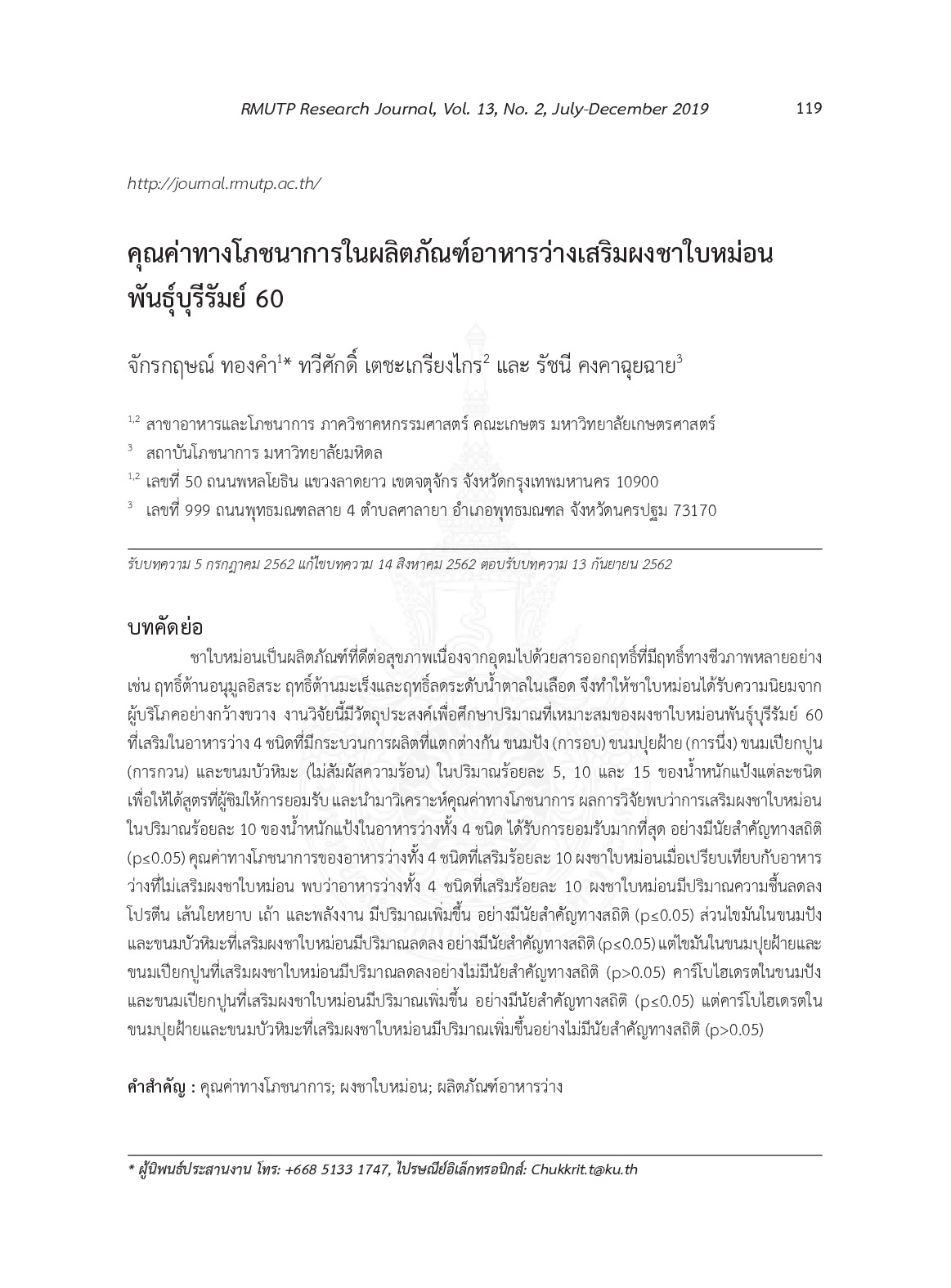
คุณค่าทางโภชนาการในผลิตภัณฑ์อาหารว่างเสริมผงชาใบหม่อนพันธุ์บุรีรัมย์ 60
The potential health benefits attributed to mulberry leaf tea and its bioactive compounds such as antioxidant effects cancer chemoprevention and lower blood sugar levels have led to a huge increase of mulberry leaf tea products in the food market. The objectives of this research were to determine the appropriate amount of mulberry leaf tea powder Buri Rum 60 added in 4 snack products which were cook by 4 different process i.e. bread (baked) puifai (steam) peakpoon (stir) and snow lotus (no heat treatment). The Mulberry leaf tea powder was used in the ingredients for 3 levels i.e. 5 10 and 15%. Then the most preferred formula was analyzed for the nutritional values. The result showed that all 4 snacks added with Mulberry leaf tea powder at level of 10% were accepted the most. The nutritive value of these 4 snacks indicated that the moisture contents decreased while protein fiber ash energy increased significantly (p≤0.05). In comparison to the original formulas fat decreased significantly in bread and snow lotus added with mulberry leaf tea powder (p≤0.05) and decreased non-significantly in puifai and peakpoon added with Mulberry leaf tea powder (p>0.05). Carbohydrate increased significantly in bread and peakpoon added with mulberry leaf tea powder (p≤0.05) and increased non-significantly in puifai and snow lotus added with Mulberry leaf tea powder (p>0.05).