จำนวน Repository ( 127 )
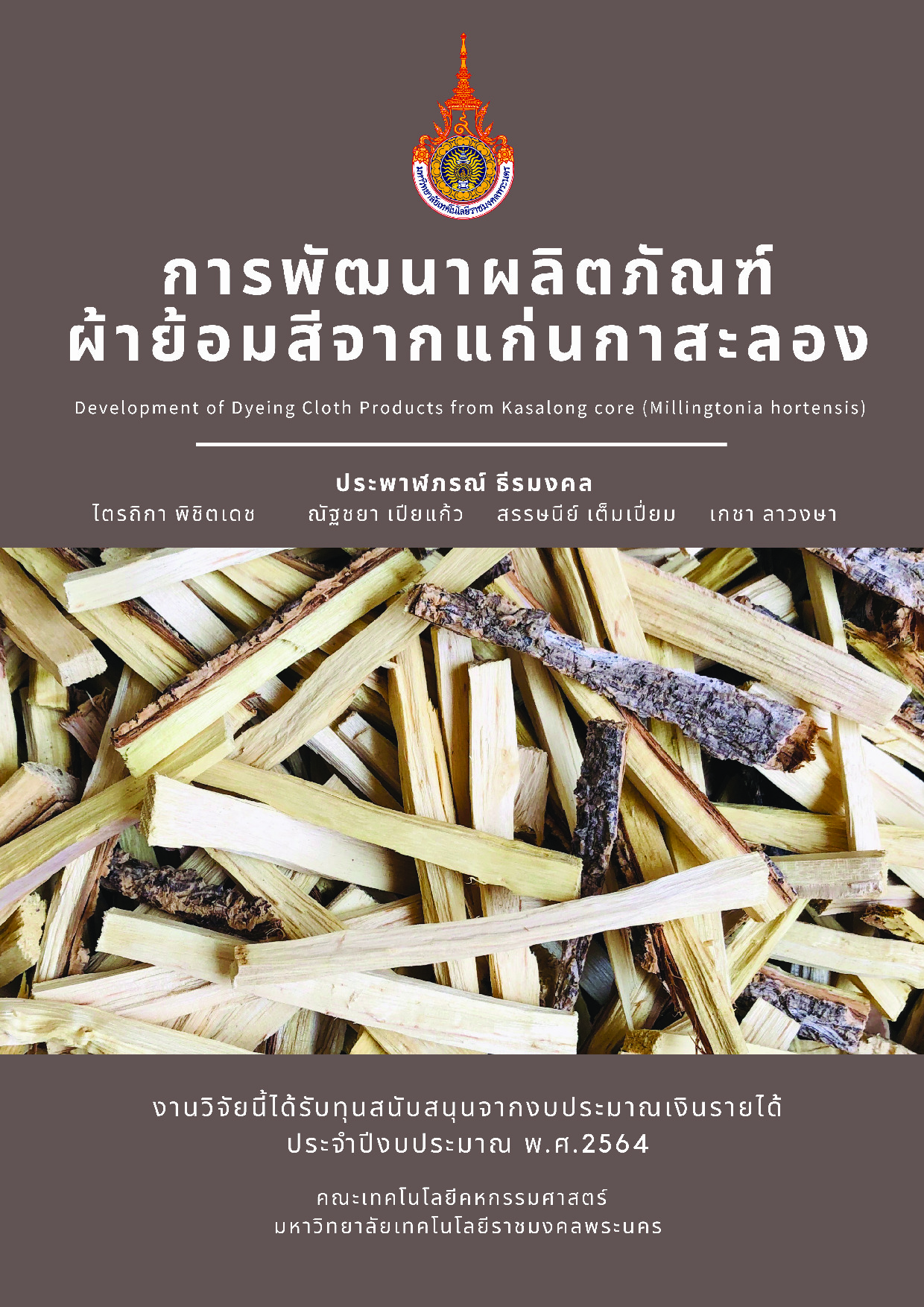
การพัฒนาผลิตภัณฑ์ผ้าย้อมสีจากแก่นกาสะลอง
Promotion of handicrafts in the field of natural dyes in the country. Increase the potential of the community and use the strengths of the cultural community. way of life and wisdom by finding ways to develop textile products by using creative textile innovations based on local wisdom in sustainable community areas To add added value to products in the ECO PRODUCT and ZERO WASTE product groups from the aforementioned concept To conserve plant genetics that exist throughout the country. The researcher therefore studied the process of dyeing fabrics by natural methods. By taking natural ingredients that are locally available and transforming them into environmentally friendly home products. This research is to study the natural dyeing of cotton fabric from Kasalong core. have a purpose Study on the effect of dyeing and the use of adjunctive agents in natural dyeing from Kasalong kernels. To develop dyed fabric products from Kasalong core and to pass on the knowledge and technology of developing dyed fabric products from Kasalong core for the general public. The result of dyeing cotton with natural dyes from Kasalong core. Four types of adhesives were used at a concentration of 20 percent as tamarind juice lime juice lime juice ash water and to test the washing fastness and sunlight resistance with the AATCC standard. The results can be summarized as follows. 1. The results of the study found that from the extraction of color from Kasalong kernels and then filtered with cloth. The color water extracted from Kasalong essence is brown. and when left for 24 hours the water color is dark brown and in this research using hot dyeing methods. 2. The result of dyeing cotton with natural dyes from Kasalong core without mordant using was found to yellow-brown but after washing the color intensity on the fabric fades slightly. 3. The result of dyeing cotton with natural color from Kasalong core. It was found that after washing the color intensity on the fabric was moderately fading. 4. The color measurement L* a* b* found that when the dye was measured in the CIELab system L* = 26.81 a* = 33.33 b* = 45.69 dL = 0.36 and dE*ab = 0.85 water. The resulting color from Kasalong will be reddish yellow. 5. Make the research prototypes as 10 of bag products. 6. Conducting technology transfer by organizing workshops dyeing course and sewing durating of the workshop for students and the general public was 1 day. Most of the participants had the highest level of satisfaction in all questions.
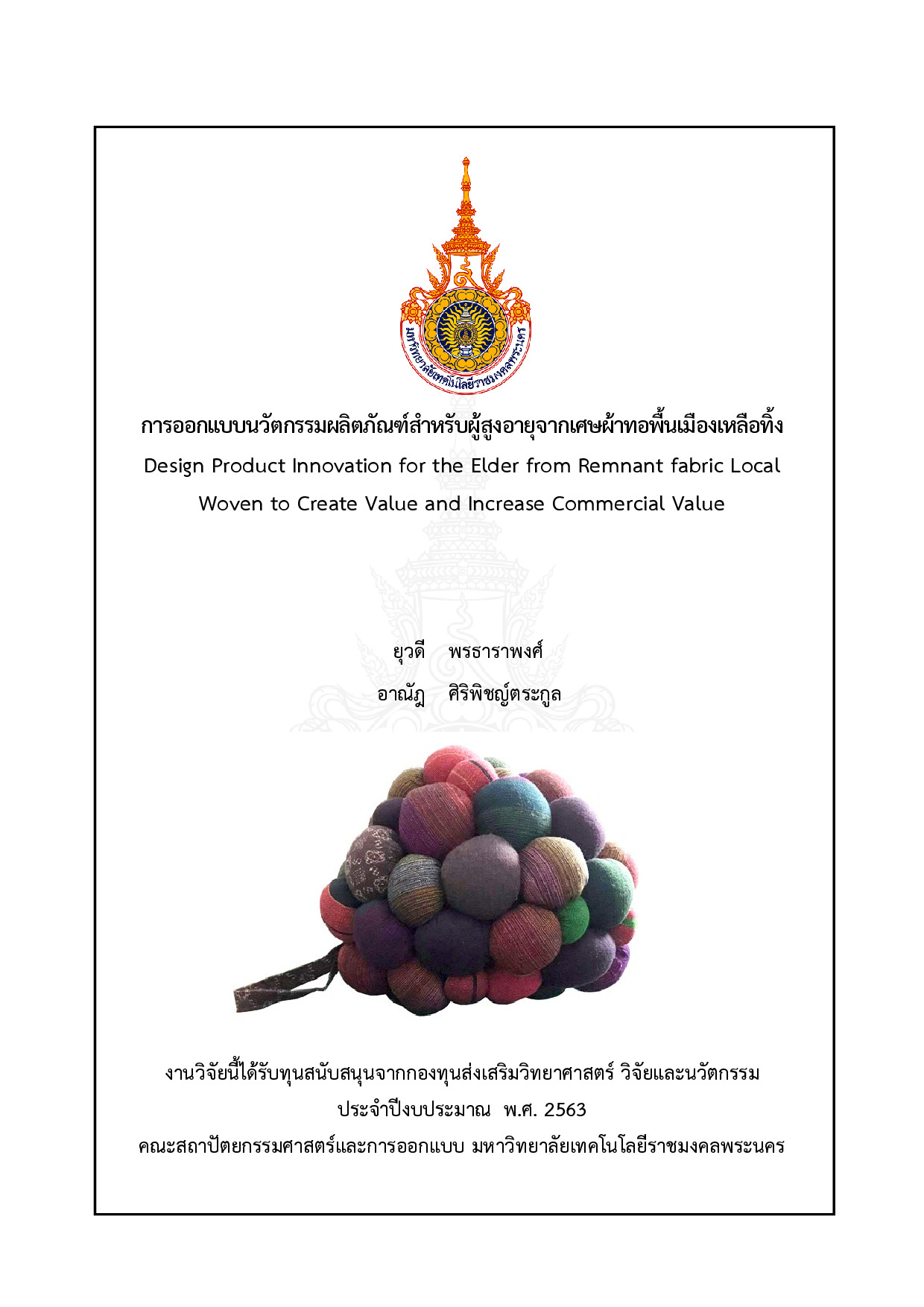
การออกแบบนวัตกรรมผลิตภัณฑ์สำหรับผู้สูงอายุจากเศษผ้าทอพื้นเมืองเหลือทิ้ง
The objectives of this research are: 1. to design innovative products for the elderly from local woven fabric scraps left over from sewing that can help and promote health in their lives; 2. to create product guidelines for the elderly from woven fabric scraps. Native leftovers from tailoring that are unique create value and add commercial value. From the study of rags from local woven cloth left over from sewing Weaving indigenous fabrics which are local wisdom. Has been used to process various products such as clothing bags guards there will be a discarded part that is not used Therefore in this research the rag was used to develop the design of products for the elderly. There is a worthwhile use of local fabric scraps. focus on style Techniques for creating curved surfaces Embossed into a ball to create a texture and pressure. In terms of shape design it can be used with the elderly. can help and promote health in life Characteristics of the product is a product that can be administered to muscles. parts of the body of the elderly. The results of the experiment by bringing innovative products for the elderly from the waste of local woven cloth were tested on 22 elderly people in terms of form beauty function use. It was found that the elderly were satisfied with the innovative products for the elderly. with an average of 4.51 is the most innovative product for the elderly from various forms of local woven fabrics It is designed to be a guideline for application. production for sale This will result in the community learning to design products related to the elderly. Community can develop potential Community products and products for the elderly resulting in the creation of local product identity It is a process of creating a body of knowledge and extending local wisdom for benefits.
การศึกษาการบำบัดน้ำเสียจากการย้อมผ้าแบบเคลื่อนที่โดยใช้ถ่านกัมมันต์จากกะลามะพร้าว
The dyeing industry both of business size and household size where the remaining water from the dyeing process is dumped into pipes and flows into natural water sources causing sewage problems. Therefore a column type wastewater treatment system has been developed by using a filtration system along with an adsorption system. The materials used to treat the wastewater from dyeing are gravel sand charcoal from wood and activated carbon from coconut shell. The study was conducted on the synthesis activated carbon from coconut shell using for color and molecules adsorption. The amount of activated carbon from coconut shell was varied at 200 400 600 and 800 g applying with filter media and other adsorption materials taking 1 hour to treat the wastewater from dyeing. The parameter using to measure water quality consisted of color value pH suspended solids conductivity turbidity value COD and TKN to indicate the water quality before and after treatment evaluating the efficiency of the wastewater treatment system. The best ratio that can treat the color is the formula containing 800 g of coconut shell activated carbon. It was able to treat the color equal to 5.94 SU or 99.43 percent compared to the wastewater before treatment.
การพัฒนาต้นแบบสินค้าที่ระลึกจากผ้าปักชาติพันธุ์ม้ง เพื่อพัฒนาคุณภาพชีวิต ผู้สูงอายุ อำเภอกัลยาณิวัฒนา จังหวัดเชียงใหม่
An investigation into the development of souvenir product prototype from Hmong embroidered fabrics to improve seniors quality of life in Kalayaniwattana District Chiang Mai Province.The aim of this study was to 1) develop a souvenir product prototype made from Hmong ethnic embroidered fabrics in Kalayaniwattana District Chiang Mai Province. 2) To develop innovative manufacturing processes to increase skills for the seniors to minimize the embroidery time. 3) To study the satisfaction towards the prototype of souvenir products from Hmong embroidered fabrics in Kalayani Wattana District Chiang Mai Province by using a sample of 200 tourists. The data collection tool was satisfaction questionnaire on the development of a prototype of a souvenir product from Hmong ethnic embroidered fabrics to improve the seniors quality of life in Kalayaniwattana District Chiang Mai Province on the aspect of its utility beauty manufacturing process and 3 souvenir product prototypes namely type 1 childrens cloth type 2 ladies robes and type 3 bags by using a random questionnaire. The data analysis generated from percentage statistics arithmetic mean and standard deviation. The study results based on the research objectives revealed the outcome as followed.l) To develop a prototype of a souvenir product from Hmong ethnic embroidered fabrics from sample group of 25 people the study found that the draft design that was satisfied as a souvenir prototype was group 1 childrens cloth. The most satisfied model was draft design 1.2 (= 4.36) group 2 shirts. The most satisfied womens group was draft design 2.1 (= 4.28). As for group 3 the bag which was assessed with highest satisfaction was draft design 3.1 (= 4.40). 2) To develop innovations in manufacturing process to enhance skills for seniors to reduce the embroidery duration it revealed that the star pattern was the simplest embroidery pattern reflecting Hmong identity through embroidered fabrics by application of antique tones together with the method of mixed silk embroidery with embroidering patch into round pieces to reduce the process and to facilitate fast embroidery process. 3) To study the satisfaction towards the prototype of souvenir products from Hmong ethnic embroidered fabrics part 1 the results of the general data study of the respondents found that most of the respondents were female accounted for 63.5 percent aged between 26-30 years representing 33.5 percent most of them were married 56% most of them graduated with a bachelors degree accounted for 60 percent most of them were employed as general staff accounted for 31 percent with monthly income at 15001-20000 baht representing 35.5% most of them domiciled in other provinces accounted for 55.5%. Part 2 information about the behavior of purchasing souvenirs found that most of the respondents already knew Kalayani Vadhana District Chiang Mai Province from social media channels (Social Network) accounted for 89 percent most of them had bought and used Hmong embroidered products 81.5 percent most of respondents would recommend other people to visit again at 100 percent most of the respondents perceived the souvenir prototypes were interesting 99 percent. Part 3 the satisfaction towards design and development of souvenir products prototypes made from Hmong embroidered fabrics found that the souvenir product prototypes that received the most satisfaction were type 3 bags (x-= 4.56 S.D. = 0.59.) in total aspects received the highest level of satisfaction followed by type 1 childrens cloth (x- = 4.52 S.D. = 0.55) with the highest level of satisfaction in all aspects and type 2 womens cloth (x-). = 4.45 S.D. = 0.65). Globally all aspects were satisfied at a high level.
ฤทธิ์ต้านแบคทีเรียของผ้าย้อมคราม
The objective of this research was to study the antibacterial activity of 16 samples of indigo dyed fabrics that are produced and sold in Sakon Nakhon Province. Effect of moisture and pH of indigo dyed fabrics on bacterial growth were also determined. The result of the study shows inhibition of S. aureus TISTR 746 and E. coli TISTR 073 by agar diffusion plate test all samples could inhibit Saureus TISTR 746 (accounted as 100%) and only 9 samples could inhibit E. coli TISTR 073 (accounted as 56.25%). Whereas the study of antibacterial activity by AATCC test method 100-2004 at 24 hours was found that the natural indigo dyed fabrics code A3-1 could inhibit both bacterial strains in the highest level. The result also shows the effect of moisture and pH of indigo dyed fabrics on bacterial growth it was found that the increased humidity levels of indigo dyed fabrics have effect on the reduction of the inhibition efficacy of both strains. While indigo dyed fabric with pH 3.0 was found to inhibit most of the growth of both strains. In addition images obtained using a scanning electron microscope (SEM) could clearly confirm the property of indigo dyed fabric on inhibition of S. Aureus TISTR 746 and E. coli TISTR 073.