จำนวน Repository ( 891 )
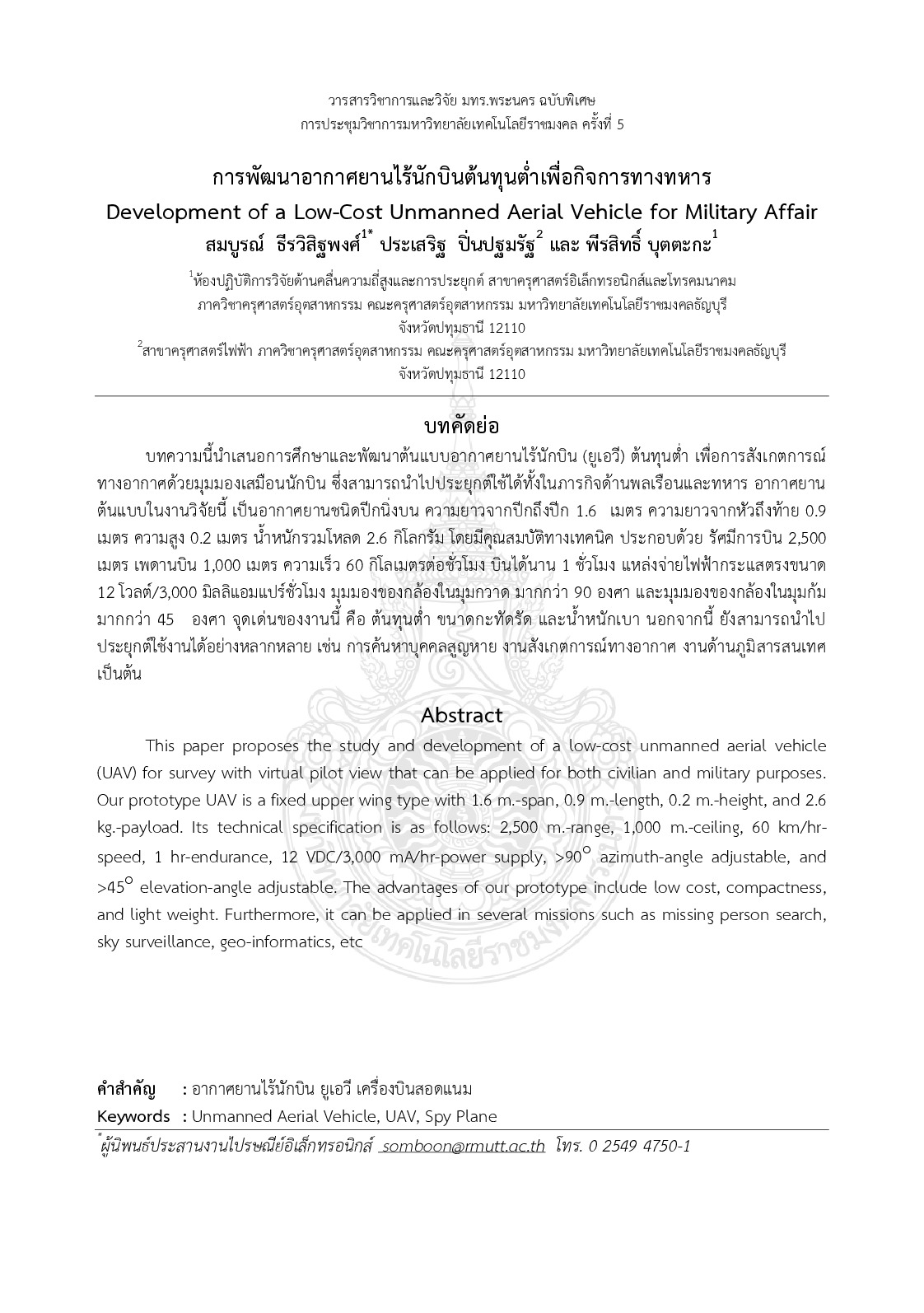
Development of a Low-Cost unmanned aerial vehicle for military affair
This paper proposes the study and development of a low-cost unmanned aerial vehicle (UAV) for survey with virtual pilot view that can be applied for both civilian and military purposes. Our prototype UAV is a fixed upper wing type with 1.6 m.-span 0.9 m.-length 0.2 m.-height and 2.6 kg.-payload. Its technical specification is as follows: 2500 m.-range 1000 m.-ceiling 60 km/hr-speed 1 hr-endurance 12 VDC/3000 mA/hr-power supply >90 azimuth-angle adjustable and >45 elevation-angle adjustable. The advantages of our prototype include low cost compactness and light weight. Furthermore it can be applied in several missions such as missing person search sky surveillance geo-informatics etc
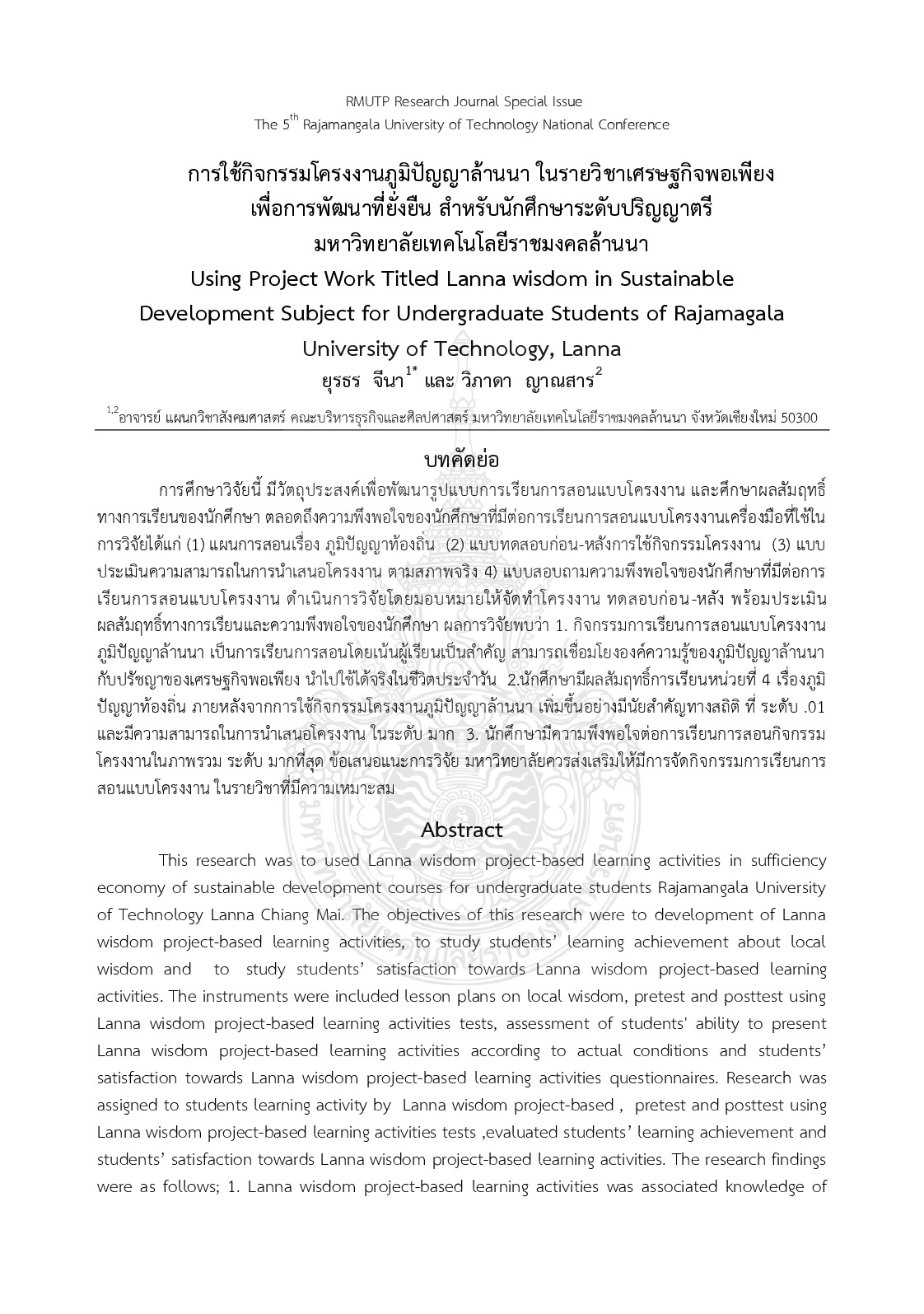
Using project work titled lanna wisdom in sustainable development subject for undergraduate students of Rajamagala University of Technology, lanna
This research was to used Lanna wisdom project-based learning activities in sufficiency economy of sustainable development courses for undergraduate students Rajamangala University of Technology Lanna Chiang Mai. The objectives of this research were to development of Lanna wisdom project-based learning activities to study students’ learning achievement about local wisdom and to study students’ satisfaction towards Lanna wisdom project-based learning activities. The instruments were included lesson plans on local wisdom pretest and posttest using Lanna wisdom project-based learning activities tests assessment of students ability to present Lanna wisdom project-based learning activities according to actual conditions and students’ satisfaction towards Lanna wisdom project-based learning activities questionnaires. Research was assigned to students learning activity by Lanna wisdom project-based pretest and posttest using Lanna wisdom project-based learning activities tests evaluated students’ learning achievement and students’ satisfaction towards Lanna wisdom project-based learning activities. The research findings were as follows; 1. Lanna wisdom project-based learning activities was associated knowledge of Lanna wisdom with sufficiency economy for application in daily life 2. Students’ learning achievement about local wisdom in lesson 4 after using Lanna wisdom project-based learning activities are increase at statistically significant level of 0.01 and capable of Lanna wisdom project-based learning activities presentation at a higher level. 3. Student overalls satisfaction towards Lanna wisdom project-based learning activities at the highest level. The recommendation of research that universities should support of appropriate teaching curriculum by project-based learning activities.
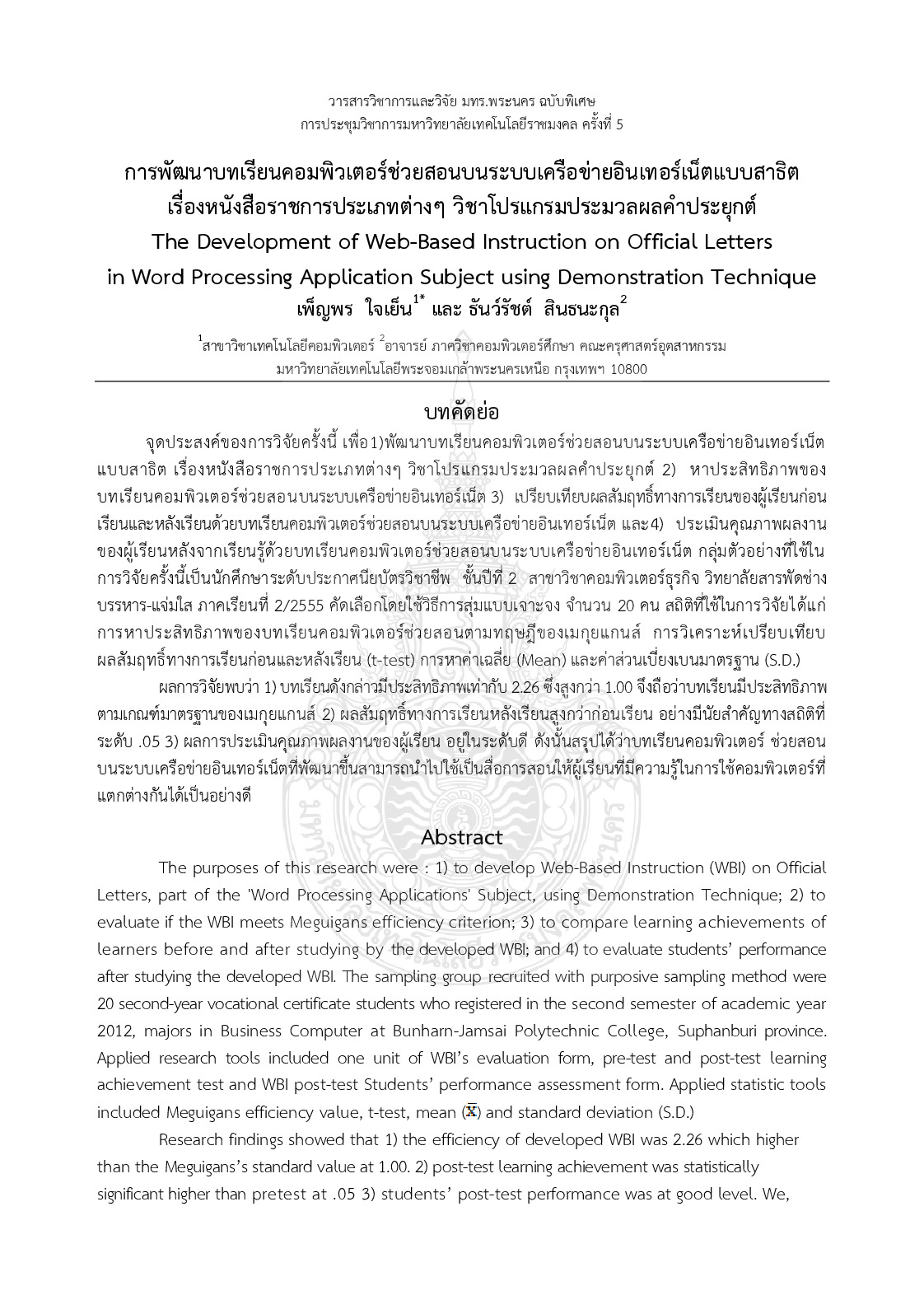
The development of web-based instruction on official letters in word processing application subject using demonstration technique
The purposes of this research were : 1) to develop Web-Based Instruction (WBI) on Official Letters part of the Word Processing Applications Subject using Demonstration Technique; 2) to evaluate if the WBI meets Meguigans efficiency criterion; 3) to compare learning achievements of learners before and after studying by the developed WBI; and 4) to evaluate students’ performance after studying the developed WBI. The sampling group recruited with purposive sampling method were 20 second-year vocational certificate students who registered in the second semester of academic year 2012 majors in Business Computer at Bunharn-Jamsai Polytechnic College Suphanburi province. Applied research tools included one unit of WBI’s evaluation form pre-test and post-test learning achievement test and WBI post-test Students’ performance assessment form. Applied statistic tools included Meguigans efficiency value t-test mean and standard deviation (S.D.) Research findings showed that 1) the efficiency of developed WBI was 2.26 which higher than the Meguigans’s standard value at 1.00. 2) post-test learning achievement was statistically significant higher than pretest at .05 3) students’ post-test performance was at good level. We therefore could conclude that the developed WBI can be utilized as teaching material for students with different computer background.
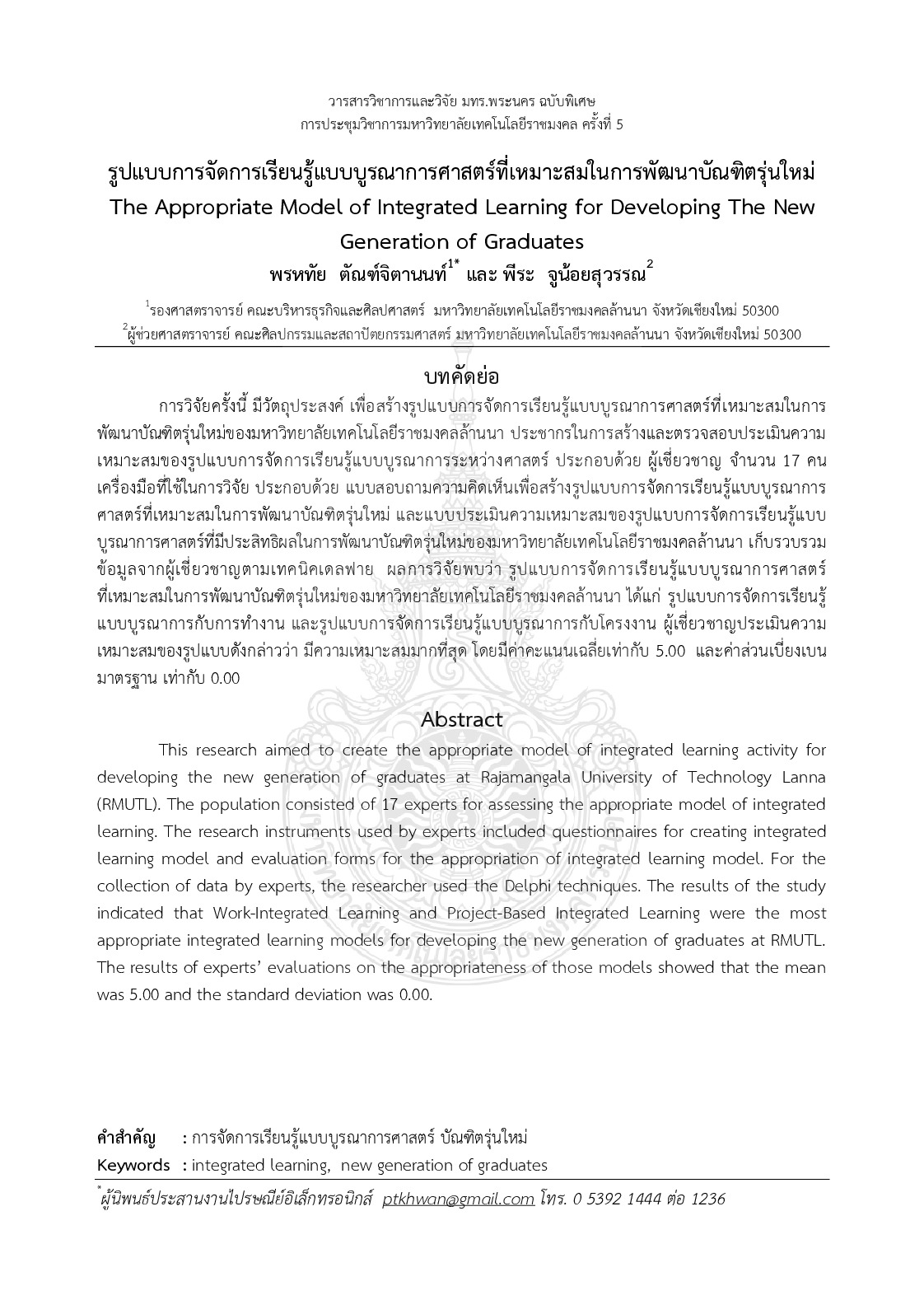
The appropriate model of integrated learning for developing the new generation of graduates
This research aimed to create the appropriate model of integrated learning activity for developing the new generation of graduates at Rajamangala University of Technology Lanna (RMUTL). The population consisted of 17 experts for assessing the appropriate model of integrated learning. The research instruments used by experts included questionnaires for creating integrated learning model and evaluation forms for the appropriation of integrated learning model. For the collection of data by experts the researcher used the Delphi techniques. The results of the study indicated that Work-Integrated Learning and Project-Based Integrated Learning were the most appropriate integrated learning models for developing the new generation of graduates at RMUTL. The results of experts’ evaluations on the appropriateness of those models showed that the mean was 5.00 and the standard deviation was 0.00.
The development of a participatory learning process model for conserving the forest-resources of communities around doi-khun-tan national park
The purposes of this study were: 1) to develop the model of a participatory learning process for conserving the forest-resources of communities around Doi-Khun-Tan National Park 2) to compare knowledge attitudes and behaviors of the samples’ in conserving the forest resources and 3) to study the satisfaction of participatory learning process. The sample selected by a purposive sampling consisted of 48 subjects representing the communities around the area of Doi Khun Tan. The instruments included all these: 1) an interview 2) a participatory learning process program for conserving the forest-resources the area of Doi Khun Tan National Park 3) a questionnaire about the knowledge attitude and behavior of conserving forest resources and 4) a questionnaire about their satisfaction with the program. The data elicitation was drawn from three sources: 1) interviews and brainstorming 2) the assessment of the knowledge attitudes behaviors by the questionnaire and 3) the assessment of the satisfaction with the participatory learning process by the questionnaire. The study revealed these findings: 1) the participatory learning process of model fell into 6 steps consisting of a) the analysis of communities key informants and literature reviews b) the implementation of the knowledge to conserve the forest resources c) the implementation of the attitude towards conserving the forest resources d) the implementation of the behaviors of conserving the forest resources e) the assessment of the participatory learning process and f) the evaluation of satisfaction with the program; 2) the subjects’ knowledge attitudes and behaviors regarding forest conservation at the boundary of Doi Khun Tan before and after the participatory learning process are statistically different at the significance level of .05; and 3) the level of their satisfaction with the participatory learning process was high.