จำนวน Repository ( 1174 )
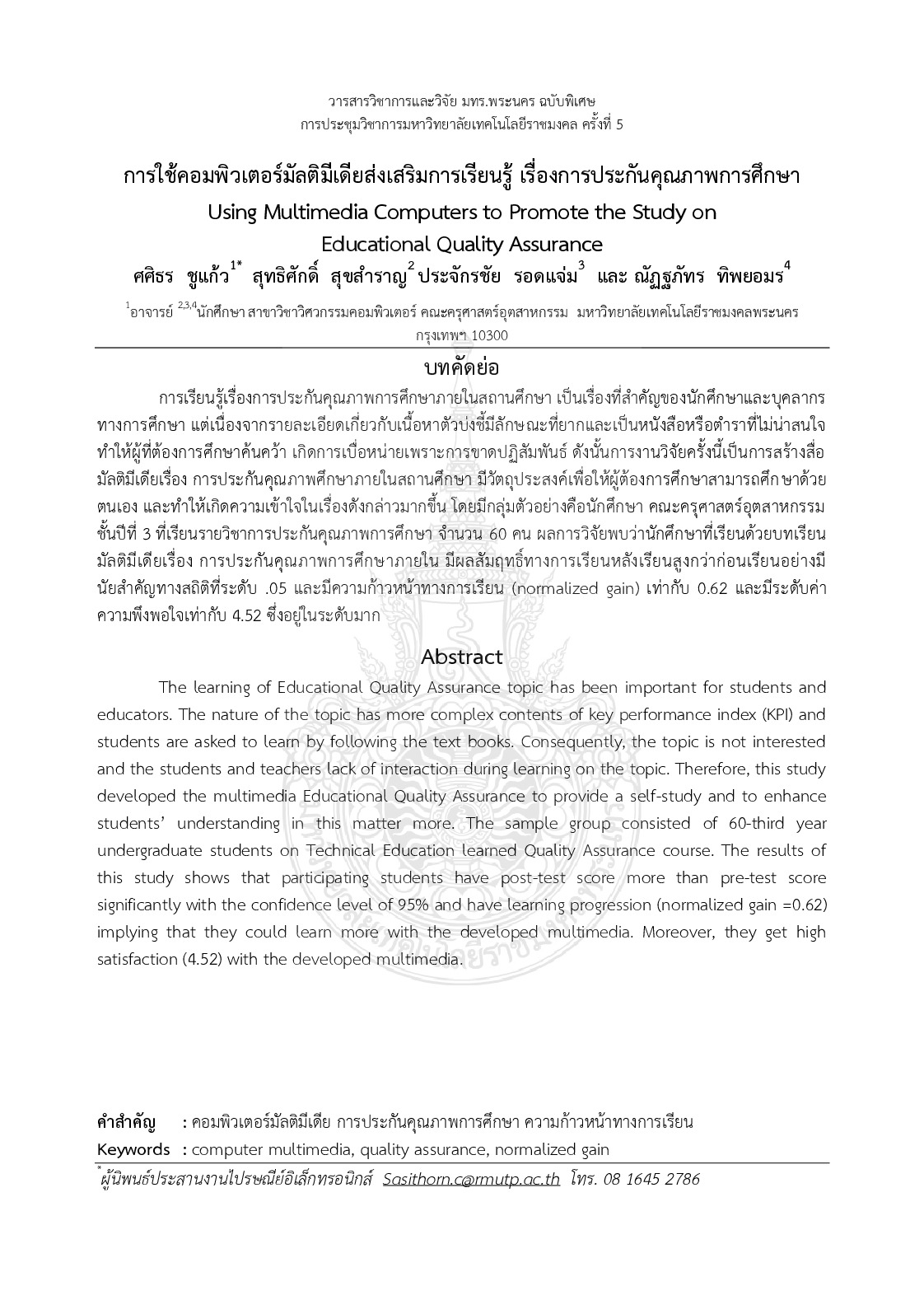
Using multimedia computers to promote the study on educational quality assurance
The learning of Educational Quality Assurance topic has been important for students and educators. The nature of the topic has more complex contents of key performance index (KPI) and students are asked to learn by following the text books. Consequently the topic is not interested and the students and teachers lack of interaction during learning on the topic. Therefore this study developed the multimedia Educational Quality Assurance to provide a self-study and to enhance students’ understanding in this matter more. The sample group consisted of 60-third year undergraduate students on Technical Education learned Quality Assurance course. The results of this study shows that participating students have post-test score more than pre-test score significantly with the confidence level of 95% and have learning progression (normalized gain =0.62) implying that they could learn more with the developed multimedia. Moreover they get high satisfaction (4.52) with the developed multimedia.
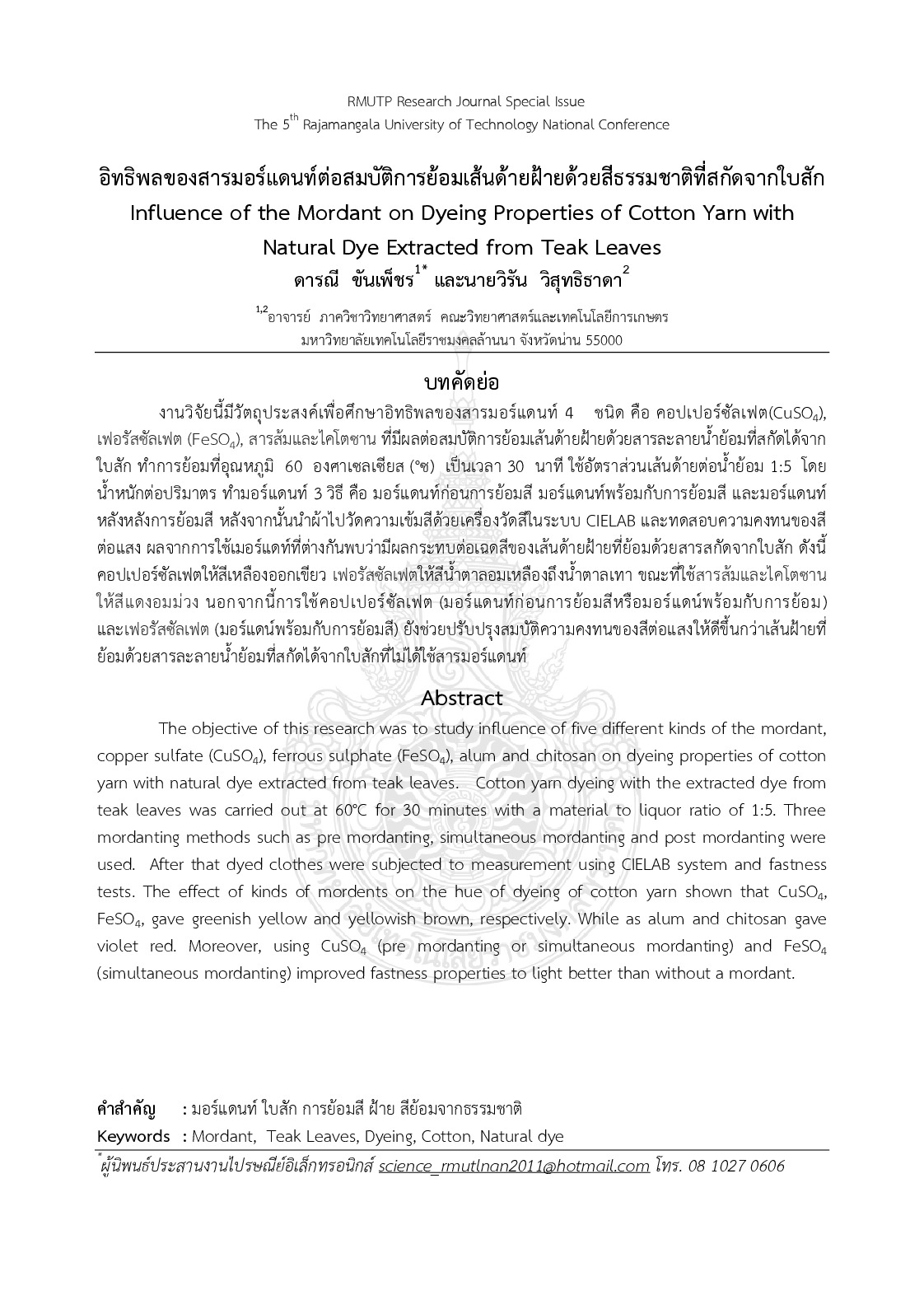
Influence of the mordant on dyeing properties of cotton yarn with natural dye extracted from teak leaves
The objective of this research was to study influence of five different kinds of the mordant copper sulfate (CuSO4) ferrous sulphate (FeSO4) alum and chitosan on dyeing properties of cotton yarn with natural dye extracted from teak leaves. Cotton yarn dyeing with the extracted dye from teak leaves was carried out at 60?C for 30 minutes with a material to liquor ratio of 1:5. Three mordanting methods such as pre mordanting simultaneous mordanting and post mordanting were used. After that dyed clothes were subjected to measurement using CIELAB system and fastness tests. The effect of kinds of mordents on the hue of dyeing of cotton yarn shown that CuSO4 FeSO4 gave greenish yellow and yellowish brown respectively. While as alum and chitosan gave violet red. Moreover using CuSO4 (pre mordanting or simultaneous mordanting) and FeSO4 (simultaneous mordanting) improved fastness properties to light better than without a mordant.
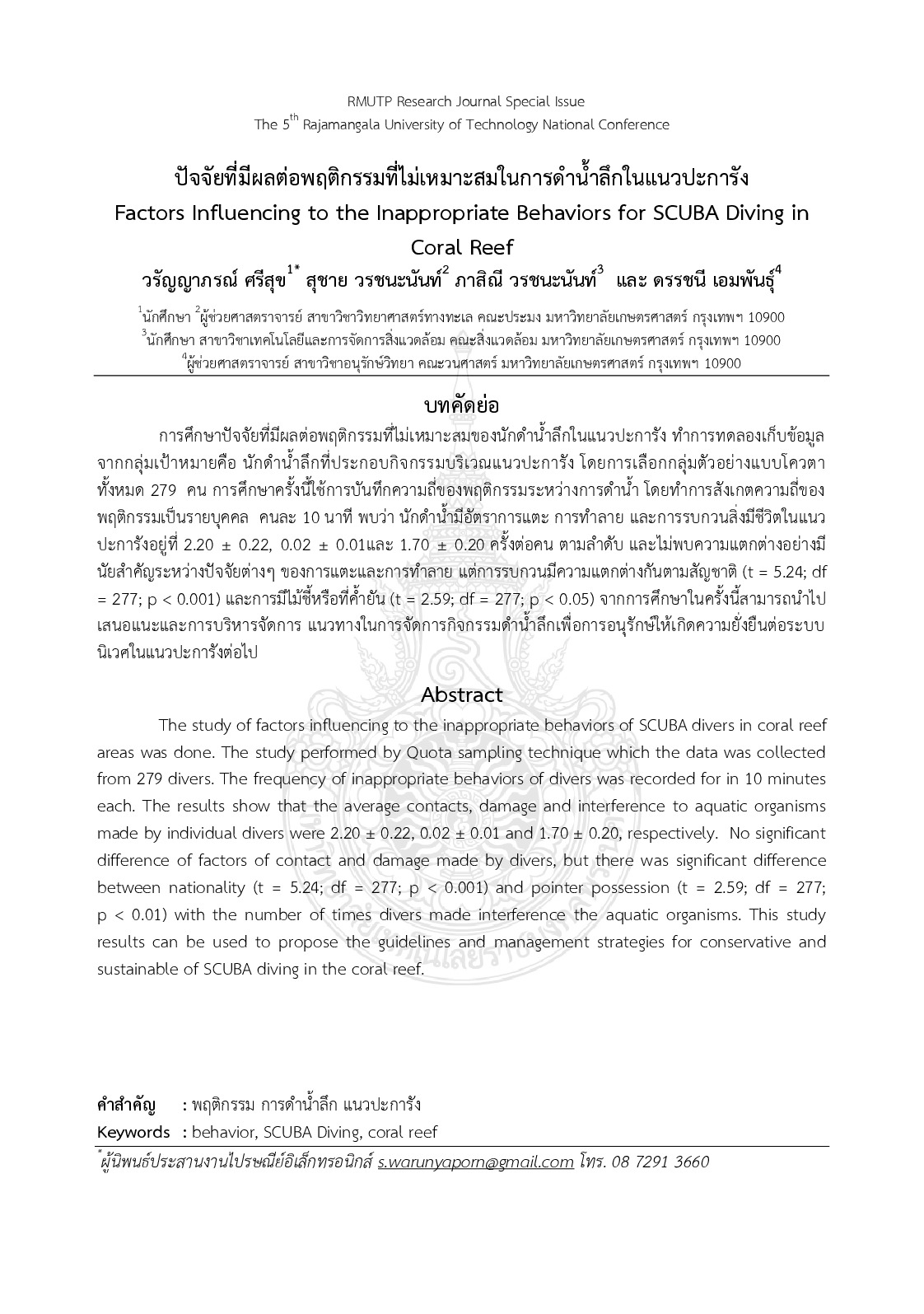
Factors influencing to the inappropriate behaviors for scuba diving in coral reef
The study of factors influencing to the inappropriate behaviors of SCUBA divers in coral reef areas was done. The study performed by Quota sampling technique which the data was collected from 279 divers. The frequency of inappropriate behaviors of divers was recorded for in 10 minutes each. The results show that the average contacts damage and interference to aquatic organisms made by individual divers were 2.20 0.22 0.02 ? 0.01 and 1.70 0.20 respectively. No significant difference of factors of contact and damage made by divers but there was significant difference between nationality (t = 5.24; df = 277; p < 0.001) and pointer possession (t = 2.59; df = 277; p < 0.01) with the number of times divers made interference the aquatic organisms. This study results can be used to propose the guidelines and management strategies for conservative and sustainable of SCUBA diving in the coral reef.
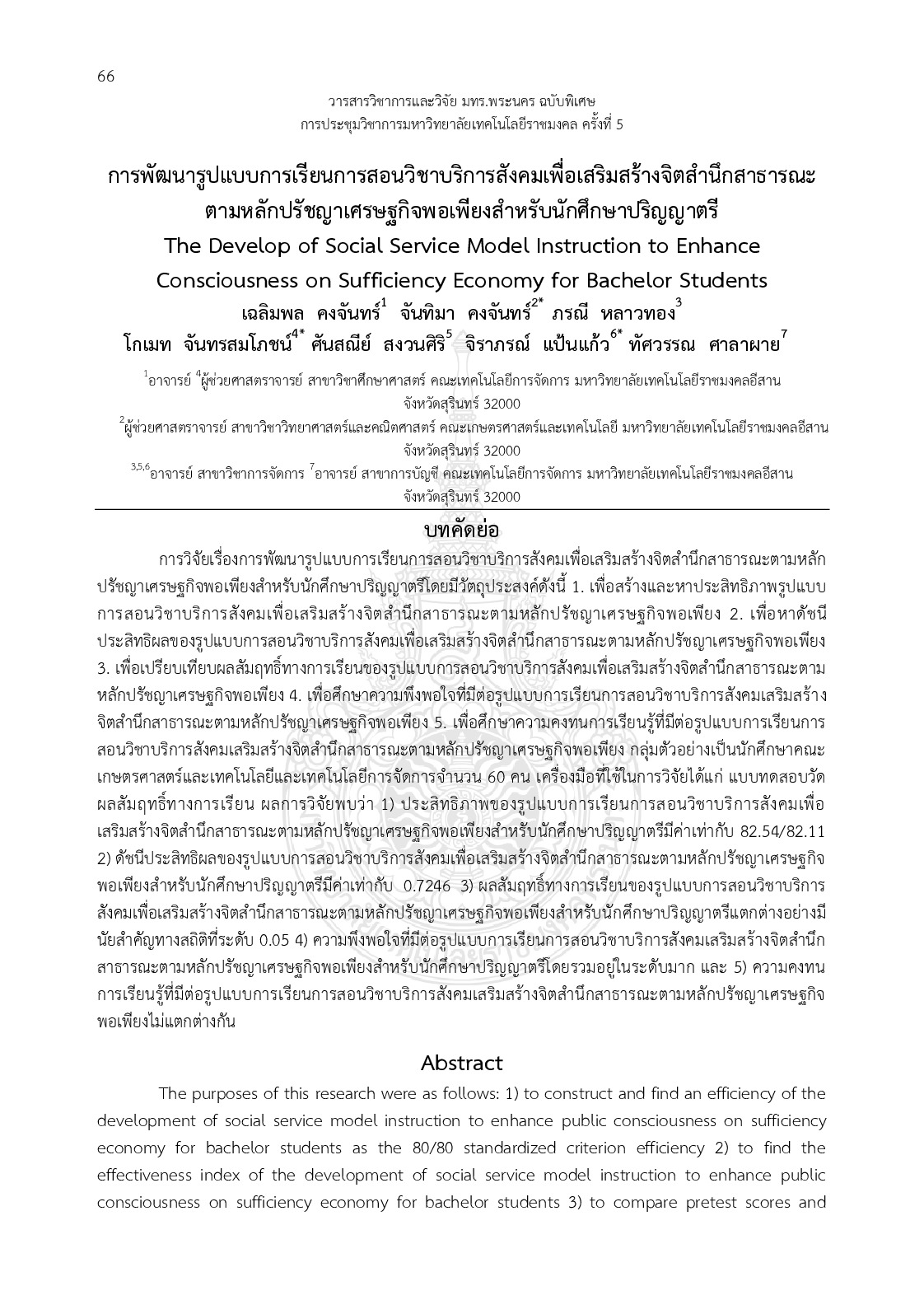
The develop of social service model instruction to enhance consciousness on sufficiency economy for bachelor students
The purposes of this research were as follows: 1) to construct and find an efficiency of the development of social service model instruction to enhance public consciousness on sufficiency economy for bachelor students as the 80/80 standardized criterion efficiency 2) to find the effectiveness index of the development of social service model instruction to enhance public consciousness on sufficiency economy for bachelor students 3) to compare pretest scores and post-test scores all lessons 4) to study the satisfaction of students after they join the class 5) to study the attitude of students after they join the class and 6) to find the retention of students after join the class in two weeks. The sixty students were area on simple random sampling selected from students in Rajamangala Technology University. The results the study was as follows: 1) An efficiency of the development of social service model instruction to enhance public consciousness on sufficiency economy for bachelor students was 82.54/82.11 which higher than the 80/80 standardized criterion efficiency. 2) The efficiency index of the development of social service model instruction to enhance public consciousness on sufficiency economy for bachelor students was 0.7246. 3) The results of the comparisons of pre-test scores and post-test scores all lesson significantly different at 0.05. 4) The results of the satisfaction of the development of social service model instruction to enhance public consciousness on sufficiency economy for bachelor students was found to be a high level. 5) The retention of the teachers after join the class in two was no significantly different.
Sensitivity analysis in efficiency of the solar water heater system self-circulated by a steam power
The sensitivity analysis in efficiency of solar water heater system self-circulated by a stream power was performed in this study. The mathematical model of the system was developed based on the experimental results to predict the available amount of water pumped temperature and pressure in main devices. This system was operated by using a simple flat plate solar collector with an exposed area of 1.58 m2 and a storage tank of 30 liters. The results of systematic performance which performed by math model was compared to the experimental results. It was found that the values of were 5.876% 3.583% and 1.361% for vapor pressure and temperature in the flat plate solar collector and temperature in the storage tank respectively. The system was workable when the solar energy input values were equal to or greater than 584 W/m2 607 W/m2 632 W/m2 and 662 W/m2 for discharge head 1 m 1.5 m 2 m and 2.5 m respectively. From system simulation the system could have the daily average thermal efficiency was between 2.94 – 11.47% and the daily average pump efficiency 0.00057 – 0.0026% depending on the intensity of incident solar radiation and the discharge head of the system.