จำนวน Repository ( 1174 )
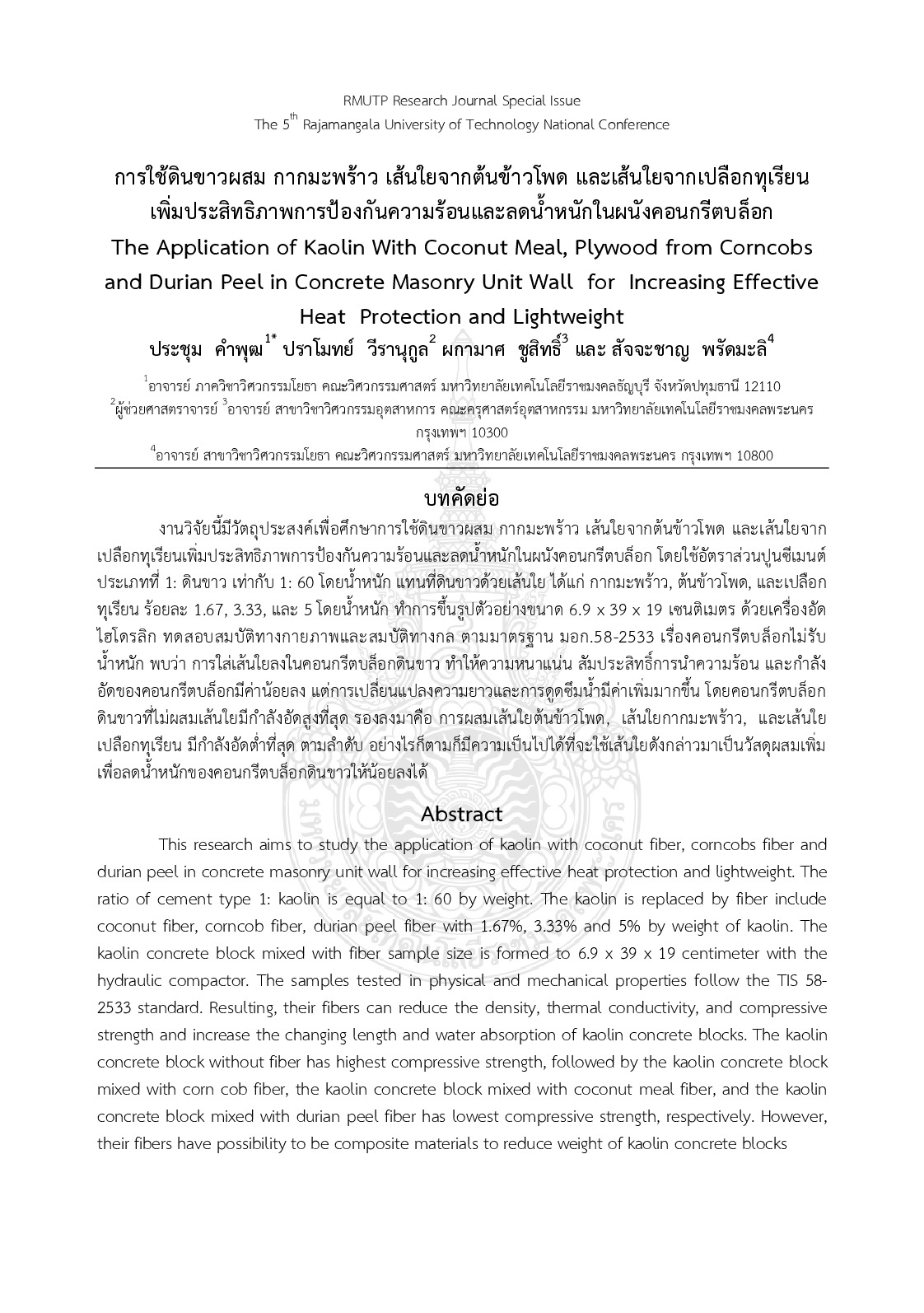
The application of kaolin with coconut meal, plywood from corncobs and durian peel in concrete masonry unit wall for increasing effective heat protection and lightweight
This research aims to study the application of kaolin with coconut fiber corncobs fiber and durian peel in concrete masonry unit wall for increasing effective heat protection and lightweight. The ratio of cement type 1: kaolin is equal to 1: 60 by weight. The kaolin is replaced by fiber include coconut fiber corncob fiber durian peel fiber with 1.67% 3.33% and 5% by weight of kaolin. The kaolin concrete block mixed with fiber sample size is formed to 6.9 x 39 x 19 centimeter with the hydraulic compactor. The samples tested in physical and mechanical properties follow the TIS 58-2533 standard. Resulting their fibers can reduce the density thermal conductivity and compressive strength and increase the changing length and water absorption of kaolin concrete blocks. The kaolin concrete block without fiber has highest compressive strength followed by the kaolin concrete block mixed with corn cob fiber the kaolin concrete block mixed with coconut meal fiber and the kaolin concrete block mixed with durian peel fiber has lowest compressive strength respectively. However their fibers have possibility to be composite materials to reduce weight of kaolin concrete blocks
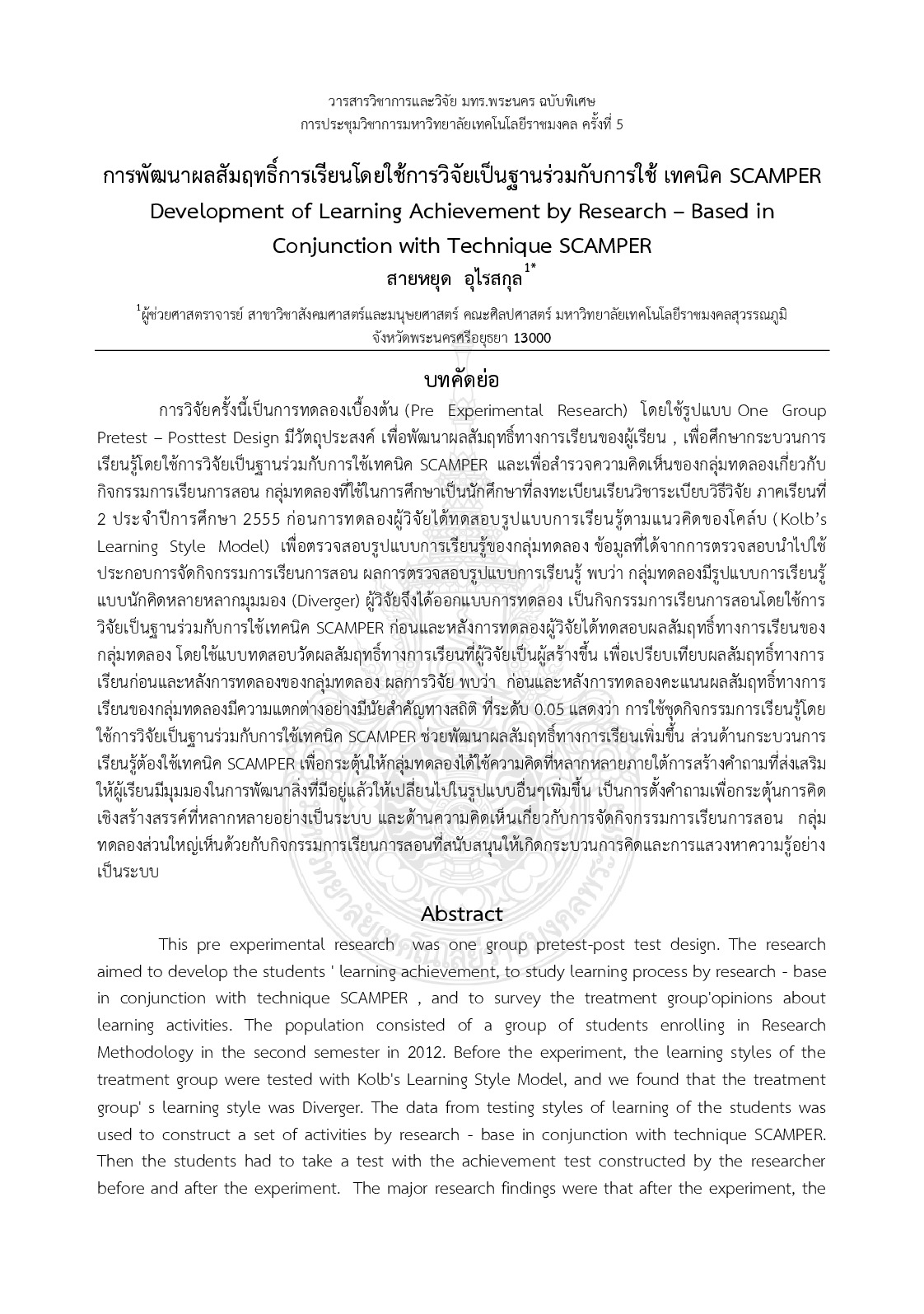
Development of learning achievement by research – based in conjunction with technique SCAMPER
This pre experimental research was one group pretest-post test design. The research aimed to develop the students learning achievement to study learning process by research - base in conjunction with technique SCAMPER and to survey the treatment groupopinions about learning activities. The population consisted of a group of students enrolling in Research Methodology in the second semester in 2012. Before the experiment the learning styles of the treatment group were tested with Kolbs Learning Style Model and we found that the treatment group s learning style was Diverger. The data from testing styles of learning of the students was used to construct a set of activities by research - base in conjunction with technique SCAMPER. Then the students had to take a test with the achievement test constructed by the researcher before and after the experiment. The major research findings were that after the experiment the scores of the treatment group were significantly different at level 0.05 therefore; we concluded that the qualified set of the learning activities by research - base in conjunction with SCAMPER was able to develop the students learning achievement. In the part of learning process the technique SCAMPER was used to promote the students different views and ideas by asking questions which encouraged students to create their thinking systematically. In the students opinions about learning activities most of them strongly agreed with this technique which contributed to the thinking process and the systematic pursuit of knowledge.
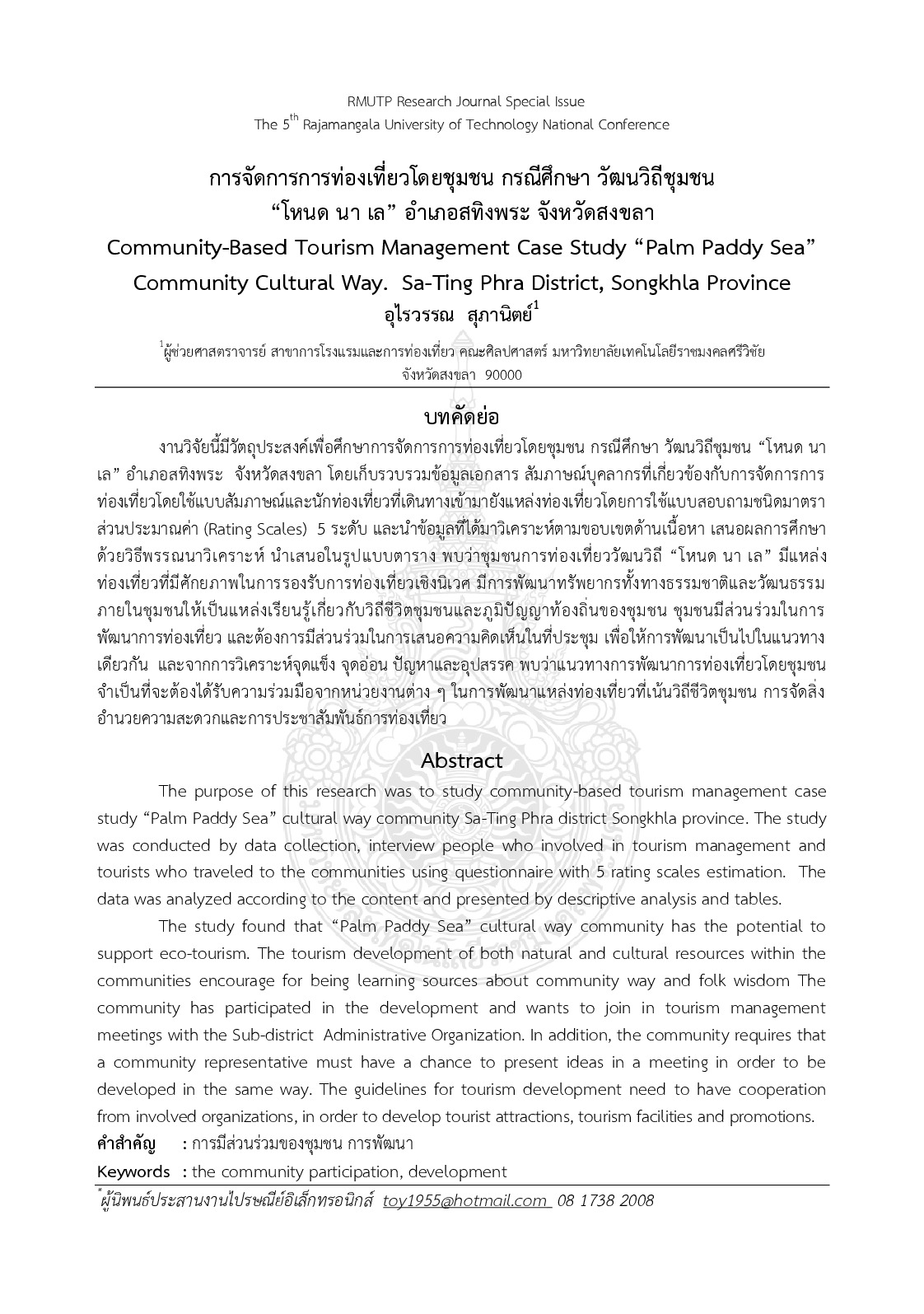
Community-based tourism management case study “palm paddy sea” community cultural way. sa-ting phra district, songkhla province
The purpose of this research was to study community-based tourism management case study “Palm Paddy Sea” cultural way community Sa-Ting Phra district Songkhla province. The study was conducted by data collection interview people who involved in tourism management and tourists who traveled to the communities using questionnaire with 5 rating scales estimation. The data was analyzed according to the content and presented by descriptive analysis and tables. The study found that “Palm Paddy Sea” cultural way community has the potential to support eco-tourism. The tourism development of both natural and cultural resources within the communities encourage for being learning sources about community way and folk wisdom The community has participated in the development and wants to join in tourism management meetings with the Sub-district Administrative Organization. In addition the community requires that a community representative must have a chance to present ideas in a meeting in order to be developed in the same way. The guidelines for tourism development need to have cooperation from involved organizations in order to develop tourist attractions tourism facilities and promotions.
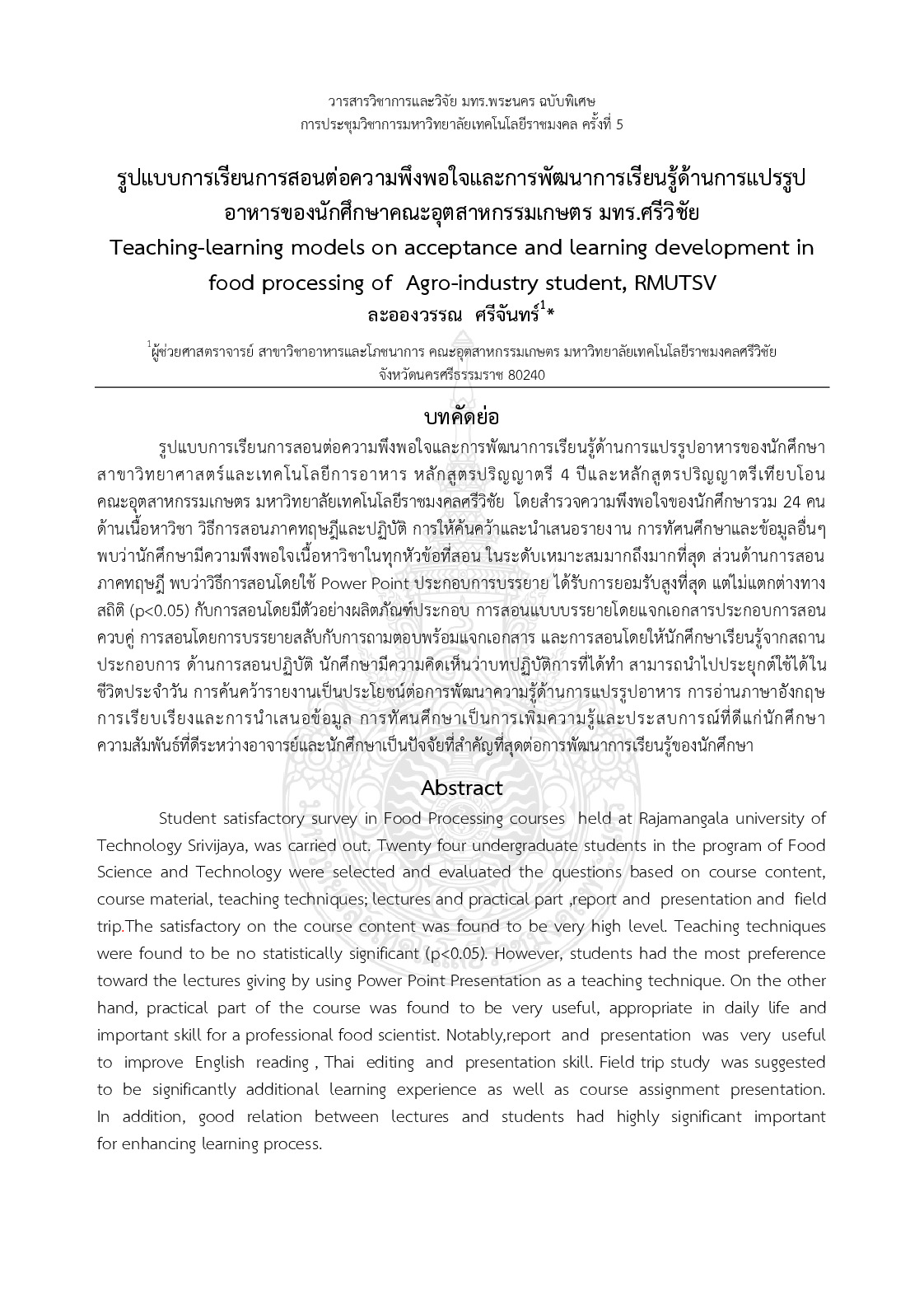
Teaching-learning models on acceptance and learning development in food processing of agro-industry student, RMUTSV
Student satisfactory survey in Food Processing courses held at Rajamangala university of Technology Srivijaya was carried out. Twenty four undergraduate students in the program of Food Science and Technology were selected and evaluated the questions based on course content course material teaching techniques; lectures and practical part report and presentation and field trip.The satisfactory on the course content was found to be very high level. Teaching techniques were found to be no statistically significant (p<0.05). However students had the most preference toward the lectures giving by using Power Point Presentation as a teaching technique. On the other hand practical part of the course was found to be very useful appropriate in daily life and important skill for a professional food scientist. Notablyreport and presentation was very useful to improve English reading Thai editing and presentation skill. Field trip study was suggested to be significantly additional learning experience as well as course assignment presentation. In addition good relation between lectures and students had highly significant important for enhancing learning process.
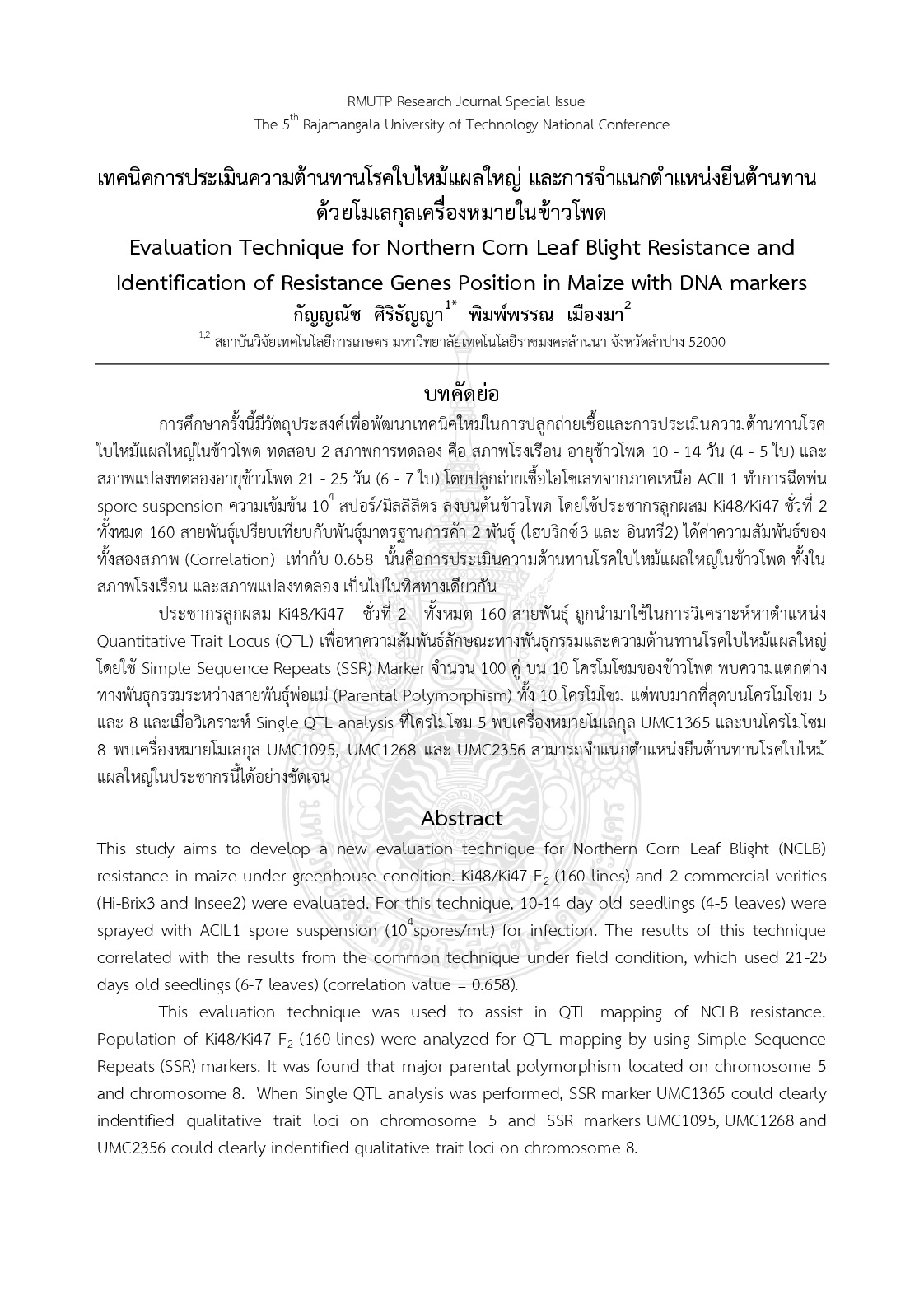
Evaluation technique for northern corn leaf blight resistance and identification of resistance genes position in maize with dna markers
This study aims to develop a new evaluation technique for Northern Corn Leaf Blight (NCLB) resistance in maize under greenhouse condition. Ki48/Ki47 F2 (160 lines) and 2 commercial verities (Hi-Brix3 and Insee2) were evaluated. For this technique 10-14 day old seedlings (4-5 leaves) were sprayed with ACIL1 spore suspension (104spores/ml.) for infection. The results of this technique correlated with the results from the common technique under field condition which used 21-25 days old seedlings (6-7 leaves) (correlation value = 0.658). This evaluation technique was used to assist in QTL mapping of NCLB resistance. Population of Ki48/Ki47 F2 (160 lines) were analyzed for QTL mapping by using Simple Sequence Repeats (SSR) markers. It was found that major parental polymorphism located on chromosome 5 and chromosome 8. When Single QTL analysis was performed SSR marker UMC1365 could clearly indentified qualitative trait loci on chromosome 5 and SSR markers UMC1095 UMC1268 and UMC2356 could clearly indentified qualitative trait loci on chromosome 8.