จำนวน Repository ( 1174 )
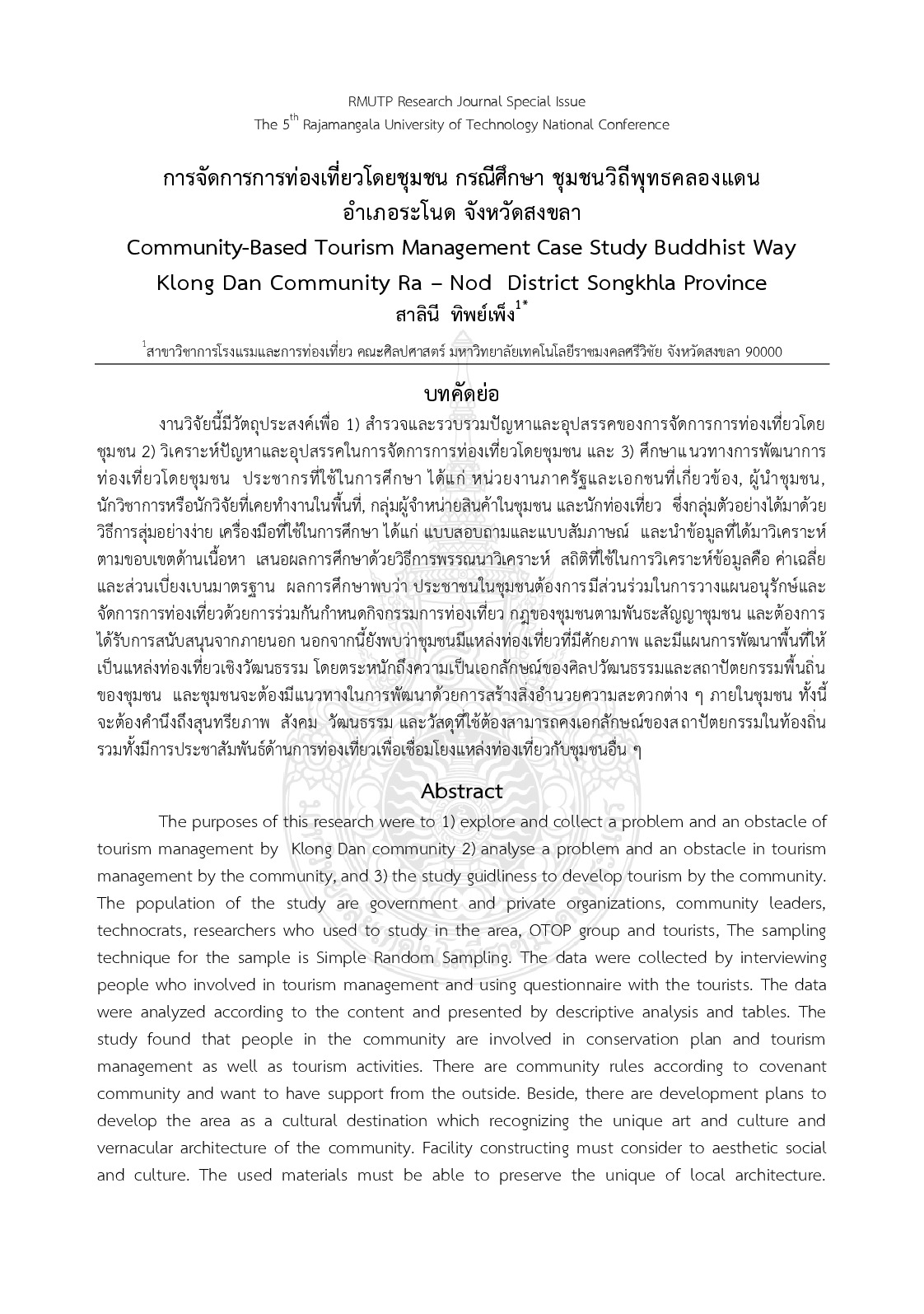
Community-based tourism management case study buddhist way klong dan community ra – nod district songkhla province
The purposes of this research were to 1) explore and collect a problem and an obstacle of tourism management by Klong Dan community 2) analyse a problem and an obstacle in tourism management by the community and 3) the study guidliness to develop tourism by the community. The population of the study are government and private organizations community leaders technocrats researchers who used to study in the area OTOP group and tourists The sampling technique for the sample is Simple Random Sampling. The data were collected by interviewing people who involved in tourism management and using questionnaire with the tourists. The data were analyzed according to the content and presented by descriptive analysis and tables. The study found that people in the community are involved in conservation plan and tourism management as well as tourism activities. There are community rules according to covenant community and want to have support from the outside. Beside there are development plans to develop the area as a cultural destination which recognizing the unique art and culture and vernacular architecture of the community. Facility constructing must consider to aesthetic social and culture. The used materials must be able to preserve the unique of local architecture. Furthermore there must be the promotion of the tourism destination to connect with other communities.
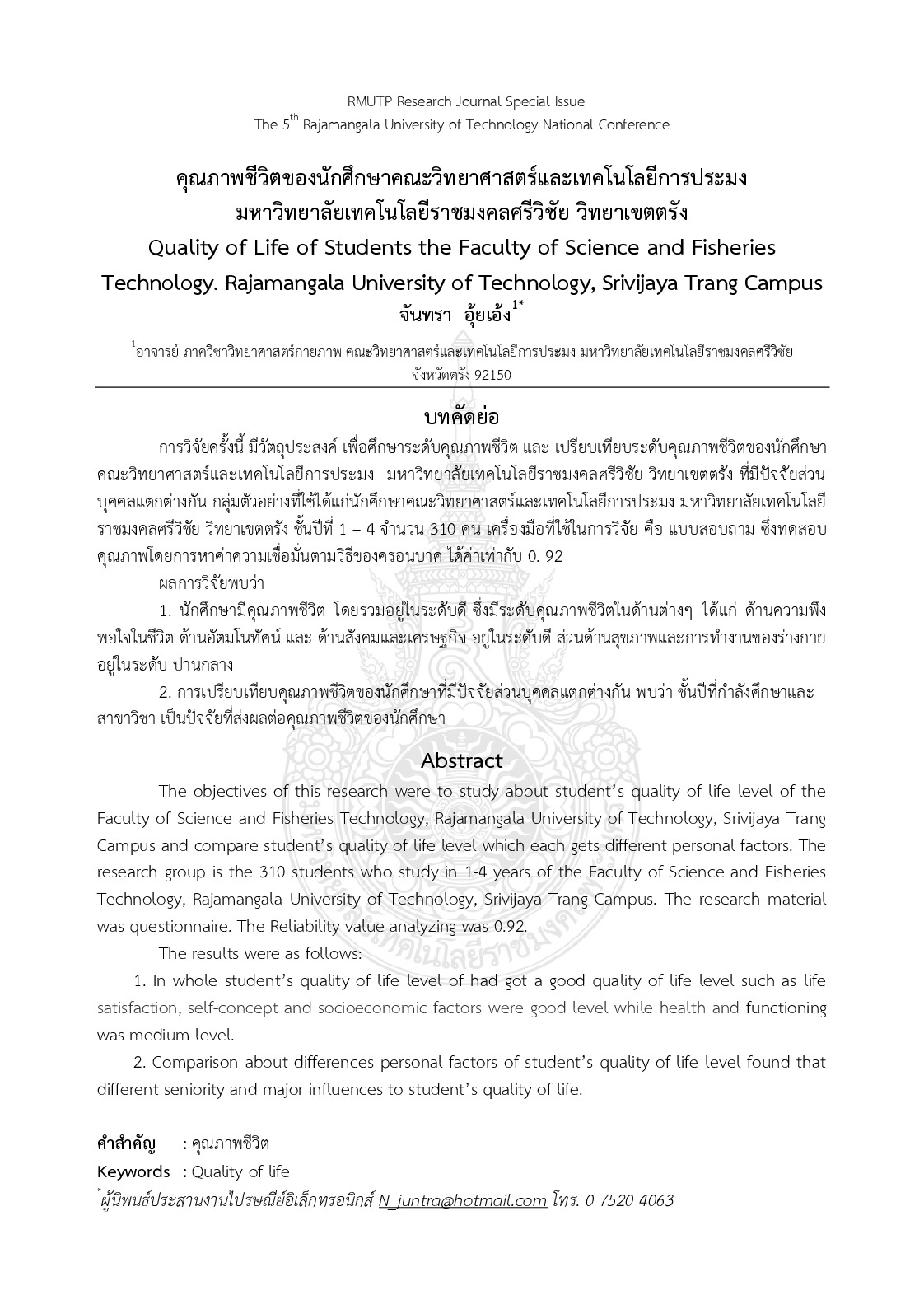
Quality of life of students the faculty of science and fisheries technology. Rajamangala University of Technology, srivijaya trang campus
The objectives of this research were to study about student’s quality of life level of the Faculty of Science and Fisheries Technology Rajamangala University of Technology Srivijaya Trang Campus and compare student’s quality of life level which each gets different personal factors. The research group is the 310 students who study in 1-4 years of the Faculty of Science and Fisheries Technology Rajamangala University of Technology Srivijaya Trang Campus. The research material was questionnaire. The Reliability value analyzing was 0.92. The results were as follows: 1. In whole student’s quality of life level of had got a good quality of life level such as life satisfaction self-concept and socioeconomic factors were good level while health and functioning was medium level. 2. Comparison about differences personal factors of student’s quality of life level found that different seniority and major influences to student’s quality of life.
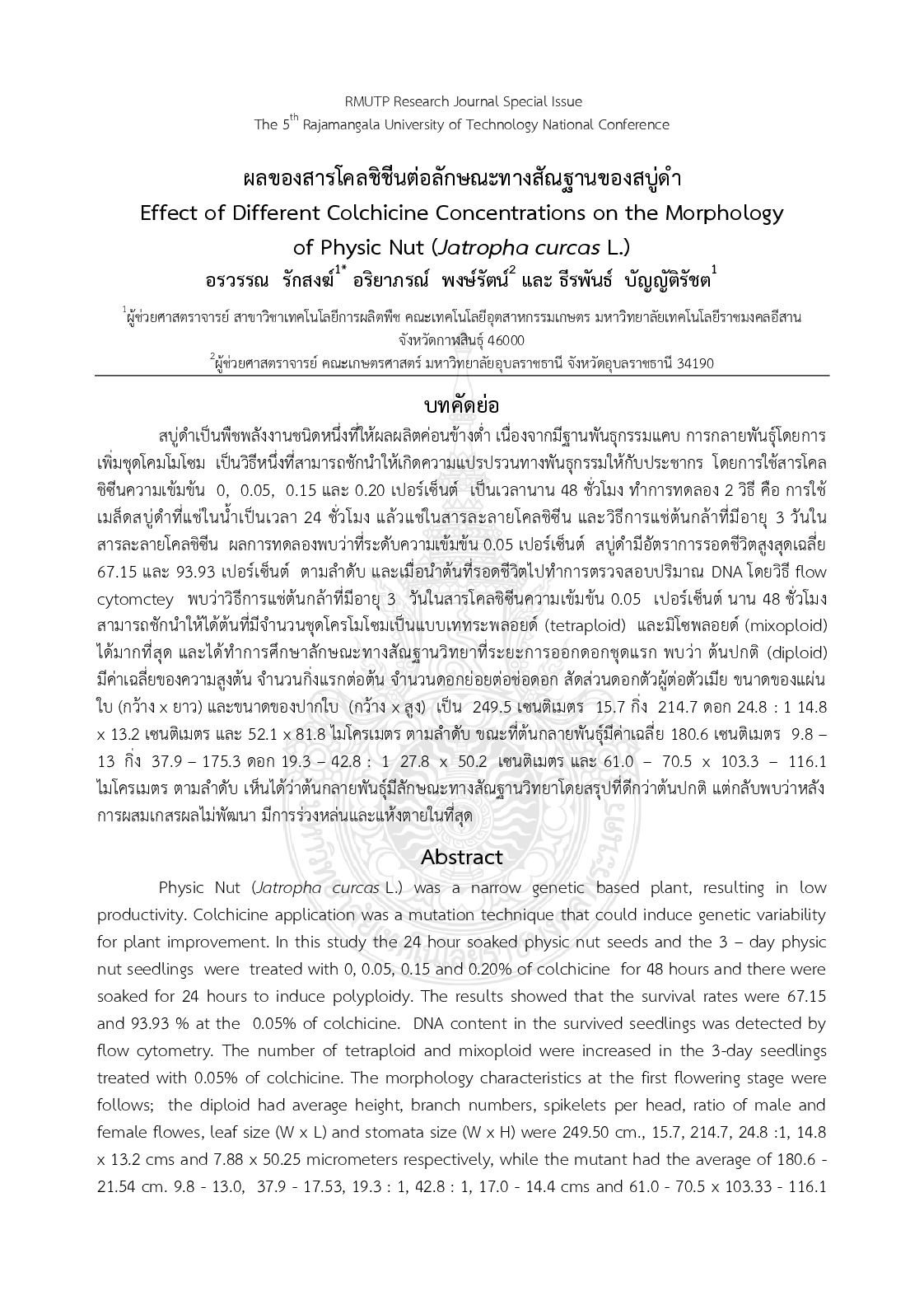
Effect of different colchicine concentrations on the morphology of physic nut (jatropha curcas l.)
Physic Nut (Jatropha curcas L.) was a narrow genetic based plant resulting in low productivity. Colchicine application was a mutation technique that could induce genetic variability for plant improvement. In this study the 24 hour soaked physic nut seeds and the 3 – day physic nut seedlings were treated with 0 0.05 0.15 and 0.20% of colchicine for 48 hours and there were soaked for 24 hours to induce polyploidy. The results showed that the survival rates were 67.15 and 93.93 % at the 0.05% of colchicine. DNA content in the survived seedlings was detected by flow cytometry. The number of tetraploid and mixoploid were increased in the 3-day seedlings treated with 0.05% of colchicine. The morphology characteristics at the first flowering stage were follows; the diploid had average height branch numbers spikelets per head ratio of male and female flowes leaf size (W x L) and stomata size (W x H) were 249.50 cm. 15.7 214.7 24.8 :1 14.8 x 13.2 cms and 7.88 x 50.25 micrometers respectively while the mutant had the average of 180.6 - 21.54 cm. 9.8 - 13.0 37.9 - 17.53 19.3 : 1 42.8 : 1 17.0 - 14.4 cms and 61.0 - 70.5 x 103.33 - 116.1 micrometers respectively. so The mutant had better characteristics but their fruits could not mature.
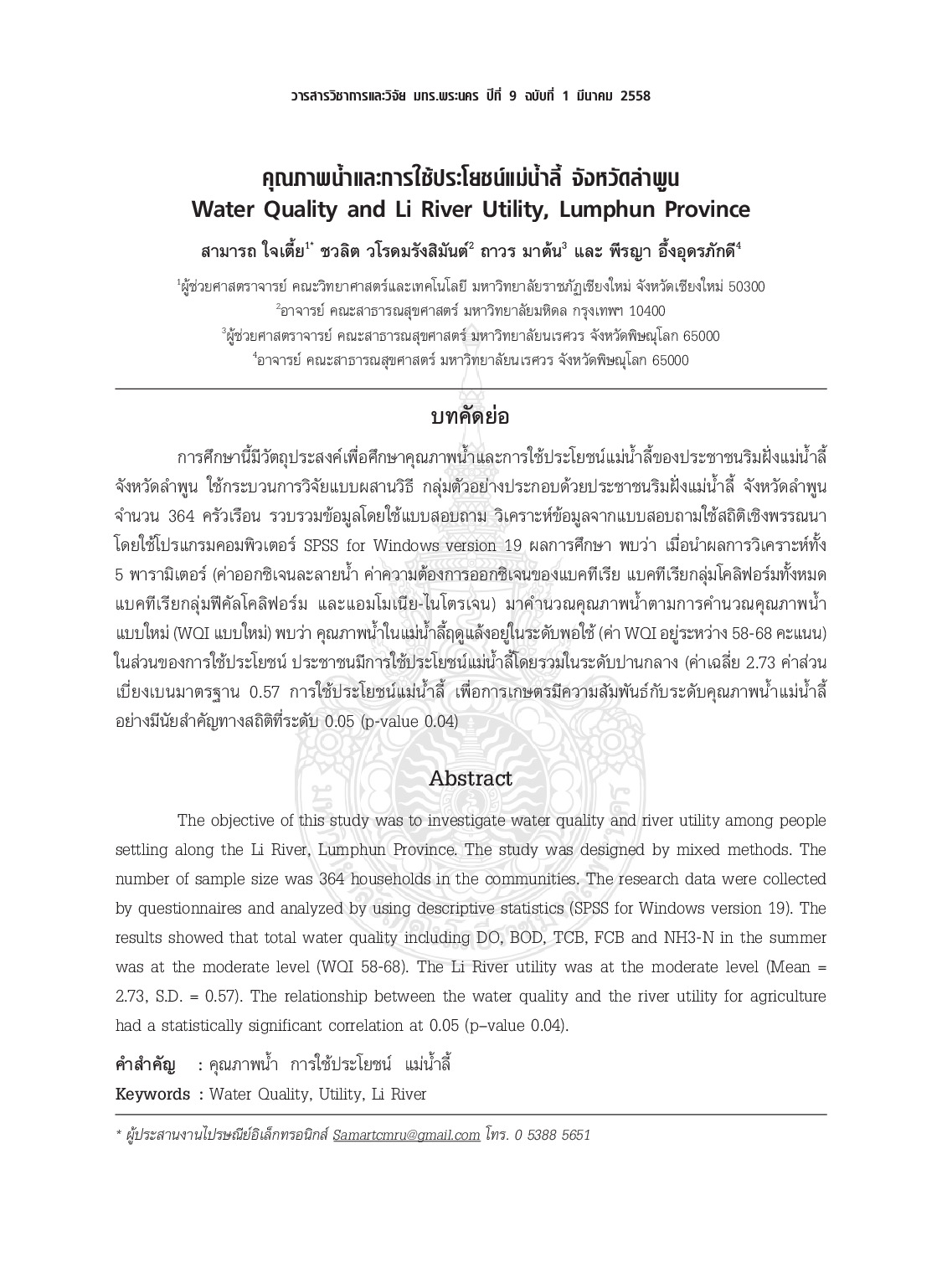
Water quality and li river utility, lumphun province
The objective of this study was to investigate water quality and river utility among people settling along the Li River Lumphun Province. The study was designed by mixed methods. The number of sample size was 364 households in the communities. The research data were collected by questionnaires and analyzed by using descriptive statistics (SPSS for Windows version 19 ).The results showed that total water quality including DO BOD TCB FCB and NH3-N in the summer was at the moderate level (WQI 58 - 68). The Li River utility was at the moderate level (Mean = 2.73 S.D. = 0.57). The relationship between the water quality and the river utility for agriculture had a statistically significant correlation at 0.05 (p –value 0.04).
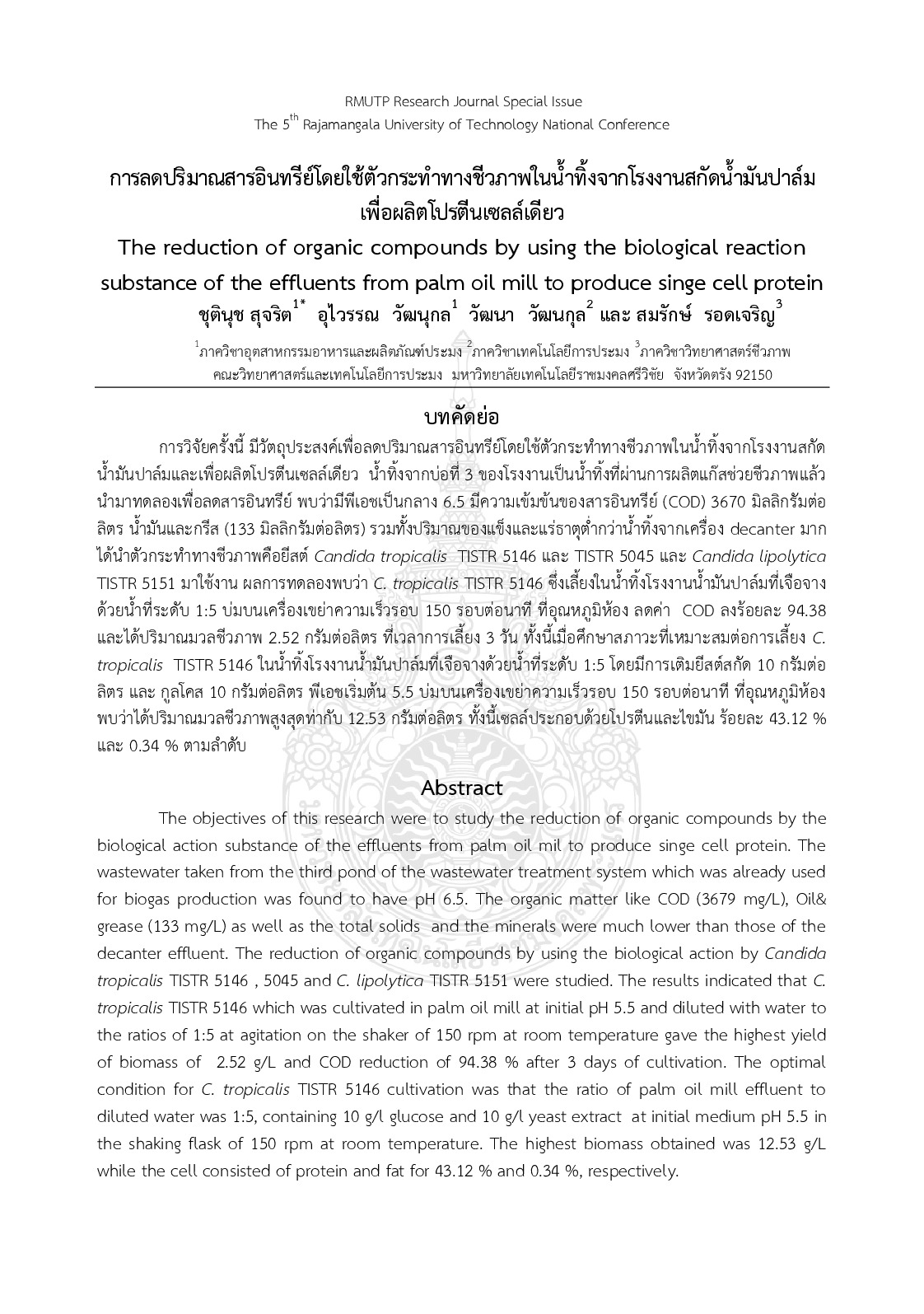
The reduction of organic compounds by using the biological reaction substance of the effluents from palm oil mill to produce singe cell protein
The objectives of this research were to study the reduction of organic compounds by the biological action substance of the effluents from palm oil mil to produce singe cell protein. The wastewater taken from the third pond of the wastewater treatment system which was already used for biogas production was found to have pH 6.5. The organic matter like COD (3679 mg/L) Oil& grease (133 mg/L) as well as the total solids and the minerals were much lower than those of the decanter effluent. The reduction of organic compounds by using the biological action by Candida tropicalis TISTR 5146 5045 and C. lipolytica TISTR 5151 were studied. The results indicated that C. tropicalis TISTR 5146 which was cultivated in palm oil mill at initial pH 5.5 and diluted with water to the ratios of 1:5 at agitation on the shaker of 150 rpm at room temperature gave the highest yield of biomass of 2.52 g/L and COD reduction of 94.38 % after 3 days of cultivation. The optimal condition for C. tropicalis TISTR 5146 cultivation was that the ratio of palm oil mill effluent to diluted water was 1:5 containing 10 g/l glucose and 10 g/l yeast extract at initial medium pH 5.5 in the shaking flask of 150 rpm at room temperature. The highest biomass obtained was 12.53 g/L while the cell consisted of protein and fat for 43.12 % and 0.34 % respectively.