จำนวน Repository ( 119 )

The product of ceiling plate-Bar from base bark of physic-nut by phenol-cyanate
The objective of this research is to produce the T-Bar. The mixed Gule Phenol-cyanate to made ceiling Plate-Bar plate from the agriculture process’s waste. The researcher brought physic nut plant to produce T- BAR plate for interior building. It was tested based on Thailand industrial standard (TIS 876-2547) for determination of moisture content density absorption and expansion when soak in water as well a cohesion and perpendicular surface tension flexural resistance and modulus of elasticity . at The results show that suitable size material should not thicker than 2 centimeters. The experiment of ratio between physic nut plant and phenol cyanide resin at 90:10 and 92:8. It was found that suitable proportion of physic nut pant and phenol cyanide resin was 92:8. The temperature used for compression was 120o C. The appropriate density prior to the compression plate was 0.80 g/cm.3 The average moisture content of materials before compression was 8.88%. The suitable compression was 151 lb/in?. The moisture content of the product was 7.64% The density was 0.818 g/cm.3 The expansion value after soaking in water for 2 hours was 8.02% and water absorption was 14.22%. Inner bond was 0.55 MPa. Flexibility was 22.44 MPa. and mordulus was 2112MPa.The result of testing complied with the Thailand Industrial Standard (TIS 876-2547).It was concluded that physic nut plant can be used as raw material to make T- Bar plate for interior building
Method for working-life enhancement of epoxy-based adhesive
For one-part adhesive systems a long working-life adhesive which can be cured rapidly at processing temperature is required in industrial applications because it provides assembly process versatility. The aim of this research was to study the methods for extending the working-life of an epoxy-based adhesive with anhydride curing agent. This adhesive formulation is used as an underfill material in electronic industry. The scope of this study was divided into two parts: 1) modification of adhesive formulation process 2) determination of the component in adhesive which causes the adhesive viscosity increased at ambient temperature. The results showed that the adhesive working-life extended from 2 hours to 6 hours with reducing formulation process time removing the moisture in filler and reducing fluxing precursor loading in adhesive. In addition the fluxing precursor loading also affects the thermo-mechanical properties of adhesive. For characterization the working-life and thermo-mechanical properties of this formulation were investigated using rheological technique and dynamic mechanical analysis (DMA) respectively.
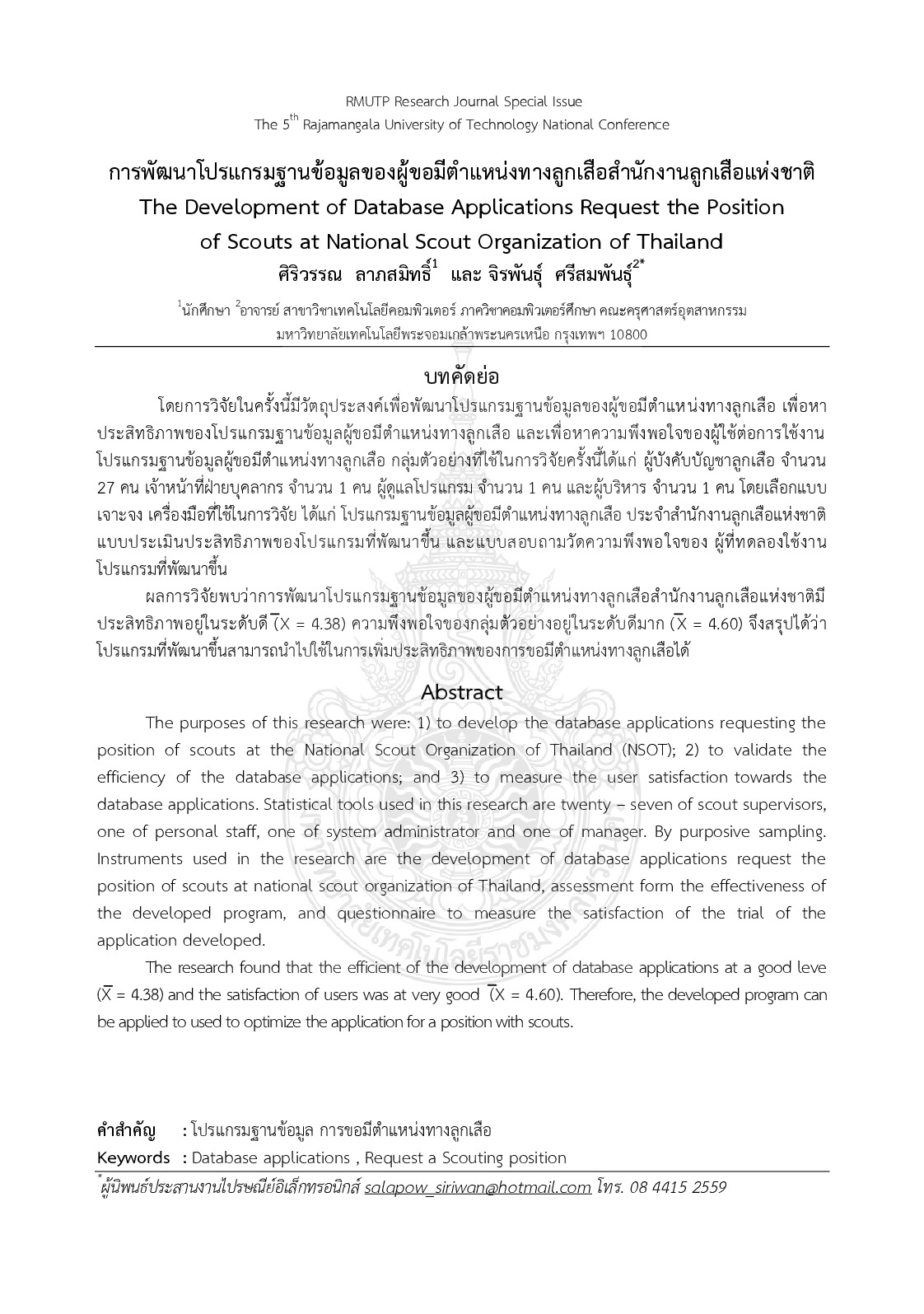
The development of database applications request the position of scouts at national scout organization of thailand
The purposes of this research were: 1) to develop the database applications requesting the position of scouts at the National Scout Organization of Thailand (NSOT); 2) to validate the efficiency of the database applications; and 3) to measure the user satisfaction towards the database applications. Statistical tools used in this research are twenty – seven of scout supervisors one of personal staff one of system administrator and one of manager. By purposive sampling. Instruments used in the research are the development of database applications request the position of scouts at national scout organization of Thailand assessment form the effectiveness of the developed program and questionnaire to measure the satisfaction of the trial of the application developed. The research found that the efficient of the development of database applications at a good leve (X = 4.38) and the satisfaction of users was at very good (X = 4.60). Therefore the developed program can be applied to used to optimize the application for a position with scouts.
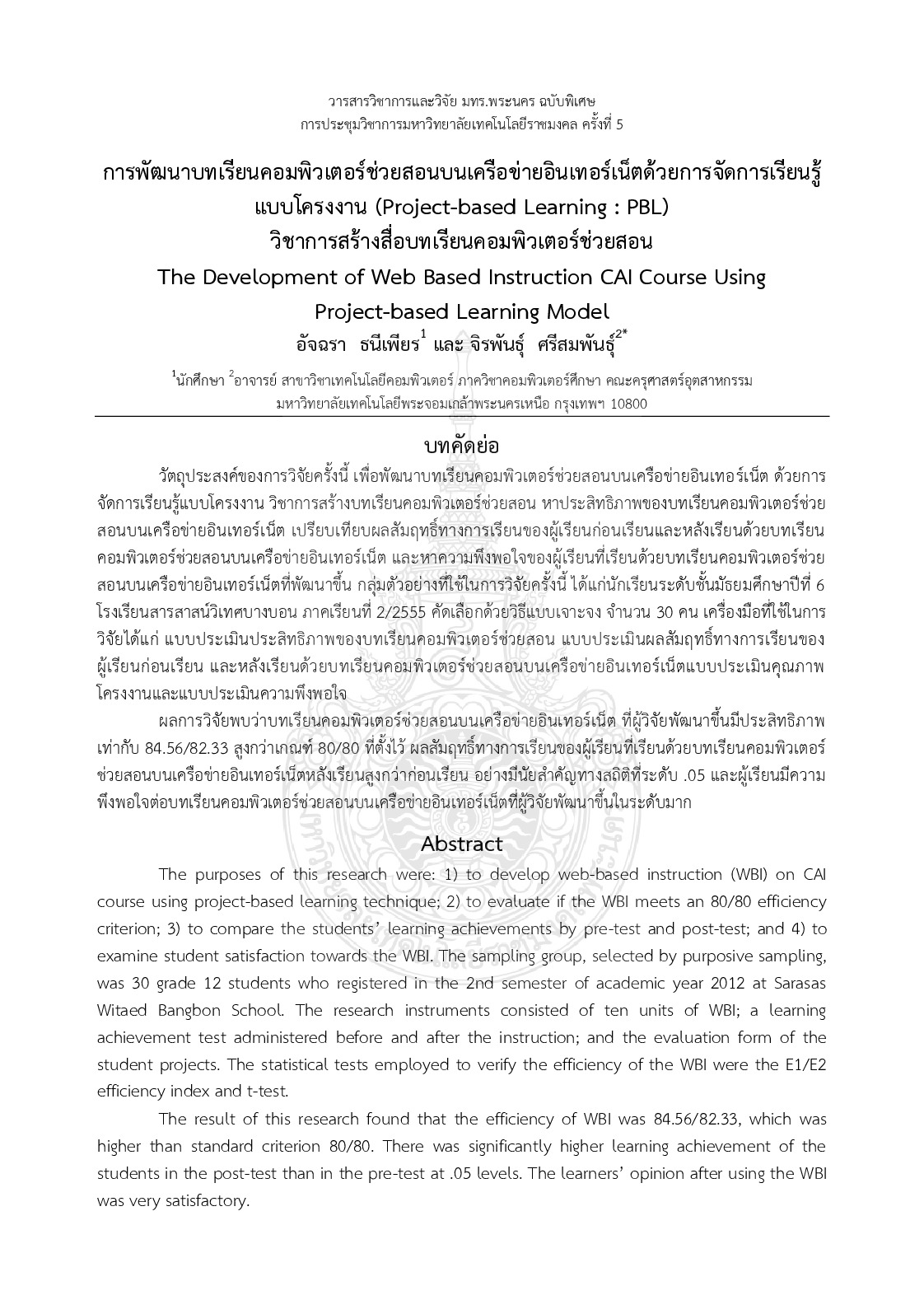
The development of web based instruction CAI course using project-based learning model
The purposes of this research were: 1) to develop web-based instruction (WBI) on CAI course using project-based learning technique; 2) to evaluate if the WBI meets an 80/80 efficiency criterion; 3) to compare the students’ learning achievements by pre-test and post-test; and 4) to examine student satisfaction towards the WBI. The sampling group selected by purposive sampling was 30 grade 12 students who registered in the 2nd semester of academic year 2012 at Sarasas Witaed Bangbon School. The research instruments consisted of ten units of WBI; a learning achievement test administered before and after the instruction; and the evaluation form of the student projects. The statistical tests employed to verify the efficiency of the WBI were the E1/E2 efficiency index and t-test. The result of this research found that the efficiency of WBI was 84.56/82.33 which was higher than standard criterion 80/80. There was significantly higher learning achievement of the students in the post-test than in the pre-test at .05 levels. The learners’ opinion after using the WBI was very satisfactory.
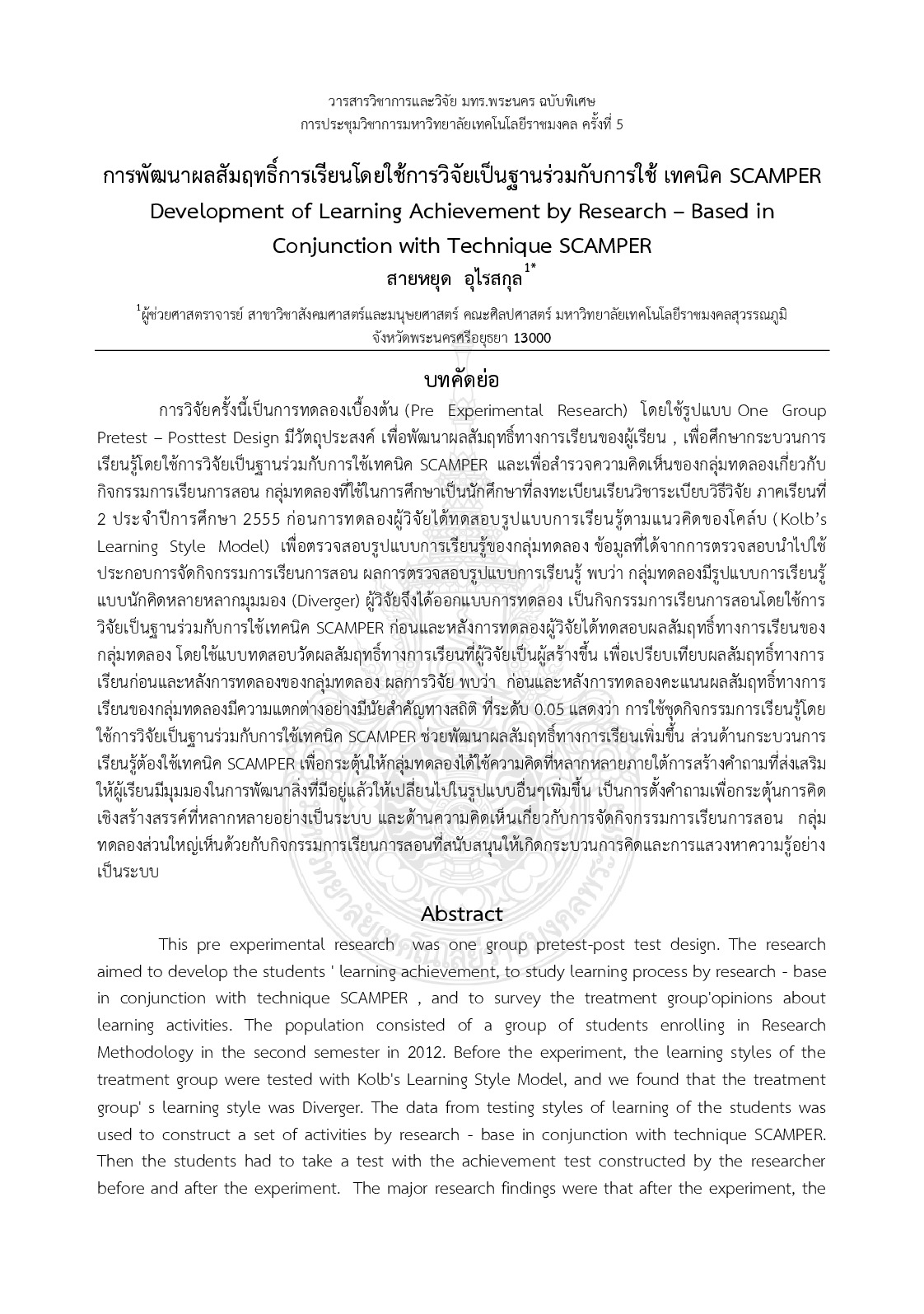
Development of learning achievement by research – based in conjunction with technique SCAMPER
This pre experimental research was one group pretest-post test design. The research aimed to develop the students learning achievement to study learning process by research - base in conjunction with technique SCAMPER and to survey the treatment groupopinions about learning activities. The population consisted of a group of students enrolling in Research Methodology in the second semester in 2012. Before the experiment the learning styles of the treatment group were tested with Kolbs Learning Style Model and we found that the treatment group s learning style was Diverger. The data from testing styles of learning of the students was used to construct a set of activities by research - base in conjunction with technique SCAMPER. Then the students had to take a test with the achievement test constructed by the researcher before and after the experiment. The major research findings were that after the experiment the scores of the treatment group were significantly different at level 0.05 therefore; we concluded that the qualified set of the learning activities by research - base in conjunction with SCAMPER was able to develop the students learning achievement. In the part of learning process the technique SCAMPER was used to promote the students different views and ideas by asking questions which encouraged students to create their thinking systematically. In the students opinions about learning activities most of them strongly agreed with this technique which contributed to the thinking process and the systematic pursuit of knowledge.