จำนวน Repository ( 97 )

Factors Correlates of Electric Energy Saving Behavior of Students in Rajamangala University of Technology
This research aims to study factors relating to and influencing students’ behavior of electricity Saving. The samples are students of Rajamangala University of Technology in 2007 academic year. Based on quota sampling 100 students from each of 9 universities at a total of 900 are selected. The tools used in this research include questionnaires and with rating scales. The variables are divided into 5 group : 1) Psychological traits variables; 2) situational variables; 3) psychological situtional variables; 4) electricity saving behavior variables; and 5) the general qualifications of students including sexes educational levels location GPA family income the number of family members educational level of father and educational level of mother all of which are the sub-variables in analyzing data. The data was collected during January and May 2007. Then it was analyzed by a ready-to-use program with statistecs percentage t-test Person’s Product Moment Correlation Coefficient and Multiple Regression Analysis of Enter Stepwise and Hierarchical.
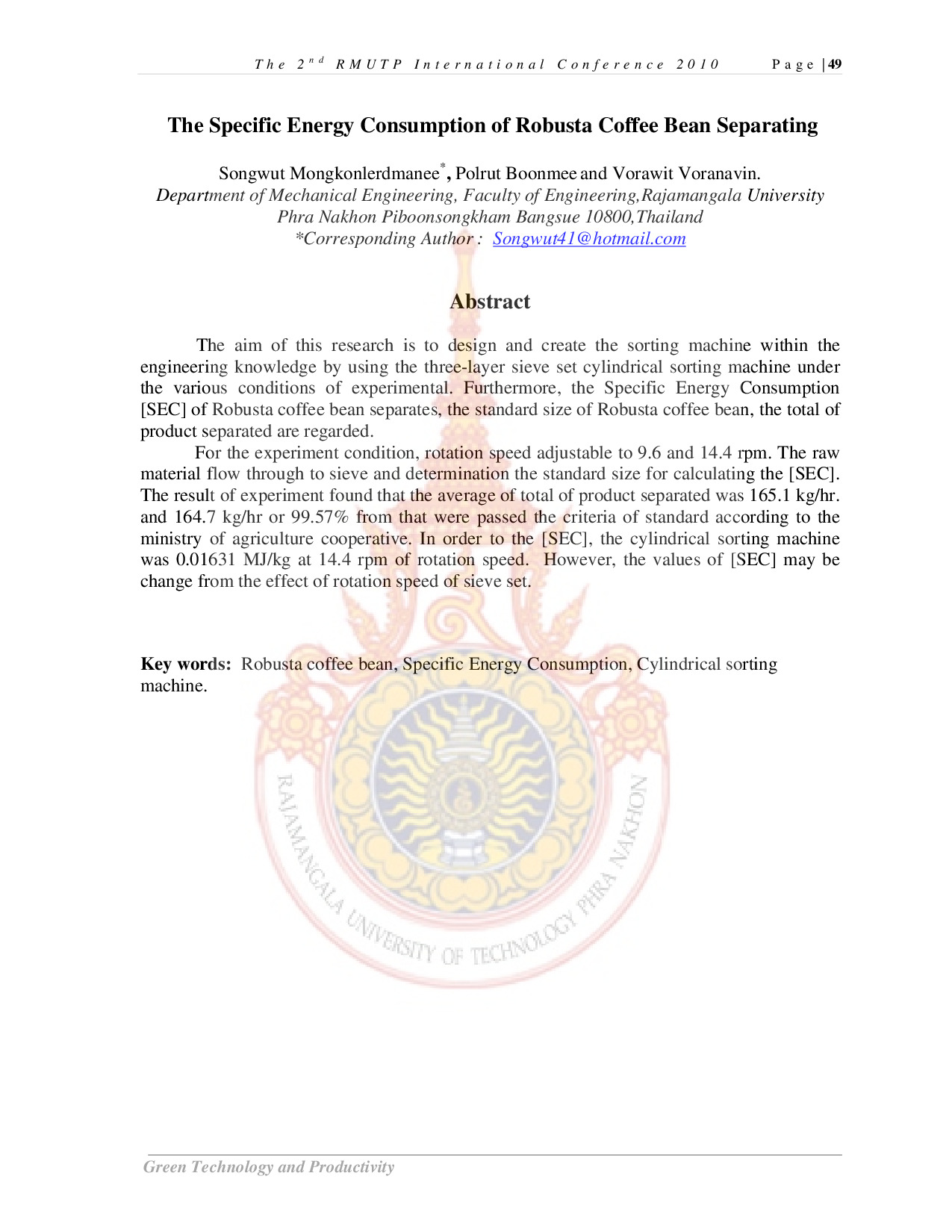
The Specific Energy Consumption of Robusta Coffee Bean Separating
The aim of this research is to design and create the sorting machine within the engineering knowledge by using the three-layer sieve set cylindrical sorting machine under the various conditions of experimental. Furthermore the Specific Energy Consumption [SEC] of Robusta coffee bean separates the standard size of Robusta coffee bean the total of product separated are regarded. For the experiment condition rotation speed adjustable to 9.6 and 14.4 rpm. The raw material flow through to sieve and determination the standard size for calculating the [SEC]. The result of experiment found that the average of total of product separated was 165.1 kg/hr. and 164.7 kg/hr or 99.57% from that were passed the criteria of standard according to the ministry of agriculture cooperative. In order to the [SEC] the cylindrical sorting machine was 0.01631 MJ/kg at 14.4 rpm of rotation speed. However the values of [SEC] may be change from the effect of rotation speed of sieve set.
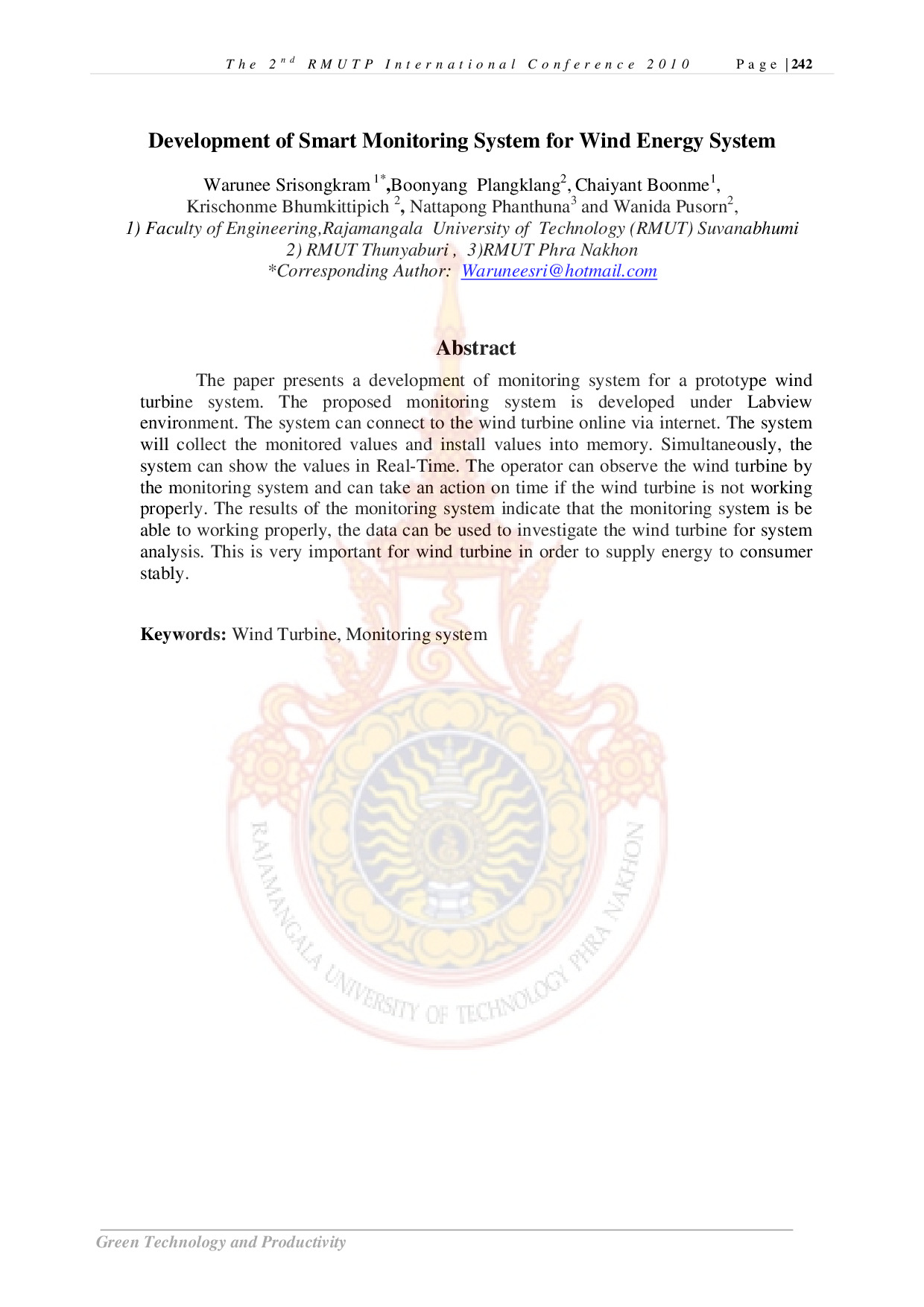
Development of Smart Monitoring System for Wind Energy System
The paper presents a development of monitoring system for a prototype wind turbine system. The proposed monitoring system is developed under Labview environment. The system can connect to the wind turbine online via internet. The system will collect the monitored values and install values into memory. Simultaneously the system can show the values in Real-Time. The operator can observe the wind turbine by the monitoring system and can take an action on time if the wind turbine is not working properly. The results of the monitoring system indicate that the monitoring system is be able to working properly the data can be used to investigate the wind turbine for system analysis. This is very important for wind turbine in order to supply energy to consumer stably.
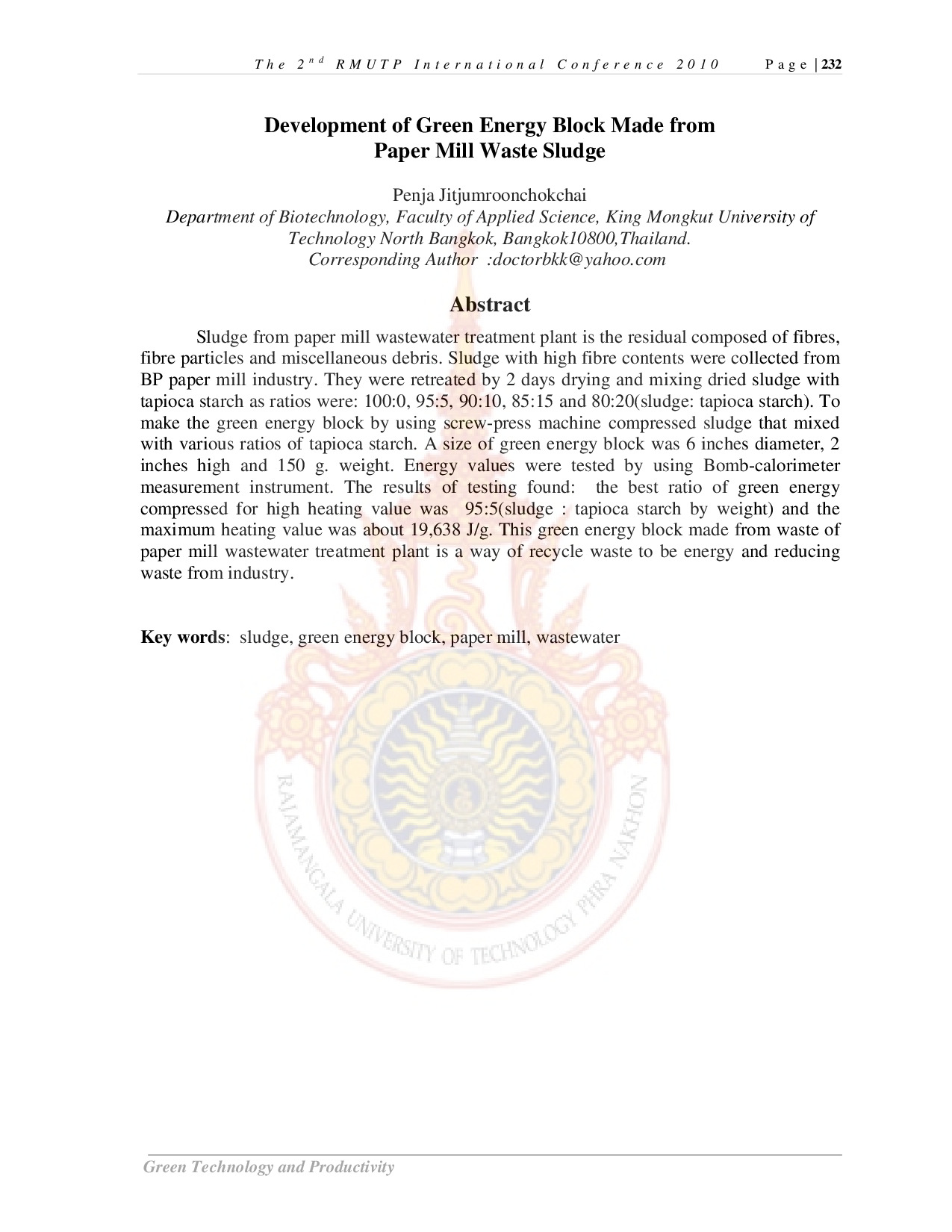
Development of Green Energy Block Made from Paper Mill Waste Sludge
Sludge from paper mill wastewater treatment plant is the residual composed of fibres fibre particles and miscellaneous debris. Sludge with high fibre contents were collected from BP paper mill industry. They were retreated by 2 days drying and mixing dried sludge with tapioca starch as ratios were: 100:0 95:5 90:10 85:15 and 80:20(sludge: tapioca starch). To make the green energy block by using screw-press machine compressed sludge that mixed with various ratios of tapioca starch. A size of green energy block was 6 inches diameter 2 inches high and 150 g. weight. Energy values were tested by using Bomb-calorimeter measurement instrument. The results of testing found: the best ratio of green energy compressed for high heating value was 95:5(sludge : tapioca starch by weight) and the maximum heating value was about 19638 J/g. This green energy block made from waste of paper mill wastewater treatment plant is a way of recycle waste to be energy and reducing waste from industry.
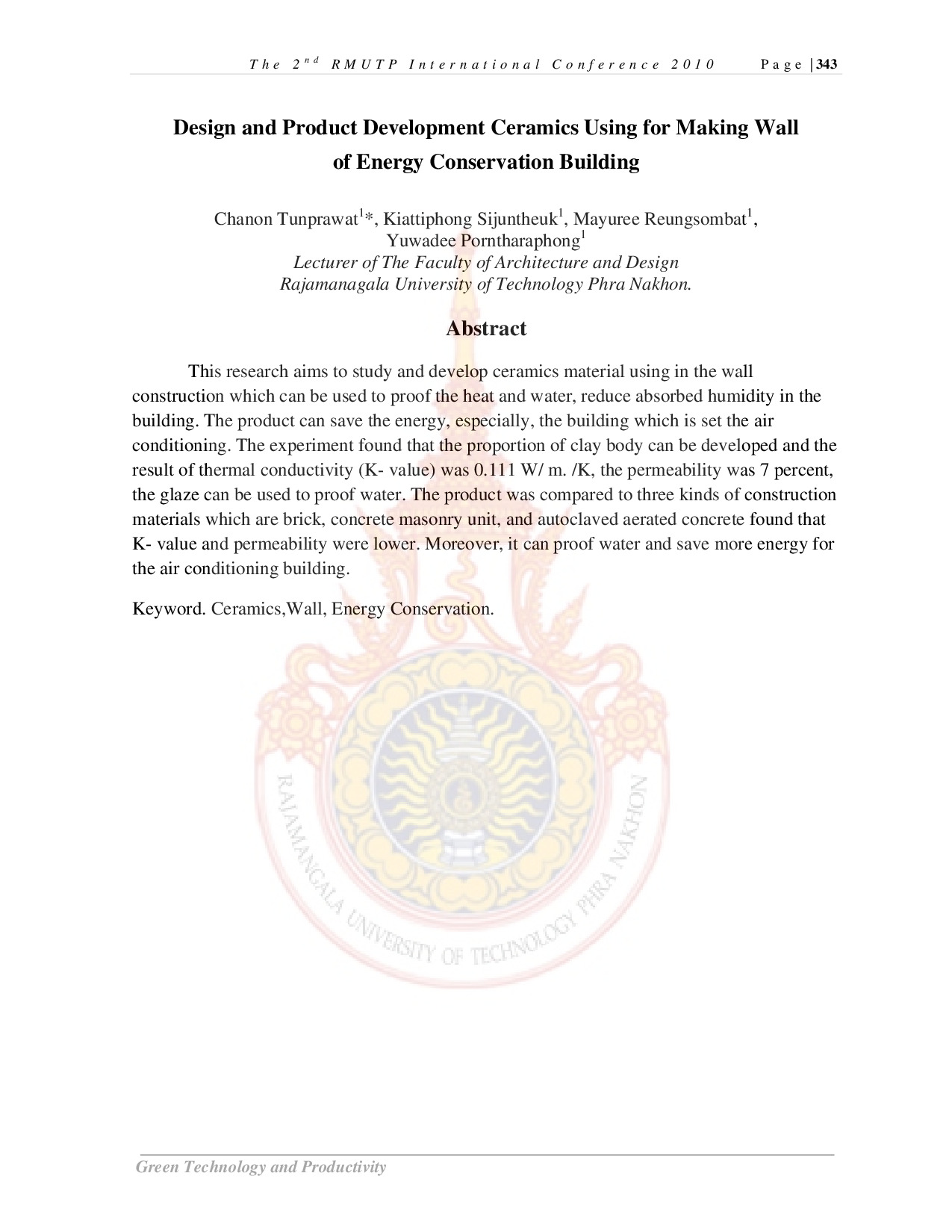
Design and Product Development Ceramics Using for Making Wall of Energy Conservation Building
This research aims to study and develop ceramics material using in the wall construction which can be used to proof the heat and water reduce absorbed humidity in the building. The product can save the energy especially the building which is set the air conditioning. The experiment found that the proportion of clay body can be developed and the result of thermal conductivity (K- value) was 0.111 W/ m. /K the permeability was 7 percent the glaze can be used to proof water. The product was compared to three kinds of construction materials which are brick concrete masonry unit and autoclaved aerated concrete found that K- value and permeability were lower. Moreover it can proof water and save more energy for the air conditioning building.