จำนวน Repository ( 1139 )
การหาปริมาณการสั่งซื้อน้ำมันเชื้อเพลิงอย่างประหยัด: กรณีศึกษาบริษัทรับขนส่งสินค้า
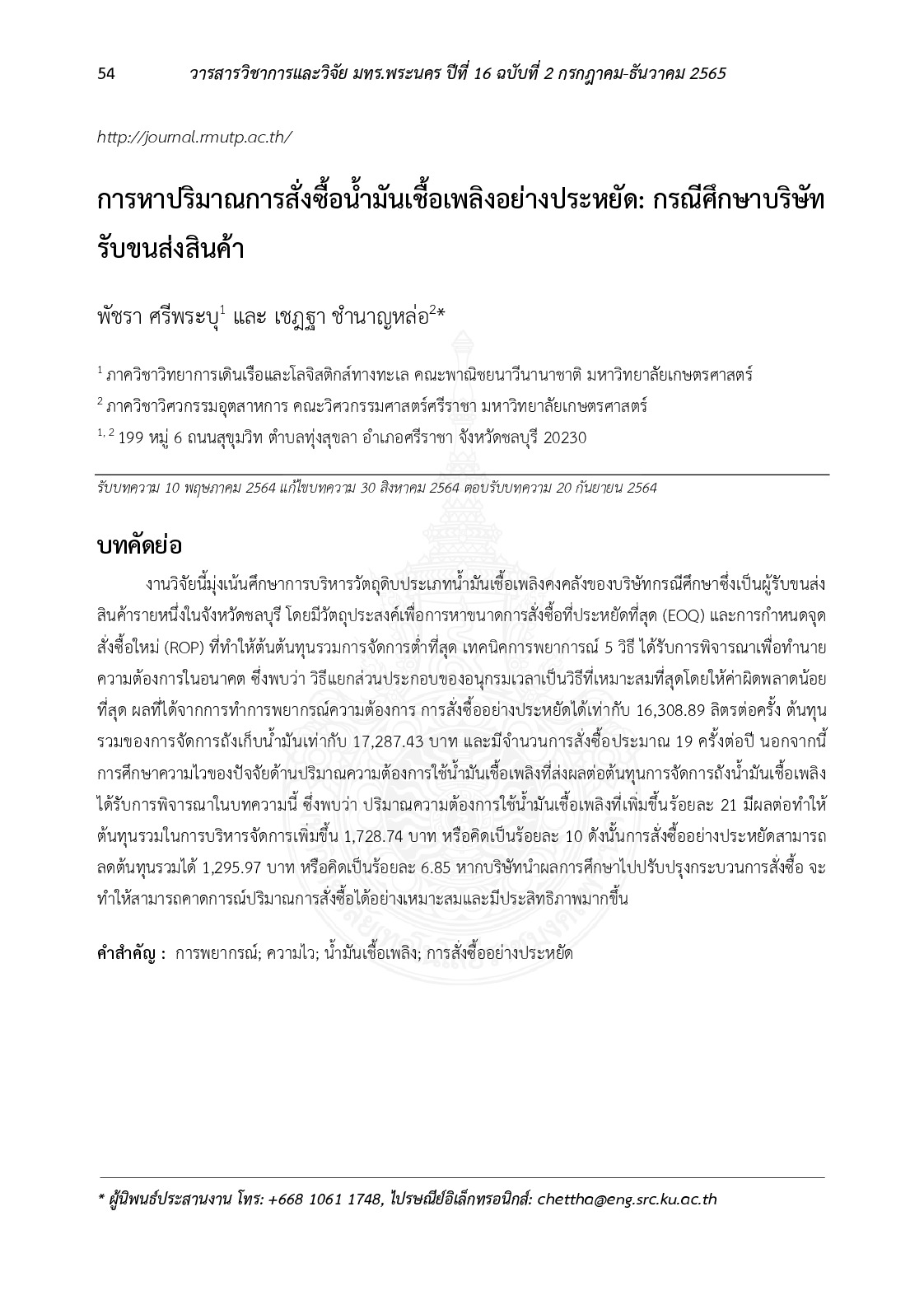
This research focuses on the raw-material management such as fuel of a case study company being a freight forwarder in Chonburi province. The objective is to determine the economic order quantity (EOQ) and the reorder point (ROP) that minimize the total cost of handling. Five forecasting techniques are investigated to predict the future demand and it was found that the time series decomposition was the most suitable method with the least error. At the result of demand forecasting the economic order quantity is 16308.89 liters per time the total cost of handling the fuel tank is 17287.43 baht and there are ordering around 19 times per year. In addition the sensitivity study on demand factors affecting the cost of fuel tank management are also considered in this paper. It was found that 21% of the increased fuel demand brings the total handling cost is 1728.74 baht or increasing 10%. Therefore ordering economically can reduce the total cost of 1295.97 baht or 6.85%. If the company brings the studied results to improve the ordering process it will be able to forecast the order quantity more appropriately and effectively.
การจำลองและการทดสอบระบบเติมอากาศแบบน้ำไหลเวียนด้วยพลังงานแสงอาทิตย์
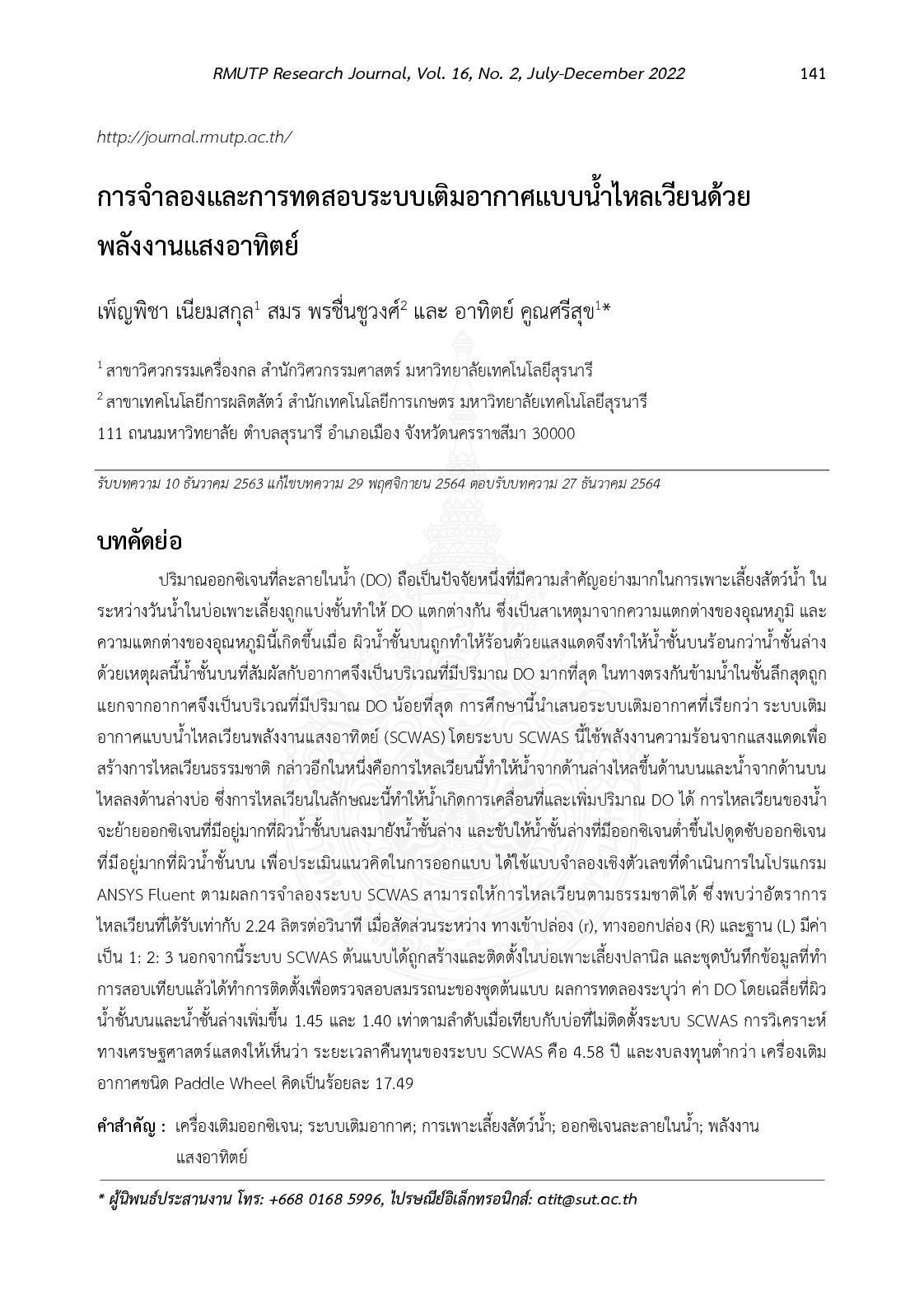
The amount of dissolved oxygen (DO) in aquaculture ponds is considered to be one of the most important aspects for the survival of fishes. The water in aquaculture ponds is stratified into distinct layers with different DO caused by differences in temperature. This temperature difference occurs when the surface layer of water heated by the sun becomes hotter than the lower water layer. Since the top layer is in contact with the air it contains the most DO. On the other hand the deepest layer is isolated from the air it contains the lowest amount of DO. This study proposed an aeration system called a Solar Circulating-Water Aeration System (SCWAS). The SCWAS uses solar thermal energy to create a natural water circulation. In other words it provides an upward current of water from the bottom to the pond surface and a downward current from the surface to the bottom. This circulation creates the movement of surface water and then increases the DO content of the surface water. This water circulation moves highly oxygenated surface water to the bottom layer forcing low oxygen water from the bottom up to the surface where it can absorb oxygen. To evaluate this design concept the numerical simulations of the system were conducted using ANSYS Fluent software. According to the simulation results the SCWAS can provide the natural water circulation. It was found that a flow rate of 2.24 L/s is obtained when the ratio between the draft tube inlet (r) the draft tube outlet (R) the base (L) is 1: 2: 3. In addition an SCWAS prototype was built and installed in a tilapia aquaculture system. A calibrated measuring system was installed to investigate the prototype performance. The experimental results indicate that the average DO values at the water surface and at the bottom of the pond increased by 1.45 and 1.40 times respectively compared with those of a pond without SCWAS. Economic analysis shows that the payback period of SCWAS is 4.58 years and its investment cost is 17.49% less than that of the paddle-wheel aerator.
การเพาะเลี้ยงเยื่อเพื่อการขยายพันธุ์และการชักนำเหง้าขนาดเล็กจากว่านชักมดลูกตัวเมีย Curcuma comosa roxb
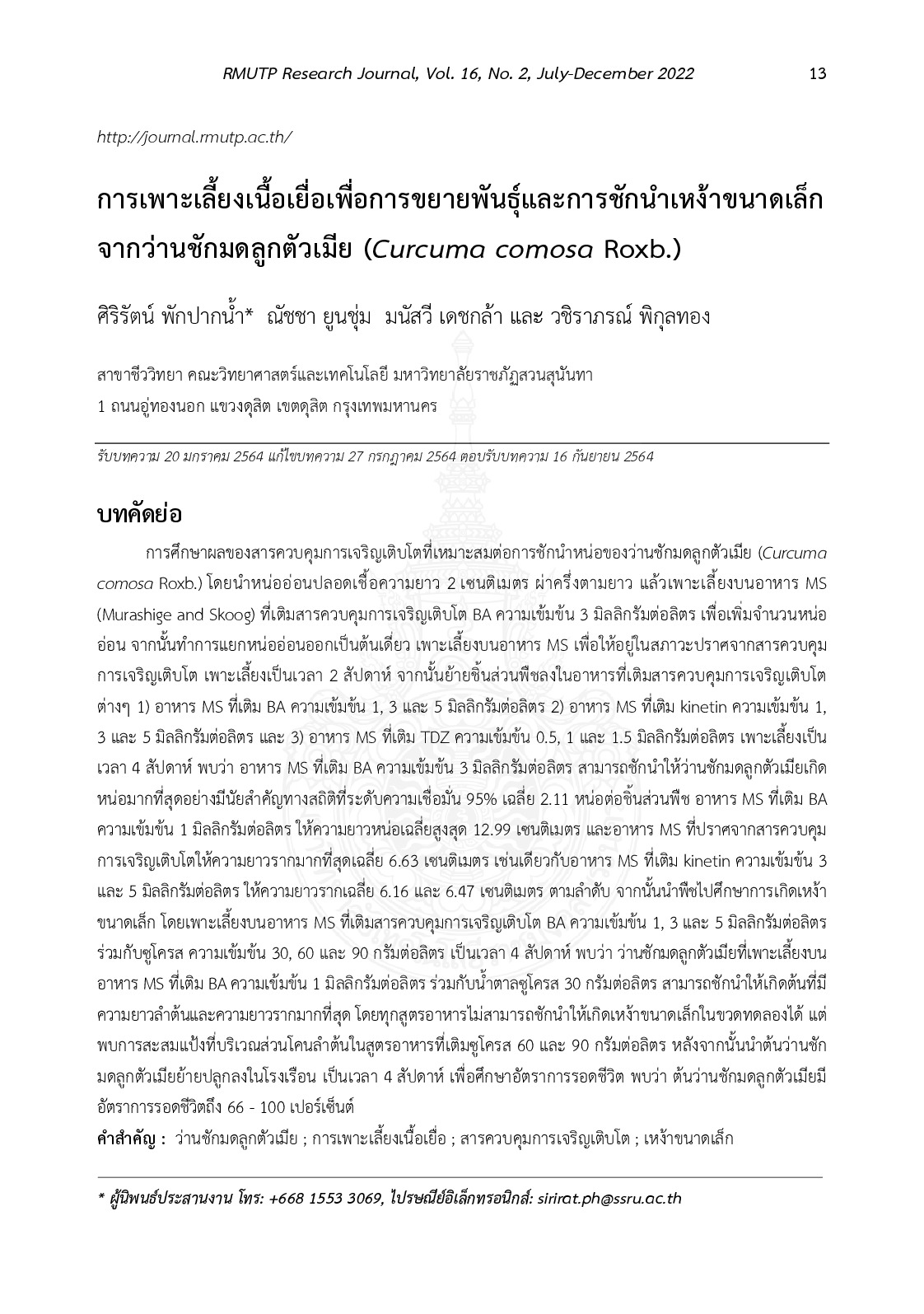
This study was conducted to determine the effects of plant growth regulators on in vitro propagated plantlets and microrhizome inductions of Curcuma comosa Roxb. for an efficient development of plant regeneration. In vitro sprouted shoots (2 cm length) of C. comosa were incised in longitudinal section and subcultured on MS media supplemented with 3 mg/L BA for shoot multiplication and plant regeneration. Subsequently the regenerated plants were transferred to MS medium with various concentrations of plant growth regulators; BA (1 3 5 mg/L) kinetin (1 3 5 mg/L) and TDZ (0.5 1 1.5 mg/L). The result showed that MS medium supplemented with 3 mg/L BA was the most effective in shoot induction with the significantly maximum average number of 2.11 shoot buds per responding explant. Moreover MS medium supplemented with 1 mg/L BA produced the longest average of shoot bud explants (12.99 cm) while the basal MS medium induced the longest average of root multiplication (6.63 cm). Furthermore microrhizome induction was produced under in vitro conditions derived young shoot buds upon transfer to MS medium containing various combinations of 1 3 and 5 mg/L BA and 30 60 and 90 g/L sucrose concentrations. The optimum combination in the induction of significantly highest average length of both stem (18.32 cm) and root (7.52 cm) multiplication was obtained on MS basal medium supplemented with 1 mg/L BA and 30 g/L sucrose for 4 weeks. Although microrhizome formation was not produced by the different amount of BA and sucrose in induction medium starch accumulation was found at the base of the stem explants cultured on MS medium containing 60 and 90 g/L sucrose concentrations. Additionally in vitro propagated C. comosa plantlets through microrhizome induction were grown under greenhouse conditions for 4 weeks and further developed into normal plants resulting in successfully high survival rates of 66 – 100% in the cultivated C. comosa.
ผลของสารสกัดหยาบด้วยเอทานอลจากสมุนไพร 7 ชนิดต่อการไล่มด
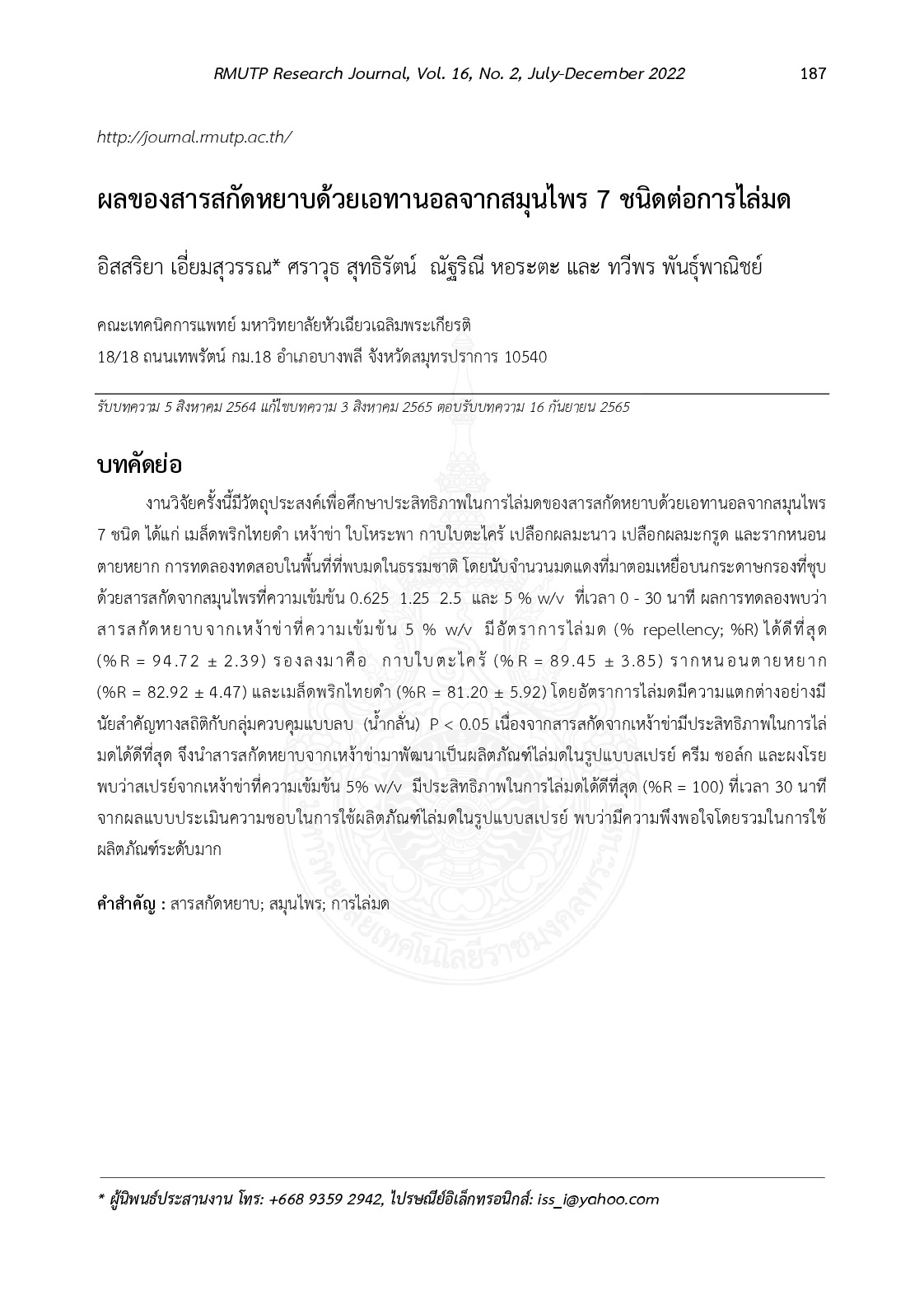
This research aims to study the ant repellent effects of the crude ethanolic extracts from 7 herbs; Piper nigrum Linn. Alpinia galanga (L.) Willd Ocimum basilicum L. Cymbopogon citratus Stapf Citrus aurantiifolia (Christm.) Swingle Citrus hystrix DC and Stemona collinsae Craib. Whatman filter paper was dipped with each concentration of the crude ethanolic extracts (0.625 1.25 2.5 and 5 % w/v) and placing the bait on a treated filter paper. The experiments were conducted in the natural. The numbers of weaver ants were recorded at 0 - 30 minutes. From the results the crude ethanolic extracts at 5% w/v of A. galanga was the most effective for repellent the ant (repellent rate; %R = 94.72 ± 2.39) followed with C. citratus (%R = 89.45 ± 3.85) S. collinsae (%R = 82.92 ± 4.47) and P.nigrum (%R = 81.20 ± 5.92). The repellent rates of those crude ethanolic extracts were significantly difference from distilled water which use for the negative control (P < 0.05). The crude ethanolic extract of A. galanga at concentration 5% w/v was prepared as spray cream chalk and powder. At 30 minutes of the observation the ethanolic extracts of A. galanga spray was the best ant repellent effect (%R = 100). The result from questionnaires reveals that a spray preparation was the more satisfaction for the using ant repellent products.
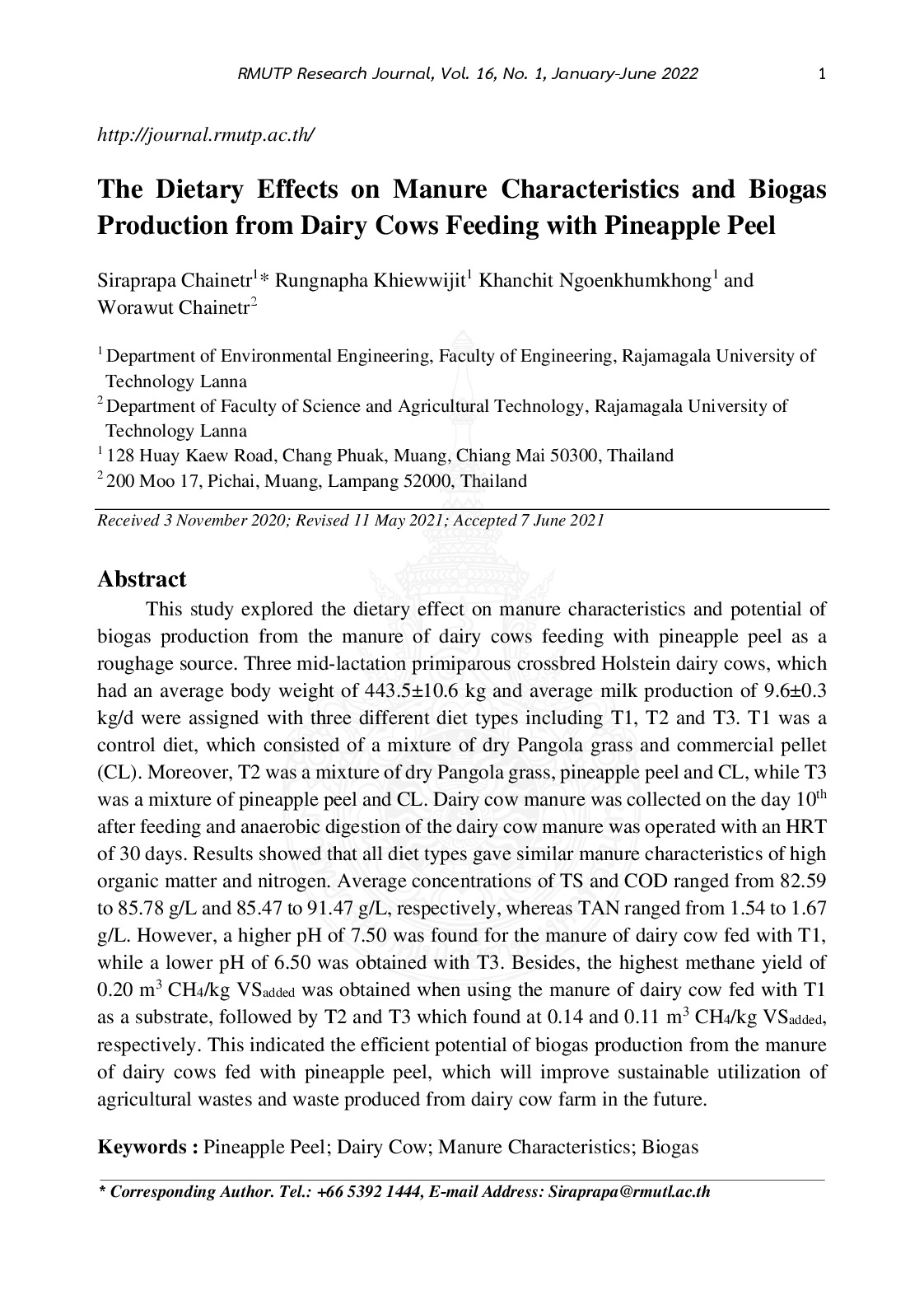
The Dietary effects on manure characteristics and biogas production from dairy cows feeding with pineapple peel
This study explored the dietary effect on manure characteristics and potential of biogas production from the manure of dairy cows feeding with pineapple peel as a roughage source. Three mid-lactation primiparous crossbred Holstein dairy cows which had an average body weight of 443.5±10.6 kg and average milk production of 9.6±0.3 kg/d were assigned with three different diet types including T1 T2 and T3. T1 was a control diet which consisted of a mixture of dry Pangola grass and commercial pellet (CL). Moreover T2 was a mixture of dry Pangola grass pineapple peel and CL while T3 was a mixture of pineapple peel and CL. Dairy cow manure was collected on the day 10th after feeding and anaerobic digestion of the dairy cow manure was operated with an HRT of 30 days. Results showed that all diet types gave similar manure characteristics of high organic matter and nitrogen. Average concentrations of TS and COD ranged from 82.59 to 85.78 g/L and 85.47 to 91.47 g/L respectively whereas TAN ranged from 1.54 to 1.67 g/L. However a higher pH of 7.50 was found for the manure of dairy cow fed with T1 while a lower pH of 6.50 was obtained with T3. Besides the highest methane yield of 0.20 m3 CH4/kg VSadded was obtained when using the manure of dairy cow fed with T1 as a substrate followed by T2 and T3 which found at 0.14 and 0.11 m3 CH4/kg VSadded respectively. This indicated the efficient potential of biogas production from the manure of dairy cows fed with pineapple peel which will improve sustainable utilization of agricultural wastes and waste produced from dairy cow farm in the future.