จำนวน Repository ( 73 )

Method for working-life enhancement of epoxy-based adhesive
For one-part adhesive systems a long working-life adhesive which can be cured rapidly at processing temperature is required in industrial applications because it provides assembly process versatility. The aim of this research was to study the methods for extending the working-life of an epoxy-based adhesive with anhydride curing agent. This adhesive formulation is used as an underfill material in electronic industry. The scope of this study was divided into two parts: 1) modification of adhesive formulation process 2) determination of the component in adhesive which causes the adhesive viscosity increased at ambient temperature. The results showed that the adhesive working-life extended from 2 hours to 6 hours with reducing formulation process time removing the moisture in filler and reducing fluxing precursor loading in adhesive. In addition the fluxing precursor loading also affects the thermo-mechanical properties of adhesive. For characterization the working-life and thermo-mechanical properties of this formulation were investigated using rheological technique and dynamic mechanical analysis (DMA) respectively.
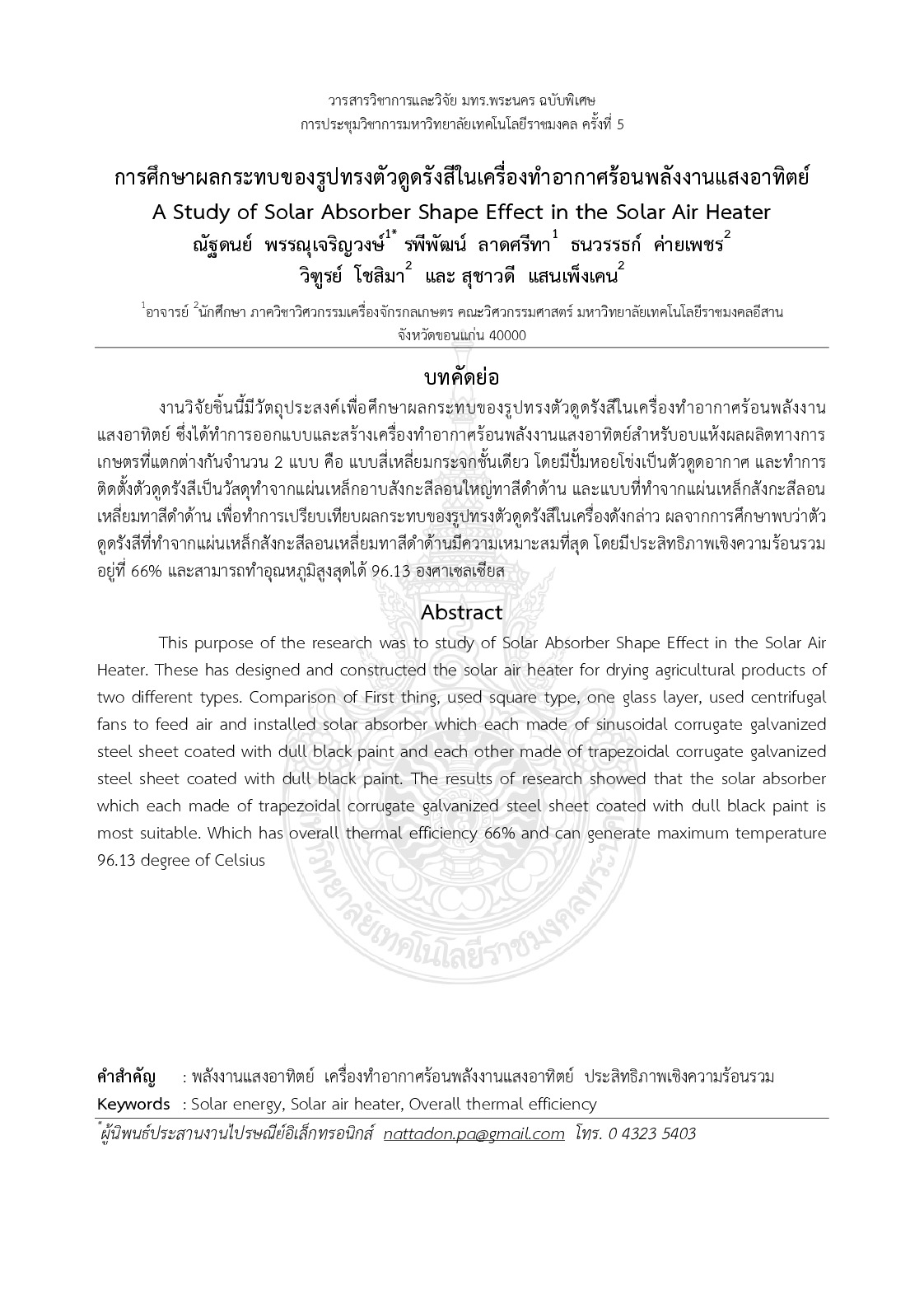
A study of solar absorber shape effect in the solar Air heater
This purpose of the research was to study of Solar Absorber Shape Effect in the Solar Air Heater. These has designed and constructed the solar air heater for drying agricultural products of two different types. Comparison of First thing used square type one glass layer used centrifugal fans to feed air and installed solar absorber which each made of sinusoidal corrugate galvanized steel sheet coated with dull black paint and each other made of trapezoidal corrugate galvanized steel sheet coated with dull black paint. The results of research showed that the solar absorber which each made of trapezoidal corrugate galvanized steel sheet coated with dull black paint is most suitable. Which has overall thermal efficiency 66% and can generate maximum temperature 96.13 degree of Celsius
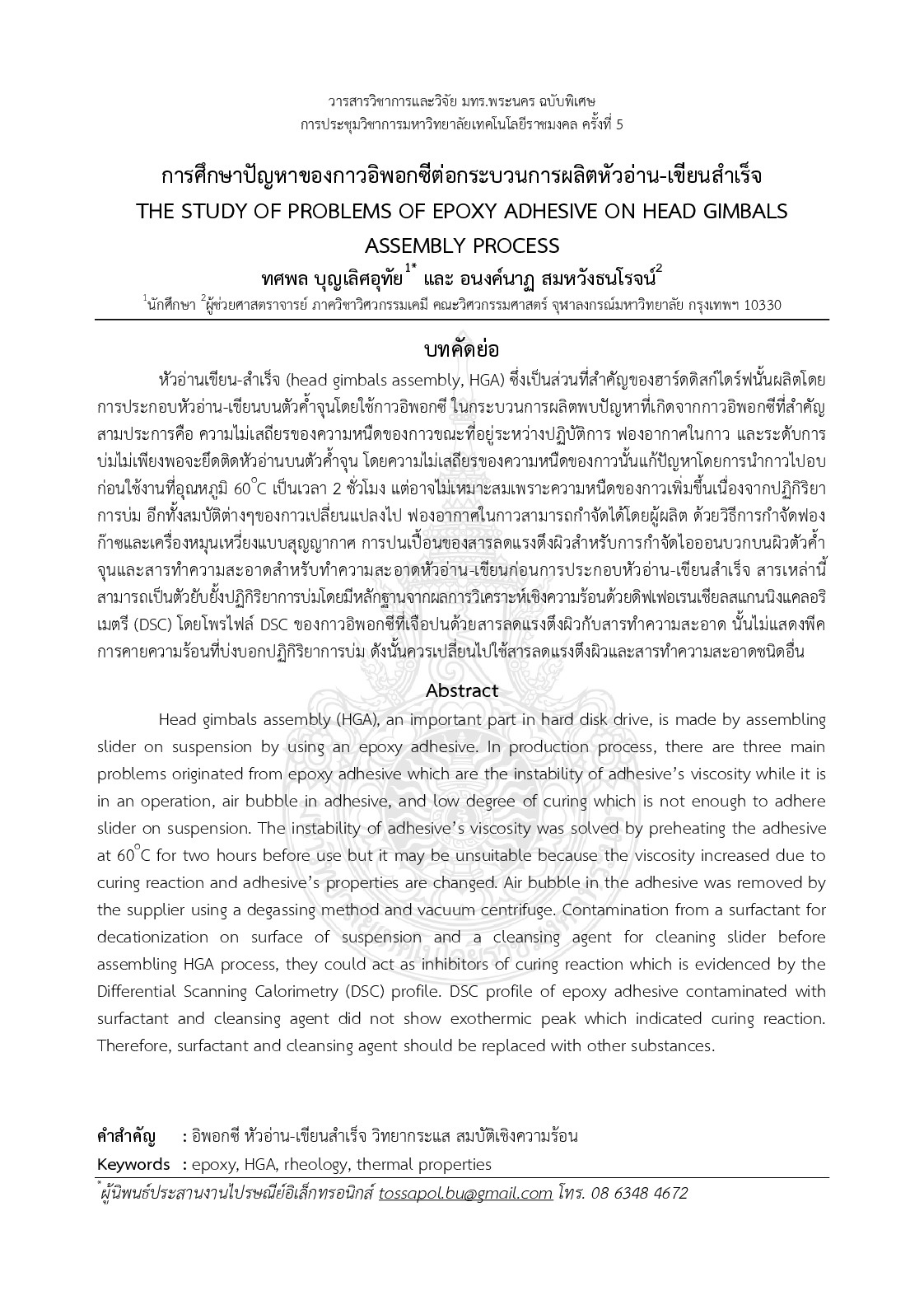
The study of problems of epoxy adhesive on head gimbals assembly process
Head gimbals assembly (HGA) an important part in hard disk drive is made by assembling slider on suspension by using an epoxy adhesive. In production process there are three main problems originated from epoxy adhesive which are the instability of adhesive’s viscosity while it is in an operation air bubble in adhesive and low degree of curing which is not enough to adhere slider on suspension. The instability of adhesive’s viscosity was solved by preheating the adhesive at 60oC for two hours before use but it may be unsuitable because the viscosity increased due to curing reaction and adhesive’s properties are changed. Air bubble in the adhesive was removed by the supplier using a degassing method and vacuum centrifuge. Contamination from a surfactant for decationization on surface of suspension and a cleansing agent for cleaning slider before assembling HGA process they could act as inhibitors of curing reaction which is evidenced by the Differential Scanning Calorimetry (DSC) pr
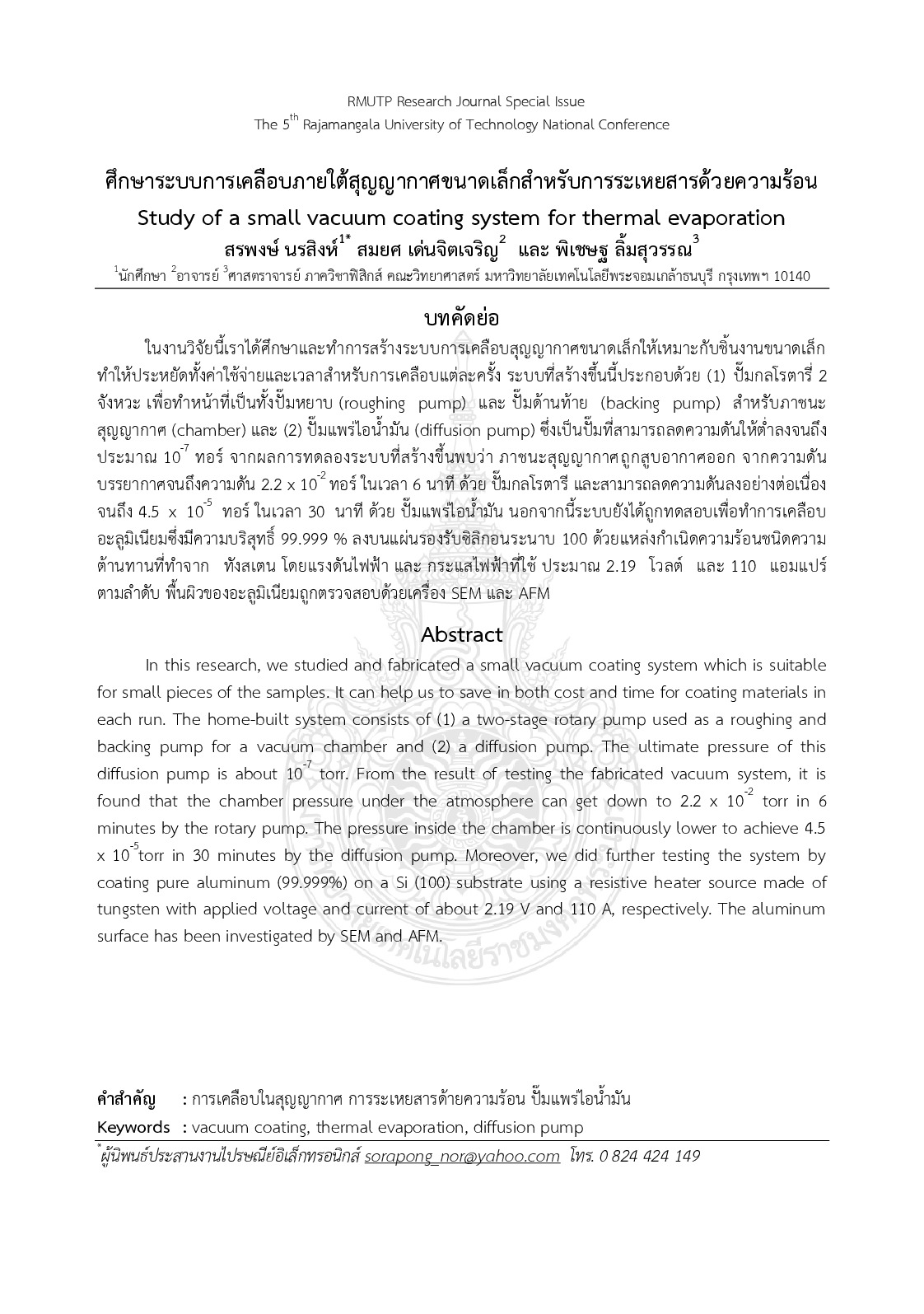
Study of a small vacuum coating system for thermal evaporation
In this research we studied and fabricated a small vacuum coating system which is suitable for small pieces of the samples. It can help us to save in both cost and time for coating materials in each run. The home-built system consists of (1) a two-stage rotary pump used as a roughing and backing pump for a vacuum chamber and (2) a diffusion pump. The ultimate pressure of this diffusion pump is about 10-7 torr. From the result of testing the fabricated vacuum system it is found that the chamber pressure under the atmosphere can get down to 2.2 x 10⁻² torr in 6 minutes by the rotary pump. The pressure inside the chamber is continuously lower to achieve 4.5 x 10⁻⁵torr in 30 minutes by the diffusion pump. Moreover we did further testing the system by coating pure aluminum (99.999%) on a Si (100) substrate using a resistive heater source made of tungsten with applied voltage and current of about 2.19 V and 110 A respectively. The aluminum surface has been investigated by SEM and AFM.
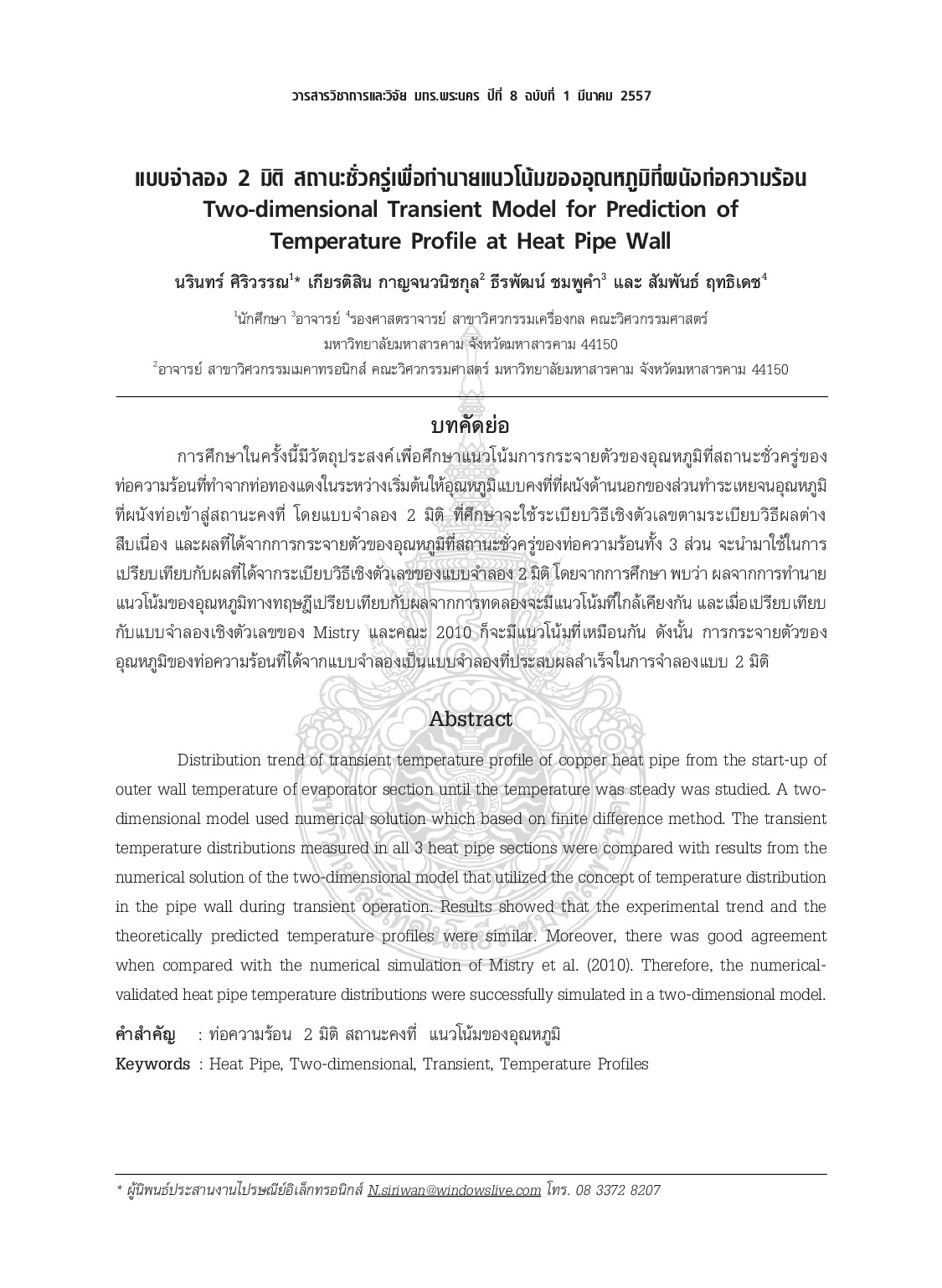
Two-dimensional transient model for prediction of temperature profile at heat pipe wall
Distribution trend of transient temperature profile of copper heat pipe from the start-up of outer wall temperature of evaporator section until the temperature was steady was studied. A two-dimensional model used numerical solution which based on finite difference method. The transient temperature distributions measured in all 3 heat pipe sections were compared with results from the numerical solution of the two-dimensional model that utilized the concept of temperature distribution in the pipe wall during transient operation. Results showed that the experimental trend and the theoretically predicted temperature profiles were similar. Moreover there was good agreement when compared with the numerical simulation of Mistry et al. (2010). Therefore the numerical-validated heat pipe temperature distributions were successfully simulated in a two-dimensional model.