จำนวน Repository ( 142 )
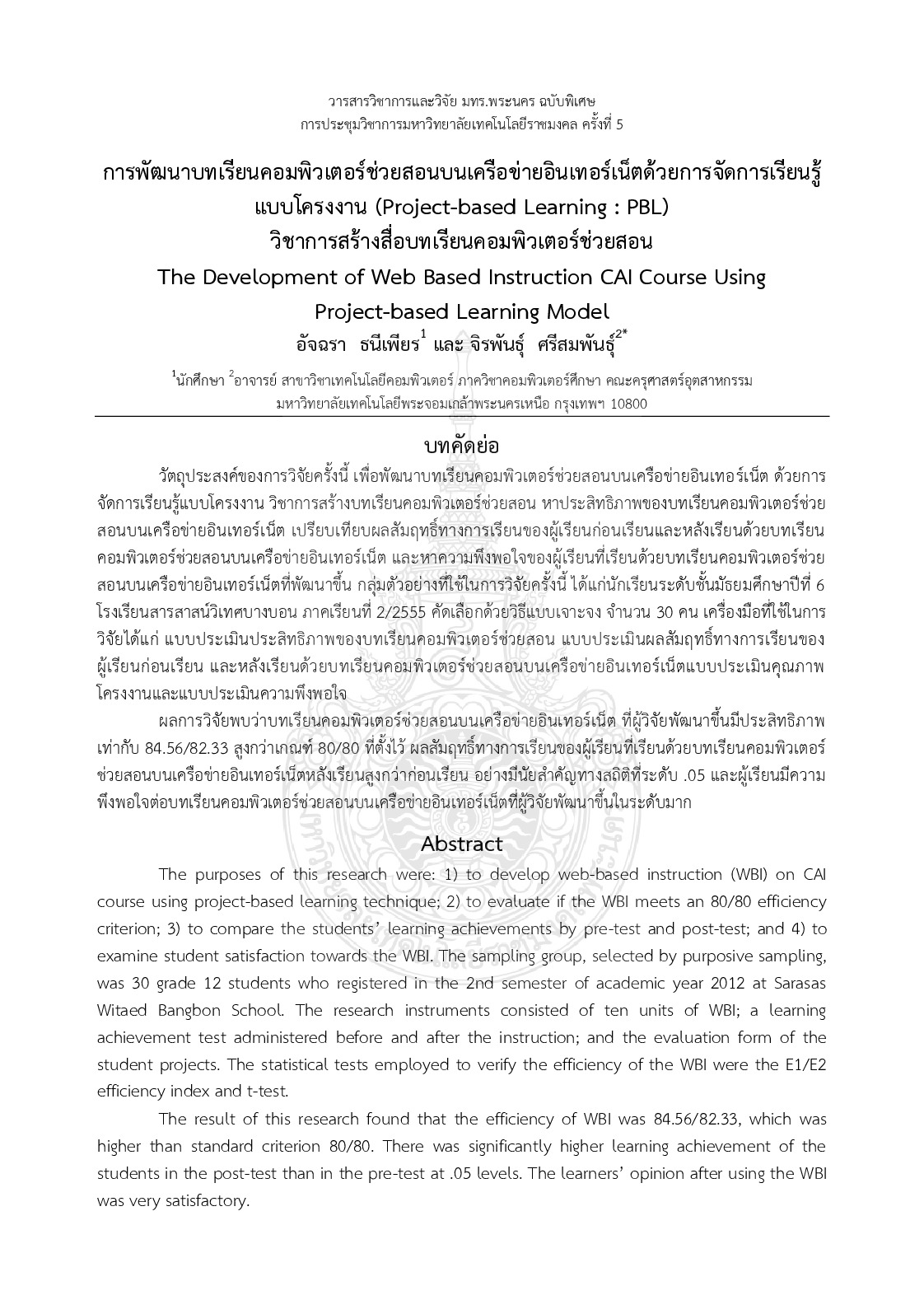
The development of web based instruction CAI course using project-based learning model
The purposes of this research were: 1) to develop web-based instruction (WBI) on CAI course using project-based learning technique; 2) to evaluate if the WBI meets an 80/80 efficiency criterion; 3) to compare the students’ learning achievements by pre-test and post-test; and 4) to examine student satisfaction towards the WBI. The sampling group selected by purposive sampling was 30 grade 12 students who registered in the 2nd semester of academic year 2012 at Sarasas Witaed Bangbon School. The research instruments consisted of ten units of WBI; a learning achievement test administered before and after the instruction; and the evaluation form of the student projects. The statistical tests employed to verify the efficiency of the WBI were the E1/E2 efficiency index and t-test. The result of this research found that the efficiency of WBI was 84.56/82.33 which was higher than standard criterion 80/80. There was significantly higher learning achievement of the students in the post-test than in the pre-test at .05 levels. The learners’ opinion after using the WBI was very satisfactory.
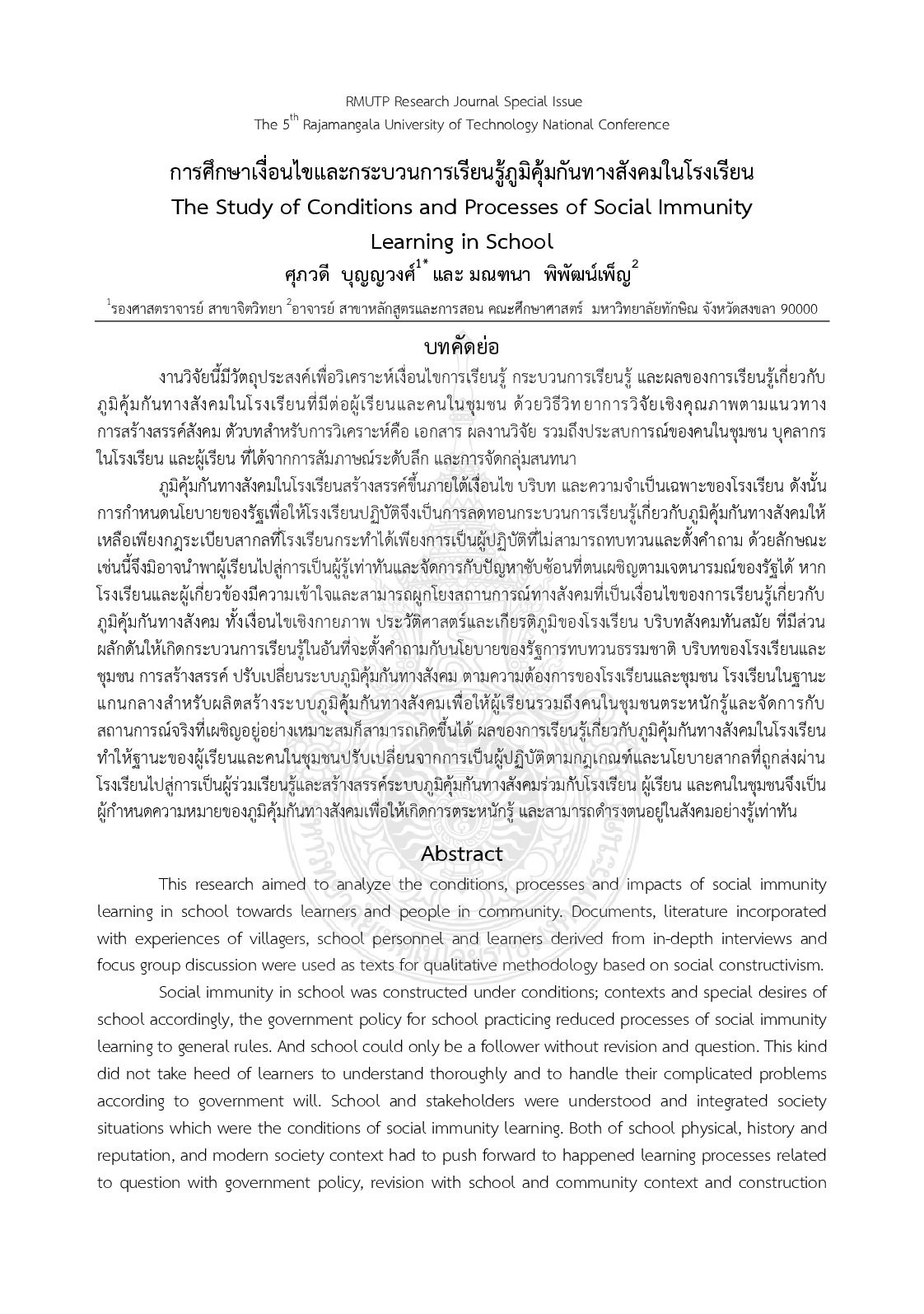
The study of conditions and processes of social immunity learning in school
This research aimed to analyze the conditions processes and impacts of social immunity learning in school towards learners and people in community. Documents literature incorporated with experiences of villagers school personnel and learners derived from in-depth interviews and focus group discussion were used as texts for qualitative methodology based on social constructivism. Social immunity in school was constructed under conditions; contexts and special desires of school accordingly the government policy for school practicing reduced processes of social immunity learning to general rules. And school could only be a follower without revision and question. This kind did not take heed of learners to understand thoroughly and to handle their complicated problems according to government will. School and stakeholders were understood and integrated society situations which were the conditions of social immunity learning. Both of school physical history and reputation and modern society context had to push forward to happened learning processes related to question with government policy revision with school and community context and construction social immunity. Therefore school as a core to construct social immunity for awareness and coping with real situations of learners and people in community was able to occur. The impact of this learning replaced the learners and villagers whom were the followers of passed general rules and policy to the participants of cooperative learning and constructing social immunity processes. Hence learners and villagers determined meaning of social immunity for awareness and having abilities to exist in society with understanding thoroughly.
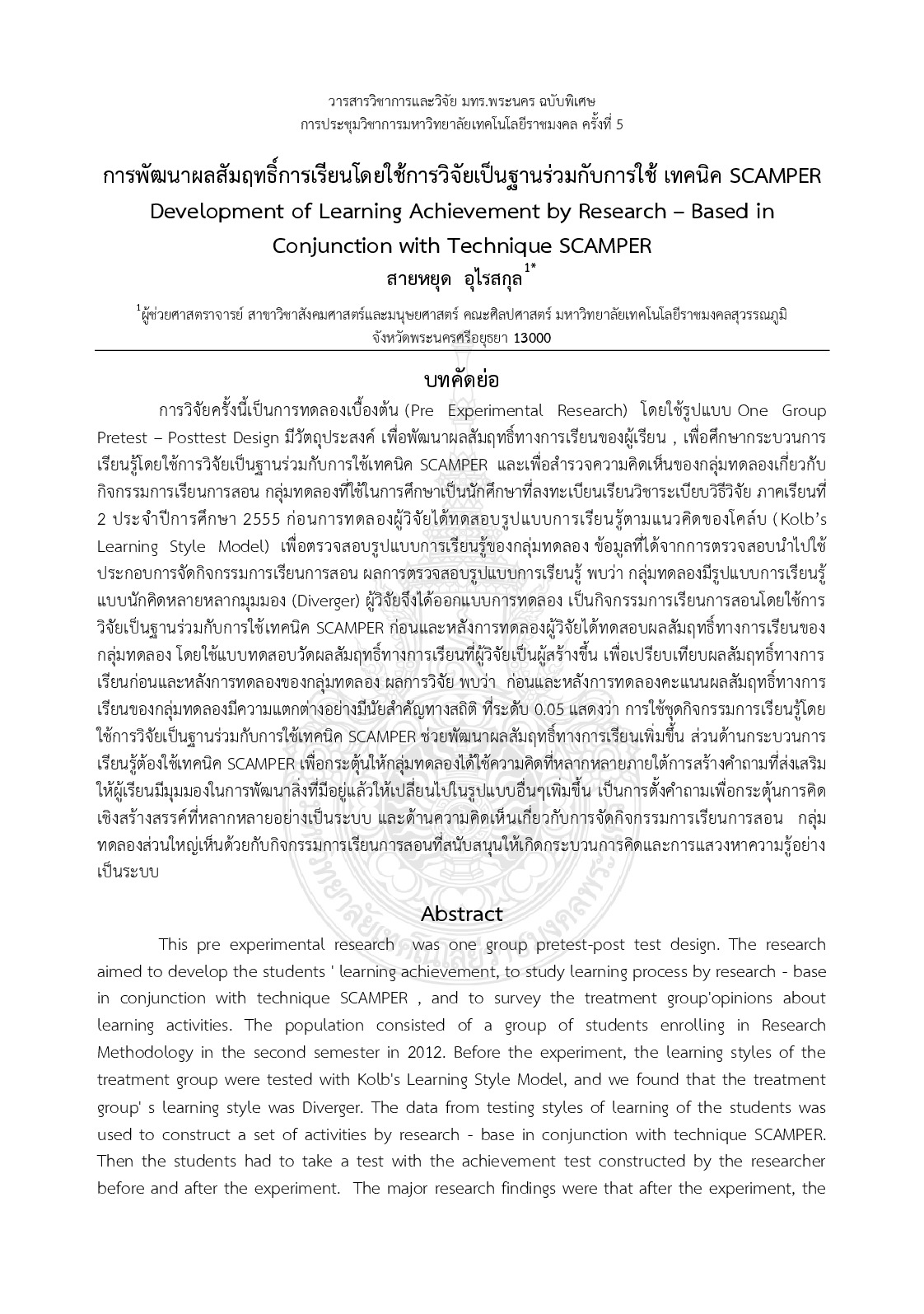
Development of learning achievement by research – based in conjunction with technique SCAMPER
This pre experimental research was one group pretest-post test design. The research aimed to develop the students learning achievement to study learning process by research - base in conjunction with technique SCAMPER and to survey the treatment groupopinions about learning activities. The population consisted of a group of students enrolling in Research Methodology in the second semester in 2012. Before the experiment the learning styles of the treatment group were tested with Kolbs Learning Style Model and we found that the treatment group s learning style was Diverger. The data from testing styles of learning of the students was used to construct a set of activities by research - base in conjunction with technique SCAMPER. Then the students had to take a test with the achievement test constructed by the researcher before and after the experiment. The major research findings were that after the experiment the scores of the treatment group were significantly different at level 0.05 therefore; we concluded that the qualified set of the learning activities by research - base in conjunction with SCAMPER was able to develop the students learning achievement. In the part of learning process the technique SCAMPER was used to promote the students different views and ideas by asking questions which encouraged students to create their thinking systematically. In the students opinions about learning activities most of them strongly agreed with this technique which contributed to the thinking process and the systematic pursuit of knowledge.
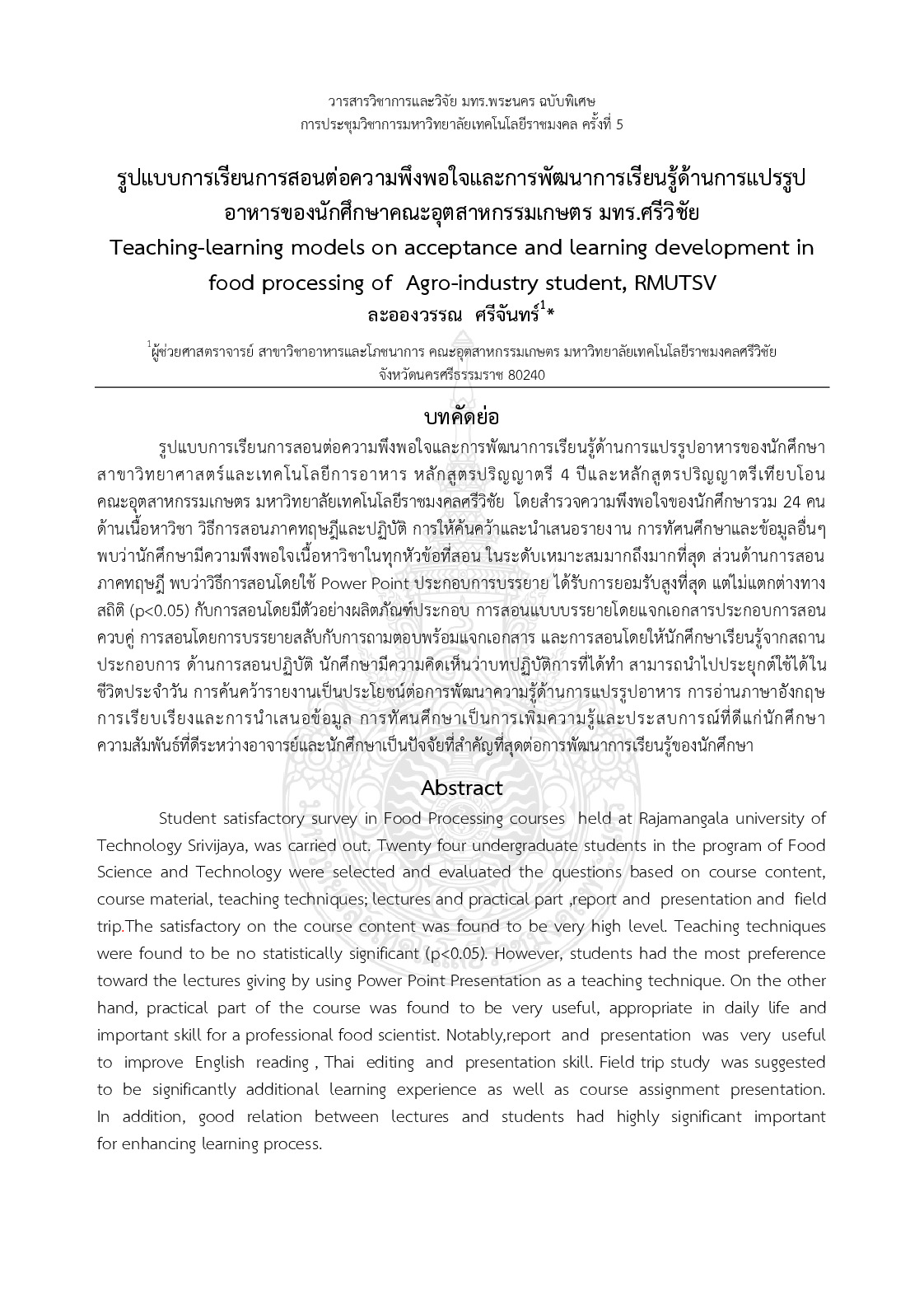
Teaching-learning models on acceptance and learning development in food processing of agro-industry student, RMUTSV
Student satisfactory survey in Food Processing courses held at Rajamangala university of Technology Srivijaya was carried out. Twenty four undergraduate students in the program of Food Science and Technology were selected and evaluated the questions based on course content course material teaching techniques; lectures and practical part report and presentation and field trip.The satisfactory on the course content was found to be very high level. Teaching techniques were found to be no statistically significant (p<0.05). However students had the most preference toward the lectures giving by using Power Point Presentation as a teaching technique. On the other hand practical part of the course was found to be very useful appropriate in daily life and important skill for a professional food scientist. Notablyreport and presentation was very useful to improve English reading Thai editing and presentation skill. Field trip study was suggested to be significantly additional learning experience as well as course assignment presentation. In addition good relation between lectures and students had highly significant important for enhancing learning process.
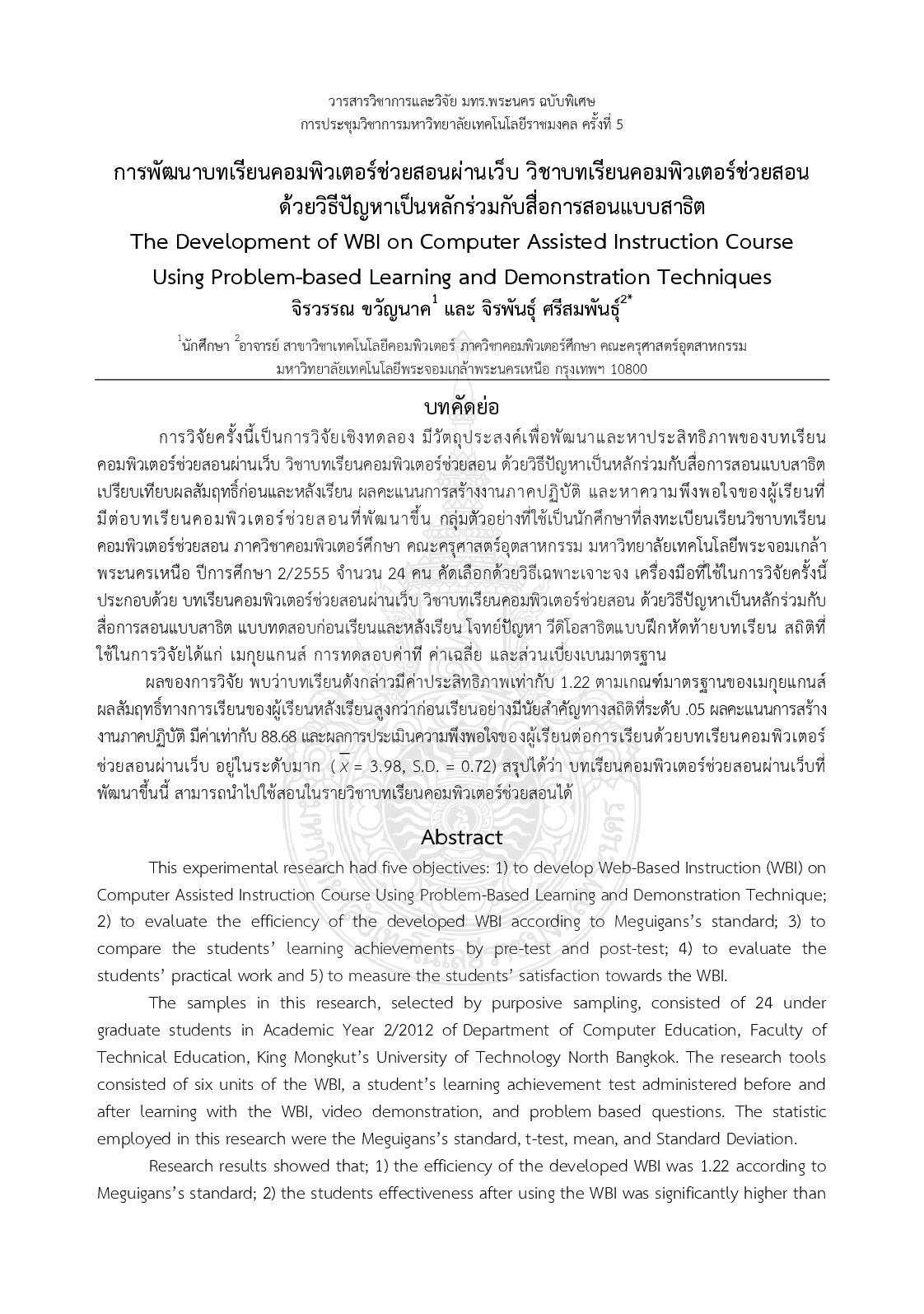
The development of wbi on computer assisted instruction course using problem-based learning and demonstration techniques
This experimental research had five objectives: 1) to develop Web-Based Instruction (WBI) on Computer Assisted Instruction Course Using Problem-Based Learning and Demonstration Technique; 2) to evaluate the efficiency of the developed WBI according to Meguigans’s standard; 3) to compare the students’ learning achievements by pre-test and post-test; 4) to evaluate the students’ practical work and 5) to measure the students’ satisfaction towards the WBI. The samples in this research selected by purposive sampling consisted of 24 under graduate students in Academic Year 2/2012 of Department of Computer Education Faculty of Technical Education King Mongkut’s University of Technology North Bangkok. The research tools consisted of six units of the WBI a student’s learning achievement test administered before and after learning with the WBI video demonstration and problem based questions. The statistic employed in this research were the Meguigans’s standard t-test mean and Standard Deviation. Research results showed that; 1) the efficiency of the developed WBI was 1.22 according to Meguigans’s standard; 2) the students effectiveness after using the WBI was significantly higher than before using it at .05; 3) the average score of the practical work was 88.68 higher than 80; 4) the students’ satisfactory was at a good level. In conclusion the developed WBI can be used for the target group properly.