จำนวน Repository ( 121 )

การใช้ประโยชน์กากดินขาวเหลือทิ้งจากเหมืองหินเป็นมวลรวมละเอียดสำหรับ ก่อสร้างอาคารประหยัดพลังงานแบบสำเร็จรูป
The Kaolinite development process to improve the characteristics. The Kaolinite mixed ratios are 10% 20% 30% and 40% and the result indicated that the experiment mortar-mix ratio at 0:8:2.75:0.2:0.05:0.04:0.5 of cement powder sand Kaolinite limestone superplasticised and clean water compared to No MK control sample covered ASTM standard in tensile strength more than 100 ksc compressive strength of MK20% with superplasticised at 434 ksc. The water absorption values under the standard passed
การลดของเสียในกระบวนการผลิต กรณีศึกษา : โรงงานดาเดียร์เซรามิกในจังหวัดลำปาง
The objective of this research is to reduce waste in the production ceramics of Dadear Ceramics Factory in Lampang Province. The 7 quality control tools (7 QC Tools) were implemented including Check sheet Graph Pareto diagram and Fishbone diagram were used in analyze problem and solve the problems. It was found that most of the wastes come from burning ceramics process. The kilns and wheelbarrow has been used for a long time furthermore the equipment and parts were damaged from lack of maintenance. The non-standard of product arrangement method into the furnace were the cause of waste. Thus the researcher were improve wheelbarrow into the kilns and design a fixture to help worker to product arrangement. The results of the research which geathering data from quality inspection department. Then comparing data before the improvement (between September to December 2013) and after the improvement (between November 2014 to February 2015) the wastes are reduced from 8.97% to 0.29%. The result of improving is very efficiency because it can reduce the wastes to 8.68%.
การพัฒนาผลิตภัณฑ์จากเปลือกนอกของก้านเผือกเหลือใช้ ในกลุ่มผู้ทานาเผือกอำเภอบ้านหมอจังหวัดสระบุรี เพื่อส่งเสริมเศรษฐกิจชุมชน
This research aims to produce paper and strands from taro fiber in order to develop into craft products and to transfer the body of knowledge and technology to community. The research consisted of 5 main steps: 1) development of paper – study concentration level of sodium hydroxide duration of pulp boiling suitable condition for breaching and softening reactive dyeing paper setting and physical testing of paper; 2) development of strand – stranding with machine strand spinning fiber combining and carding drawing reducing size of fiber and yarn spinning; 3) fiber property testing – cross-sectional test length crimp and fiber fineness; 4) product development – making evaluating and improving draft models of rubber-coated artificial flowers hanging clocks multipurpose boxes and product prototype development; and 5) transfer of technology to members of Talad Noi Agricultural Community Enterprise as well as nearby communities in Ban Moh district Saraburi province. Results of the study showed that the most suitable condition in separating fiber was boiling in 15 grams-per-liter sodium hydroxide solution at 100 Degree Celcius for 1 hour. Then breach with 9 grams-per-liter hydrogen peroxide solution at 100 Degree Celcius for 20 minutes. Next soften the fiber with 6 grams-per-liter anion softener at 60 Degree Celcius for 20 minutes. The use the fiber to set 40x40 centimeter piece of paper by spreading 20 grams of fiber equally. The resulting 0.237mg thick piece of paper was fairly resistance to piercing pressure and tearing force and was suitable to make craft products. In addition development of strands by yarn spinning method was suitable to produce strands which had more strength than strands from other plants. The strands were also suitable for further industrial production. The prototypes of utility and furnishing products were evaluated by consumers as highly suitable in 3 aspects - uniqueness of local product attractive design and size shape and weight – with mean values of 3.72 3.96 and 3.94 respectively. Price was evaluated as averagely suitable at a mean value of 3.12. Results of technology transfer showed that overall trainees were highly satisfied with the technology transfer process at a mean value of 4.55. Assessment of satisfaction and data for course improvement were both in the highest level with mean values of 4.60 and 4.51 respectively.
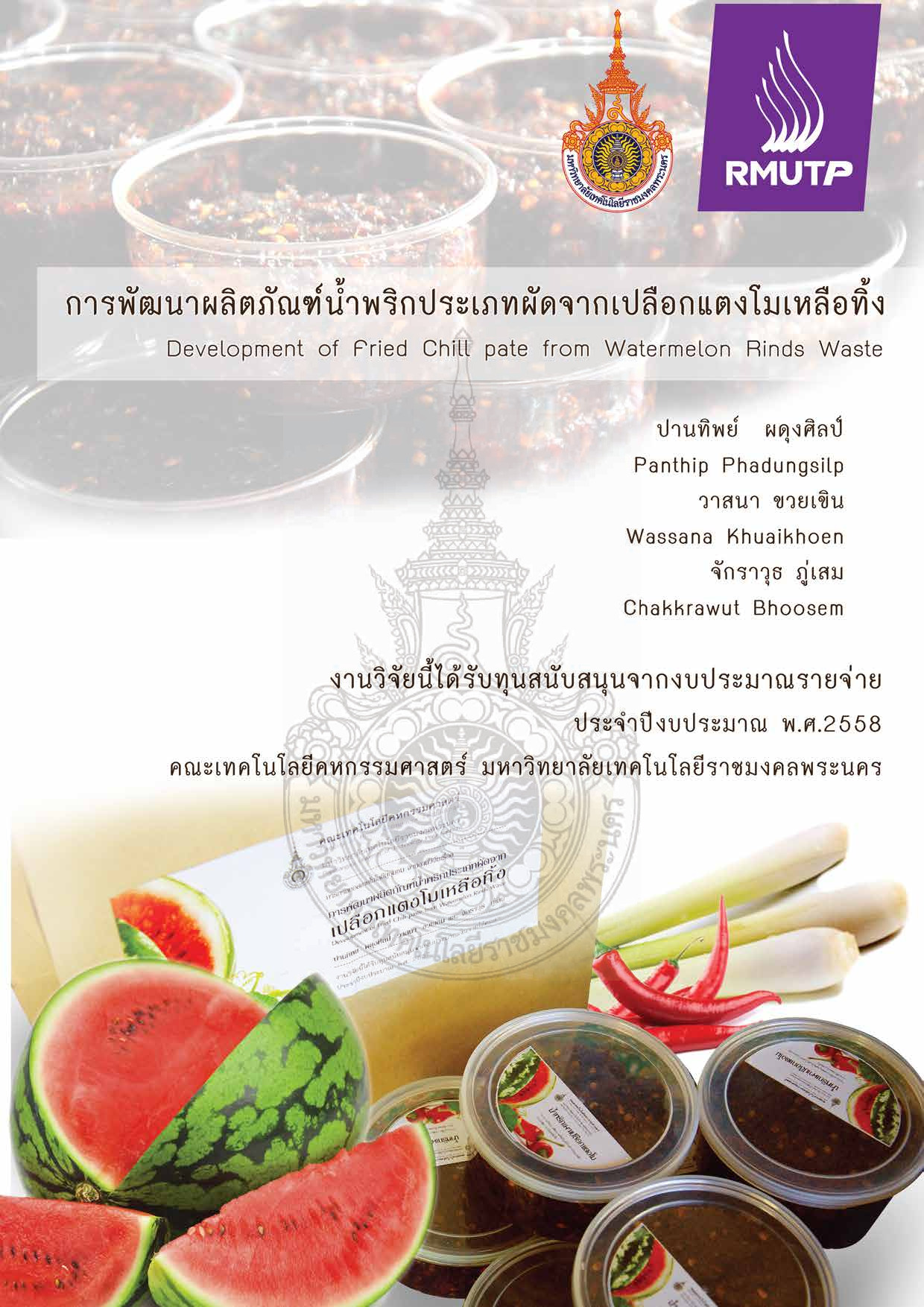
การพัฒนาผลิตภัณฑ์น้ำพริกประเภทผัดจากเปลือกแตงโมเหลือทิ้ง
The research products of chili fried watermelon rind remains were found. The decent amount enhancing of the watermelon rind in fried chili pastes are 25% 50% and 75% of total weight. The results show the 50% enhancing of the watermelon rind in fried chili pastes all of sample such as roast chili paste fermented fish chili paste Tadand chili paste and Oong chili paste were recognized in the like moderately-like very much. Increase of watermelon rind at 75% of total weight the acceptance is decrease. The texture of samples of fried chili pastes enhancing of the watermelon rind show that 1035.74-1901.16gram of the consistency -132.16- -98.07 gram: milligram of the cohesiveness and 2.15-5.67 gram of the viscosity. The chemical composition of fried chili pastes enhancing of the watermelon rind show that the 50% of watermelon rind in roasted chili pastes were 233 Kcals of total energy 7.20 of protein 9.56 of fat 4.83 of ash 29.60 of carbohydrate and 7.09 of crude fiber. The 50% of watermelon rind in fermented fish chili paste were 152 Kcals of total energy 5.93 of protein 5.60of fat 4.21of ash 19.4of carbohydrate and 5.41of crude fiber. The 50% of watermelon rind in Tadand chili paste were 183 Kcals of total energy 6.68 of protein 3.26 of fat 7.34 of ash 31.80 of carbohydrate and 11.10 of crude fiber. The 50% of watermelon rind in Oong chili paste were 182 Kcals of total energy 6.77 of protein 12.80 of fat 2.61 of ash 9.92 of carbohydrate and 3.21 of crude fiber For the technology transfer of Fried Chili paste from Watermelon Rinds Waste to Center Concert career womens groups Don Kang. The participants were satisfied with the course of 92.67
การใช้เศษพลาสติกโพลิเอทธิลีนเทเรฟทาเลตเป็นวัสดุผสมสำหรับผลิตไม้เทียมขยะกล่องนมที่มีความแข็งแรงสูง
The objectives of this research are to study the production to find the proper ratio to test the properties to suggest the implementation and to transfer the technology of high strength milk carton waste artificial wood mixed with poly ethylene terephthalate (PET) plastic waste. The ratios of this artificial wood included milk carton waste: PET plastic waste equal to 80:20 75:25 70:30 65:35 and 60:40 by weight. The milk carton and PET plastic wastes were grinded though sieve no.4. The artificial woods were casted by hot compression with 180 degree of Celsius for 5 minutes. The samples tested follow the TIS.966-2547 standard. From the results the 60:40 of ratio was the proper ratio which can pass the standard. The increasing of PET waste effected to decrease the density moisture and swelling of properties. In case of bending strength elastic modulus and tensile strength perpendicular to surface the increasing of PET effected to decrease their properties. The developed artificial wood mixed with milk cotton waste and PET plastic waste has the possibility to implement in decoration and construction both interior and exterior wall building. These results can register the petty patent and write the research paper which to transfer the technology.