จำนวน Repository ( 83 )

Pore structure changes of blended cement pastes containing fly ash, rice husk ash, and palm oil fuel ash caused by carbonation
In this paper the effects of carbonation on pore structure of blended pozzolan cement pastes were investigated. Ordinary Portland cement _OPC_ was partially replaced with ground palm oil fuel ash _POA_ ground rice husk ash _RHA_ and classified fine fly ash _FA_. The strength total porosity specific surface area and pore size distribution were tested. In general incorporation of pozzolans increased the total porosity of blended cement pastes in comparison to that of OPC paste. Carbonation of pastes under 5% CO2 and 50% relative humidity _RH_ for 28 days resulted in filling of the pore voids and possible attack on calcium silicate hydrate _CSH_ depending on the type of pozzolan used. After carbonation total porosity decreased and specific surface areas of the blended pozzolan cement pastes reduced indicating the infilling of voids. Pore size distributions of POA and RHA pastes were different to those of FA pastes. Large pores of the POA and RHA pastes were increased indicating coarsening of pores owing to possible attack on CSH. It is possible that POA and RHA were highly reactive and hence their uses resulting in severe carbonation compared to use of FA.
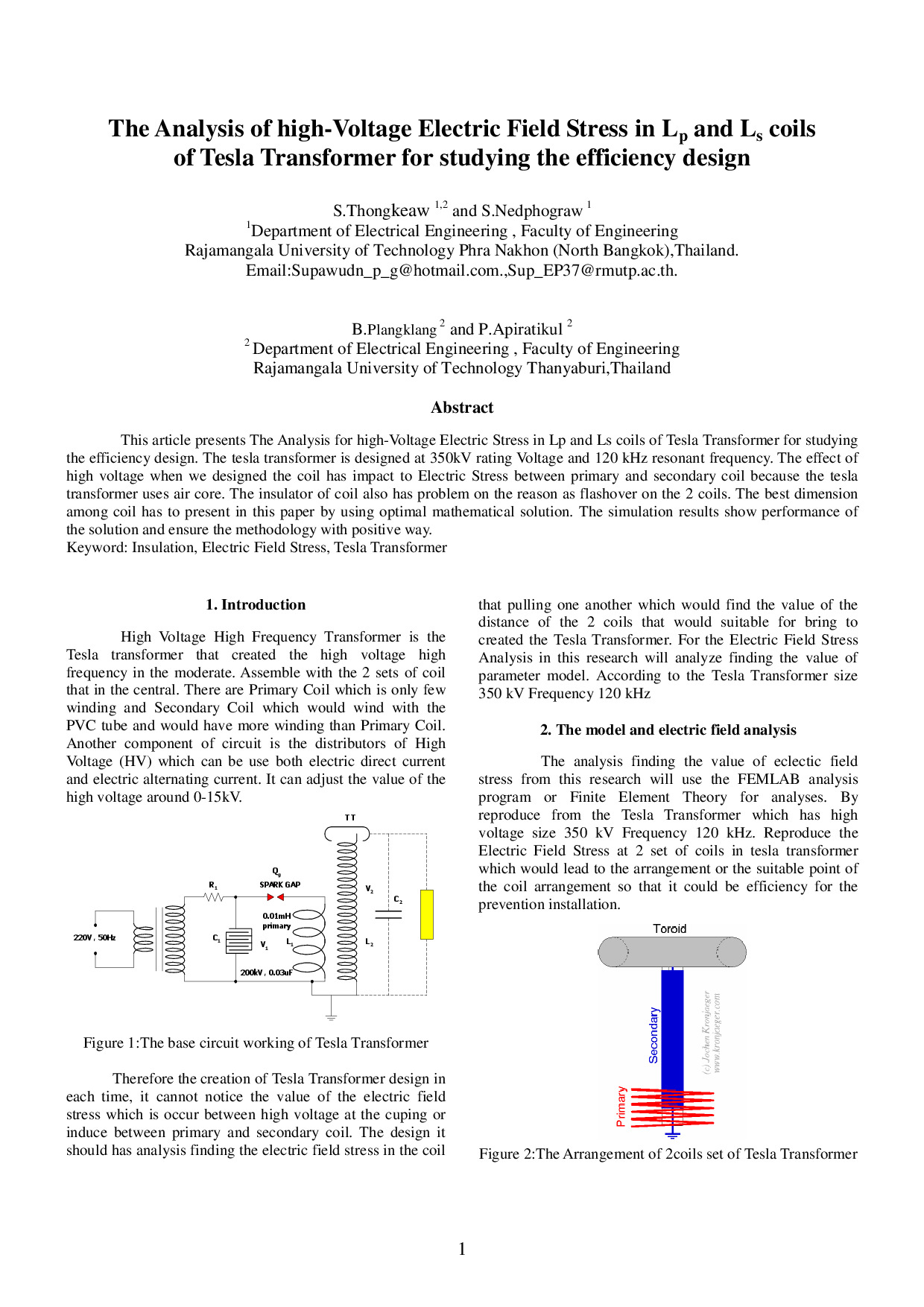
The Analysis of high-Voltage Electric Field Stress in Lp and Ls coils of Tesla Transformer for studying the efficiency design
This article presents The Analysis for high-Voltage Electric Stress in Lp and Ls coils of Tesla Transformer for studying the efficiency design. The tesla transformer is designed at 350kV rating Voltage and 120 kHz resonant frequency. The effect of high voltage when we designed the coil has impact to Electric Stress between primary and secondary coil because the tesla transformer uses air core. The insulator of coil also has problem on the reason as flashover on the 2 coils. The best dimension among coil has to present in this paper by using optimal mathematical solution. The simulation results show performance of the solution and ensure the methodology with positive way.
A Study of Moisture Separation from Hydraulic Oil
The objective of this research was to study and evaluate of the efficiency of moisture separation from hydraulic oil. This method was conducted by mixing pure water and oil in an oil tank which was classified into 4 cases: 250 ppm. 500 ppm. 750 ppm. and 1000 ppm. The results showed that when the maximum quantity of water was 1000 ppm. the 710 ppm. of moisture could be separated from hydraulic oil. The highest temperature at 70ฐC was utilized when that water was 750 ppm. The maximum efficiency was 80% when the quantity of water was 500 ppm.
Strength and chloride resistance of blended Portland cement mortar containing palm oil fuel ash and fly ash
This paper presented a study on the strength and chloride resistance of mortars made with ternary blends of ordinary Portland cement (OPC) ground palm oil fuel ash (POA) and classified fly ash (FA). The mortar mixtures were made with Portland cement type I containing 0-40wt% FA and POA. FA and POA with 1wt%-3wt% retained on a sieve No.325 were used. The compressive strength and rapid chloride penetration depth of mortars were determined. The results reveal that the use of ternary blended cements produces good strength mortars. The use of the blend of FA and POA also produces high strength mortars and excellent resistance to chloride penetration owing to the synergic effect of FA and POA. A mathematical analysis and two-parameter polynomial model were presented to predict the compressive strength. The mathematical model correlated well with the experimental results. The computer 3-D graphics of strength of the ternary blended mortars were also constructed and could be used to aid the understanding and the proportioning of the blended system.
Contamination in Hydraulic Oil
Hydraulic machines were used in both medium and large scale From industries studying problems of hydraulic systems around 70-80 percentage of the machine expiration was due to the deterioration of hydraulic oil from contamination so the best way to maintain the hydraulic machine was to take care of hydraulic oil to have the purity level and other properties suitable for the components in those machines. This article described the duty of hydraulic oil types of contamination sources of contamination the standard for measuring the purity level of oil equipments used to measure and analyze the contamination in hydraulic oil recommended purity levels the effects from the contamination in hydraulic oil to machine and methods to protect and to eliminate the contamination in hydraulic oil. All of these were useful as the guidelines to maintain the hydraulic machines to work in high efficiency and more long life time.