จำนวน Repository ( 771 )
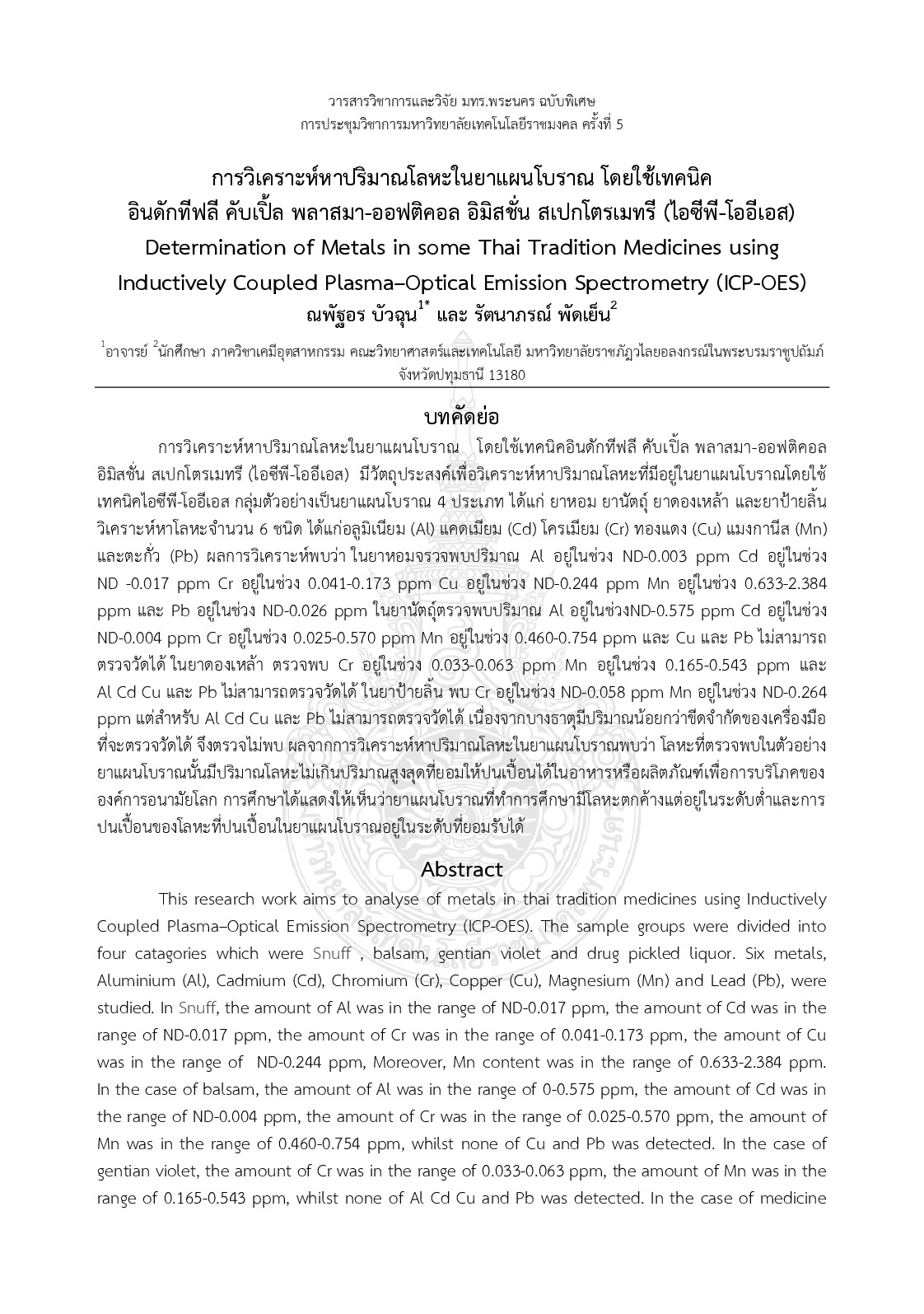
Determination of metals in some thai tradition medicines using inductively coupled plasma–optical emission spectrometry (ICP-OES)
This research work aims to analyse of metals in thai tradition medicines using Inductively Coupled Plasma–Optical Emission Spectrometry (ICP-OES). The sample groups were divided into four catagories which were Snuff balsam gentian violet and drug pickled liquor. Six metals Aluminium (Al) Cadmium (Cd) Chromium (Cr) Copper (Cu) Magnesium (Mn) and Lead (Pb) were studied. In Snuff the amount of Al was in the range of ND-0.017 ppm the amount of Cd was in the range of ND-0.017 ppm the amount of Cr was in the range of 0.041-0.173 ppm the amount of Cu was in the range of ND-0.244 ppm Moreover Mn content was in the range of 0.633-2.384 ppm. In the case of balsam the amount of Al was in the range of 0-0.575 ppm the amount of Cd was in the range of ND-0.004 ppm the amount of Cr was in the range of 0.025-0.570 ppm the amount of Mn was in the range of 0.460-0.754 ppm whilst none of Cu and Pb was detected. In the case of gentian violet the amount of Cr was in the range of 0.033-0.063 ppm the amount of Mn was in the range of 0.165-0.543 ppm whilst none of Al Cd Cu and Pb was detected. In the case of medicine pickled the amount of Cr was in the range of ND-0.058 ppm the amount of Mn was in the range of ND-0.264 ppm the amount of Ni was in the range of 0-0.034 ppm no metals Al Cd Cu and Pb was observed. The detected metals in thai tradition medicines have the contamination value under the optimization scale for consumable under WHO. It show that some metals were retained in thai tradition medicines and the contamination level of metals in were acceptable.
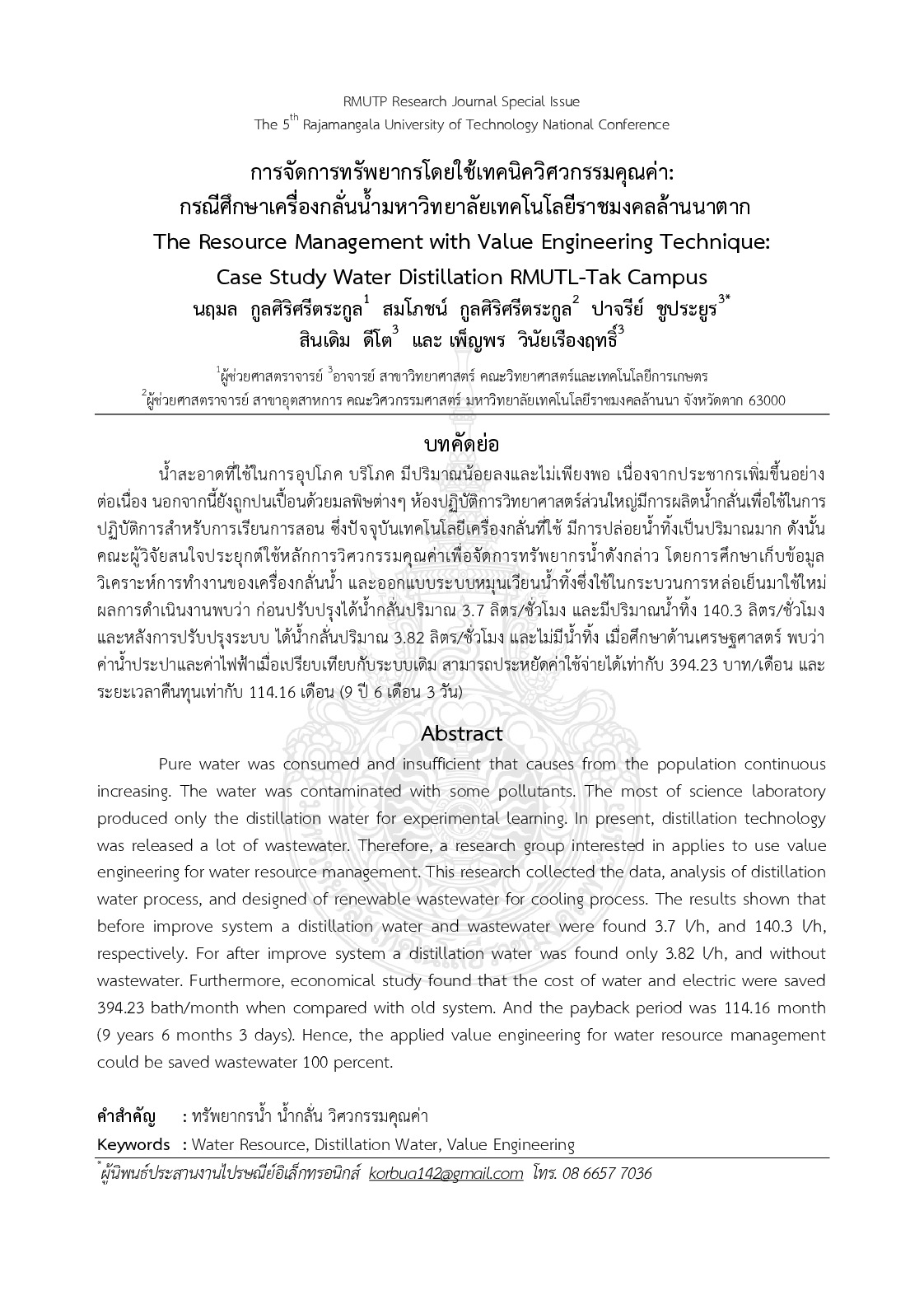
The resource management with value engineering technique: case study water distillation RMUTL-tak campus
Pure water was consumed and insufficient that causes from the population continuous increasing. The water was contaminated with some pollutants. The most of science laboratory produced only the distillation water for experimental learning. In present distillation technology was released a lot of wastewater. Therefore a research group interested in applies to use value engineering for water resource management. This research collected the data analysis of distillation water process and designed of renewable wastewater for cooling process. The results shown that before improve system a distillation water and wastewater were found 3.7 l/h and 140.3 l/h respectively. For after improve system a distillation water was found only 3.82 l/h and without wastewater. Furthermore economical study found that the cost of water and electric were saved 394.23 bath/month when compared with old system. And the payback period was 114.16 month (9 years 6 months 3 days). Hence the applied value engineering for water resource management could be saved wastewater 100 percent.
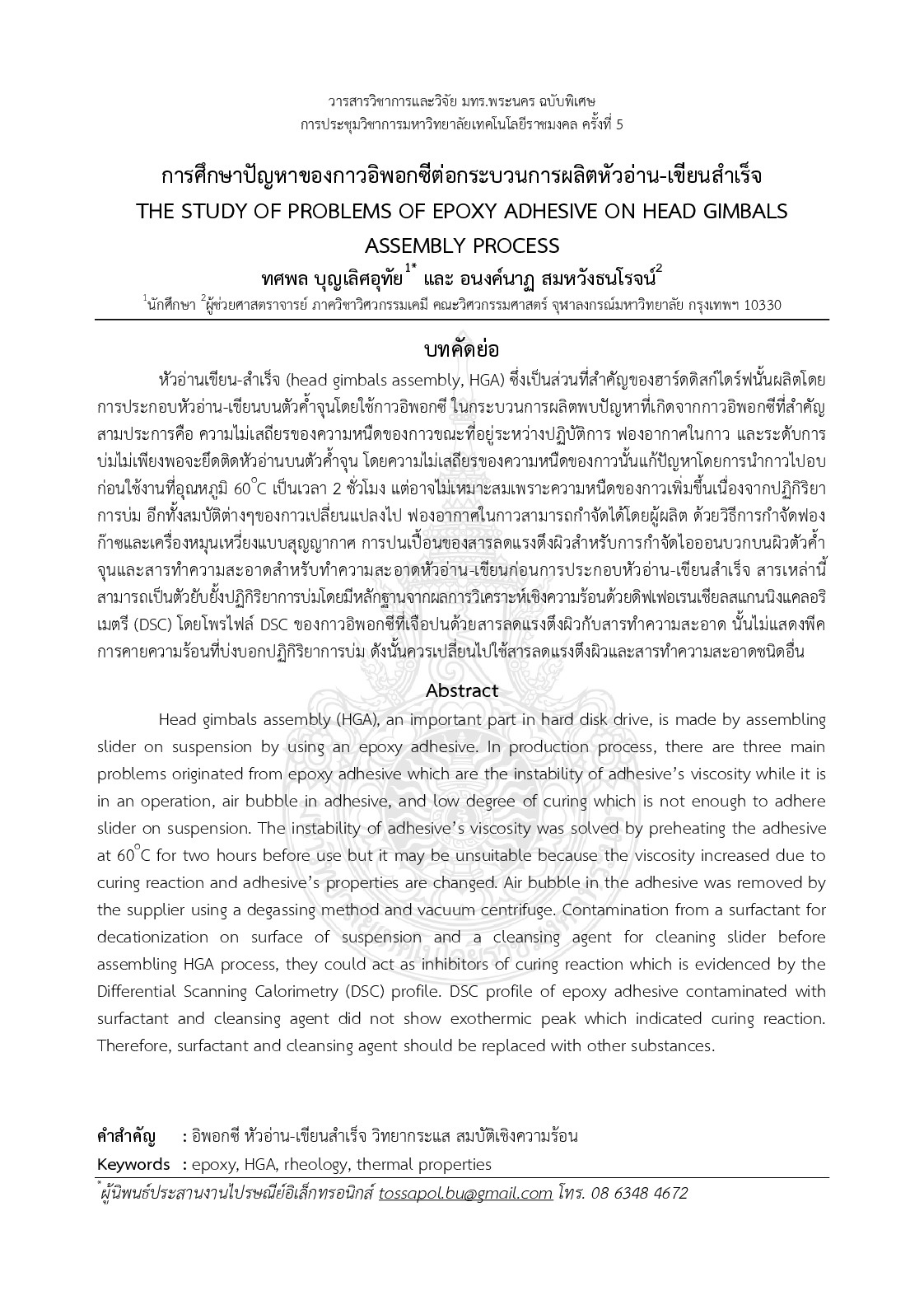
The study of problems of epoxy adhesive on head gimbals assembly process
Head gimbals assembly (HGA) an important part in hard disk drive is made by assembling slider on suspension by using an epoxy adhesive. In production process there are three main problems originated from epoxy adhesive which are the instability of adhesive’s viscosity while it is in an operation air bubble in adhesive and low degree of curing which is not enough to adhere slider on suspension. The instability of adhesive’s viscosity was solved by preheating the adhesive at 60oC for two hours before use but it may be unsuitable because the viscosity increased due to curing reaction and adhesive’s properties are changed. Air bubble in the adhesive was removed by the supplier using a degassing method and vacuum centrifuge. Contamination from a surfactant for decationization on surface of suspension and a cleansing agent for cleaning slider before assembling HGA process they could act as inhibitors of curing reaction which is evidenced by the Differential Scanning Calorimetry (DSC) pr
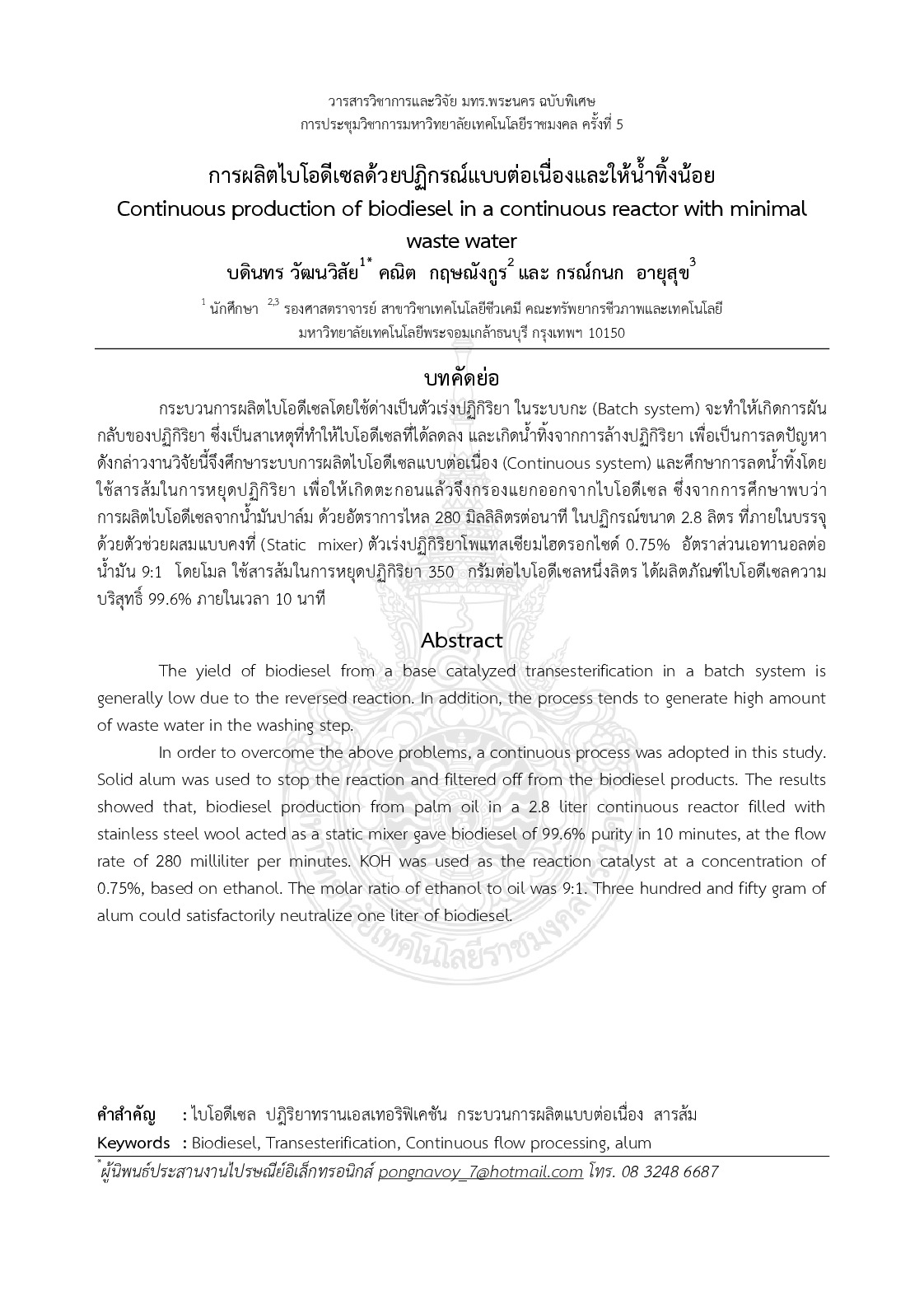
Continuous production of biodiesel in a continuous reactor with minimal
The yield of biodiesel from a base catalyzed transesterification in a batch system is generally low due to the reversed reaction. In addition the process tends to generate high amount of waste water in the washing step. In order to overcome the above problems a continuous process was adopted in this study. Solid alum was used to stop the reaction and filtered off from the biodiesel products. The results showed that biodiesel production from palm oil in a 2.8 liter continuous reactor filled with stainless steel wool acted as a static mixer gave biodiesel of 99.6% purity in 10 minutes at the flow rate of 280 milliliter per minutes. KOH was used as the reaction catalyst at a concentration of 0.75% based on ethanol. The molar ratio of ethanol to oil was 9:1. Three hundred and fifty gram of alum could satisfactorily neutralize one liter of biodiesel.
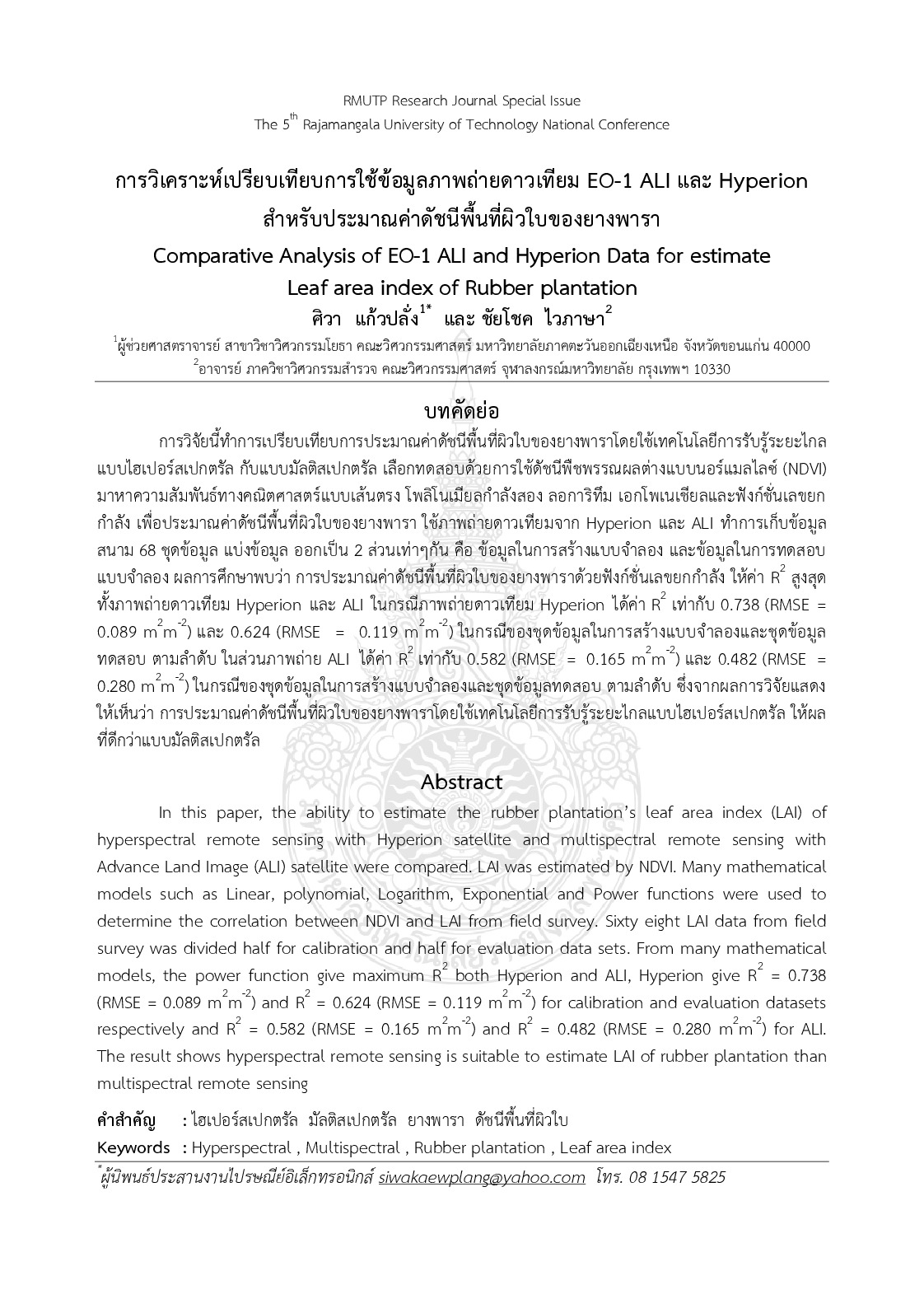
Comparative analysis of EO-1 ALI and Hyperion data for estimate leaf area index of rubber plantation
In this paper the ability to estimate the rubber plantation’s leaf area index (LAI) of hyperspectral remote sensing with Hyperion satellite and multispectral remote sensing with Advance Land Image (ALI) satellite were compared. LAI was estimated by NDVI. Many mathematical models such as Linear polynomial Logarithm Exponential and Power functions were used to determine the correlation between NDVI and LAI from field survey. Sixty eight LAI data from field survey was divided half for calibration and half for evaluation data sets. From many mathematical models the power function give maximum R2 both Hyperion and ALI Hyperion give R2 = 0.738 (RMSE = 0.089 m2m-2) and R2 = 0.624 (RMSE = 0.119 m2m-2) for calibration and evaluation datasets respectively and R2 = 0.582 (RMSE = 0.165 m2m-2) and R2 = 0.482 (RMSE = 0.280 m2m-2) for ALI. The result shows hyperspectral remote sensing is suitable to estimate LAI of rubber plantation than multispectral remote sensing