จำนวน Repository ( 1174 )
Expenditure Behavior Following the Sufficiency Economy Concept of Teachers Faculty of Business Administration Rajamangala University of Technology Pha Nakhon.
The objectives of this study were to study expenditure behaviors following the Sufficiency Economy Concept of teachers Faculty of Business Administration Rajamangala University of Technology Pha Nakhon in 3 aspects : moderation reasonableness immunization; compare the expenditure behaviors of the teachers by sex monthly incomes debt conditions and years of work experiences. The sample consisted of 92 teachers Faculty of Business Administration Rajamangala Univerity of Technology Pha Nokhon. The instrument used in data collection was a 5-level scale questionnaire with an alpha reliability of 0.95. The descriptive statistics used in data analysis were frequency percentage mean standard deviation. The statistics used in hypothesis tests were t-test One-Way ANOVA and post hoc LDS tests. The result of the study are as follows. 1. The expenditure behaviors following the Sufficiency Economy Concept of teachers Faculty of Business Administratjon Rajamangala University of Technology Pha Nakhon as a whole and individual 3 aspects : moderation reasonableness and immunization were at the high level. 2. The male and female teachers did not have different expenditure behaviors following the Sufficiency Economy Concept as a whole and individual 3 aspects. 3. The teachers having different monthly incomes had significantly different expenditure behaviors following the Sufficiency Economy Concept as a whole the moderation and the reasonableness at .01 level; teachers having > 29519 Baht monthly incomes had higher mean of the expenditure behaviors as a whole the moderation and the reasonableness than those having < 22251 Baht monthly incomes and 22251-29519 Baht monthly incomes. 4. The teachers having different debt conditions had significantly different expenditure behaviors following the Sufficiency Economy Concept as a whole and individual aspects at .01 level; teachers having no debt and teachers having manageable debt had higher means of the expenditure behaviors as a whole and the 3 aspects than those having unmanageable debt. 5. The teachers having different years of work experiences did not have different expenditure behaviors following the Sufficiency Economy Concept as a whole. When considered individual aspects it was found that means of 2 aspects were significantly different at .05 level as follows : teachers having 20-27 years of work experiences and > 27 years of work experiences had significantly higher means in the moderation aspect than teachers having < 20 years of work experiences; and teachers having > 27 years of work experiences had significantly higher mean in the reasonableness than teachers having < 20 years of work experiences.
A Study of Requirement and Factors Influlence Purchasing Decision
The purposes of the study were 1) to investigate factors influencing the needs and purchasing decisions of Malaysians to buy processed foods 2) to study the relationship between the variable factors affecting Thai entrepreneurs decision making and 3) to examine the goodness of fit of the causal model of the factors affecting the needs and purchasing decisions of Malaysians to buy processed foods with empirical data. The study applied mixed research method. The research samples selected through Simple Random Sampling were Malaysians buying Halal processed food products from Thailand. The research data were collected by questionnaires and analyzed by Confirmatory Factor Analysis (CFA) and Structural Equation Modeling (SEM). The research findings were as follows that 1) the factors affecting the needs and purchasing decisions to buy processed foods of Malaysians consisted of cultural factors perceived marketing mix factors past behavior factors quality confidence factors and factors regarding purchase intention on Thai processed foods. 2) Confirmatory Factor Analysis was administered and the findings revealed that every factor applied was appropriate. Even though the number of the variables decreased structural reliability remained acceptable and could suitably be applied to Thai export businesses. 3) The model explaining the relationship between the factors according to the hypothesis analyzed by Linear Structure Equation Modeling yielded direct influences consistent with the five hypotheses having been proposed. The research result showed that Malaysians were confident in Thai Halal Products Standard Certification with high reliability of 80
Attitude and achievement in business finance of students in faculty of Business Administration of Rajamangala University of Technology Phra Nakhon , learning through cooperative learning method
The purpose of this study was to study the attitude and the undergraduates’ learning achievement towards Business Financial of undergraduate of Rajamangala University of Technology Phra Nakhon through the use of a cooperative learning method. The study participates selected by Purposive sampling. The Experimental Design was Randomized Control-Group Pretest-Posttest Design. The 3 item tests and 28 item questionnaires of Likert’s rating scales was used as the research instrument. Percentage mean standard deviation and t - test for independent sample analysis were statistical method to analyze data. The results were as follows: 1. The attitude towards Business Finance of the experimental group were significant higher than control group at the 0.01 level. 2. Business Finance learning achievement of the experimental group were significant higher than control group at the 0.01 level.
Clothes design for local product style development case study : Pha Chok Thai – Yuan Ratchaburi province
Clothes design for local Product Style Development Case study : Pha Chok Thai – Yuan Ratchaburi province there is important objective in the education studies the production of Pha Chok Thai – Yuan Ratchaburi province to style analyze Clothes Design for Local Product Style Development . The focus of the development of local products The study result meets that of Pha Chok Thai – Yuan Ratchaburi province there is format development of cloth design follows requirement way of consumer group by have the idea in cloth weaving original way cooperates the production for the business for responds to build market system where happens from the development follows idea frame in the community development cloth Thai weaving has whirled can separate weaving way 2 and encourage the idea development from garment of Pha Chok Thai – Yuan Ratchaburi province the point for example the point is first weaving for inheriting wisdom the point is second weaving for the business which bilateral the point can separate the character has of the fabric 4 the group for example 1 pha sin tin chok 2. pha sin Ta 3. the cloth no motif 4. the cloth of other designs will have weaving applied format character follows the idea of Weavers that create to go up from the experience by 4 both of group cloths have will the design that implies way idea lead original integrate with contemporary idea which can summarize get 2 the group for example 1. the original pattern 2. the applicability pattern. Study then lead the cloth in the group of sin ta comes to use in designing clothes because of the cloth in this group has design character that splits full the clothes there is the suitability in the bringing uses in designing clothes most and the design has small-sized and have using color various moreover the price still have the suitability in the bringing develops products format bring design the clothes for the age group works by age between 25 - 40 year by have analysis result attitude lead that have to build the filtration uses readymade clothes from the cloth weaves cloth natives comes to use cooperate designing clothes 6 group amounts emphasize format development are appropriate the target group and use valuable cloth is appropriate the bringing processes to garment clothes.
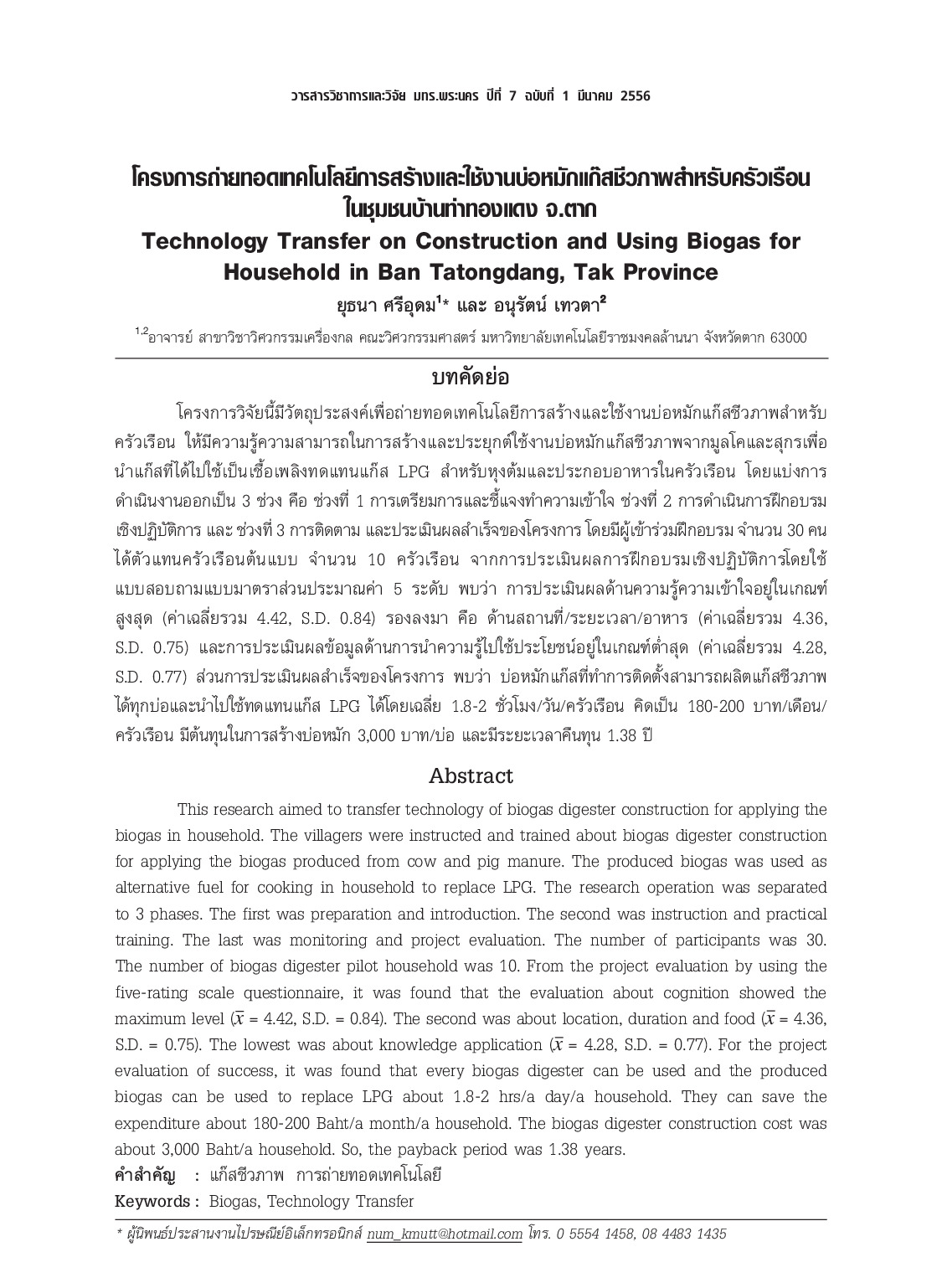
Technology transfer on construction and using biogas for household in ban tatongdang tak province
This research aimed to transfer technology of biogas construction for applying the biogas in household. The villagers were instructed and trained about digester construction for applying the biogas produced from cow and pig manure. The produced biogas was used as alternative fuel for cooking in household to replace LPG. The research operation was separated to 3 phases. the first was preparation and introduction. The second was instruction and practical training. The last was monitoring and project evaluation. The number of participants was 30. The number of biogas digester pilot household was 10. From the project evaluation by using the five-rating scale questionnaire it was found that the evaluation about cognition showed the maximun level (x=4.42 S.D. = 0.84). The second was about location duration and food (X = 4.36 S.D. = 0.75). The lowest was about knowledge application (X= 4.28 S.D. = 0.77). For the project evaluation of success it was found that every biogas digester can be used and the produced biogas can be used to replace LPG about 1.8-2 hrs/a day/a housenold. They can save the expenditure about 180-200 Baht/a month/a household. The biogas digester construction cost was about 3000 Baht/a household. So the payback period was 1.38 years.