จำนวน Repository ( 757 )
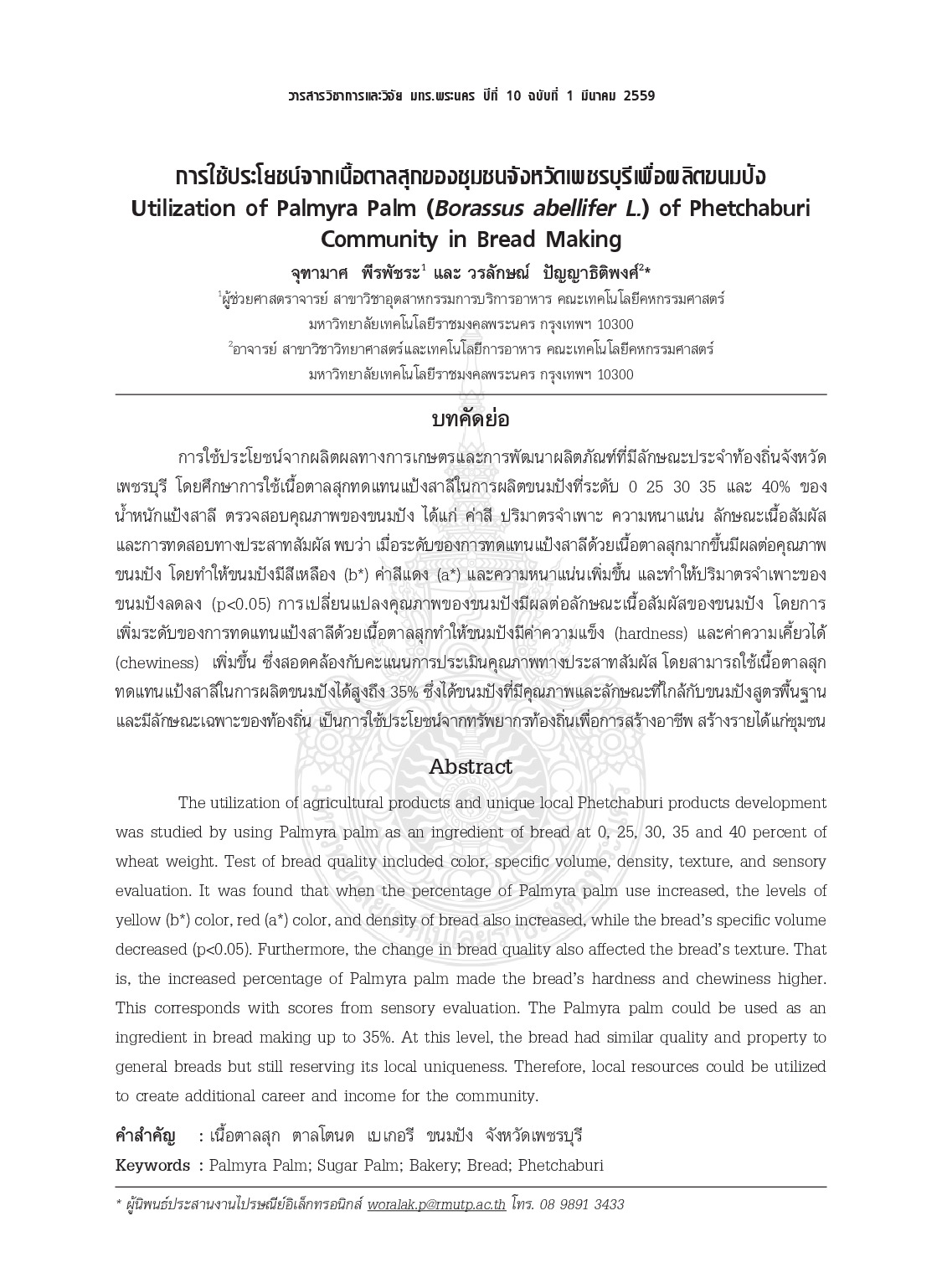
การใช้ประโยชน์จากเนื้อตาลสุกของชุมชนจังหวัดเพชรบุรีเพื่อผลิตขนมปัง
The utilization of agricultural products and unique local Phetchaburi products development was studied by using Palmyra palm as an ingredient of bread at 0 25 30 35 and 40 percent of wheat weight. Test of bread quality included color specific volume density texture and sensory evaluation. It was found that when the percentage of Palmyra palm use increased the levels of yellow (b*) color red (a*) color and density of bread also increased while the bread’s specific volume decreased (p<0.05). Furthermore the change in bread quality also affected the bread’s texture. That is the increased percentage of Palmyra palm made the bread’s hardness and chewiness higher. This corresponds with scores from sensory evaluation. The Palmyra palm could be used as an ingredient in bread making up to 35%. At this level the bread had similar quality and property to general breads but still reserving its local uniqueness. Therefore local resources could be utilized to create additional career and
Factors affecting successful implementation of balanced scorecard of companies in Bangkok Metropolitan
The purposes of the study were to explore success of the organizations which applied Balanced Scorecard to assess the performance and also investigate factors affecting successful implementation of the balanced scorecard of companies in Bangkok metropolitan. The data were collected from the samples which were organizations in production industry registered with Federation of Thai Industries up to 2010 by means of 400 copies of the questionnaire and analyzed by the frequency distribution percentage distribution standard deviation Pearson Product Moment Correlation Coefficient and Multiple Regression Analysis. The result showed that factors that influenced the implementation of the balanced scorecard in the organizations were factors regarding working process organizational structure and conflicts respectively.
นวัตกรรมคอนกรีตมวลเบาแบบเซลลูล่าด้วยการใช้วัสดุเหลือทิ้ง
This research presents a study of the compressive strength tensile strength flexural strength and water absorption of Cellular Lightweight Concrete containing fine fly ash and ground bagasse ash. Portland cement (CT) is partially replaced with pozzolans 20 30 and 40% by weight of the cementitious materials. The results show that the compressive strength tensile strength flexural strength and low water absorption of Cellular Lightweight Concrete improves substantially with partial replacement of Portland cement with fly ash and bagasse ash. Cellular Lightweight Concrete mix cement containing 20 and 30% of pozzolans can be used to make cementitious materials. In addition the use of fly ash and ground bagasse ash produces Cellular Lightweight Concrete mix with good compressive strength tensile strength flexural strength and water absorption.

การพัฒนาแผ่นใยไม้อัดซีเมนต์จากาการประยุกต์ใช้เส้นใยธรรมชาติจากกากมะพร้าวและต้นข้าวโพด
This research aims to study the application of coconut meal and corncob fiber as high density cement-bonded fiberboard. The cement: fine sand: coconut meal and corncob fiber: water: cement setting accelerator (aluminium sulphate (Al2(SO4)3) calcium chloride (CaCl2) sodium silicate (Na2SiO3)) ratio is equal to 1: 0.2: 0.05: 0.3: 0.03 by weight. The fibers are taken from coconut meal: corncob that 5 ratios are used following: 0.0500: 0 (CN0) 0.0375: 0.0125 (CN25) 0.0250: 0.0250 (CN50) 0.0125: 0.0375 (CN75) and 0: 0.0500 (CN100) by weight. 12% of Sodium Hydroxide (NaOH) was used to modify the fibers by using 1: 10 of fiber: solution and boiling 100 degree of Celsius (1-3 hours). The fiberboard production use pressure casting in normal temperature (30 – 35 degree of Celsius) and 0.75 g/cm3 of density. Resulting the CN75 ratio is suitable ratio which pass TIS 878-2537 standard (cement bonded particle board: high density) and has good physical properties mechanical properties and thermal insulation. The most suitable cement setting accelerator is calcium chloride (CaCl2).
Potential of extracts of Ficus hispida linn for controlling germination and Growth of Weed in Rice Field for Increase the value of biodiversity and its sustainable use
The potential of extracts of the Ficus hispida Linn to inhibit germination and growth of barnyardgrass (Echinochloa crus-galli) a common weed in rice. The bark leaves and fruit of F. hispida isolated by the Maceration and extracted by the polarity of the solvent (Sequential Extraction) with organic solvents such as hexane ethyl acetate and methanol when each part of the crude extract was tested the type of phytochemical tested for germinate inhibition root length inhibition stem length inhibition and dry weight inhibition of barnyardgrass and selected extracts with highest inhibition to separation using column chromatography the fractions tested repeating. The results showed that 1. Crude methanolic extracts from the bark leaves and fruit of barnyardgrass at a concentration of 3000 ppm showed highest inhibited percentage of germinate inhibition root length inhibition stem length inhibition and dry weight inhibition. 2. Fractions methanolic extracts from the bark leaves and fruit of barnyardgrass on a separate with column chromatography found that fractions extracts F5 F8 and F2 showed highest inhibited percentage of germinate inhibition root length inhibition stem length inhibition and dry weight inhibition.