จำนวน Repository ( 103 )
การวิเคราะห์แรงดันเกินในระบบกราวด์ ของสถานีไฟฟ้าสูงโดยใช้โปรแกรมเอทีพี/อีเอ็มทีพี
The analysis of the grounding system overvoltage in High voltage substation will be held at Bumnetnarong substation Electricity Generating Authority of Thailand ( EGAT ) by using ATP draw for grounding system’s model of substation also to model overvoltage from lightning and to read the result of overvoltage from differences positions. The advantages of the experiment are to be educated and to who design Grounding system in high voltage substation EGAT. The Study’s result of the over voltage level on Ground Potential Rise: GPR model shows that the pie will show close result to the result from the calculation by standard IEEE Std 80-2000 and the result of the Fault Current at the middle position of the grounding system will result in higher overvoltage than at the result at the corner position of Grounding system. The result of Ground Resistance: Rg shows that the increasing of overvoltage the increasing of Ground Resistance: Rg
การสร้างและหาประสิทธิภาพบทเรียนคอมพิวเตอร์ช่วยสอนวิชาการวิเคราะห์ระบบไฟฟ้ากำลัง บทที่ 1-2
The purposes of the research were to create computer assisted instruction for Electric Power System Analysis Chapter 1-2 to find out the efficiency validation of computer assisted instruction based on the standard of 90/90 and to analyse the students learning achievement after using the computer assisted instruction. The subjects in the study were 17 third-year diploma engineering students enrolling at Rajamangala University of Technology Phra Nakhon. The researcher made the experiment by having the students pretest. Then they studied by using the computer assisted instruction focused on practicing basic turning. After the students had studied and had posttest the efficiency of the computer assisted instruction was calculated as well as the learning achievement was analysed. The research result revealed that the efficiency of the computer assisted instruction was at the standard of 90 / 90. Moreover the learning achievement after using the computer assisted instruction was different at the significant level of 0.05.
การวิเคราะห์ความอยู่รอด : การศึกษาการออกกลางคันของนักศึกษา ปวส.สายช่างอุตสาหกรรม มหาวิทยาลัยเทคโนโลยีราชมงคลพระนคร วิทยาเขตพระนครเหนือ
The objectives of the study were to fine the survival probabilities the haazard rates of dropping out of the tecnical diploma level students at Rajamangala University of Technology phra Nakhon North Bangkok Campus and the factors influencing on the university in 2005. The study foud tht the frist semester the survival probabilities of students in all divisions were high ranging from 0.9210 to 1.00 For the second semester the survival probabilities of students in all divisions ranged from 0/7820 to 0.8815 except Industrial Technology which had a maximum value of 0.9295 aned Metal Technology which had aminimum value of 0.6271. For the third and the fourth semester there were 6 division which had survival probabilities ranging from 0.7142 to 0.7971. They were Tool and Die Making Computer technology Eletrical Technology Electronics Auromatic Machine and production design. They 4 were Mechanical Tool Technology Business Computer Mechanical Power and Industrial Technolog. the hazard rates of dropping of students in all divising were low ranging for 0.00 to 0.0822. For the second semester the hazard rates of dropping of students in all divisions ranged from 0.1260 to 0.2458 except Industrial technology which had a minimum value of 0.0730 and Metal Technology which had a miximum value of 0.5221. For the third and the fourth semester the hazard rates of students in all division ranged from 0.1355 to 0.2962 excepy metal Technology which had the maximum value of 0.5932 and Tool and Die Making which had the value of 0.3364. The factors influencing on hazard rates of students drpout were place of previous school region of previos school and grade point average of previons school. The hazard rate of dropping of students graduation from school in the central region (not including Bankok Metropolitan Area) was 43% (0.562 times) less than the hazard rate of dropping of students graduation from schools in Bangkok metropolitan area. The hazard rate of dropping of students having grade aveage of 3.10-3.50 and 3.51-4.00 from previous school was 43.1% (0.569 times) and 63.7% (0.377 times) less than the hazard rate of students having grade point average of 2.00-2.50 respectively.
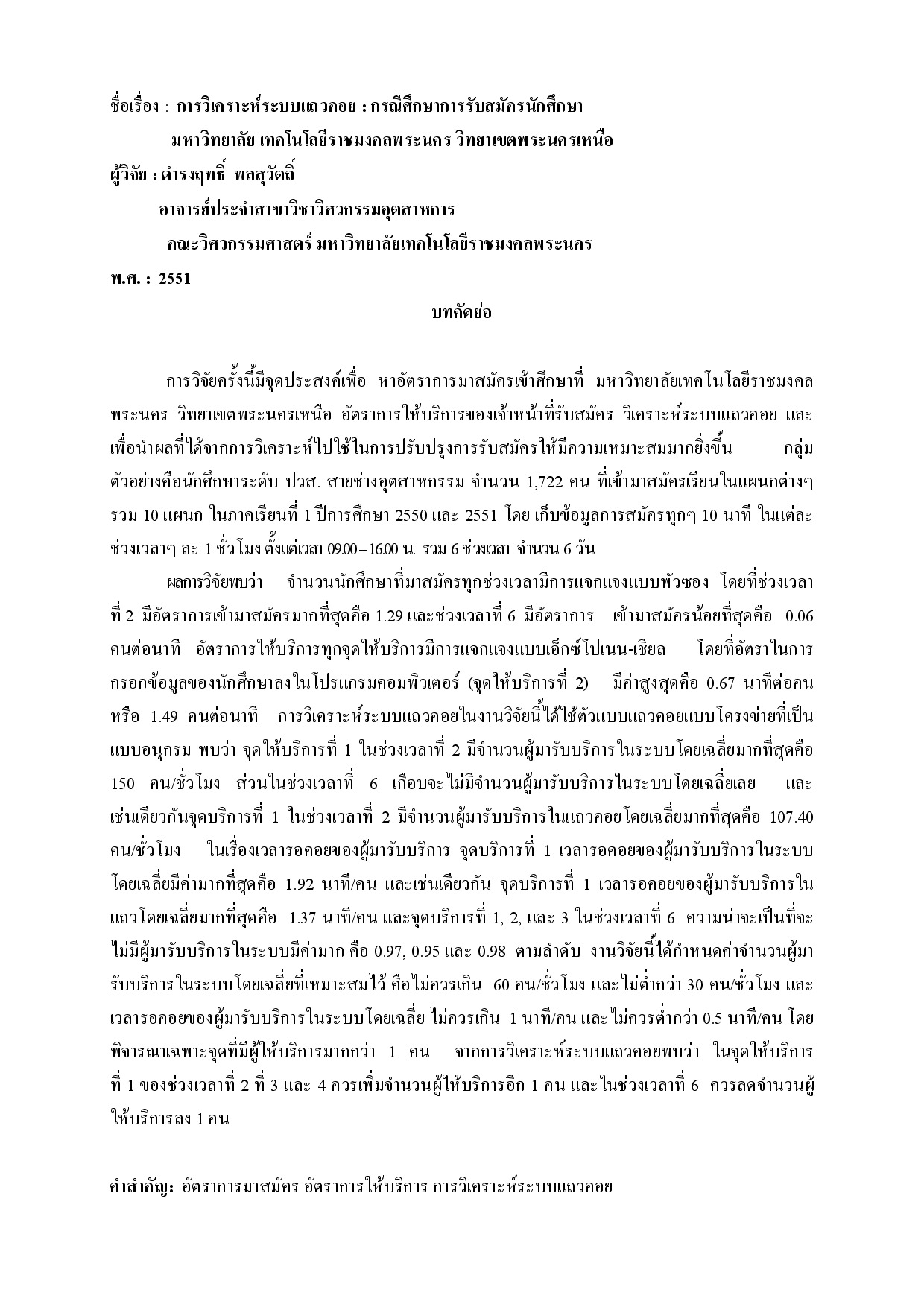
การวิเคราะห์ระบบแถวคอย, กรณีศึกษาการรับสมัครนักศึกษามหาวิทยาลัยเทคโนโลยีราชมงคลพระนคร วิทยาเขตพระนครเหนือ
The objectives of the study were to find the arrival rate of applicants who applied to study at Rajamangala university of Technology Pra Nakhon North Bangkok Campus the service rate of admission officers and to analyze queuing system in order to improve the admission system. The sample was 1722 technical students who applied to study in 10 divisions in 2007 and 2008. The application data was collected every 10 minutes in each one-hour period from 09.00 am. to 16.00 pm. for 6 days. The study found that the distribution of the number of applicants was Poisson distribution. The highest arrival rate 1.29 students/min was at the second period and the lowest arrival rate 0.06 students/min was at the sixth period. The distribution of service time at each station was exponential distribution. The highest service rate 0.67 min/student or 1.49 students/min was at the second station entering data into a computer. Queuing analysis in this study was series network. The analysis found that the highest expected number of applicants in the system 150 students/hour was at the first station in the second period and in the sixth period there was almost none. The highest expected number of applicants in the queuing system 107.40 students/hour was at the first station in the second period. The highest expected waiting time in the system 1.92 min/student and in the queuing system 1.37 min/student were at the first station. The probabilities of none of applicants in the system at the first the second and the third station in the sixth period were high 0.970.95 and 0.98 respectively. The proper value of the expected number of applicants in the system set in this study was not more than 60 students/hour and not less than 30 students/hour. The proper value of the waiting time in the system was not more than 1 min/student and not less than 0.5 min/students for stations with more than one servers. The analysis found that at the first station one more server should be added in the second the third and the forth period and one less server should be reduced in the sixth period.
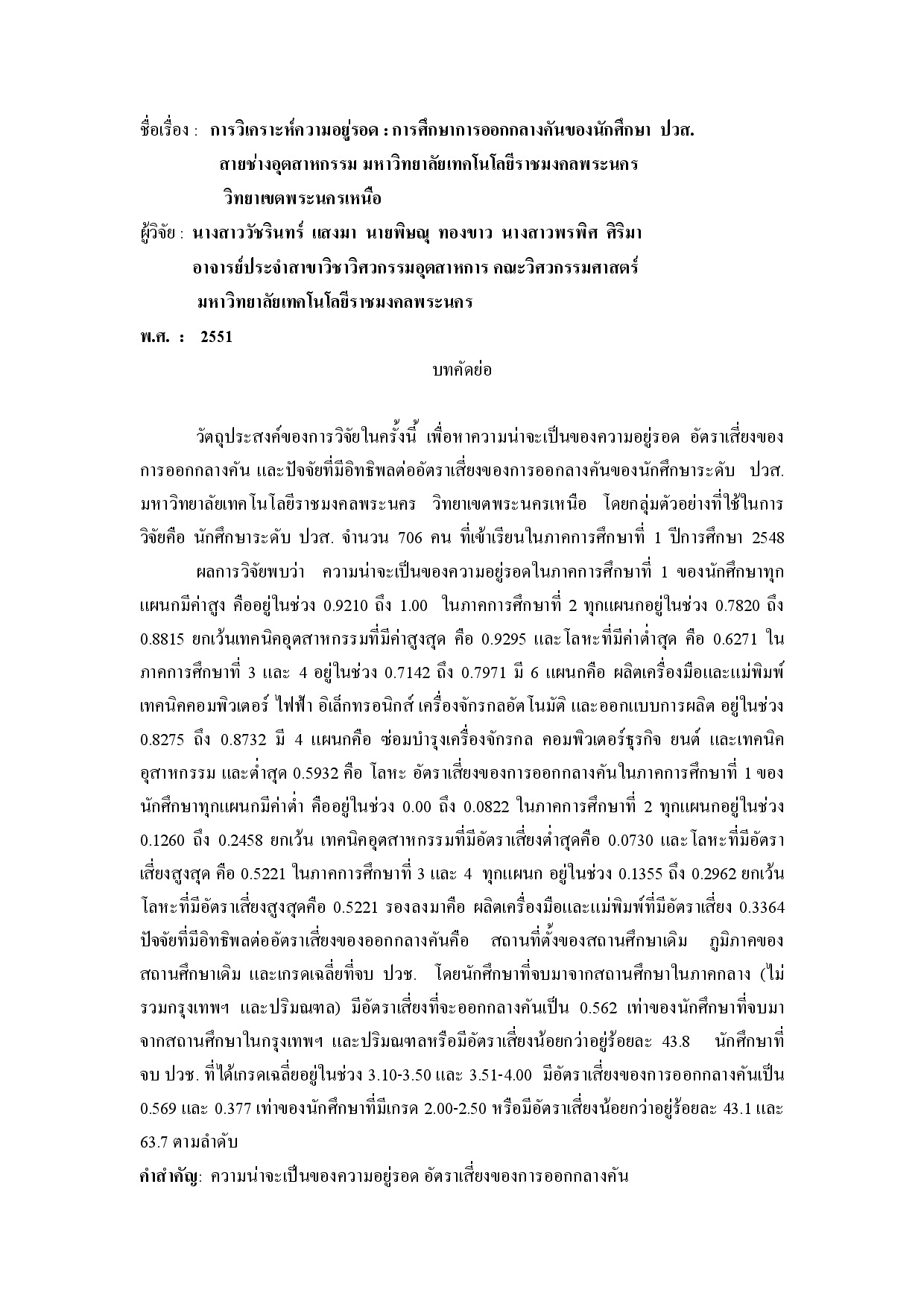
การวิเคราะห์ความอยู่รอด : การศึกษาการออกกลางคันของนักศึกษา ปวส. สายช่างอุตสาหกรรม มหาวิทยาลัยเทคโนโลยีราชมงคลพระนคร วิทยาเขตพระนครเหนือ
The objectives of the study were to find the survival probabilities the hazard rates of dropping out of the technical diploma level students at Rajamangala University of Technology Phra Nakhon North Bangkok Campus and the factors influencing on the hazard rates of students dropout. The sample was the students enrolling in the university in 2005. The study found that for the first semester the survival probabilities of students in all divisions were high ranging from 0.9210 to 1.00. For the second semester the survival probabilities of students in all divisions ranged from 0.7820 to 0.8815 except Industrial Technology which had a maximum value of 0.9295 and Metal Technology which had a minimum value of 0.6271. For the third and the fourth semester there were 6 divisions which had survival probabilities ranging from 0.7142 to 0.7971. They were Tool and Die Making Computer Technology Electrical Technology Electronics Automatic Machine and Production design. There were 4 divisions which had survival probabilities ranging from 0.8275 to 0.8732. They were Mechanical Tool Technology Business Computer Mechanical Power and Industrial Technology. The division of Metal Technology had the minimum value of 0.5932. For the first semester the hazard rates of dropping of students in all divisions were low ranging from 0.00 to 0.0822. For the second semester the hazard rates of dropping of students in all divisions ranged from 0.1260 to 0.2458 except Industrial Technology which had a minimum value of 0.0730 and Metal Technology which had a maximum value of 0.5221. For the third and the fourth semester the hazard rates of dropping of students in all divisions ranged from 0.1355 to 0.2962 except Metal Technology which had the maximum value of 0.5932 and Tool and Die Making which had the value of 0.3364. The factors influencing on hazard rates of students dropout were place of previous school region of previous school and grade point average of previous school. The hazard rate of dropping of students graduating from schools in the central region (not including Bangkok Metropolitan Area) was 43.8% (0.562 times) less than the hazard rate of dropping of students graduating from schools in Bangkok Metropolitan Area. The hazard rate of dropping of students having grade point average of 3.10-3.50 and 3.51-4.00 from previous school was 43.1% (0.569 times) and 63.7% (0.377 times) less than the hazard rate of dropping of students having grade point average of 2.00-2.50 respectively.