จำนวน Repository ( 73 )

Fatigue life evaluation of a closed-loop oscillating heat-pipe with check valves (CLOHP/CV) at operated temperature
This study evaluates the fatigue life of a closed-loop oscillating heat-pipe with check valves (CLOHP/CV). The method was predicting the fatigue life of the copper tube to apply for the CLOHP/CV. The fatigue test was carried out by using the specimens made of copper tube (C1220) at the temperature of 293 (room temperature) 473 and 573 K. The three types of hourglass shaped specimen included uniform type one-wave type and two-wave type specimens. It was found that the effect was a direct extension of material structures of specimen and hourglass shaped. It can be said that the number of cycles to failure (Nf) of the two-wave type specimen hourglass shaped specimen was rather sensitive to fatigue motion during testing and the temperature of 573 K has the greatest failure impact.
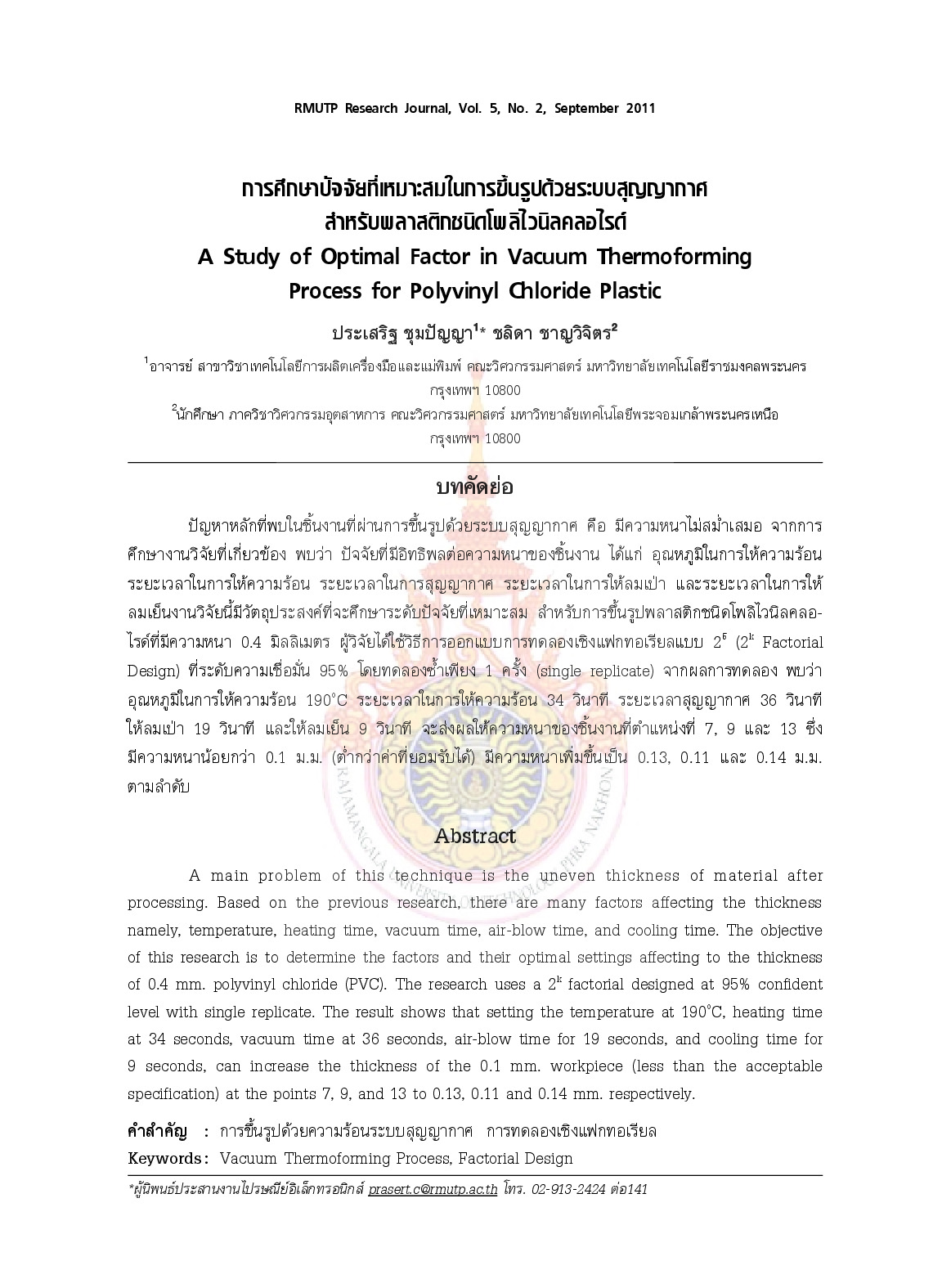
การศึกษาปัจจัยที่เหมาะสมในการขึ้นรูปด้วยระบบสุญญากาศสำหรับพลาสติกชนิดโพลิไวนิลคลอไรด์
ปัญหาหลักที่พบในชิ้นงานที่ผ่านการขึ้นรูปด้วยระบบสุญญากาศ คือ มีความหนาไม่สม่ำเสมอ จากการ ศึกษางานวิจัยที่เกี่ยวข้อง พบว่า ปัจจัยที่มีอิทธิพลต่อความหนาของชิ้นงาน ได้แก่ อุณหภูมิในการให้ความร้อน ระยะเวลาในการให้ความร้อน ระยะเวลาในการสุญญากาศ ระยะเวลาในการให้ลมเป่า และระยะเวลาในการให้ ลมเย็นงานวิจัยนี้มีวัตถุประสงค์ที่จะศึกษาระดับปัจจัยที่เหมาะสม สำหรับการขึ้นรูปพลาสติกชนิดโพลิไวนิลคลอ- ไรด์ที่มีความหนา 0.4 มิลลิเมตร ผู้วิจัยได้ใช้วิธีการออกแบบการทดลองเชิงแฟกทอเรียลแบบ 25 (2k Factorial Design) ที่ระดับความเชื่อมั่น 95% โดยทดลองซ้ำเพียง 1 ครั้ง (single replicate) จากผลการทดลอง พบว่า อุณหภูมิในการให้ความร้อน 190๐C ระยะเวลาในการให้ความร้อน 34 วินาที ระยะเวลาสุญญากาศ 36 วินาที ให้ลมเป่า 19 วินาที และให้ลมเย็น 9 วินาที จะส่งผลให้ความหนาของชิ้นงานที่ตำแหน่งที่ 7 9 และ 13 ซึ่ง มีความหนาน้อยกว่า 0.1 ม.ม. (ต่ำกว่าค่าที่ยอมรับได้) มีความหนาเพิ่มขึ้นเป็น 0.13 0.11 และ 0.14 ม.ม. ตามลำดับ
A Modeling of Heat Transfer in Cooling Coil using Finite Element Method
In general for the refrigeration the cooling coil is almost used to be the device to decrease the temperature. Thus in order to design heat exchange we should study the heat transfer into the cooling coil. This research proposes the numerical using finite element method for calculating the temperature at any position of the cooling point for considering to porous media. After that to create an algebraic equation fmite element for writing the program to search the solution by estimating the temperature. The research demonstrates that the changing of temperature will be decreased to saturated condition that is the temperature around the region of the cooling coil model edge will be decreased. The longer time the lower temperature around each position will decrease respectively until the temperature at each position inside the model are the same as region of the cooling coil model edge. Therefore this search result can be the basic for the comparison with the similar problem of other