จำนวน Repository ( 81 )


การปรับปรุงคุณภาพภาดฃพโดยวิธีการปรับเท่าฮีสดตแกรมออกเป็นสองส่วนผ่านทางเวฟเล็ต
The image enhancement process of a digital image is a part of digital signal processing which it plays an important role in some industrial segments for instance object classification or bio-identification satellite exploration or aerial images robot vision cancer treatment etc. These image applications are necessary to consume many resources in physical hardware and computer programming including the intelligent algorithm development of complexly advanced processing in order to enhance digital images – as well as be easy to analyse by humans. This research is aimed to present on Contrast Enhancement using Bi-Histogram Equalization via Two Dimensional Discrete Wavelet Transform (BHE2DWT) in order to compose the coefficient wavelet from other signals. At the end of the process information on the approximation band from DWT will be divided into two sub-histograms and then histograms will be independently equalized. After that resulting histograms will be decomposed by IDWT. Resulting images will be not only more displaying in high contrast than their original images but also preserve the absolute mean brightness error (AMBE) to close their original images.
The development of critical thinking about financial ratio by cooperative learning : numbered heads together technique. case study undergraduate of Sripatum University chonburi campus
The objectives of this research were 1) study about educational achievement in financial ratio of undergraduate of Sripatum University by cooperative learning: numbered heads together. 2) compare the learning achievement in financial ratio being taught by cooperative learning: numbered heads together technique and the Traditional teaching method . The population used in the research was 80 students that enrolled in business finance on semester 1/2012. The population was divided into a control group and an experimental group. Each group contained 40 students. For data analysis mean standard deviation t-test were used. The research finding indicated that the learning achievements of students using the cooperative learning : numbered heads together technique and the traditional teaching method were at variance with statistical significance at the level of .05 whereas the learning achievement of students of the experimental group treated by cooperative learning: numbered heads together was found higher than the experimental group treated by the traditional teaching method.
Optimization for sewing machine setup using experimental design technique
The objective of the research was to identify the optimized thread tensile values for the setup of Model D – We 1218-55 computerized 18-needles sewing machine in order to minimize a number of times the machine halts. The cause of the sewing machine halting which reduced the efficiencies of the machine was found to be torn threads. In order to maximize the efficiencies the experimental design technique was utilized to find the optimal values for five types of cloth: polo tc-cool cotton jacket and shirt. The method involved three nested designs which are the type of thread number of sewing layers and thread-hole size. The three thread tensile levels experimented were low (2 oz.) medium (5 oz.) and high (8 oz.) and the response was the number of times the machine halted in the span of 30 minutes. The ANOVA (Analysis of Variance) used for the experimental design showed that the three factors significantly affected the machine’s halt. The number of times the machine halted was used to create Surface Plot with polynomial trend-lines and the quadratic equation was applied to determine the optimal value for each type of thread number of sewing layers and thread-hole size. The values obtained were then set for another experiment the results of which were that the sewing machine halted less frequently and the efficiencies thus increased about by 77.01%.
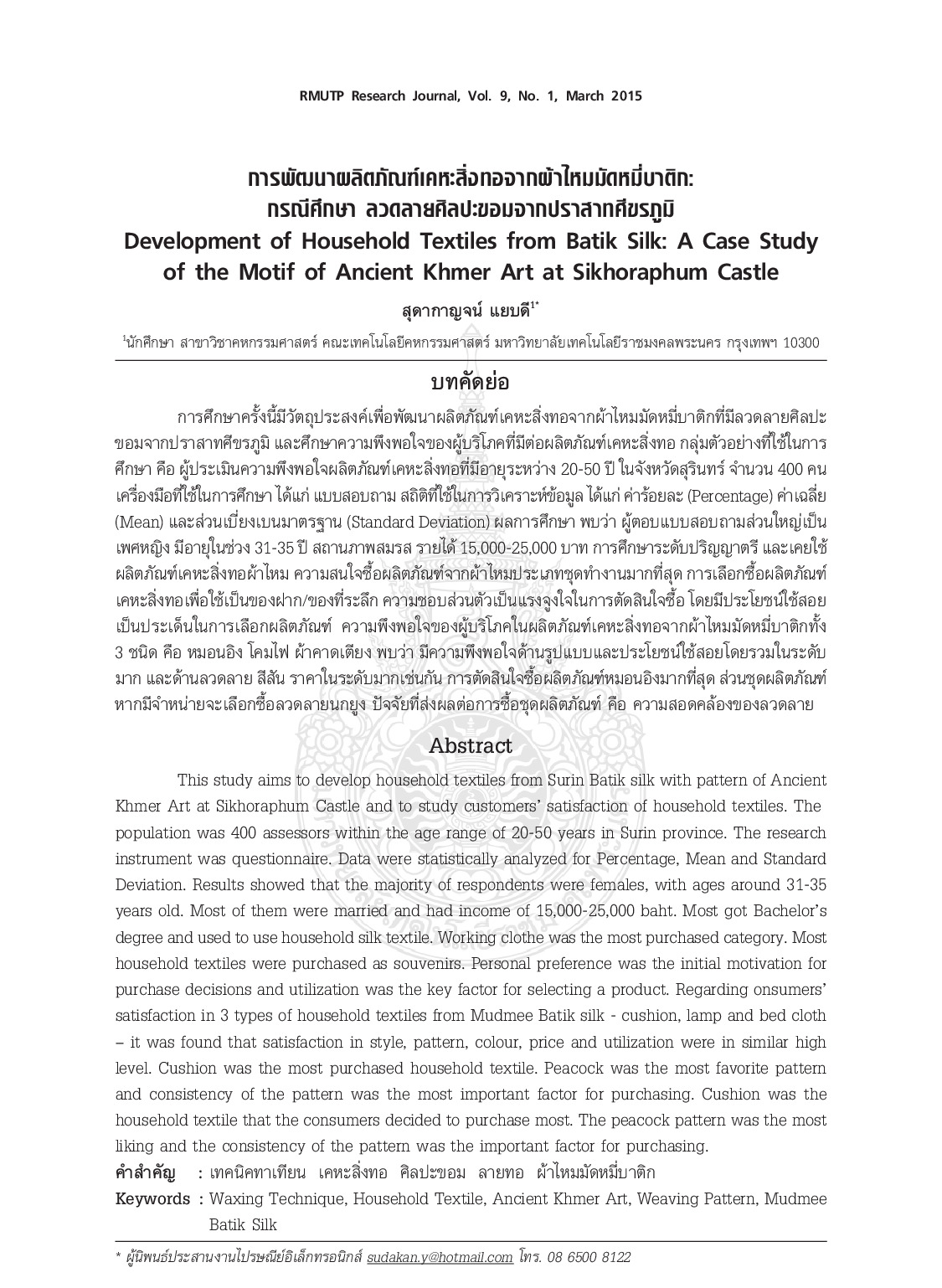
Development of household textiles from batik silk: a case study of the motif of ancient khmer art at sikhoraphum castle
This study aims to develop household textiles from Surin Batik silk with pattern of Ancient Khmer Art at Sikhoraphum Castle and to study customers’ satisfaction of household textiles. The population was 400 assessors within the age range of 20 - 50 years in Surin province. The research instrument was questionnaire. Data were statistically analyzed for Percentage Mean and Standard Deviation. Results showed that the majority of respondents were females with ages around 31 - 35 years old. Most of them were married and had income of 15000 – 25000 baht. Most got Bachelor’s degree and used to use household silk textile. Working clothe was the most purchased category. Most household textiles were purchased as souvenirs. Personal preference was the initial motivation for purchase decisions and utilization was the key factor for selecting a product. Regarding onsumers’ satisfaction in 3 types of household textiles from Mudmee Batik silk - cushion lamp and bed cloth – it was found that satisfaction in style pattern colour price and utilization were in similar high level. Cushion was the most purchased household textile. Peacock was the most favorite pattern and consistency of the pattern was the most important factor for purchasing.