จำนวน Repository ( 93 )
การพัฒนาผลิตภัณฑ์เบเกอรี่จากหยวกกล้วยและส่วนเหลือทิ้งใน การผลิตกล้วยตากของกลุ่มวิสาหกิจชุมชนแม่บ้านบางตาโฉม จังหวัดสิงห์บุรีสู่เชิงพาณิชย์อย่างยั่งยืน
Bakery Products Development from the Banana Pseudo-stems and Waste from Dried Banana Production at Ban Bang Ta Chom Community Enterprise Sing Buri Province for Sustainable Commerce. Research on bakery product development from paprika and bananas in Production of Dried Banana of Bang Ta Chom Housewife Community Enterprise Group Sing Buri province for sustainable commercialization in order to: 1. Develop bakery products from 4 types of Banana Pseudo-stems and Waste 2. study the formulas and production processes of bakery products from Banana Pseudo-stems and Waste 3. study the consumer test of bakery products from 4 types of Banana Pseudo-stems and Waste and 4. To transfer technology Little Bakery products from Banana Pseudo-stems and Waste then bring the shelf life in conditions ranging from 0-10 days and compare the physical properties. Chemical and microorganisms such as pH value color measurement and total number of microorganisms found that Khanom Jeen noodles stored in modified atmosphere conditions have longer shelf life than those stored. At normal atmospheric conditions and vacuum conditions. Chemical analysis results showed that the bakery products decreased their pH over time. With values between 4.31 ± 0.00 and 2.99 ± 0.01 and bakery products Stored at 100% carbon dioxide (CO2) modified atmosphere packed in a sealed nylon / PET vacuum plastic bag. Store at room temperature. Can be stored for up to 10 days and found that the total number of microbes increased when the storage life is longer But not over the standard of community products so the products are safe and not harmful to consumers. Consumer test results show that consumers like and are interested in buying bakery products that use 100 percent carbon dioxide (CO2) at 75 percent.
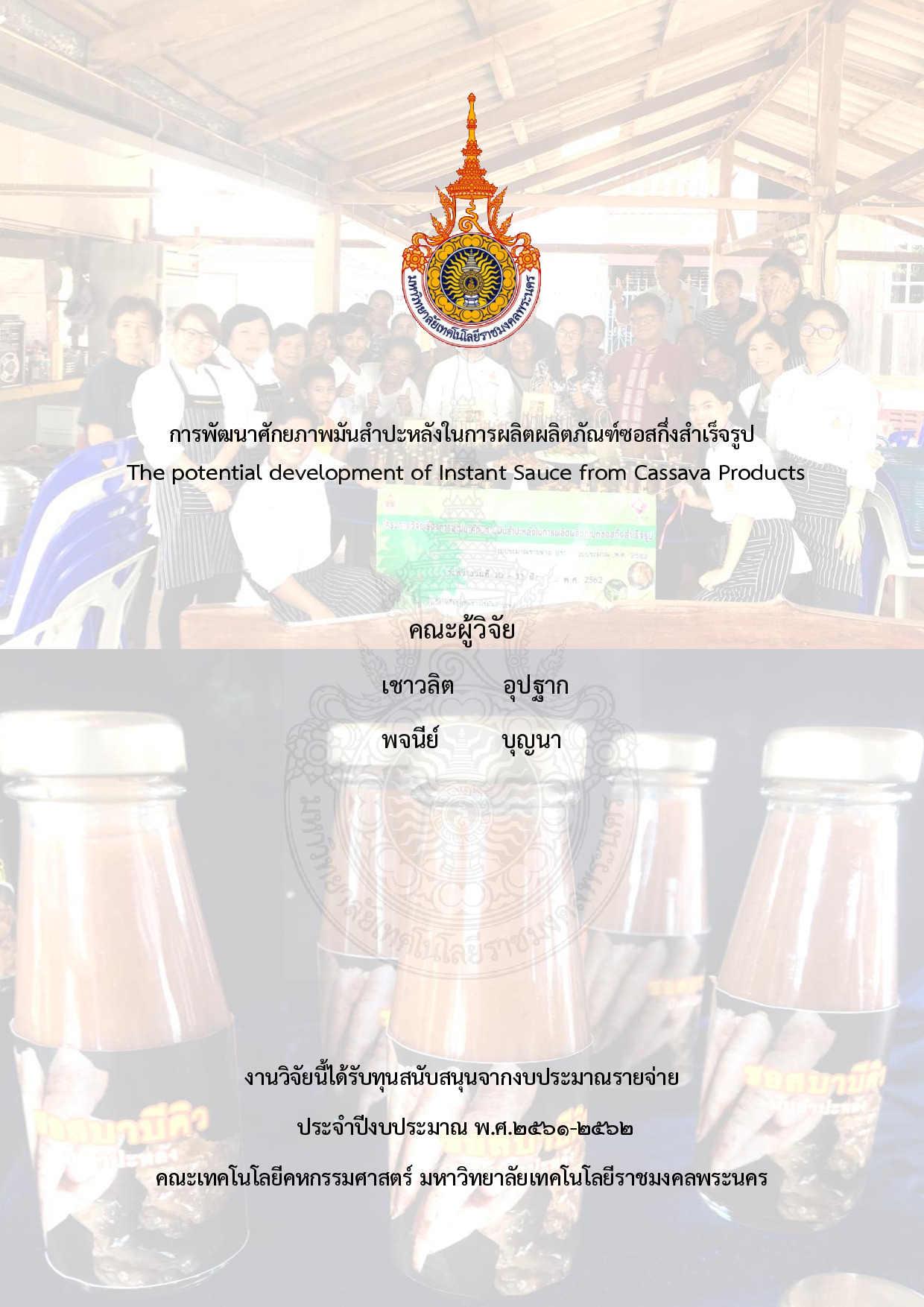
การพัฒนาศักยภาพมันสำปะหลังในการผลิตผลิตภัณฑ์ซอสกึ่งสำเร็จรูป
This research has objectives to study about production process of four types of finished sauce product made from cassava to study about quality of finished sauce product made from cassava to study about consumer test towards finished sauce product made from cassava. From the test it was found that study about quantity of suitable cassava supplement to the four types of finished cassava product by testing about acceptance of testers who were 40 instructors in field of Food and Nutrition field of Food and Nutrition Science and field of Food Service Industry. The method was to give marks for favor in type of 9-point hedonic scale by supplementing cassava into Teriyaki Sauce at levels of 0 20 40 and 60 percent of total ingredient. It was found that the testers accepted the sauce at level of 20 percent which was in the most favorite level. Semi-finished frying sauce supplemented with cassava at level of 0 40 60 and 80 percent of total ingredient; it was found that the testers accepted the level of 60 percent of Barbeque sauce supplemented with cassava at level of 0 40 60 and 80 percent of total ingredient; it was found that the testers accepted level of 40 percent in the level of much favor of semi-finished flavored fermented frying sauce supplemented with cassava at level of 0 20 40 and 60 percent of total ingredient it was found that the testers accepted the sauce at level of 40 percent which is in the level of much favor. Nutritional value of semi-finished sauce product it was found that Teriyaki sauce for 20 percent has moisture value of 78.66 percent fat value of 1.08 percent fiber for 1.36 percent ash for 2.29 percent and protein for 3.34 percent. Semi-finished frying sauce it was found that semi-finished frying sauce supplemented with cassava for 60 percent had moisture value of 80.85 percent fat value of 0.55 percent fiber for 1.35 percent ash for 3.35 and percent and protein for 3.29 percent. cassava for 60 percent it was found that chemical quality had moisture for 82.31 percent fat value for 0.75 percent fiber for 1.51 percent ash for 2.41 percent and protein for 3.37 percent. Semi-finished fermented flavored sauce it was found that semi-finished fermented flavor sauce supplemented with cassava for 40 percent it was found that chemical quality had moisture value for 83.67 percent fat value for 0.07 percent fiber 4.54 percent ash for 4.54 percent and protein for 2.42 percent. However supplementing of cassava into process of finished food products of 4 types; supplementing can be made but there shall be realizing about chemical elements of starting components for example moisture and fat quantity. These components may have effect on physical features for example smell smell and taste and texture. These features affected acceptance of products. The result of study about acceptance of consumers (Consumer test) towards product of semi-finished sauce supplemented with cassava and 100 consumers in Faculty of Home Economics Technology Rajamangala University of Technology Phra Nakhon and people in Tevet Market. Feeling towards acceptance of semi-finished sauce product supplemented with cassava it was found that consumers were satisfactory towards Teriyaki sauce product in moderate favor level having feeling on product in appearance color smell smell and taste in moderate favor level. Feeling towards acceptance of semi-finished sauce product it was found that consumers were satisfactory towards semi-finished frying sauce product 60 percent in moderate favor level having feeling on product in appearance color smell smell and taste in moderate favor level. Feeling towards acceptance of semi-finished fermented sauce product it was found that consumers were satisfactory towards semi-finished fermented sauce product 75 percent in moderate favor level having feeling on product in appearance color smell smell and taste in moderate favor level. Result of technology transfer in project of cassava potential development in production of semi-finished sauce product Tapioca Farmer Community Enterprise Group 480 Khon Buri District and Nong Bunmak District Nakhon Ratchasima Province 45 trainees; most were female having age of 36-45 years to be 96.00 percent. From evaluation it was found that 45 respondents used knowledge to be 100 percent and satisfactory of service receivers in academic aspect and professional aspect towards benefit from service of trainees in level from much to the most to be 100 percent.
การพัฒนาศักยภาพมันสำปะหลังในการผลิต ผลิตภัณฑ์น้ำพริก
The purpose of this research to study the process of destruction of cyanide in cassava. Prior to use in product of Thai pastes and study use of cassava in Thai pastes production of 4 types in tha dang pastes roasted chili paste lohng reuua paste Tamarind chili paste. study physical properties and chemical properties of product and consumer test studies in cassava products affective. in order that transfer technology of development products to the community. The study process to destroy cyanide in cassava before to use in products of pastes. The steaming process in cassava is the low dose of cyanide 18.9 ppm. Studies using cassava to produce 4 types of pastes. The average score of tha dang pastes supplement of cassava 15 percentage in terms of appearance color taste texture and overall liking. The average score was 7.20.7.30.7.00.7.20 and 7.50. This is a preference at a moderate level. Sensory evaluation of roasted paste supplement of cassava 40 percent in terms of appearance color taste texture and overall liking. The average score was 7.86 8.05 7.79 7.86 7.71 and 7.79 This is a preference at a moderate level. Sensory evaluation of lohng reuua paste supplement of cassava 10 percent in terms of appearance color aroma taste texture and overall liking. The average score was 7.30 6.70 7.00 7.50 7.30 and 7.25. This is a preference small and medium-like. Sensory evaluation of tamarind paste supplement of cassava 20 percent in terms of appearance color aroma taste texture and overall liking. The average score was 7.40 7.15 7.15 7.20 7.20 and 7.50. there is a preference moderate inclination. When all 4 types of products were tested for physical chemical and microbiological. we found increasing the amount of cassava in products has affect the color of the products and increase of fat and fiber in the products. All 4 types of cassava products of biomass are no harmful by Thai Industrial Standards Institute. The study on consumer acceptance of the products cassava paste the 4 types. The consumers test responded to the questionnaire were female. The age of the respondents is 21-30year and occupation of the respondents are students. Most of the revenue will be at 10001-15000 baht. The consumers liking the product in rate like very much to like most and accept all 4 types of cassava products. Most consumers buy for storing themselves including buying as souvenirs. The price of products in consumers agree on the price of 35 baht.
การใช้ลูกหนามแดงทดแทนมะขามอ่อนบางส่วนในผลิตภัณฑ์น้ำพริกมะขาม
This study was to investigate: the basic recipe of tamarind chili paste the suitable proportion of karonda fruit that used instead of young tamarind in the product of tamarind chili paste the quality and the chemical properties of tamarind chili paste and the basic recipe and recipe of tamarind mixed with karonda fruit. The result of the basic recipe of tamarind chili paste was acceptable by 50 samples and the 9-point hedonic scale was used in this study. For the appearance color smell flavor texture and overall taste the respondents rated the taste for tamarind chili paste that 240 gram of young tamarind ground per 200 gram pork ground (6:5 ratio) with the very high level score (8.02-8.20). Then study the substitutions of tamarind with karonda fruit that used 25% 50% and 75% of the young tamarind weight respectively. The result of sensory test found that respondents acceptably rate was 75% of using karonda fruit instead of tamarind in tamarind chili paste. For the quality of the basic tamarind chili paste recipe and the use karonda fruit instead of tamarind chili paste 75% color values (L * a * b *) and water activity (aw) were not significantly different (p>0.05). But tamarind chili paste shows that pH 4.20 that is lower than tamarind chili paste mixed with karonda fruit pH 4.49. The chemical composition of tamarind chili paste that substituted with karonda fruit 75% provides energy 237 kcal protein 11.5% fat 10.5% ash 4.47% carbohydrate 23.7% (fiber 5.20%) and moisture content 49.33%. Moreover tamarind chili paste mixed with karonda fruit contents iron 1.71±0.01% Phenolic content 1.49 mg GAE/g extract and it has antioxidant activity DPPH 4.68 umole Trolox/g extract.
การลดการดูดซับน้ำมันในผลิตภัณฑ์แห้วทอดด้วยเทคโนโลยีสนามไฟฟ้า
This research is studying of an electric field combine with a frying process in a Chinese water chestnut product for reducing oil absorb. An electric field that is used in an experiment will have a stress from 1-3 kV/cm. This will be generated by using a direct current high Voltage from 1066 to 3200 V. which is distributed to an electrode in an uniform and non-uniform of an electric field. This will have a dielectric barrier discharge. There is an analysis for finding a relationship of a moisture on absorbing oil of a Chinese water chestnut fried product due to a moisture has an effect on absorbing oil directly. From an experimental result this is found that the best electric field stress which will have an effect on reducing a moisture of a Chinese water chestnut is an non-uniform electric field form that is created from a direct current high voltage at 3200 V. and this will have an electric field stress at 3 kV/cm. This will have an average of a difference of a moisture at 0.6 g. This will select to use a direct current non-uniform electric field at 3 kV/cm. In an experiment combine with a fried process in a Chinese water chestnuts fried product this is done for reducing of absorbing oil. By this will fry at the temperature of 180๐C for 5 minutes. This is found that this can reduce an absorbing of oil best at 17.93% when this has compared to a Chinese water chestnuts fried that hasn’t passed an electric field.