จำนวน Repository ( 132 )
การประเมินค่าการปนเปื้อนของฝุ่นละอองขนาดไม่เกิน 10 ไมโครเมตร (PM10) ในมหาวิทยาลัยเทคโนโลยีราชมงคลพระนคร ศูนย์พระนครเหนือ
For this work PM10 were collected from 7 stations within the area of North Phra Nakhon campus Rajamangala University of Technology Phra Nakhon Thailand. The samples were collected within 24 hours from January to April 2015. The result shows that the concentrations of PM10 values are in the range of 0.06 - 0.16 mg/m3 and average PM10 of 0.09 mg/m3. The maximum PM10 were found in front of the university. The comparison of maximum PM10 with the standard value of Pollution Control Department (PCD) was slightly over but did not affect human health.
ผลการใช้สื่อวีดิทัศน์ในการเรียนการสอนวิชาธุรกิจงานดอกไม้
The purposes of this research were to investigate the quality of video-assisted teaching in Flower Business on the topic of basic flower arrangement including video content creation to explore the learning achievement of the learners from video-assisted teaching and to survey the learners’ satisfaction on the video-assisted teaching. Data tools were 1) video-assisted teaching in Flower Business on the topic of basic flower arrangement 2) a learning achievement test 3) learners’ satisfaction questionnaires on video-assisted teaching. The research samples were 27 students of Home Economics Business Administration Department from the Faculty of Home Economics Technology who studied Flower Business in semester 1 / 2014 The results were found as follows: 1) The arithmetic mean of the content quality of video-assisted teaching in Flower Business was at the highest level (x ̅ = 4.53) The arithmetic mean of the quality of video-assisted teaching was at the high level (x ̅ = 4.13) 2) From the learning achievement test it was found that the mean pre-test score was(x ̅=10.5 S.D. =1.397) and the mean posttest score was (x ̅ = 15.8 S.D. = 1.841) 3) The t-test of learning achievement between the pre-test and posttest wast = -14.822 The significance level was .05 The learners’ satisfaction on video-assisted teaching in Flower Business was at the highest level with the mean of (x ̅ = 4.53)In conclusion video-assisted teaching in Flower Business is effective on the achievement of the learners and the learners satisfied video-assisted teaching in Flower Business at the highest level.
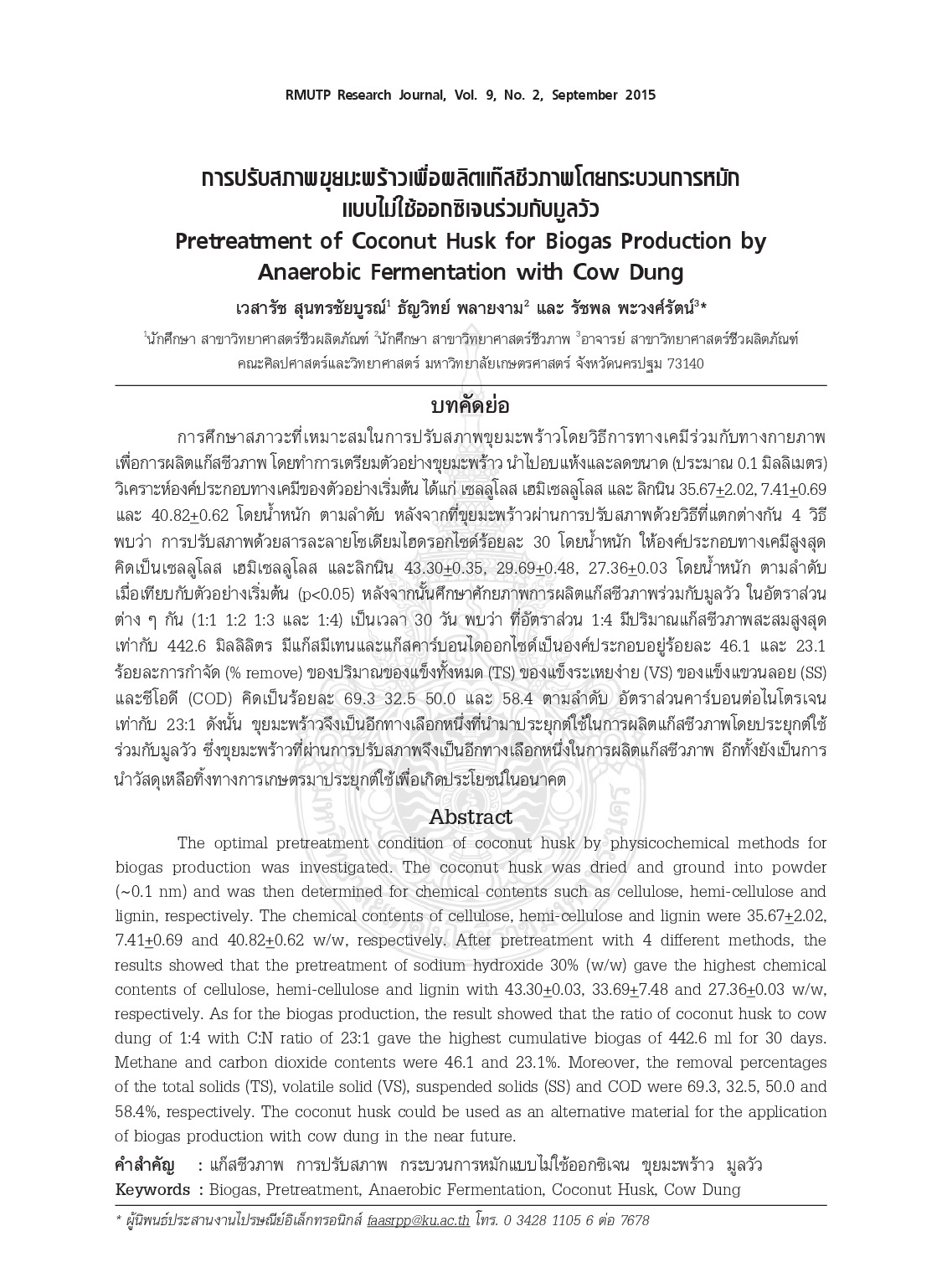
การปรับสภาพขุยมะพร้าวเพื่อผลิตแก๊สชีวภาพโดยกระบวนการหมักแบบไม่ใช้ออกซิเจนร่วมกับมูลวัว
The optimal pretreatment condition of coconut husk by physicochemical methods for biogas production was investigated. The coconut husk was dried and ground into powder (~0.1 nm) and was then determined for chemical contents such as cellulose hemi-cellulose and lignin respectively. The chemical contents of cellulose hemi-cellulose and lignin were 35.67±2.02 7.41±0.69 and 40.82±0.62 w/w respectively. After pretreatment with 4 different methods the results showed that the pretreatment of sodium hydroxide 30 % (w/w) gave the highest chemical contents of cellulose hemi-cellulose and lignin with 43.30±0.03 33.69±7.48 and 27.36±0.03 w/w respectively. As for the biogas production the result showed that the ratio of coconut husk to cow dung of 1:4 with C:N ratio of 23:1 gave the highest cumulative biogas of 442.6 ml for 30 days. Methane and carbon dioxide contents were 46.1 and 23.1 %. Moreover the removal percentages of the total solids (TS) volatile solid (VS) suspended solids (SS) and COD were 69.3 32.5 50.0 and 58.4 % respectively. The coconut husk could be used as an alternative material for the application of biogas production with cow dung in the near future.
การอนุรักษ์และเผยแพร่ศิลป์ดอกไม้แบบไทยกรณีศึกษา : ประเพณีงานแต่งงาน
The purpose of the study is as follows : 1) to collect and study Thai floral art in wedding ceremony 2) to produce the digital media namely Thai floral art in wedding ceremony 3) to survey the satisfaction of the target group towards the media. The data is collected and analyzed form 50 persons of the target group. And the results on the media satisfaction as a whole are highly rated (4.02) when considering each category the satisfaction is highly rated from highest level to lowest level as follows : interesting contents 4.30 comfortable steps to do themselves 4.22 well sequences 4.18 revealing conservative media 4.16 pict continuity and presentation duration 4.08 special technics pictures speed motion and narration 3.96 sound effects on the media 3.88 clearly motion picture 3.82 leagible letter design 3.80 and suitable picture size 3.70
การใช้ประโยชน์จากต้นมันสำปะหลังเหลือทิ้งผสมซีเมนต์ สำหรับเป็นแผ่นผนังไม้เทียมเพื่อป้องกันความร้อนภายในอาคาร
This research aims to study the using cassava pit wastes mixed with cement to particle board walls. The Portland cement type1: fine sand: tap water ratio is equal to 1: 0.5: 0.416 by weight. The ratios of cassava pit wastes to cement are used following: 0.05 0.06 0.07 0.08 0.09 and 0.10 by weight. The cassava pit wastes are crushed by plastic plastics granulators (pass sieve no.4). The casting of particle board walls use the compression machine in room temperature (30 – 35 degree of Celsius) and control 0.75 g/cm3 of density. The TIS 878-2537 standard (cement bonded particle board: high density) is followed to test the properties of particle board wall. Resulting the cassava pit wastes mixed with cement can cast to particle board walls and have good properties especially the thermal insulation property.