จำนวน Repository ( 96 )
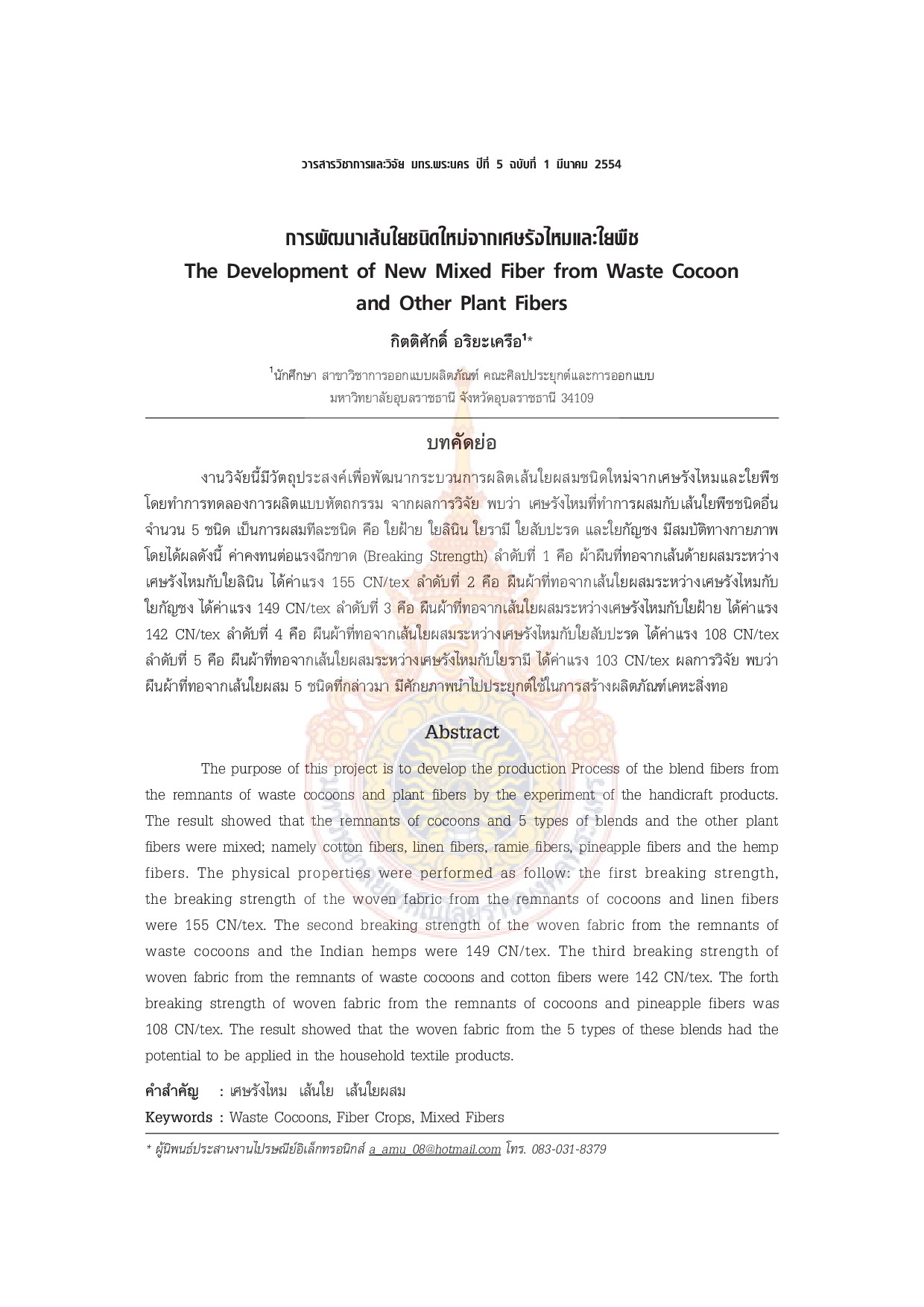
The Development of New Mixed Fiber from Waste Cocoon and Other Plant Fibers
The purpose of this project is to develop the production Process of the blend fibers from the remnants of waste cocoons and plant fibers by the experiment of the handicraft products. The result showed that the remnants of cocoons and 5 types of blends and the other plant fibers were mixed; namely cotton fibers linen fibers ramie fibers pineapple fibers and the hemp fibers. The physical properties were performed as follow: the first breaking strength the breaking strength of the woven fabric from the remnants of cocoons and linen fibers were 155 CN/tex. The second breaking strength of the woven fabric from the remnants of waste cocoons and the Indian hemps were 149 CN/tex. The third breaking strength of woven fabric from the remnants of waste cocoons and cotton fibers were 142 CN/tex. The forth breaking strength of woven fabric from the remnants of cocoons and pineapple fibers was 108 CN/tex. The result showed that the woven fabric from the 5 types of these blends had the potential to be applied in the household textile products
การพัฒนาเส้นด้ายพิเศษจากเส้นใยกล้วยผสมฝ้าย
The research of development Fancy yarn from Banana fiber and cotton fiber blend to seek Ratio of Banana fiber and cotton fiber to sliver by ROLLER CARD was found that Blending Banana fiber and cotton fiber at 20 : 30 30 : 40 40 : 60 and 50 : 50 to able to spin as sliver. Due to the quantity of Banana fiber there are quantity of yarn less than or equal with cotton fiber it made both fibers can cling together. In the parts of the suitable sliver laying direction to contain to the GAREBO YARN TUBE was found that the suitable laying direction to contain to the GAREBO YARN TUBE to find that the suitable Sliver laying direction is the longwise laying direction of GAREBO YARN TUBE because Sliver laid down orderly and was not overlay so it can easy draw thread and continues spin yarn. About Ratio and weight of sliver in GAREBO YARN TUBE that was affect to Fancy yarn spinning as SLUB YARN was found that the qualification of thread for seeking yarn twist yarn strength and Elongation (Percentage) of Banana Fiber: cotton Fiber 20:80 was found that the weight of Sliver 20 grams have yarn twist (turn/inches) mean 10.8 (Newton) of sliver 40 grams mean 6.27 and Elongation (Percentage) of sliver 30 grams mean 4.45. Banana Fiber : cotton Fiber 30:70 was found that the weight of Sliver 30 grams have yarn twist (turn/inches) mean 10.9 (Newton) of sliver 30 grams mean 7.68 and Elongation (Percentage) of sliver 30 grams mean 4.93. Banana Fiber : cotton Fiber 40:60 was found that the weight of Sliver 40 grams have yarn twist (turn/inches) mean 10.5 (Newton) of sliver 20 grams mean 6.20 and Elongation (Percentage) of sliver 40 grams mean 4.76. Banana Fiber : cotton Fiber 50:50 was found that the weight of Sliver 20 and 40 grams have yarn twist (turn/inches) mean 10.9 (Newton) of sliver 30 grams mean 6.07 and Elongation (Percentage) of sliver 20 grams mean 5.09. Banana Fiber : cotton Fiber 60:40 was found that the weight of Sliver 20 grams have yarn twist (turn/inches) mean 11.2 (Newton) of sliver 40 grams mean 5.34 and Elongation (Percentage) of sliver 40 grams mean 4.57.
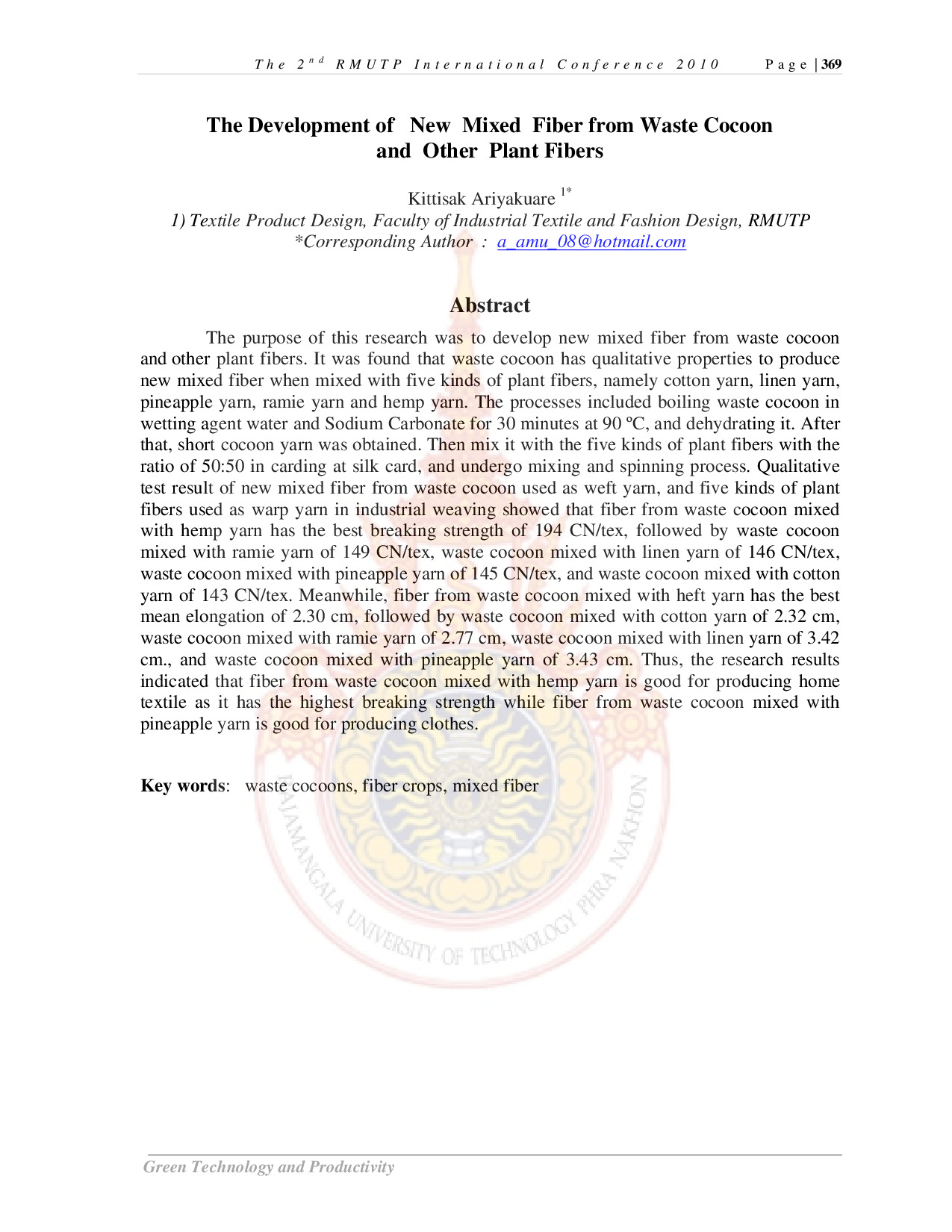
The Development of New Mixed Fiber from Waste Cocoon and Other Plant Fibers
The purpose of this research was to develop new mixed fiber from waste cocoon and other plant fibers. It was found that waste cocoon has qualitative properties to produce new mixed fiber when mixed with five kinds of plant fibers namely cotton yarn linen yarn pineapple yarn ramie yarn and hemp yarn. The processes included boiling waste cocoon in wetting agent water and Sodium Carbonate for 30 minutes at 90 ºC and dehydrating it. After that short cocoon yarn was obtained. Then mix it with the five kinds of plant fibers with the ratio of 50:50 in carding at silk card and undergo mixing and spinning process. Qualitative test result of new mixed fiber from waste cocoon used as weft yarn and five kinds of plant fibers used as warp yarn in industrial weaving showed that fiber from waste cocoon mixed with hemp yarn has the best breaking strength of 194 CN/tex followed by waste cocoon mixed with ramie yarn of 149 CN/tex waste cocoon mixed with linen yarn of 146 CN/tex waste cocoon mixed with pineapple yarn of 145 CN/tex and waste cocoon mixed with cotton yarn of 143 CN/tex. Meanwhile fiber from waste cocoon mixed with heft yarn has the best mean elongation of 2.30 cm followed by waste cocoon mixed with cotton yarn of 2.32 cm waste cocoon mixed with ramie yarn of 2.77 cm waste cocoon mixed with linen yarn of 3.42 cm. and waste cocoon mixed with pineapple yarn of 3.43 cm. Thus the research results indicated that fiber from waste cocoon mixed with hemp yarn is good for producing home textile as it has the highest breaking strength while fiber from waste cocoon mixed with pineapple yarn is good for producing clothes.
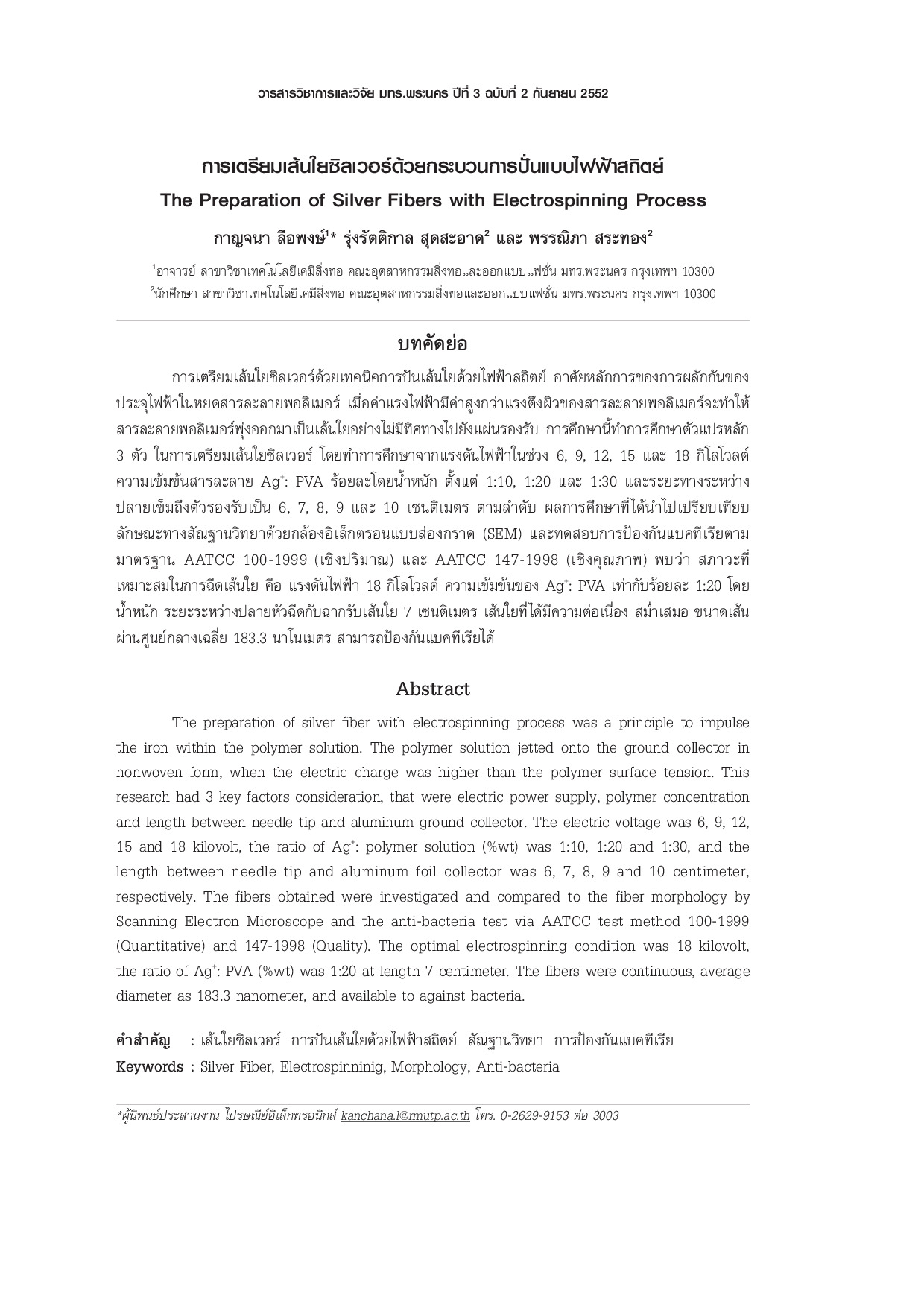
The Preparation of Silver Fibers with Electrospinning Process
The preparation of silver fiber with electrospinning process was a principle to impulse the iron within the polymer solution. The polymer solution jetted onto the ground collector in nonwoven form when the electric charge was higher than the polymer surface tension. This research had 3 key factors consideration that were electric power supply polymer concentration and length between needle tip and aluminum ground collector. The electric voltage was 6 9 12 15 and 18 kilovolt the ratio of Ag : polymer solution (%wt) was 1:10 1:20 and 1:30 and the length between needle tip and aluminum foil collector was 6 7 8 9 and 10 centimeter respectively. The fibers obtained were investigated and compared to the fiber morphology by Scanning Electron Microscope and the anti-bacteria test via AATCC test method 100-1999 (Quantitative) and 147-1998 (Quality). The optimal electrospinning condition was 18 kilovolt the ratio of Ag : PVA (%wt) was 1:20 at length 7 centimeter. The fibers were continuous average diameter as 183.3 nanometer and available to against bacteria.
The Development of Fancy Yarn from Banana and Cotton Fiber Blend
The research of development Fancy yarn from Banana fiber and cotton fiber blend was conducted to seek Ratio of Banana fiber and cotton fiber for making sliver by ROLLER CARD. It was found that blending banana fiber and cotton fiber at 20: 30 30: 40 40: 60 and 50: 50 was able to be spun as sliver. Due to the quantity of Banana fiber there were quantity of yarn less than or equal with cotton fiber it made both fibers cling together. In the parts of the suitable sliver laying direction to contain to the GAREBO YARN TUBE was found that the suitable laying direction to contain into the GAREBO YARN TUBE could make sliver easily draw and continue spinning yarn. About Ratio and weight of sliver in GAREBO YARN TUBE that was affect to Fancy yarn spinning as SLUB YARN was found that the qualification of thread for seeking yarn twist yarn strength and Elongation (Percentage) of Banana Fiber : cotton Fiber 20:80 was found that the weight of Sliver 20 grams have yarn twist (turn/inches) mean 10.8 (newton) of sliver 40 grams mean 6.27 and Elongation (Percentage) of sliver 30 grams mean 4.45. Banana Fiber : cotton Fiber 30:70 was found that the weight of Sliver 30 grams have yarn twist (turn/inches) mean 10.9 (newton) of sliver 30 grams mean 7.68 and Elongation (Percentage) of sliver 30 grams mean 4.93. Banana Fiber : cotton Fiber 40:60 was found that the weight of Sliver 40 grams have yarn twist (turn/inches) mean 10.5 (newton) of sliver 20 grams mean 6.20 and Elongation (Percentage) of sliver 40 grams mean 4.76. Banana Fiber : cotton Fiber 50:50 was found that the weight of Sliver 20 and 40 grams have yarn twist (turn/inches) mean 10.9 (newton) of sliver 30 grams mean 6.07 and Elongation (Percentage) of sliver 20 grams mean 5.09. Banana Fiber : cotton Fiber 60:40 was found that the weight of Sliver 20 grams have yarn twist (turn/inches) mean 11.2 (newton) of sliver 40 grams mean 5.34 and Elongation (Percentage) of sliver 40 grams mean 4.57.