จำนวน Repository ( 87 )
A Modeling of Heat Transfer in Cooling Coil using Finite Element Method
In general for the refrigeration the cooling coil is almost used to be the device to decrease the temperature. Thus in order to design heat exchange we should study the heat transfer into the cooling coil. This research proposes the numerical using finite element method for calculating the temperature at any position of the cooling point for considering to porous media. After that to create an algebraic equation fmite element for writing the program to search the solution by estimating the temperature. The research demonstrates that the changing of temperature will be decreased to saturated condition that is the temperature around the region of the cooling coil model edge will be decreased. The longer time the lower temperature around each position will decrease respectively until the temperature at each position inside the model are the same as region of the cooling coil model edge. Therefore this search result can be the basic for the comparison with the similar problem of other

Using the kaolin with coir, rice straw and rice hush in concrete masonry unit wall for increasing effective heat protection
The objective of this research project is to develop an effectively applicable prevention of heat for concrete masonry unit wall. By using kaolin mixture coir rice straw and husk as a major ingredient in concrete to replacing usual stone dust the hollow non-load-bearing concrete masonry units obtained had the size of 70 X 190 X 390 mm. The test results showed that the reliably ideal ratio of these mixture materials had to be from the combination of kaolin coir rice straw and husk by replacing them at 5%: 5%: 15% and 50/0. The block obtained also had other certain qualifications such as Weight at 6.08 kg. water absorption at 7.96% and compressive strength at 65.4 ksc. Moreover these combined materials harbored heat capacity less than the standard concrete masonry units with the weight not more than 29%.
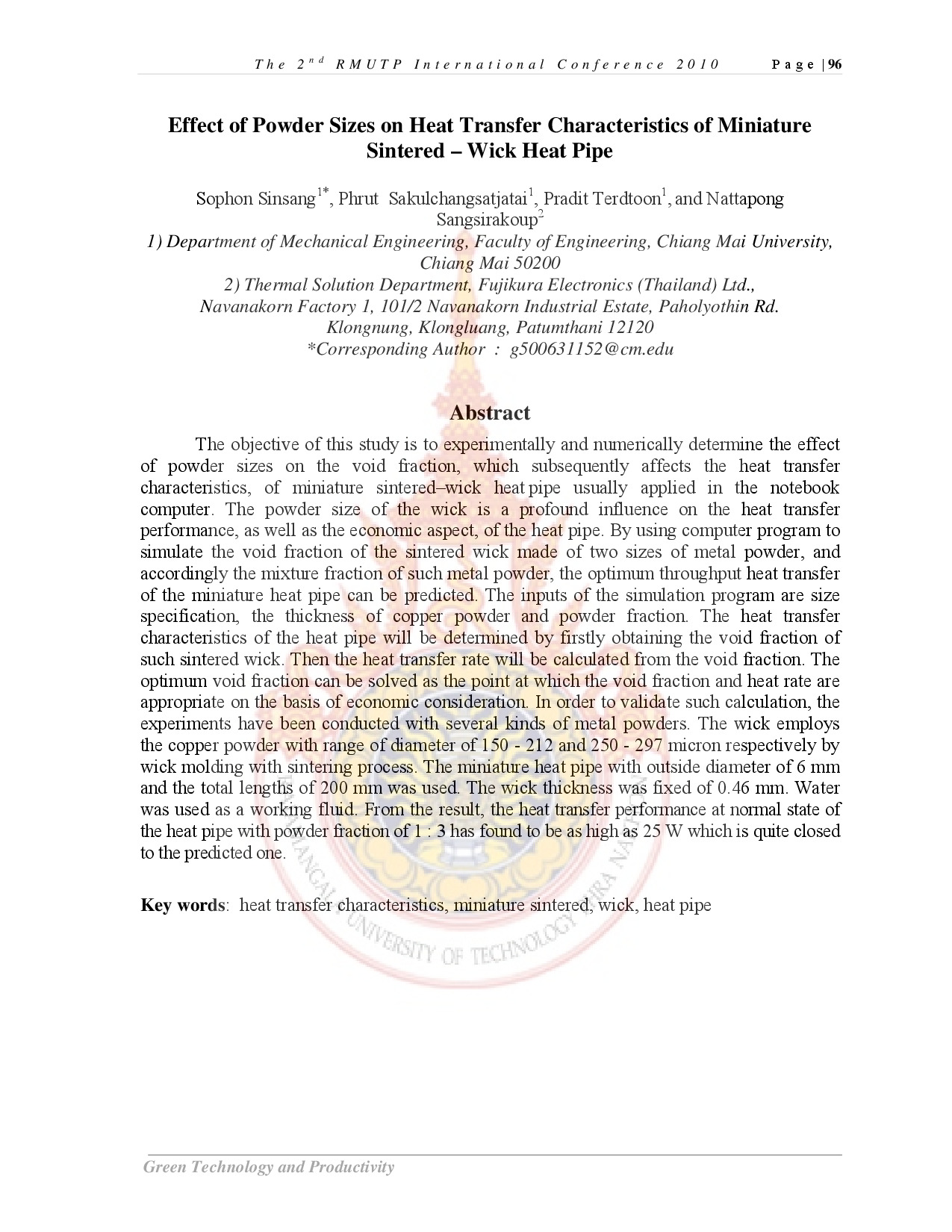
Effect of Powder Sizes on Heat Transfer Characteristics of Miniature Sintered – Wick Heat Pipe
The objective of this study is to experimentally and numerically determine the effect of powder sizes on the void fraction which subsequently affects the heat transfer characteristics of miniature sintered–wick heat pipe usually applied in the notebook computer. The powder size of the wick is a profound influence on the heat transfer performance as well as the economic aspect of the heat pipe. By using computer program to simulate the void fraction of the sintered wick made of two sizes of metal powder and accordingly the mixture fraction of such metal powder the optimum throughput heat transfer of the miniature heat pipe can be predicted. The inputs of the simulation program are size specification the thickness of copper powder and powder fraction. The heat transfer characteristics of the heat pipe will be determined by firstly obtaining the void fraction of such sintered wick. Then the heat transfer rate will be calculated from the void fraction. The optimum void fraction can be solved as the point at which the void fraction and heat rate are appropriate on the basis of economic consideration. In order to validate such calculation the experiments have been conducted with several kinds of metal powders. The wick employs the copper powder with range of diameter of 150 - 212 and 250 - 297 micron respectively by wick molding with sintering process. The miniature heat pipe with outside diameter of 6 mm and the total lengths of 200 mm was used. The wick thickness was fixed of 0.46 mm. Water was used as a working fluid. From the result the heat transfer performance at normal state of the heat pipe with powder fraction of 1 : 3 has found to be as high as 25 W which is quite closed to the predicted one.
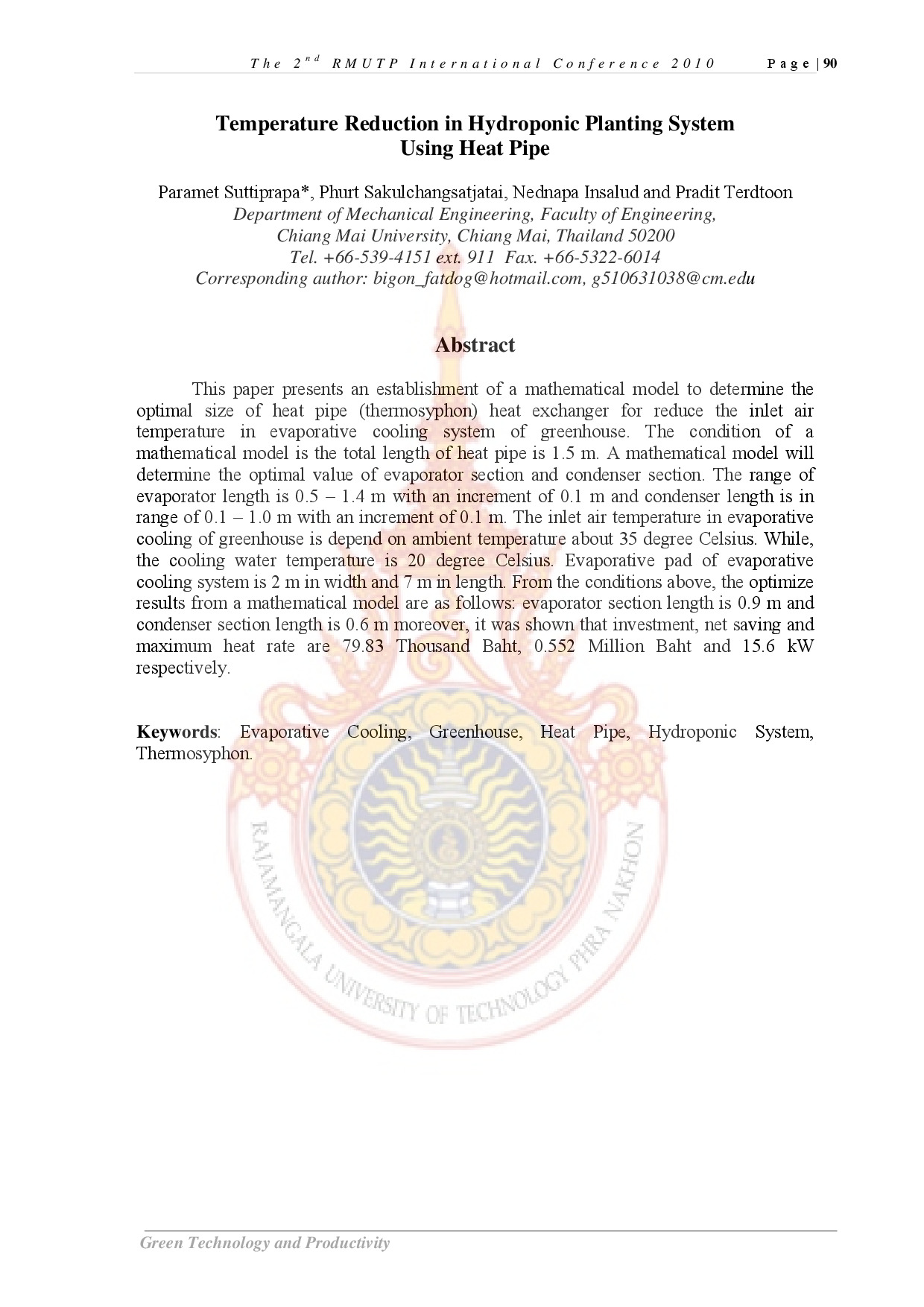
Temperature Reduction in Hydroponic Planting System Using Heat Pipe
This paper presents an establishment of a mathematical model to determine the optimal size of heat pipe (thermosyphon) heat exchanger for reduce the inlet air temperature in evaporative cooling system of greenhouse. The condition of a mathematical model is the total length of heat pipe is 1.5 m. A mathematical model will determine the optimal value of evaporator section and condenser section. The range of evaporator length is 0.5 – 1.4 m with an increment of 0.1 m and condenser length is in range of 0.1 – 1.0 m with an increment of 0.1 m. The inlet air temperature in evaporative cooling of greenhouse is depend on ambient temperature about 35 degree Celsius. While the cooling water temperature is 20 degree Celsius. Evaporative pad of evaporative cooling system is 2 m in width and 7 m in length. From the conditions above the optimize results from a mathematical model are as follows: evaporator section length is 0.9 m and condenser section length is 0.6 m moreover it was shown that investment net saving and maximum heat rate are 79.83 Thousand Baht 0.552 Million Baht and 15.6 kW respectively.
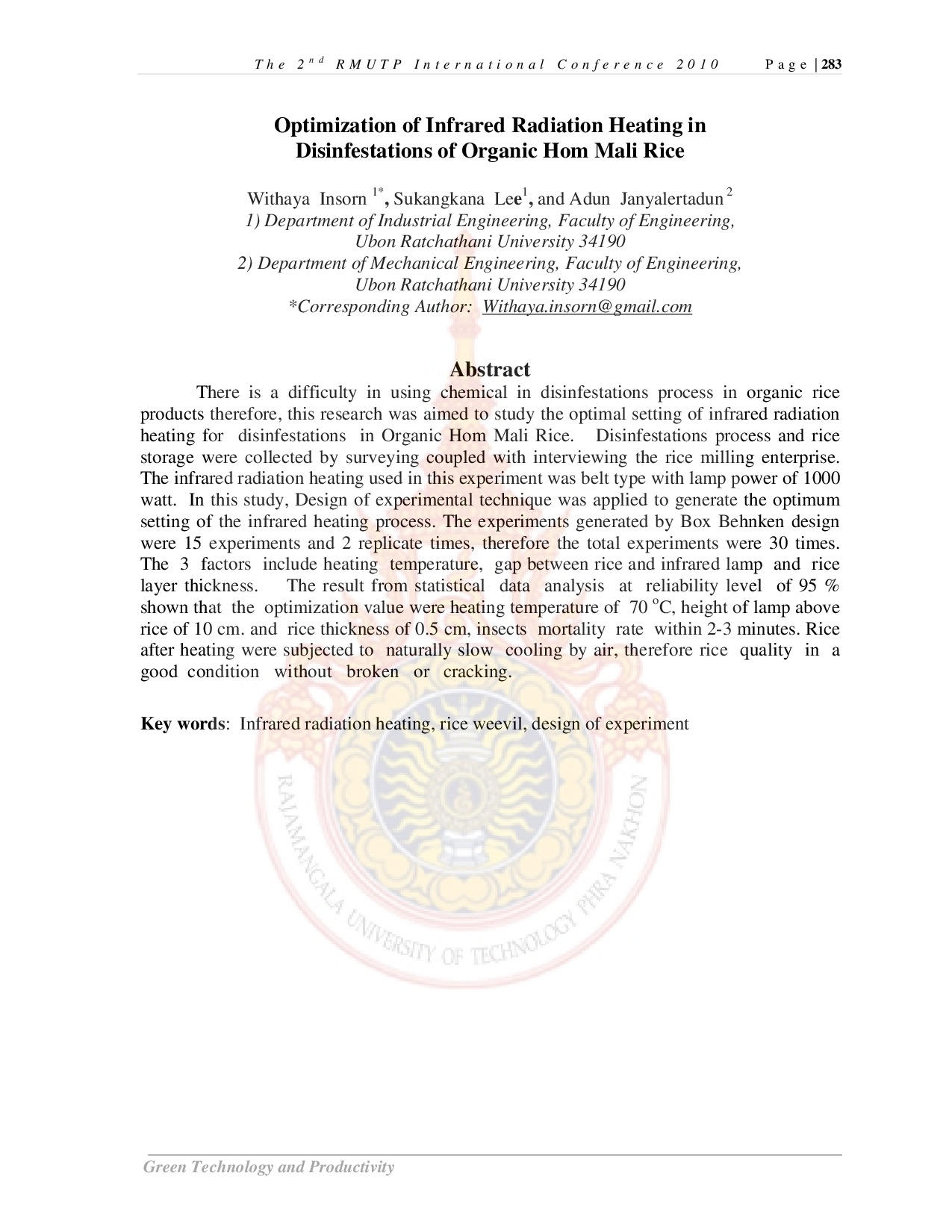
Optimization of Infrared Radiation Heating in Disinfestations of Organic Hom Mali Rice
There is a difficulty in using chemical in disinfestations process in organic rice products therefore this research was aimed to study the optimal setting of infrared radiation heating for disinfestations in Organic Hom Mali Rice. Disinfestations process and rice storage were collected by surveying coupled with interviewing the rice milling enterprise. The infrared radiation heating used in this experiment was belt type with lamp power of 1000 watt. In this study Design of experimental technique was applied to generate the optimum setting of the infrared heating process. The experiments generated by Box Behnken design were 15 experiments and 2 replicate times therefore the total experiments were 30 times. The 3 factors include heating temperature gap between rice and infrared lamp and rice layer thickness. The result from statistical data analysis at reliability level of 95 % shown that the optimization value were heating temperature of 70 oC height of lamp above rice of 10 cm. and rice thickness of 0.5 cm insects mortality rate within 2-3 minutes. Rice after heating were subjected to naturally slow cooling by air therefore rice quality in a good condition without broken or cracking.