จำนวน Repository ( 127 )
A Design of Low Rate Wireless Sensor Network Coordinator with Multi-Network Using Single Processor
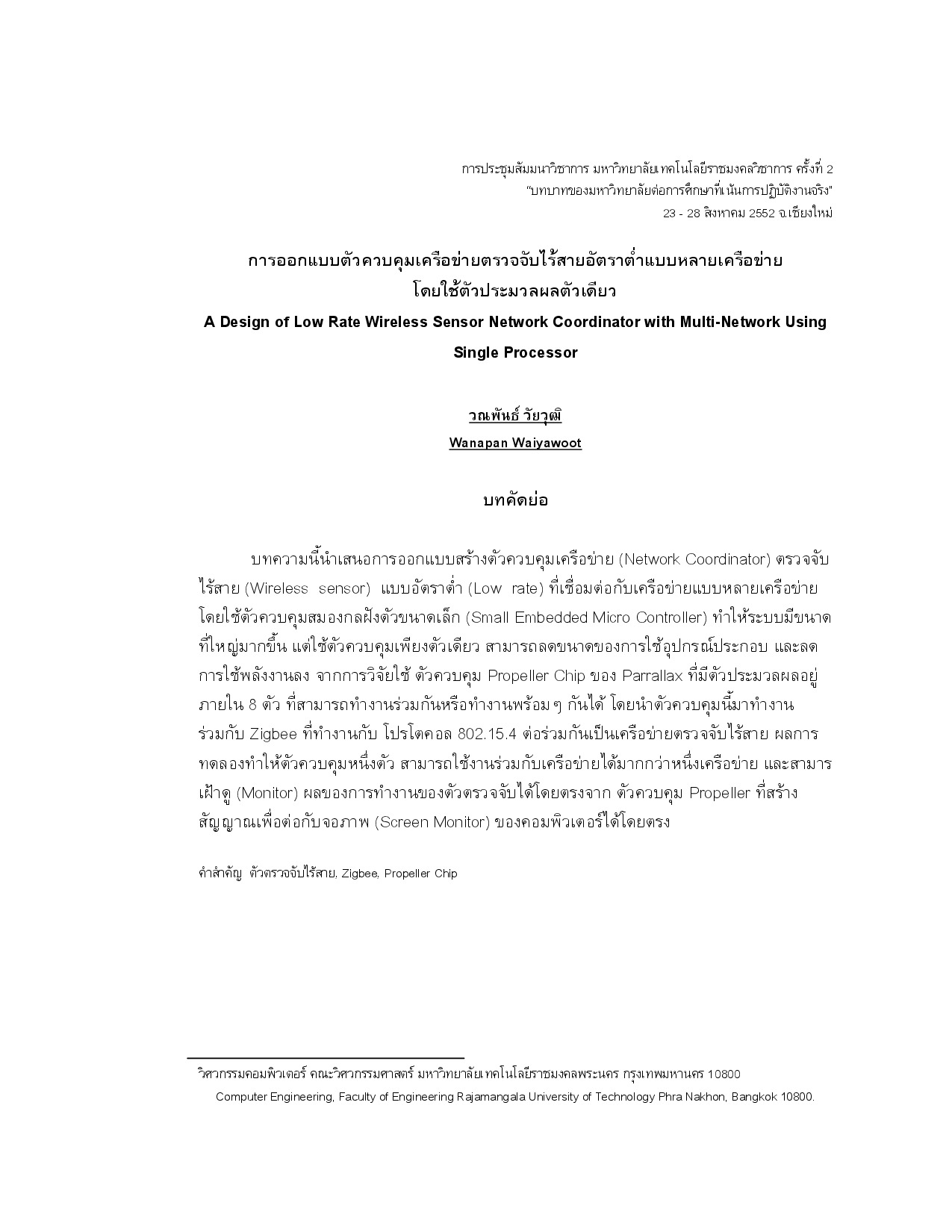
This paper presents the development of a low rate wireless sensor network coordinator with multi-network. This research used small embedded micro controller. The system can expand into multi network and work with single processor. This design will reduce components and power assumption. The research use Propeller Chip by Parrallax Inc. This chip contains eight processors inside. All eight processors can perform tasks simultaneously or with coordination from other processors. It comprised of zigbee chip to perform wireless sensor network that work with 802.15.4 protocol. Experimental results show that we can use single microcontroller work with multi-network. It can monitor result of network directly from Propeller chip by generating computer monitor signal.

การหาค่าประสิทธิภาพโปรโตคอลการเข้าถึงหลายทางบน โครงข่ายใยแสง DWDM ด้วยการสวิทซ์ทางแสงเพื่อพัฒนาเทคโนโลยีโครงข่ายใยแสง
We present the comparison of CDMA MAC protocol with and without beat noise by using 2-D optical CDMA MAC protocol over WDM networks. We use the asymmetric primehop sequence code. Moreover we analyse the effect of the number of available wavelengths in tenns ofaverage number of attempted to transmissions per time slot (offered load) and beat noise is considered. The presented numerical results based on the throughput and delay time versus the offered load. We divide into two parts. The first one we consider the effect of the number of available wavelengths. Another is the effect of with and without beat noise in the 2-D OCDMA over WDM systems.
การหาค่าประสิทธิภาพโปรโตคอลการเข้าถึงหลายทางบน โครงข่ายใยแสง DWDM ด้วยการสวิทซ์ทางแสงเพื่อพัฒนาเทคโนโลยีโครงข่ายใยแสง
We present the comparison of CDMA MAC protocol with and without beat noise by using 2-D optical CDMA MAC protocol over WDM networks. We use the asymmetric primehop sequence code. Moreover we analyse the effect of the number of available wavelengths in tenns ofaverage number of attempted to transmissions per time slot (offered load) and beat noise is considered. The presented numerical results based on the throughput and delay time versus the offered load. We divide into two parts. The first one we consider the effect of the number of available wavelengths. Another is the effect of with and without beat noise in the 2-D OCDMA over WDM systems.
Students' behaviors and Goals of Using Internet in Rajamangala University of Technology
The purpose of this research were to study and compare students behaviors and goals of Internet using in Rajamangala University of Technology (RMUT). Sample were 2500 students who studied in the academic year 2005. They were selected by satisfied quota random sampling. Behaviors and goals of Internet using questionnaire with the reliability of .96 and .98. The data were analysed with means standard deviation t-test and One-way ANOVA. The result were as follows: 1. Students acquired the knowledge of Internet from friends classroom learning and by themselves which were almost equal. They largely had their own computer. They used Internet from RMUT and Internet cafe which were almost equal. Most of them used Internet with friends and alone which were almost equal. Most of students received 1000-3000 bath per month. They paid Internet expense by their own which less than 500 bath per month. Most of students had Internet experience between 2-4 years and more than 4 years which were almost equal. They used Internet 1-3 times per week and 1-3 hours per time in weekdays and between 16.01pm.-20.00 pm. 2. Students used Internet at the high level. 3. Students had objectives ofInternet using in RMUT at the moderate level. 4. Sex age education level academic programs using private computer and Internet experience shown statistical significantly different at level of .05 in students behaviors ofInternet using in RMUT. 5. Sex academic programs using private computer and Internet experience shown statistical significantly difference at .05 level in students goals ofInternet using in RMUT.
Lighting Control System with Low Rate Network Green Computing System
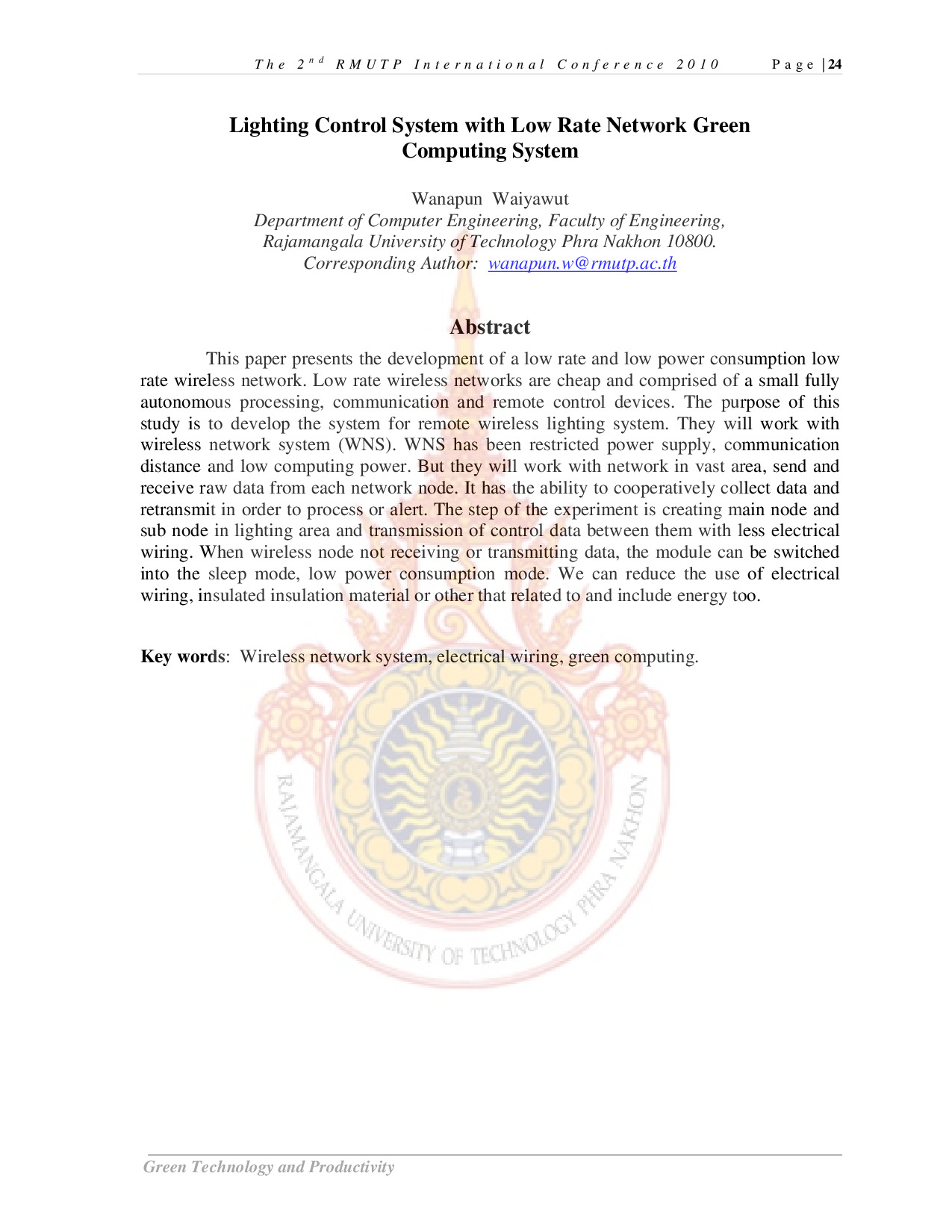
This paper presents the development of a low rate and low power consumption low rate wireless network. Low rate wireless networks are cheap and comprised of a small fully autonomous processing communication and remote control devices. The purpose of this study is to develop the system for remote wireless lighting system. They will work with wireless network system (WNS). WNS has been restricted power supply communication distance and low computing power. But they will work with network in vast area send and receive raw data from each network node. It has the ability to cooperatively collect data and retransmit in order to process or alert. The step of the experiment is creating main node and sub node in lighting area and transmission of control data between them with less electrical wiring. When wireless node not receiving or transmitting data the module can be switched into the sleep mode low power consumption mode. We can reduce the use of electrical wiring insulated insulation material or other that related to and include energy too.