จำนวน Repository ( 1174 )

Species diversity and reproductive phenology of Podostemaceae in Na Hahaeo District, Loei Province, Northeastern Thailand.
The species composition of Podostemaceae was studied in Loei northeastern Thailand from November 2009 to July 2010 by extensive surveying in the rapids and waterfalls inside and outside of national parks wildlife sanctuaries and protected areas. The samples collected are classified into 2 subfamilies which are Tristichoideae and Podostemoideae. The former contains 2 genera and 3 species Dalzellia kailarsenii Terniopsis sp. 1 Terniopsis sp. 2. The latter has 4 genera and 9 species Hanseniella heterophylla Hydrobryum japonicum Hydrobryum loeicum Hydrobryum tardhuangense Hydrobryum vientianense Hydrobryum sp. 1 Hydrobryum sp. 2 Polypleurum sessile Thawatchaia trilobata. The highest number of species occurs in Hydrobryum with 6 species following by Terniopsis with 2 species. The other four genera have one species each. Based on morphological and molecular analyses revealed that 2 species of the genus Hydrobryum are new and 2 taxa of Terniopsis are also new species. Polypleurum sessile and Thawatchaia trilobata are new recorded in Loei province. The result from this study indicates that the genus richness is relatively high in Loei province which encompasses 60% of the total number of genera (10) in Thailand. The plants in vegetative phase are completely submersed in swiftly running water during a warm wet season (May-October). The plants flower and set fruits and seeds when exposing to air during water level drop in a cool dry season (November- February).
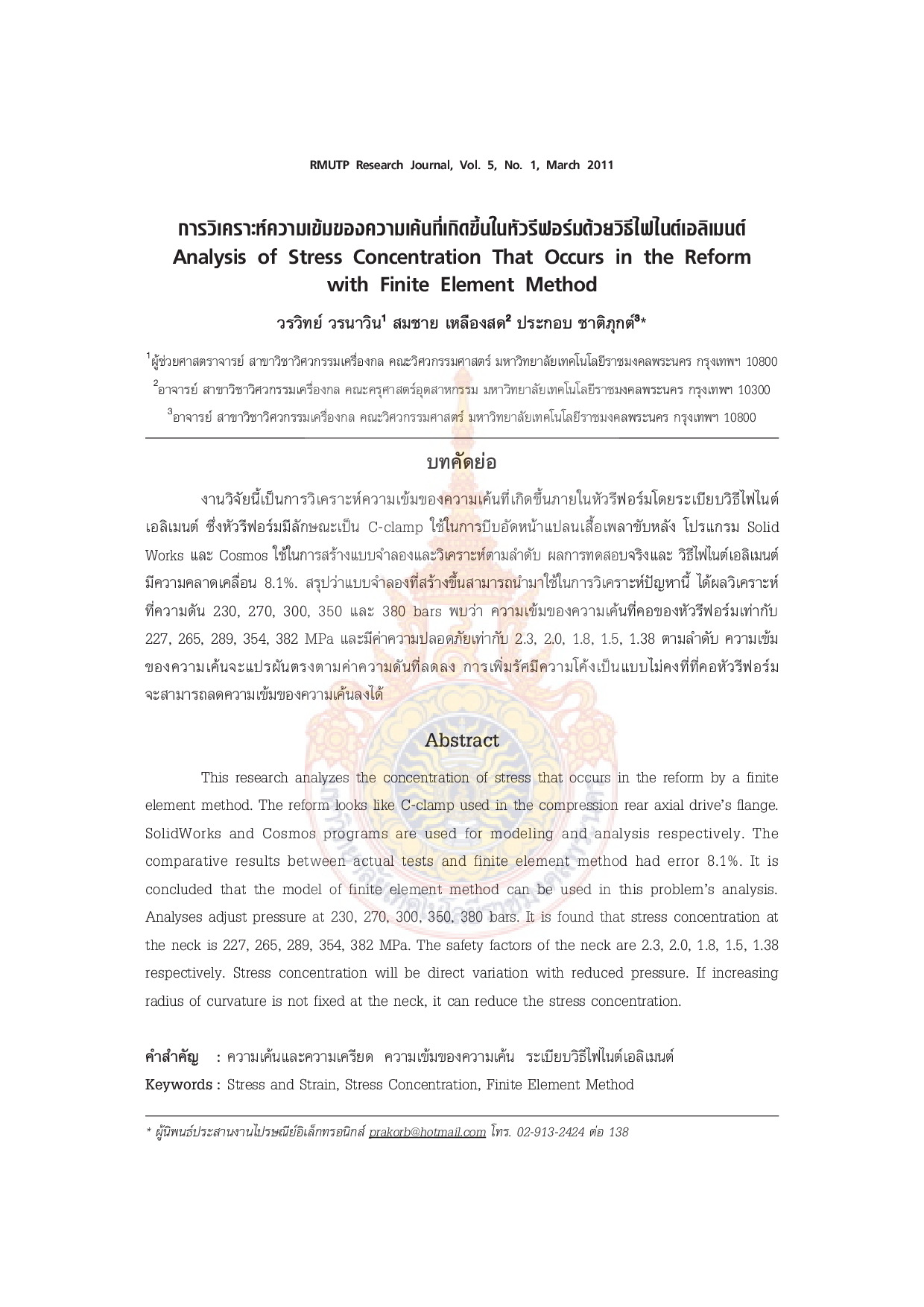
Analysis of Stress Concentration That Occurs in the Reform with Finite Element Method
This research analyzes the concentration of stress that occurs in the reform by a finite element method. The reform looks like C-clamp used in the compression rear axial drive’s flange. SolidWorks and Cosmos programs are used for modeling and analysis respectively. The comparative results between actual tests and finite element method had error 8.1%. It is concluded that the model of finite element method can be used in this problem’s analysis. Analyses adjust pressure at 230 270 300 350 380 bars. It is found that stress concentration at the neck is 227 265 289 354 382 MPa. The safety factors of the neck are 2.3 2.0 1.8 1.5 1.38 respectively. Stress concentration will be direct variation with reduced pressure. If increasing radius of curvature is not fixed at the neck it can reduce the stress concentration.
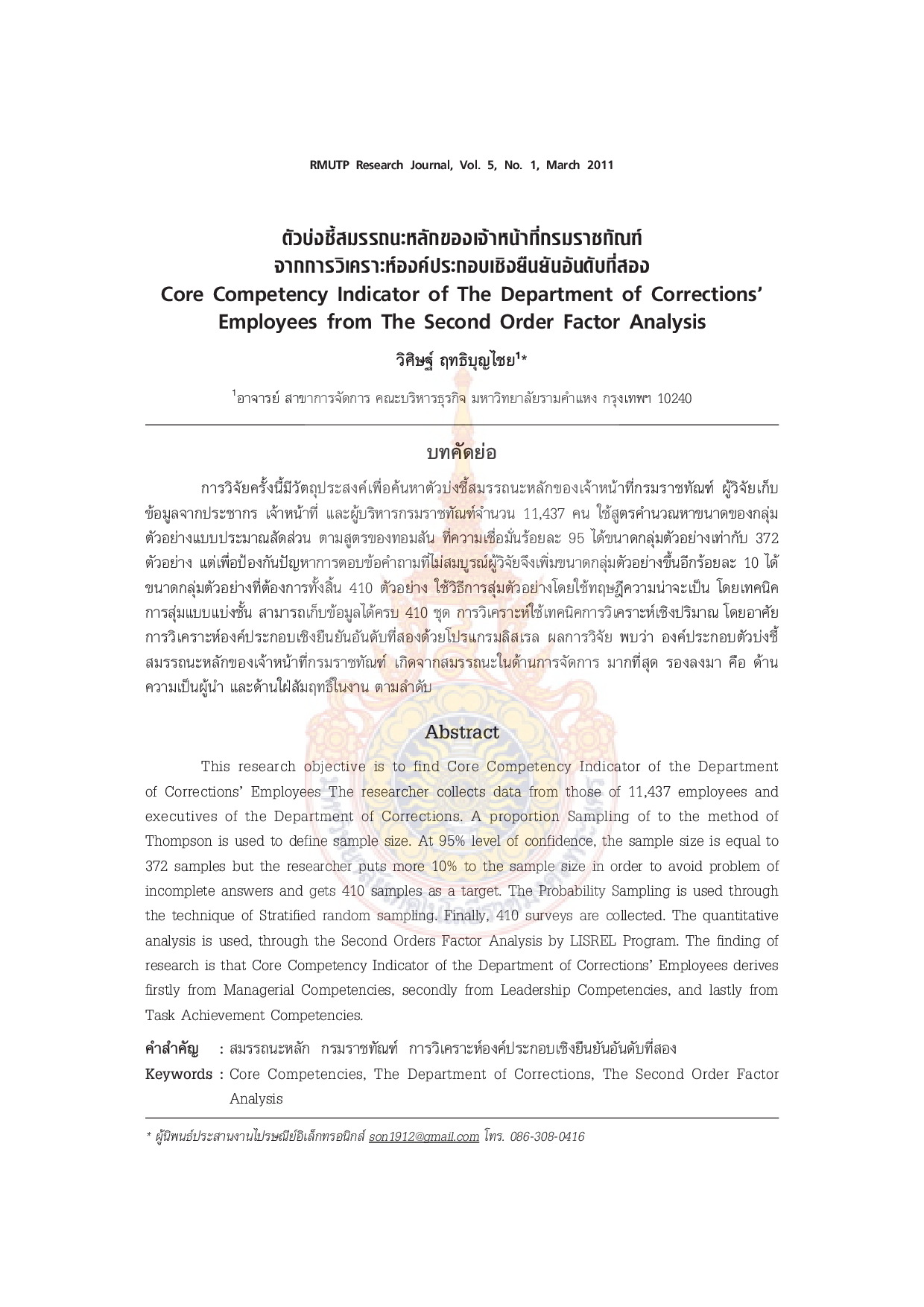
Core Competency Indicator of The Department of Corrections’ Employees from The Second Order Factor Analysis
This research objective is to find Core Competency Indicator of the Department of Corrections’ Employees The researcher collects data from those of 11437 employees and executives of the Department of Corrections. A proportion Sampling of to the method of Thompson is used to define sample size. At 95% level of confidence the sample size is equal to 372 samples but the researcher puts more 10% to the sample size in order to avoid problem of incomplete answers and gets 410 samples as a target. The Probability Sampling is used through the technique of Stratified random sampling. Finally 410 surveys are collected. The quantitative analysis is used through the Second Orders Factor Analysis by LISREL Program. The finding of research is that Core Competency Indicator of the Department of Corrections’ Employees derives firstly from Managerial Competencies secondly from Leadership Competencies and lastly fromTask Achievement Competencies
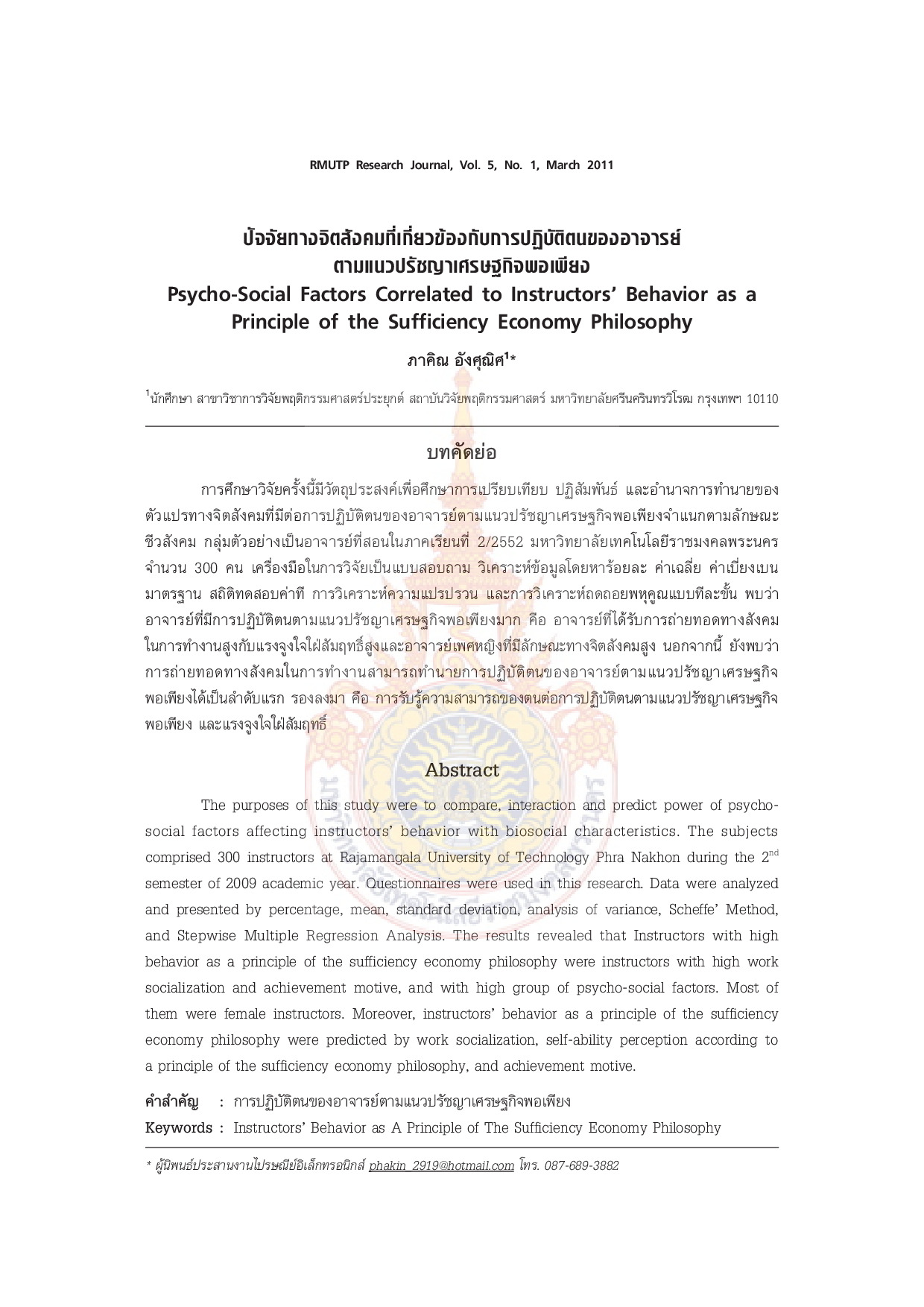
Psycho-Social Factors Correlated to Instructors’ Behavior as a Principle of the Sufficiency Economy Philosophy
The purposes of this study were to compare interaction and predict power of psychosocial factors affecting instructors’ behavior with biosocial characteristics. The subjects comprised 300 instructors at Rajamangala University of Technology Phra Nakhon during the 2nd semester of 2009 academic year. Questionnaires were used in this research. Data were analyzed and presented by percentage mean standard deviation analysis of variance Scheffe’ Method and Stepwise Multiple Regression Analysis. The results revealed that Instructors with high behavior as a principle of the sufficiency economy philosophy were instructors with high work socialization and achievement motive and with high group of psycho-social factors. Most of them were female instructors. Moreover instructors’ behavior as a principle of the sufficiency economy philosophy were predicted by work socialization self-ability perception according to a principle of the sufficiency economy philosophy and achievement motive
Studying and product development of handicraft from elephant dung parer for addings income to community at Changwat Phra Nakhon Si Ayuttha
The research aimed to study and develop handicraft products from elephant dung paper for community income generation in Ayutthaya province and to compare the product satisfaction of the target group for the original style and the new one of elephant dung paper The target group eas from 143 tourists from other provinces and 143 of local tourists. Both of target groups would like to but handicraft products from elephant dung paper and helped generate community income in Ayutthaya province. Research tool eas done by questionnaire and data were analyzed by statistically percentage mean and mode. Questionnaire was used for the product attributes satisfacion avaluation of the target grouq including alternative evaluation process and comparison of product styles evaluation process. Data were analyzed by statistically percentage.mean and t-test dependent sample The results of were foun as follows: 1. The target group chose the third style of handicraft products from elephant dung paper 2. For the product attributs satisfaction of the target group it was found that the new style of hansicraft prosuct was more acceptable than the oniginal one at a significance level of 0.05.