จำนวน Repository ( 1574 )
การผลิตวัสดุปรับปรุงดินจากเศษอาหารและผักตบชวาด้วยกรรมวิธีดีไฮเดรชั่น
The purpose of this study is to produce the soil improvement materials from food waste and water hyacinth by using a dehydration process. The experiments were divided into two parts : 1) the study of the optimum temperature and time for converting food waste and water hyacinths to soil improvement materials by determining the temperatures of 100 °C 150 °C and 200°C in the periods of 1 hour 2 hours and 3 hours respectively 2) the study of nutrient content in the materials before and after mixing into the soil for 5 days. The soil used in the experiment was sampled from Sai Ma Subdistrict Nonthaburi Province. The parameters used to evaluate the ability to improve the soil quality were soil moisture pH electro conductivity total nitrogen total phosphorus total potassium and organic matter. The results showed that the optimum temperature for drying the food waste was 150°C for 2 hours and the optimum temperature for drying the water hyacinth was 200°C for 3 hours. When the materials were mixed into soil it found that the soil drainage was improved. Mixing the materials into soil could increase the pH value from 5.2 to 5.4 and increase the electrical conductivity from 0.72 mS/cm to 14.78 mS/cm. Besides the plant nutrients including Nitrogen phosphorus and potassium also increased after adding soil improvement materials.
ปัจจัยที่มีความสัมพันธ์ระหว่างคุณภาพอาหารสดกับกระบวนการตัดสินใจ เลือกซื้อผ่านแอปพลิเคชันออนไลน์ภายใต้บรรทัดฐานใหม่
The objectives of this research are 1) to study the behavior of buying fresh food through an online application under the new norms.2) To study the importance of fresh food quality influencing the food purchasing decision-making process through an online application under the new norms.3) To compare personal factors and decisionmaking processes to buy fresh food through online application under the new norms.4) To study the relationship between the quality factors of fresh food and the process of making decisions in food purchasing through an online application under the new norms. This research is a quantitative research. The sample group of 400 people are Thai consumers who have used an online application to order fresh food at least once. The questionnaire was used as a tool for data collection. The statistics used for data analysis were frequency percentage mean standard deviation t-Test and F-Test fromone-way analysis of variance and the Pearson correlation coefficient. The findings of this study shown that almost of participants who use the online application are female age between 22-38 which have income 15001-20000 Thai Bahtper month work as employee in private company and all are single. Most of them are living with their families including 3-4 family members. In terms of participants’ behavior they know Tesco Lotuss online application for ordering fresh food the most however mostly ordered the fresh food through Tops #1 Food&Grocery. Participants know the information on how to order food from social media and usually ordered pork. Normally they decided to buy their own and often choose to buy on Saturday from 10.01 - 12.00 and have an average cost of 501 baht or more. The importance of fresh food quality influencing online shopping app decisionmaking under the new norms. Overall opinions and aspects were found to be at the highest level in all aspects. And decisions affecting fresh food choices through online applications under the new norms overall opinion found that the decision was made at the highest level. The highest level of decision making was found in 4 factors and only 1 factor is at the high level. The results of a comparison of consumer decisionmaking processes towards purchasing fresh food through an online application under the new norms the classification according to demographic characteristics were found that gender age average monthly income status and number of family members all the aspects were found to have a statistically significant difference in the decisionmaking process at the 0.05 level. And the analysis of the relationship between fresh food quality and the process of making a decision on choosing fresh food through an online application under the new norms overall aspects were found at moderate level and correlate in the same direction. When considering each aspect it was found that there was a moderate relationship. It also found that the relationship was in the same direction in 3 factors: physical quality sensory quality and safety for consumption.
คุณภาพของข้อมูลทางบัญชี ที่ส่งผลต่อประสิทธิภาพการตัดสินใจของผู้บริหารในธุรกิจขนาดกลางและขนาดย่อมในเขตปริมณฑล
The objective of this research is to study the relationship between the quality of accounting data knowledge and understanding of accounting information business organization feature and the decision-making efficiency of executives in small and medium-sized businesses in the metropolitan area. The demographic group is the management of 351 companies. The data is analyzed using descriptive statistics such as frequency percentage mean and standard deviation and inferential statistics such as pearson’s Correlation Coefficient and multiple Regression. The results showed that the administrators had a high level of knowledge and understanding of accounting information and the quality of accounting data the characteristics of business organizations and the overall decision-making efficiency of the executives at a very good level. In the multiple regression analysis between cognitive information quality of account data and business organization feature to the efficiency of the executive decision making in general (Y) the regression equation was statistically significant at the level of 0.01
การศึกษาแป้งถั่วขาวทดแทนแป้งสาลีในทาร์ตสับปะรดไต้หวัน
Study on white bean flour in place of wheat flour in Taiwan pineapple tart The objective is to study the basic recipe of Taiwanese pineapple tart. And study the amount of white bean flour in place of wheat flour in Taiwan pineapple tart. By studying the 3 basic recipes of Taiwanese pineapple tart flour. To get the recipe that the tastemakers accept the most And to study the amount of white bean flour instead of wheat flour in 5 levels of Taiwanese pineapple which are 0 percent (control formula) white bean flour instead of wheat flour in 25 percent Taiwanese pineapple tart 50 percent 75 percent and 100 percent. of all wheat flour. The randomized complete block design (RCBD) was used to plan the sensory qualities of appearance color smell taste texture and overall liking. With a 9-point Hedonic Scale tasting method using 40 tasting participants 2 repeated. Who is a teacher and students in the food and nutrition program Faculty of Home Economics Technology Rajamangala University of Technology Phra Nakhon Take the result to find the mean 𝑥̅ Analysis of Variance (ANOVA) and compare the difference of the mean by the method (Least Significant Difference (LSD). The results of white bean flour instead of wheat flour in Taiwan pineapple tart. The tasters accept 25 percent of the taste texture and overall liking. With an average 7.50 7.40 and 7.43 respectively At a moderate level. Regarding appearance and color tasters accepted 0 percent with an average of 7.30 and 7.35 respectively. At a moderate level. As for the smell The tasters accepted 50% with an average of 7.45. Ata moderate level. When used to analyze the variance compare the differences. Found that the appearance color smell taste texture and overall liking. There is a statistically significant difference at the level of 0.05.
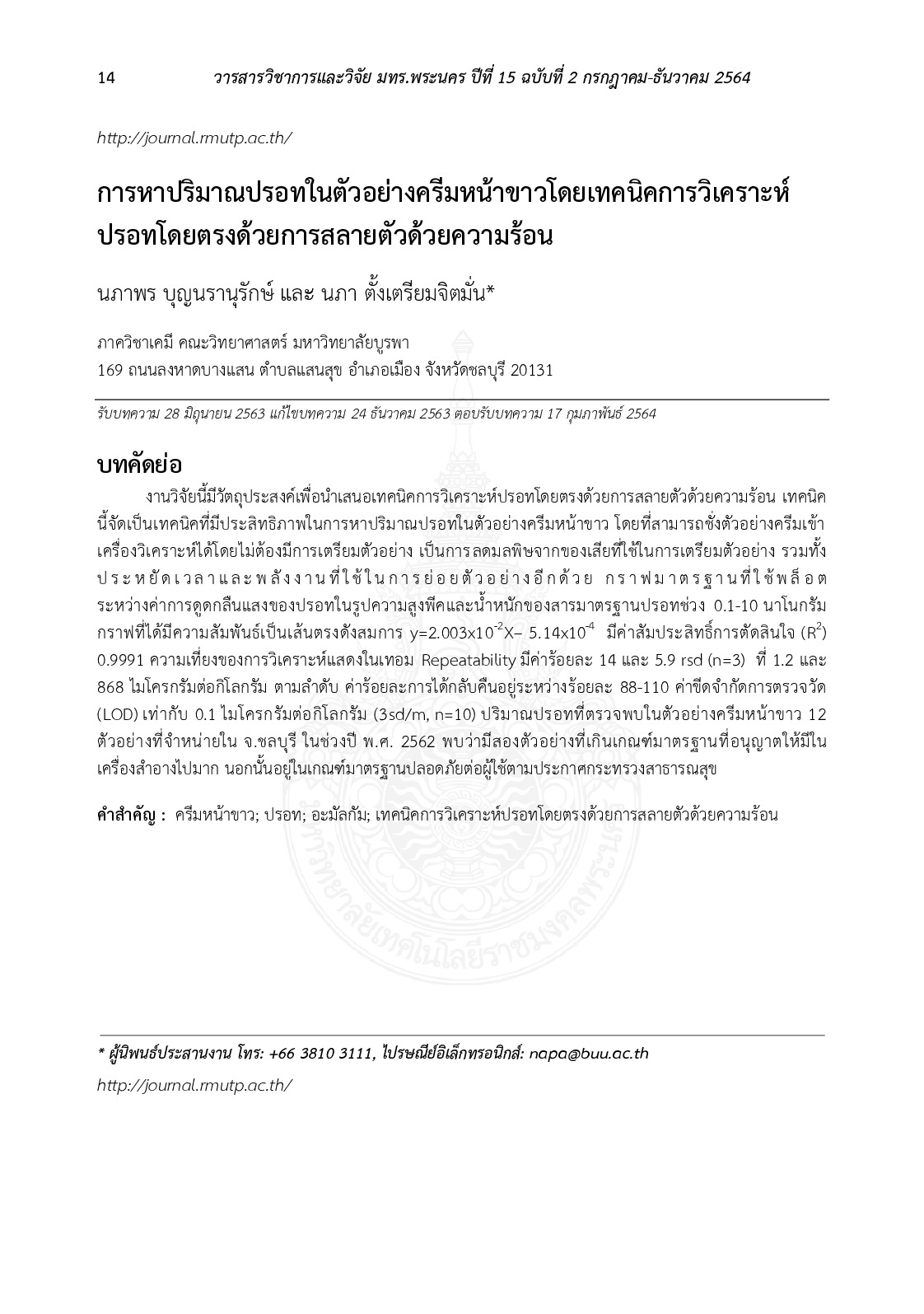
การหาปริมาณปรอทในตัวอย่างครีมหน้าขาวโดยเทคนิคการวิเคราะห์ปรอทโดยตรงด้วยการสลายตัวด้วยความร้อน
Direct thermal decomposition mercury analysis is an efficient technique for determination of mercury in facial whitening creams. The analysis can be performed without any sample preparation. The samples can be weighed and placed directly into the analyzer. Thus there is no chemical waste produced in sample preparation. The time and energy used in sample digestion are saved as well. The calibration curve between mercury absorbance in terms of peak height and weight of standard mercury in the range of 0.1-10 ng was created. The calibration curve was linear followed the equation y=2.003x10⁻²X– 5.14x10⁻⁴ with coefficient of determination (R2) 0.9991. The precision in term of repeatability were 14% and 5.9% rsd (n=3) at 1.2 and 868 µg kg-1 respectively. The recoveries were between 88-110%. The detection limit (LOD) was 0.1 µg kg-1 (3sd/m n=10). The amount of mercury detected in 12 whitening cream samples sold in Chonburi province during the year 2019 were within the safety standard permitted in general cosmetics under the notification of the Ministry of Public except two samples were over the permitted standard.