จำนวน Repository ( 137 )

Analysis of needs and expert’s opinions on the competency required of computer Job category for work integrated learning (WiL) in higher education
The aim of this research is to analyze the needs and opinions of experts concerning competency required for computer related jobs in the present and the future. Its outcomes would be used in designing a Work-integrated learning (WiL) programs in undergraduate computer related programs (Computer Engineering Software Engineering Computer Science Information Technology and Information System) which meet quality standard specified by The Association for Computing Machinery (ACM) The Association for Information Systems (AIS) and The Institute of Electrical and Electronics Engineer - Computer Society (IEEE-CS). The forty educational institutions and industries in line with the development of hardware and software the installation of operating system the installation and maintenance of the network the application of information technology and the use of information system in management were invited to participate in this study. The instruments employed for data collection were questionnaires comprising six parts: 1) General Knowledge of Computer Personnel; 2) Knowledge of Computer Engineering Personnel; 3) Knowledge of Software Engineering Personnel. 4) Knowledge of Computer Science Personnel; 5) Knowledge of Information Technology Personnel and 6) Knowledge of Information System Personnel. Statistic devices used in analyzing the data were frequency percentage arithmetic mean and standard deviation. The results were also compared with the performance analysis of Competency of Computer Jobs Category in ASEAN countries Japan Europe and America. The results were also validated by 12 specialists using a purposive sampling from educational institutions enterprises and the professional associations. It was found that the Competency Required of Computer Job Category for educational management on WIL program were: 1) Computer Architect 2) Computer Support 3) Computer Specialist 4) Project Manager 5) Software Development 6) Applied Program Specialist 7) Computer Consultant 8) Sale and Marketing and 9) Computer Education Trainer. All job positions should be consistent with the empirical data which are statistically significant at p-value =0.05. The Competency Required of Computer Job Category overall fit are accepted.
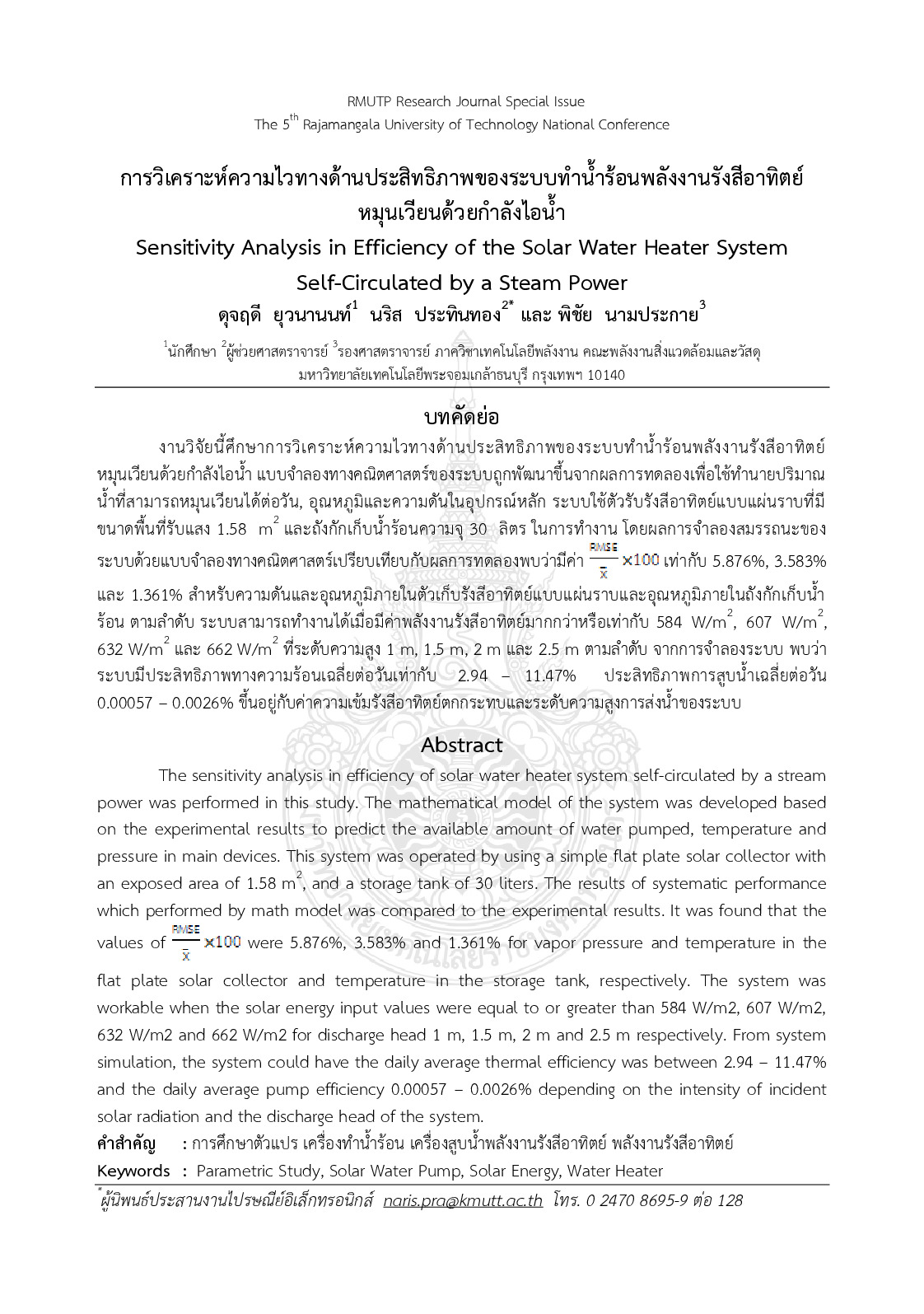
Sensitivity analysis in efficiency of the solar water heater system self-circulated by a steam power
The sensitivity analysis in efficiency of solar water heater system self-circulated by a stream power was performed in this study. The mathematical model of the system was developed based on the experimental results to predict the available amount of water pumped temperature and pressure in main devices. This system was operated by using a simple flat plate solar collector with an exposed area of 1.58 m2 and a storage tank of 30 liters. The results of systematic performance which performed by math model was compared to the experimental results. It was found that the values of were 5.876% 3.583% and 1.361% for vapor pressure and temperature in the flat plate solar collector and temperature in the storage tank respectively. The system was workable when the solar energy input values were equal to or greater than 584 W/m2 607 W/m2 632 W/m2 and 662 W/m2 for discharge head 1 m 1.5 m 2 m and 2.5 m respectively. From system simulation the system could have the daily average thermal efficiency was between 2.94 – 11.47% and the daily average pump efficiency 0.00057 – 0.0026% depending on the intensity of incident solar radiation and the discharge head of the system.
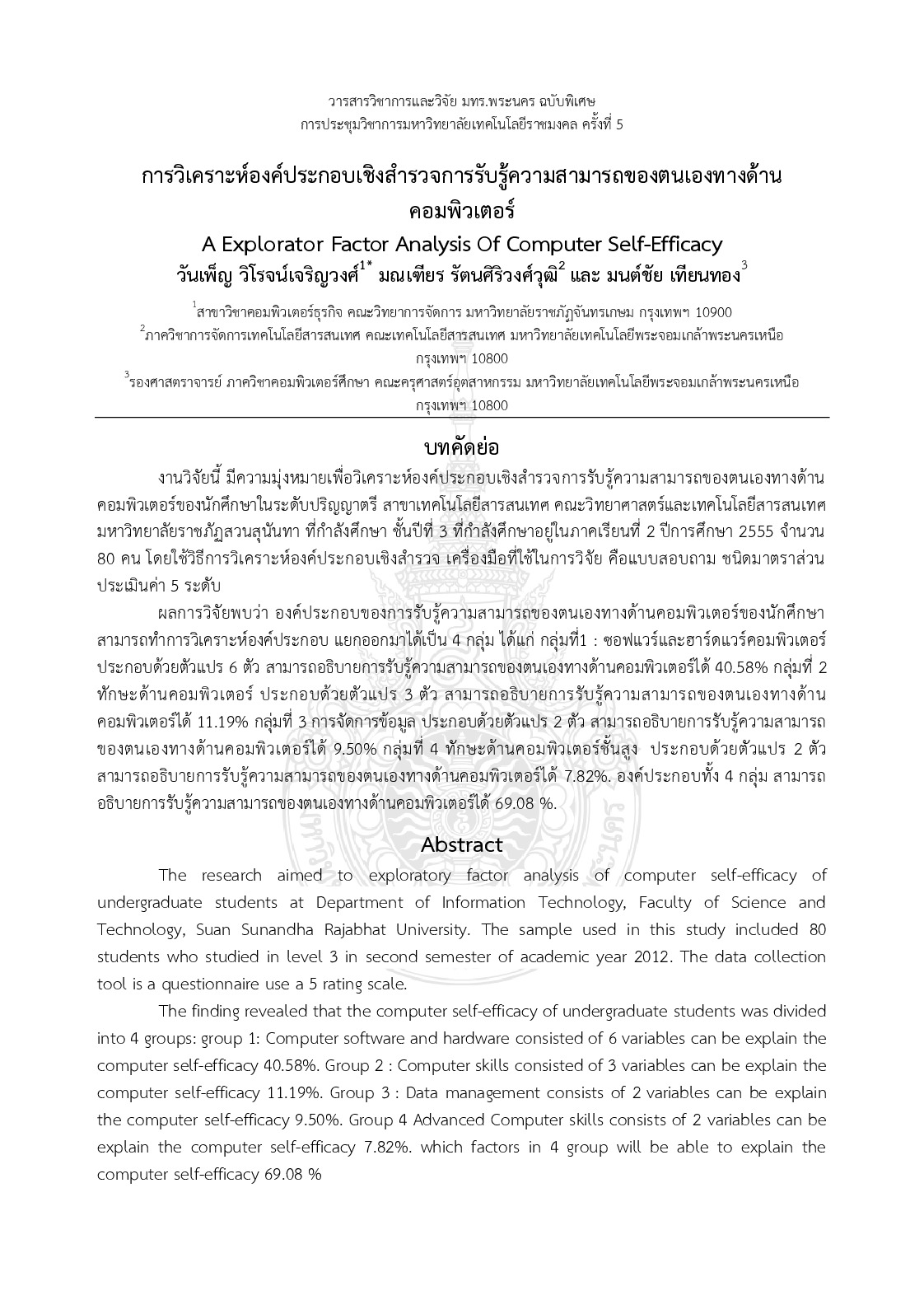
A explorator factor analysis Of computer self-efficacy
The research aimed to exploratory factor analysis of computer self-efficacy of undergraduate students at Department of Information Technology Faculty of Science and Technology Suan Sunandha Rajabhat University. The sample used in this study included 80 students who studied in level 3 in second semester of academic year 2012. The data collection tool is a questionnaire use a 5 rating scale. The finding revealed that the computer self-efficacy of undergraduate students was divided into 4 groups: group 1: Computer software and hardware consisted of 6 variables can be explain the computer self-efficacy 40.58%. Group 2 : Computer skills consisted of 3 variables can be explain the computer self-efficacy 11.19%. Group 3 : Data management consists of 2 variables can be explain the computer self-efficacy 9.50%. Group 4 Advanced Computer skills consists of 2 variables can be explain the computer self-efficacy 7.82%. which factors in 4 group will be able to explain the computer self-efficacy 69.08 %
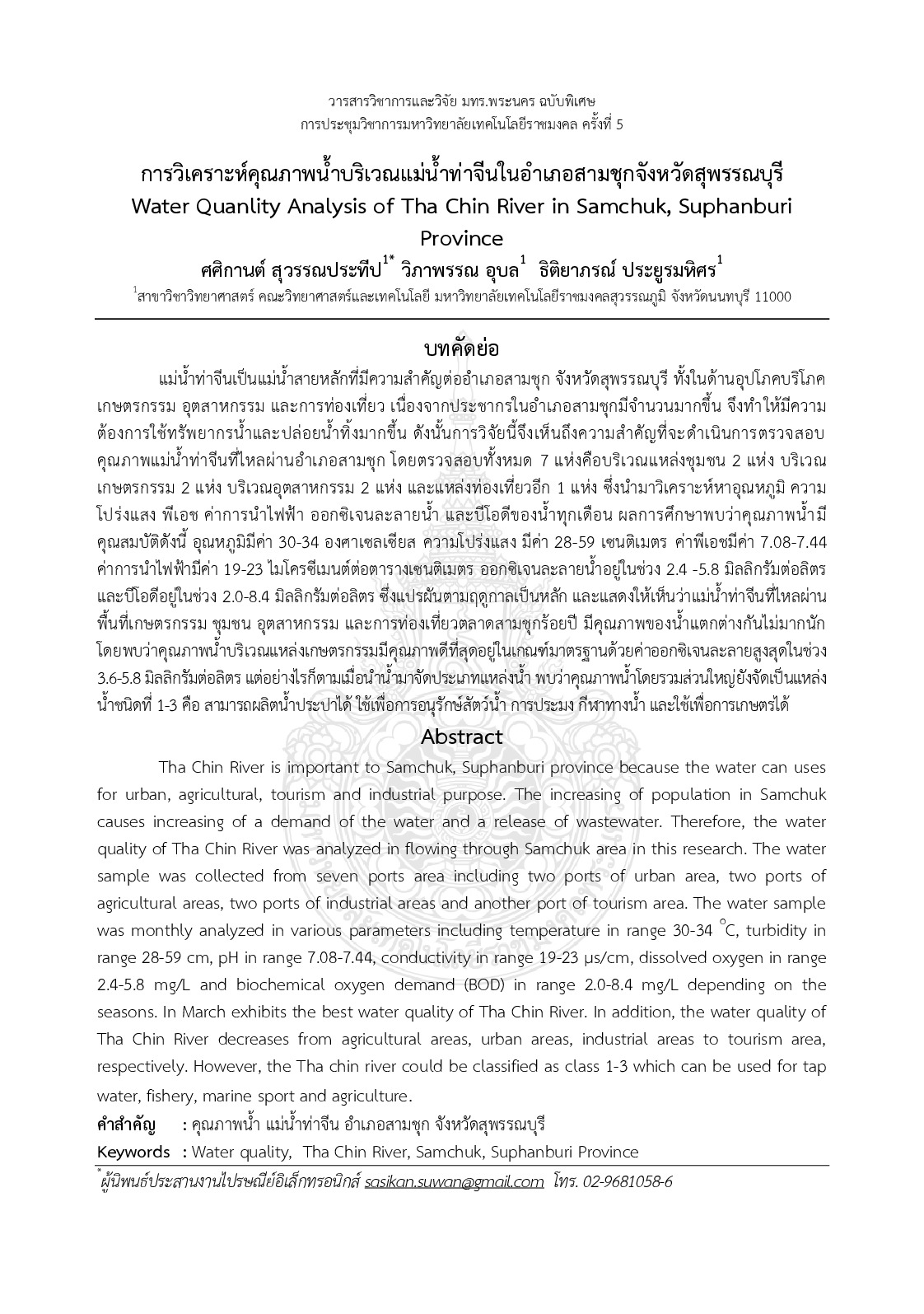
Water quanlity analysis of tha chin river in samchuk, suphanburi province
Tha Chin River is important to Samchuk Suphanburi province because the water can uses for urban agricultural tourism and industrial purpose. The increasing of population in Samchuk causes increasing of a demand of the water and a release of wastewater. Therefore the water quality of Tha Chin River was analyzed in flowing through Samchuk area in this research. The water sample was collected from seven ports area including two ports of urban area two ports of agricultural areas two ports of industrial areas and another port of tourism area. The water sample was monthly analyzed in various parameters including temperature in range 30-34 oC turbidity in range 28-59 cm pH in range 7.08-7.44 conductivity in range 19-23 s/cm dissolved oxygen in range 2.4-5.8 mg/L and biochemical oxygen demand (BOD) in range 2.0-8.4 mg/L depending on the seasons. In March exhibits the best water quality of Tha Chin River. In addition the water quality of Tha Chin River decreases from agricultural areas urban areas industrial areas to tourism area respectively. However the Tha chin river could be classified as class 1-3 which can be used for tap water fishery marine sport and agriculture.
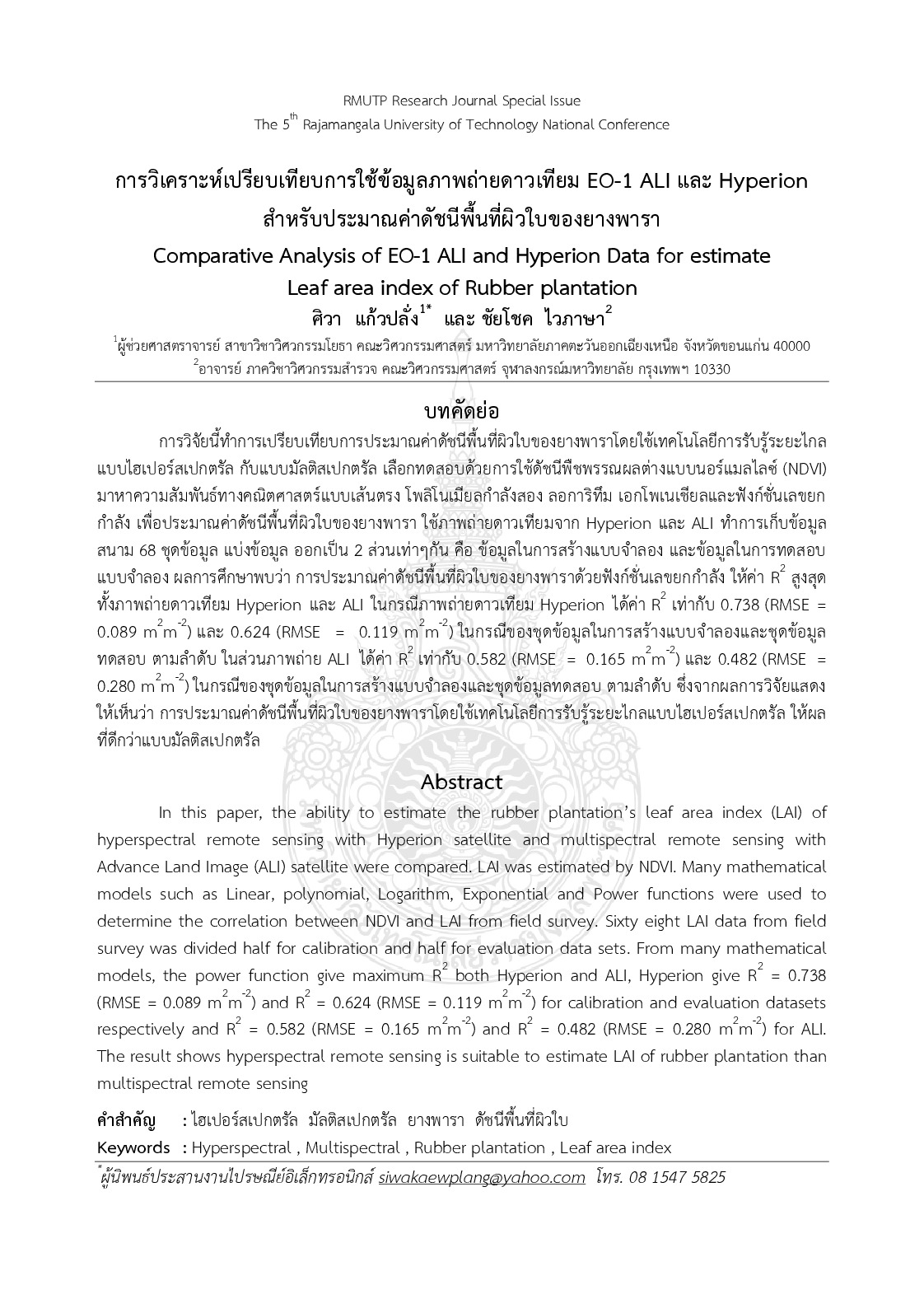
Comparative analysis of EO-1 ALI and Hyperion data for estimate leaf area index of rubber plantation
In this paper the ability to estimate the rubber plantation’s leaf area index (LAI) of hyperspectral remote sensing with Hyperion satellite and multispectral remote sensing with Advance Land Image (ALI) satellite were compared. LAI was estimated by NDVI. Many mathematical models such as Linear polynomial Logarithm Exponential and Power functions were used to determine the correlation between NDVI and LAI from field survey. Sixty eight LAI data from field survey was divided half for calibration and half for evaluation data sets. From many mathematical models the power function give maximum R2 both Hyperion and ALI Hyperion give R2 = 0.738 (RMSE = 0.089 m2m-2) and R2 = 0.624 (RMSE = 0.119 m2m-2) for calibration and evaluation datasets respectively and R2 = 0.582 (RMSE = 0.165 m2m-2) and R2 = 0.482 (RMSE = 0.280 m2m-2) for ALI. The result shows hyperspectral remote sensing is suitable to estimate LAI of rubber plantation than multispectral remote sensing