จำนวน Repository ( 126 )
การถ่ายทอดเทคโนโลยีการสร้างตราสินค้าและบรรจุภัณฑ์เพื่อเพิ่มมูลค่าผลิตภัณฑ์จากเศษวัสดุสิ่งทอเหลือทิ้ง
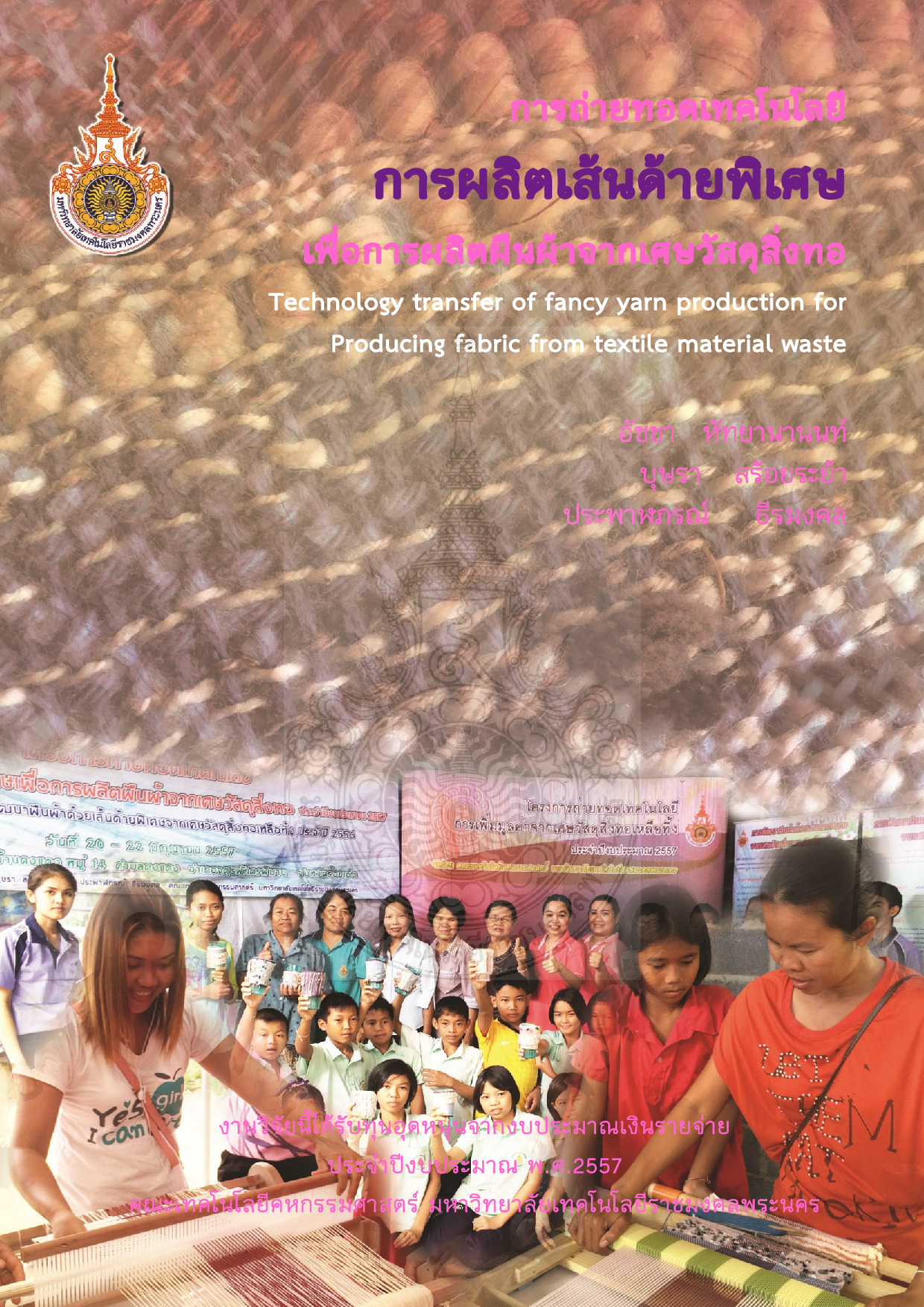
The research aimed to Technology transfer of fancy yarn production for producing fabric from textile material waste. The purpose is to technology transfer of fancy yarn production for producing fabric to people and community and to evaluate of technology transfer of fancy yarn production for producing fabric. The procedures were as follows target population for the transfer of knowledge and technology as Small and Micro community Enterprise--SMCE and individuals interested in Dang Dong sub-district Bang Bon district at Roi-Ed province. A total of 34 peoples and two days on 20 - 21 June 2557 and a satisfaction survey with a questionnaire after training. The data were analyzed using frequency percentage and mean. The results that general Information are female and younger than 21 years of education in elementary education as a student. A question that asking about their satisfaction with the course and to divide into three aspects: the purpose of the project The course structure and the contents of the course. The majority were satisfied with the very best. The purpose and the content are high level of satisfaction. In relation to technology transfer of fancy yarn production for producing fabric from textile material waste divided into three aspects: the process provides trainers and facilities was found that were satisfied at all of the 3 parts. The participants are mainly used to provide benefits to themselves for one month to apply the knowledge gained after the training. The participants modified using a new material and used local materials applied accordingly. Moreover a focus will be capped by the school to take courses and workshops and to teach another one for working out or as part of the courses taught at the school. Satisfaction with the benefits of technology transfer and utilization. Satisfaction at the highest level. The comments and suggestions of the participants found that they need for re-training again. They would like to have a longer period of training in order to gain more knowledge. All lecturer can transfer knowledge during the training as well.

การผลิตคู่มือให้ความรู้เรื่องอาหารแก่ผู้ป่วยไตวายเรื้อรัง
The purpose of study had the following objectives 1) to produce food handbook for chronic kidney disease patients. 2) to test effectiveness of the food knowledge handbook. 3) to compare knowledge before and after learning the handbook on food for chronic kidney disease patients. The population of this research were 100 chronic kidney disease patients who were tested at the kidney center of Galyani Vadhana Siriraj hospital age between 40 – 59 years. The population were randomize age sample through purposive sampling. The tools were food knowledge handbook and knowledge measurement form participant were tested for nutrition knowledge before learning the handbook. The knowledge was analyzed using mean and standard deviation. Difference between the averages was measured by the standard deviation (t-test) The study showed that the handbook contains knowledge of diet therapy for chronic kidney disease. The handbook was 80.00/83.40 effective comparing to the standard 80/80 specified. Result of the knowledge after learning the handbook was higher than the result before learning significantly different statistically at 0.05
Automated production of traditional liquor by cooling method
An automated production of traditional liquor by cooling method is presented in this paper. Thai traditional liquor is a product of One Tombon One Product (OTOP) and it was refined using traditional method. That is boil the fermented rice that obtained from fermented sticky rice with leavening and then condense the steam in coolant tank until receive the 35 degree distilled liquor. The entire production process is mainly base on worker’s experience which cause the uncertainty of production time and the alcohol percentage is not constant. In this paper we have developed the automatic distillation by using microcontroller to control the production process. The digital thermometer and limit switch are used to check temperature and water level (maximum-minimum) inside coolant tank respectively. And temperature in the coolant tank is controlled to vary slightly between 38-40 degrees. When the temperature inside the coolant tank is higher than a certain threshold the microprocessor instructs to solenoid valve and water pump to drain hot water and to pump cold water into tank respectively. So the temperature inside coolant tank is constant. An automated production of traditional liquor by cooling method was fabricated and experimented with community at Banlang Mueang Lampang. The results show that the proposed method has the volume of liquor rather than the original method. In 100 minutes the proposed method has distilled liquor 10 liters while the original method has 8.4 liters. And alcohol percentage is constant at 35 degrees.
Dry reforming of methane reaction for hydrogen and syngas production using cobalt catalysts and nickel-cobalt bimetallic catalysts
The cobalt catalysts (cobalt content by weight: 7% 10% and 15%) and cobalt-nickel bimetallic catalysts (cobalt-nickel content by weight: 3.5%-3.5% 5%-5% and 7%-7%) were studied in dry reforming of methane for hydrogen and syngas production. All catalysts were synthesized by the wetness impregnation method. The dry reforming of methane was carried out at 700oC atmosphere pressure using a mixture; CH4 and CO2 in ratio 1:1. The result showed that the good activity and stability depend on metal content in catalysts and the combined 2 metals as bimetallic catalysts. The optimum amounts of catalysts are 10wt% Co for mono-metallic catalysts 75%CH4 and 75%CO2 conversion and 7wt% Ni-7wt% Co for bimetallic catalysts 87%CH4 and 89%CO2 conversion.
The participatory learning process of leaung rice 11 production without toxic substance case study : khoklam village kamalasai district kalasin provice
This research aims to study participatory learning process to strengthen rural communities through Leaung Rice 11 production which promotes self-reliability and capability of the communities. This is a participatory action research (PAR) with farm experimental methods. It demonstrates a model to empower community which allows members to identify problems discuss find commitment and approve incoming development. Researchers here are therefore facilitators helping people in the community to achieve effective production of Yellow Rice 11. After providing sufficient information about Leaung Rice 11 production the main problems identified is a high production cost with chemical fertilizer being abundantly used causing health and environment problems to the community. This results in a solution of choosing organic Yellow Rice 11 production that is harmless and friendly to the environment. Despite co-operative learning and problems identification locals also get an opportunity to plant Leaung Rice 11 with organic fertilizer and Effective Microorganisms (EM) as a model to safe cost. It is obvious that rice production is also increased (737.69 Kilogram per Rai). Moreover production cost decreases to 1227.50 Baht per Rai per family. This research provides the community ability to analyze self-problems and potentiality under modern research methodology; problems identification solution identification experiment process co-operative learning data collection data discrimination data analysis and data application.