จำนวน Repository ( 952 )
เครื่องคัดแยกขนาดเมล็ดสารกาแฟโรบัสต้า
In the procedure processes of Robusta coffee initial from bring the green coffee after dried and removed the outside shell and bring it to separating process. The sale price depends on the size of green coffee. If their size of still standard the sale price have been increased. Most of the separating process is majorly with the labor experience. Based on human experience the error with operating and working time is increased. In this reason we will study to the criteria of Robusta coffee for designing and creating the Robusta coffee bean separator machine for Robusta size standard testing. The separator machine consists of the three-layer cylindrical sieve set and the diameter of the layers was 4 6 and 7.5 mm. respectively. For the standardization of Robusta coffee bean is controlled by size of hole sieve. In this research considers to 4 importance parameters by the efficiency of sorting out standard of green coffee Specific Energy Consumption [SEC] and assessment way economic engineering. The result of research shows that the maximum efficiency of green coffee separating is 164.7 kg/hr under the condition of testing with 14.4 rpm at 4 angle incline. In term of standard it found that the machine can separated only for standard and smaller than standard size of green coffee and the maximum moistness are 9.9%. For the least Specific Energy Consumption [SEC] is 0.01631 MJ/kg and occur with the same condition of experiment. Based on this condition the Break-Even Point must be sorting out with 1070550 kilogram per year and Payback Period will occur at 3.598 years. However the quantity of separating or the efficiency of machine is mainly effect to Break-Even Point and Payback Period.

การพัฒนาอุปกรณ์พิมพ์สกรีนต้นแบบเพื่องานอุตสาหกรรมสิ่งทอ
Devlopment of Screen Printign Devices Prototypes for Textile lndustry was a research project which it was established to solve the practical learning of the faculty of industrial textile and fashhion desing students at Rajamangala University of Technology Phra Nakhon. This set had 3 important machines such as a self assembly aluminum block screen an automatic aluminum screen could saved the saved the screen fabric1.76 m2 reduced the chemical usageand waste minimization in the process.The practical time reduced from 16 minutes to 1 minute using the automatic aluminum screen coating. The efficiency time was 97.81. The 400 gram emulsion consumed obtained the thin film layer on the screen fabricand evenness.The sharpen pattern displayed when the exposed time was 3minutes.Moreoverthe drying and fixation machine was completely for natural fiber and synthetic fibers at 80-180 C. Therefore the Screen Printing Devices Prototypes was effectively used in textile industrialdispose of the practical learning problemraw material savingand waste minimization adjacent to clean technology process.The prototype set was produced by house equipmentsand extended for textile industrial.
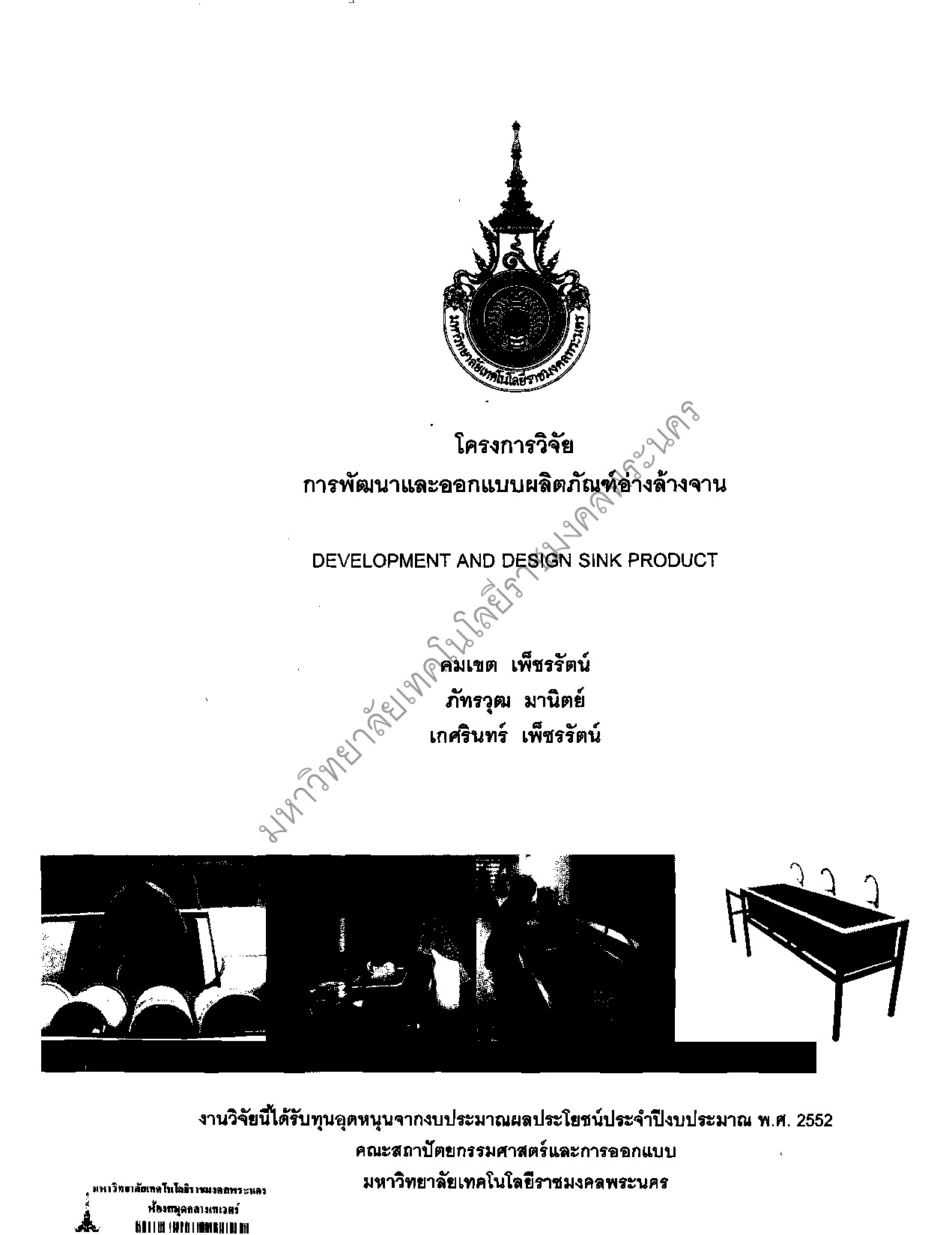
Development and Design Sink Product
The main objective of the study was to explore The relationship of cleaning the container behavior with sink space guide line for sink product. This research an integration of field survey and quasi-experimental techniques were utilized to people who live in condominium in Bangkok and preference assessment of Thai sink product by ninety seven users. This research based on work triangle and evaluation environment for cooking in condominium by experimental. And attitudes expectation of Thai sink product prototype. Variables were used in the framework of this study: size and spatial characteristics of each area understudied for washing in sink. The sizes of areas which could optimally accommodate such activities were derived from eleven cases of experimentation. Other than body size and the extent of disability the study also found that variation in area size was determined by additional factors such as types of activities approach to the area and the individuals skill for that particular activity. Intervening variables such as fatigues after prolonged and repeated tests were found partially affected the results of experiments and attitudes toward the environment and the extent of difficulty to perform each task. The final analysis of the attitude toward the suggested sink product modification was done using data collected from ninety seven users respondents accompanying the disabled. The sink product modification to accommodate all users inclUding the disabled members of the family in accordance with the former environment. The study found however that the extent of intimacy with the disabled significantly determined towards sink product modification. In conclusion the study suggested that conditional application of sink production modification according to the nature of the disabled-in terms of social psychology familial background the extent of disability and the specific needs required by each of the canteen.