จำนวน Repository ( 1852 )
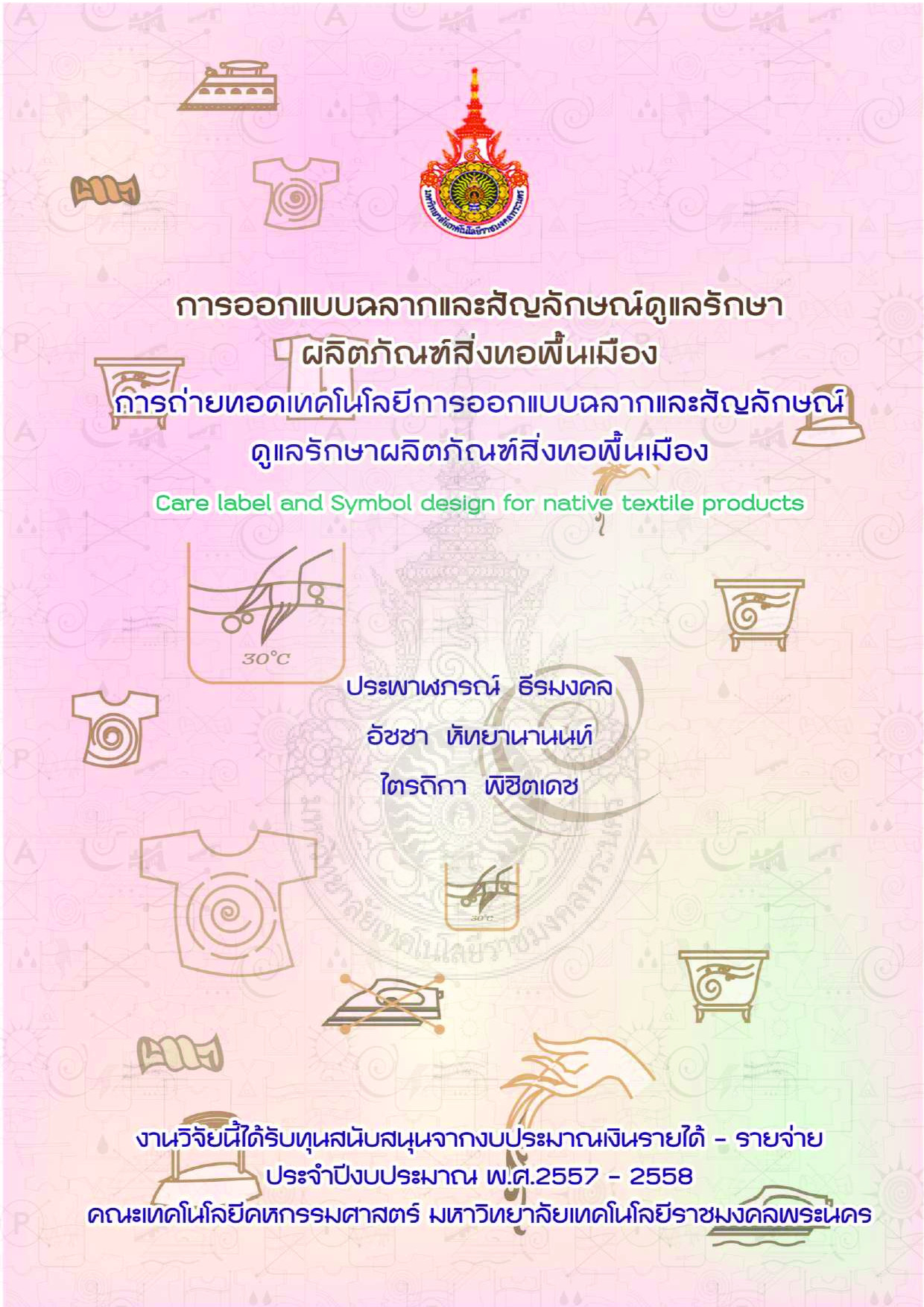
การออกแบบฉลากและสัญลักษณ์ดูแลรักษาผลิตภัณฑ์สิ่งทอพื้นเมือง
This research is Care label and Symbol design for native textile products. The purpose of this research were 1) to study and design the care label and symbol design of native textile products. 2) to design the care label and symbol design of native textile products and 3) to assessment the consumers satisfaction towards the care label and symbol design for native textile products. 4) to transfer knowledge towards the SMEs production communities about the care label and symbol design for native textile products. 5) to assessment the consumers satisfaction towards the care label and symbol design for native textile products. The research instruments used to collect data: 1) a draft care label and symbol design of native textile products of 6 types (10 prototypes) as 60 prototypes of washing bleaching spinning twisting and drying ironing and colour dropping. 2) Questionnaire of expert opinion and selective drafts for 3 models as 18 prototypes. 3) Questionnaire of consumers satisfaction towards the care label and symbol design for native textile product of 100 people: buyers sellers manufacturers and those interested in native textiles. The evaluation data was analyzed by using SPSS program in frequency mean and percentage. All in conclusion as table and descriptive. In the second research year the process are focus group people for transfer knowledge as SMEs community Enterprise OTOP production communities and other that it is interesting in this research : MEA-LA small enterprise in Singburi province PAMONT Hand-woven Communities in Ratchaburi province and Thai SONG-DUM Woven Ban-Sa-Kee-Rai in Nakhompathum province. To plan the schedule and set the date place amount of participate and lectures 102 people on 12 22 and 28 July 2015 and asking for consumer satisfaction of the curriculum and lecture for “transfer knowledge the care label and symbol design for native textile product” by Questionnaire of participate satisfaction. Last the evaluation data was analyzed by using SPSS program in mean and percentage. The First year’s research showed that mostly respondents were male at 59 percent aged 46 years at 52 percent and also being the entrepreneurs / business owners at 45 percent. 48 percent as bachelors degree and their income were an average of 20001 - 25000 baht at 46 percent. The analysis of consumers satisfaction can be concluded that the first types of care label and symbol design for native textile product at highest levels satisfaction is Colour dropping at 4.46. The next types is bleaching at 4.44 Washing at 4.42 Ironing at 4.38 Twisting and Drying at 4.32 and the last types is at least levels satisfaction is Spinning at 4.28 but all have been satisfied at maximum average and highest level of satisfaction. The research in the second year found that mostly participates were female aged 51 – 60 years old finished the secondary school and also there are farmer. The participates are their income under 5000 baht and They are moderately understanding symbol and care label but they are not make for their products. In relation to technology transfer of “the care label and symbol design for native textile product” divided into 3 parts it is also the curriculum and lecture for this research. The analysis of participate satisfaction It have been satisfied at maximum average and highest level of satisfaction in facilities. The participants are mainly used to provide benefits to themselves for one month to apply the gained after the training. The participants used care and symbol label for their products. Moreover a focus will be capped by the other communities to teach another one for working out. Satisfaction with the benefits of technology transfer and utilization. Satisfaction at the highest level. The comments and suggestions of the participants found that they need for re-training again. They would like to have a longer period of training in order to gain more knowledge. All lecturer can transfer knowledge during the training as well.
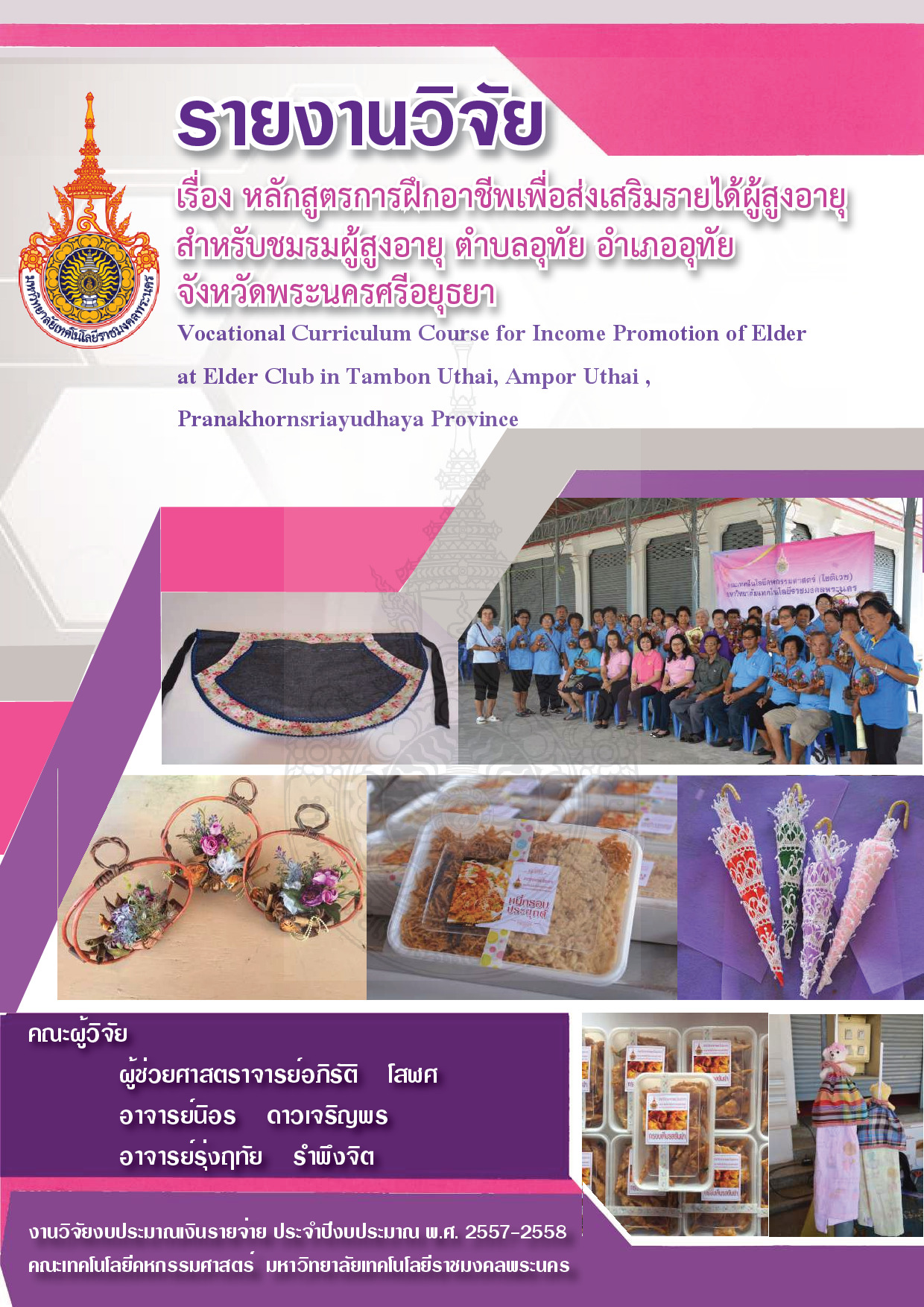
หลักสูตรการฝึกอาชีพเพื่อส่งเสริมรายได้ผู้สูงอายุสาหรับชมรมผู้สูงอายุ ตาบลอุทัย อาเภออุทัย จังหวัดพระนครศรีอยุธยา
The purposes of this study were to 1) develop a professional skills course for promoting income of the elderly at the senior people club in Uthai district Ayutthaya 2) evaluate the effectiveness of the professional skills course for promoting income of the elderly at the senior people club in Uthai district Ayutthaya and 3) the implementation of the effective professional skills course for promoting income of the elderly at the senior people club in Uthai district Ayutthaya with the target group of 60 people. The research instruments were 1) a professional skills course for promoting income of the elderly comprising six units namely 1) The Elder And The Home Economics professions 2) Foods For Being Rich 3) Clothing and Accessories 4) Home Furniture 5) Herbs and Souvenirs and Professional Training for Additional Income. Other research instruments included the assessment forms to seek for 1) for the suitability 2) the association and the satisfaction of the course. The data were analyzed by the percentage distribution mean and standard deviation. The course development was divided into two phases: 1) the course outline which covered the principles objectives contents applications of the course as well as the course assessment; 2) the course assessment concerning its suitability and association. It was found that the suitability was in good level and the course association rate was higher than the expectation. After the course trial in actual situations and some improvement the course was satisfying and adequately appropriate for implementing with the target group which were 60 senior residents in Uthai district Ayutthaya for three days. The satisfaction for the attending the course was measured and the result revealed high satisfaction toward the professional skills course.
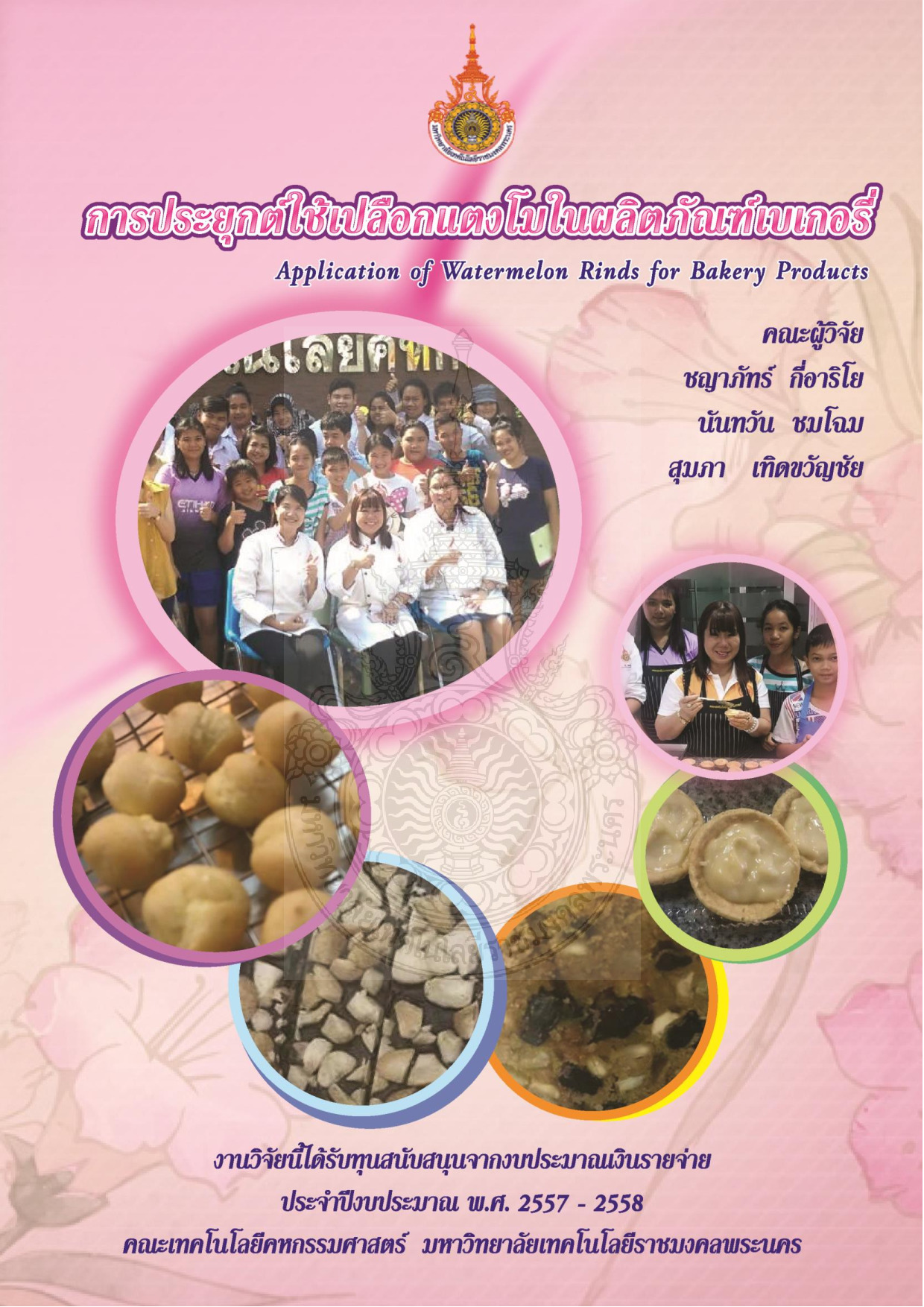
การประยุกต์ใช้เปลือกแตงโมในผลิตภัณฑ์เบเกอรี
The purpose of the application of watermelon rinds for bakery products is to study an appropriate amount of used watermelon rinds in four of bakery products such as cookie bar fruit cake Eclair with vanilla cream and coconut tarte. The research was planned in accordance with “Randomized Complete Block Design RCBD”. Sense test by tasting method by giving favorite scores of 9 levels (9 – Point Hedonic Scale) quality test of chemical composition and physical composition including acceptance test of 100 people towards the products were performed. The use of watermelon rinds in syrup added in cookie bar at 10% 15% and 20% of all total ingredients weight was found that the testing persons favored the cookie bar added watermelon rinds in syrup at 15% of all total ingredients weight. There are of favorite score in appearance color smell taste food texture and overall at 7.70 7.90 7.85 7.90 7.80 and 7.80 respectively. When analyzed with Oneway ANOVA compared the average of favorite scorn found that color smell taste food texture and overall the difference in statistical significant at (p 0.05). The approximate chemical compositions of cookie bar added watermelon rinds in syrup at 100g. were consisting of energy 436 Kcal carbohydrate 57.10g. protein 6.10g. fat 20.40g. moisture 15.20g. and ash 1.24g. physical quality of water activity (AW) as 0.80. The use of watermelon rinds in syrup substitute cherry in fruit cake at 50% 75% and 100% the testing persons favored the watermelon rinds in syrup substitute cherry in fruit cake at 100%. There are of favorite score in appearance color smell taste food texture and overall at 7.40 7.90 7.95 8.00 7.90 and 7.75 respectively. When analyzed with One-way ANOVA compared the average of favorite scorn found that color smell taste food texture and overall the difference in statistical significant at (p 0.05). The approximate chemical compositions of watermelon rinds in syrup substitute cherry in fruit cake at 100g. were consisting of energy 330 Kcal carbohydrate 63g. protein 6.08g. fat 5.93g. moisture 23.70g. and ash 1.31g. physical quality of water activity (AW) as 0.78. The use of watermelon rinds added in Eclair with vanilla cream at 20% 40% and 60% of vanilla cream weight was found that the testing persons favored the Eclair with vanilla cream added watermelon rinds at 20% of vanilla cream weight. There are of favorite score in color smell taste food texture and overall at 8.50 8.40 8.40 8.00 and 8.10 respectively. When analyzed with Oneway ANOVA compared the average of favorite scorn found that color smell taste food texture and overall the difference in statistical significant at (p 0.05). The approximate chemical compositions of Eclair with vanilla cream added watermelon rinds at 100g. were consisting of energy 190 Kcal carbohydrate 28.80g. protein 4.24g. fat 6.40g. moisture 59.70g. and ash 0.82g. physical quality of water activity (AW) as 0.97. The use of watermelon rinds substitute coconut in coconut tarte at 50% 75% and 100% the testing persons favored the watermelon rinds substitute coconut in coconut tarte at 75%. There are of favorite score in appearance color smell taste food texture and overall at 8.05 7.85 7.70 7.65 7.70 and 7.60 respectively. When analyzed with One-way ANOVA compared the average of favorite scorn found that appearance color taste food texture and overall the difference in statistical significant at (p 0.05). The approximate chemical compositions of watermelon rinds substitute coconut in coconut tarte at 100g. were consisting of energy 167 Kcal carbohydrate 27.80g. protein 1.78g. fat 5.38g. moisture 64.30g. and ash 0.69g. physical quality of water activity (AW) as 0.78. This research was found that the appected consumers in four of bakery products because of this products is add-value and using local ingredient from agriculture in this country. From the technology transfer of bakery products from watermelon rinds to community the results showed that the majority of participants were female with an average age ranging from 21 to 30 years old. Overall satisfaction level towards this project was high and respondent opinions towards trainers were high.
ความสัมพันธ์ระหว่างเจตคติการดูแลสุขภาพตนเอง การเข้าถึงระบบบริการสาธารณสุขกับพฤติกรรมการดูแลสุขภาพตนเอง ของกลุ่มผู้สูงอายุชุมชนบ้านห้วยทรายเหนือ จังหวัดเพชรบุรี
The main purposes of this research are 1) to investigate basic information about attitude towards self-care behavior access to public healt care system of the elderlies at Ban Huay Sai Nue community Phetchaburi province; 2) to study self-care behavior attitude towards self-care behavior and access to public healt care system; 3) to study a relationship between self-care attitude and self-care behavior; and 4) to study a relationship between access to public health service and self-care behavior of the elderlies. Data were collected from a population of 103 elderlies at Ban Huay Sai Nue community with interviewing forms. Data were tatistically analyzed for percentage means standard deviation and a relationship between attitude towards self-care behavior access to public healt care system and self-care behavior using Pearson coefficient correlation. Results of the study showed that the elderlies at Ban Huay Sai Nue Phetchaburi province had overall self-care behavior in nutrition and exercising aspects in high level ( =3.18). That is there was average relationship between attitude towards self-care and self-care behavior (r=.313). There was no significant relationship at .05 level between access to public health care service system and self-care behavior of the elderlies at Ban Huay Sai Nue community Phetchaburi province (r=.153).
การรับรู้บทบาทวิชาชีพคหกรรมศาสตร์ของนักศึกษา คณะเทคโนโลยีคหกรรมศาสตร์ มหาวิทยาลัยเทคโนโลยีราชมงคลพระนคร
The purposes of the research were to study and investigate the relationship between the role perception in Home Economics profession of students from the Faculty of Home Economics Technology and personal and supporting factors. The personal factor consisted of gender year level academic achievement and department. Supporting factor consisted of knowledge experience in Home Economics profession attitude towards Home Economics profession and students’ participation in professional activities. Researchers used stratified random sampling to obtain a sample population of 318 bachelor’s degree students from the Faculty of Home Economics Technology Rajamangala University of Technology Phra Nakhon. Research tools were a questionnaire and a test. Data were analyzed by descriptive and inferential statistics. The results were found that the role perception in Home Economics profession of students from the Faculty of Home Economics Technology was at the high level. There was a significant relationship between the role perception in Home Economics profession of students from the Faculty of Home Economics Technology and year level department attitude towards Home Economics profession and students’ participation in professional activities at the 0.05 level. There was not a significant relationship between the role perception in Home Economics profession of students from the Faculty of Home Economics Technology and gender academic achievement and knowledge and experience in Home Economics profession.