จำนวน Repository ( 1574 )

The Factors that Effects 0n Household Saving Behaviors in Koh Peah Community, Trang Province
The Factors that Effects on Household Saving Behaviour in Koh Peach Community Trang Province This study investigates effects on household saving behaviour in Koh Paech Community Trang Province. The objectives are (1) to examine the household saving behaviour (2) to analyse various factors affecting the household saving behaviour and (3) to compare household saving behaviour between general household and those which are members of the Saving Group for Production. For primary data questionnaires are employed to obtain information from a total 326 households interviewed in July 2012. These data are examined and evaluated by way of simple statistical analysis with multiple regression used to investigate the relationship between household saving and factors determining it such as the household leader’s age income expenditure and level of education. The study includes consideration of the boosting household consumption policies of the Thai government. Results of this paper indicate that most household leaders are male (70.9%) and half of them are over the age of 50 years. The majority are agriculturists (57%) and most have an elementary education (58.3%). Average number of dependents is two and the average income of households interviewed is 352904 baht/year. Average household expenditure is 186151 baht/year average assets are 2681596 baht/year average debt is 311809 baht and average household saving is 91008 baht/year. Multiple regression analysis reveals that income (0.78) and assets (0.18) both have highly significant positive relationships with household saving while for expenditure (-0.36) there is a highly significant negative relationship. An unexpected finding of no effect from interest rates on household saving may be due to a preference for convenience over returns from saving. In comparing saving behaviour the result show that households which are members of the Saving Group for Production have an average saving of 80342 baht/year. They mostly save money before spending and usually have monthly security deposits. For general households the average saving is 96274 baht/year. They mostly spend rather than save money and have infrequent security deposits.

Development Information System to support activities of Nang Loeng Community, Bangkok
The objectives of this research are to analysis design and develop the Information System to support activities of Nang Loeng Community Bangkok. Also to install test and evaluate the system. To develop the System Development Life Cycle (SDLC) method is used. To develop and implement PHP script language and MySQL database management system are used. And the system is installed on the Internet Server. To evaluate the satisfaction the 2 groups are the samples the first is the group of 19 operation users and the second is the groups of 30 general users. Convenience sampling is used for sampling method. Gathered and analyzed the data by statistical processing program for Windows software. The result of research show that the satisfaction of the first group (19 operation users) about input screen a data entry is in a good level (x=4.00). About working process and reporting of the system is in a good level (x=4.15) the satisfaction of the group is a good level (x=4.08) The satisfaction of the group (43 general users) the results appear in the same level to the satisfaction of the first group in every case (x=4.21). So the research results can be concluded that all samples are highly satisfied with this information system. And this system can be installed in real working and suit the user requirement.
Problems and Barriers for cooperative Education Student Trainee Recruitment according to the Work Place’s concept : A Case Study of Undergraduates of Business Administration Faculty : A Case Study of Undergraduates of Business Administration Faculty, Rajamangala University of Technology Phra Nakhon
This research is to study the problems and barriers for cooperative education student trainee recruitment according to the work place’s concept the aspects of training management training format training students’ qualifications and training students’ knowledge. The population are owners of various workplaces who accept 180 fourth year undergraduate students in training. Questionnaires are used to collect data statistically analyzed by Percentage Mean and Standard Deviation. The findings of the research reveals problems and obstacles as follow : 1. For the training management aspect the workplaces are not able to cooperate with the university to set aims and prepare the students before training the workplaces do not recognize purposes of the university’s training course the suitable positions for the students are not provided by the workplaces. 2. For the training students’ qualifications the students are unlikely to make decision in their performances’ problem solving no self-confidence and carefulness in their performances. 3. For the training students’ knowledge the students are unable to analyze and plan their performances; they have not a good command of both written and spoken English and Thai. In addition they lack of vocational skills.
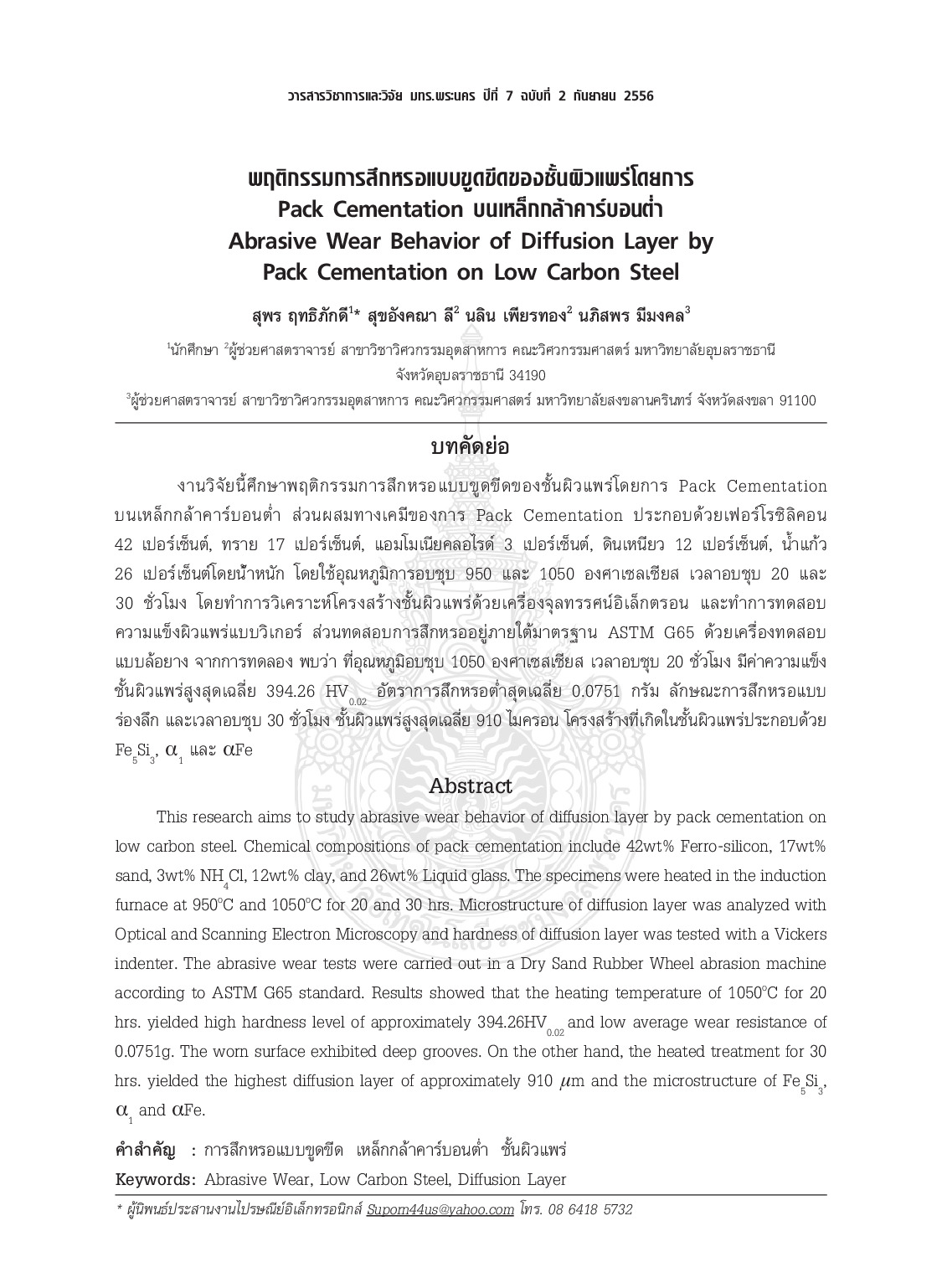
Abrasive wear behavior of diffusion layer by Pack Cementation on low carbon steel
This research aims to study abrasive wear behavior of diffusion layer by pack cementation on low carbon steel. Chemical compositions of pack cementation include 42wt% Ferro-silicon 17wt% sand 3wt% NH4Cl 12wt% clay and 26wt% Liquid glass. The specimens were heated in the induction furnace at 950?C and 1050?C for 20 and 30 hrs. Microstructure of diffusion layer was analyzed with Optical and Scanning Electron Microscopy and hardness of diffusion layer was tested with a Vickers indenter. The abrasive wear tests were carried out in a Dry Sand Rubber Wheel abrasion machine according to ASTM G65 standard. Results showed that the heating temperature of 1050?C for 20 hrs. yielded high hardness level of approximately 394.26HV0.02 and low average wear resistance of 0.0751g. The worn surface exhibited deep grooves. On the other hand the heated treatment for 30 hrs. yielded the highest diffusion layer of approximately 910?m and the microstructure of Fe5Si3 ?1 and ?Fe.

นวัตกรรมคอนกรีตต้นทุนต่ำไหลเข้าแบบง่ายโดยการใช้เถ้าทิ่้ง
This research presents a study of the compressive strength porosity chloride penetration resistance to carbonation and corrosion of self-compacting concrete containing fly ash ground rice husk-bark ash and ground bottom ash. Portland cement (CT) is partially replaced with pozzolans 0-40% by weight of the cementitious materials. Fly ash ground rice husk-bark ash and ground bottom ash have a high potential to be used as a good cementitious material. The results show that the compressive strength and low porosity of self-compacting concrete improves substantially with partial replacement of Portland cement with fly ash. Self-compacting concrete mix cement containing 20-40% of pozzolans can be used to make cementitious materials. The use of fly ash ground rice husk-bark ash and ground bottom ash produces concrete mix with good strength and resistance to chloride and corrosion.