จำนวน Repository ( 113 )
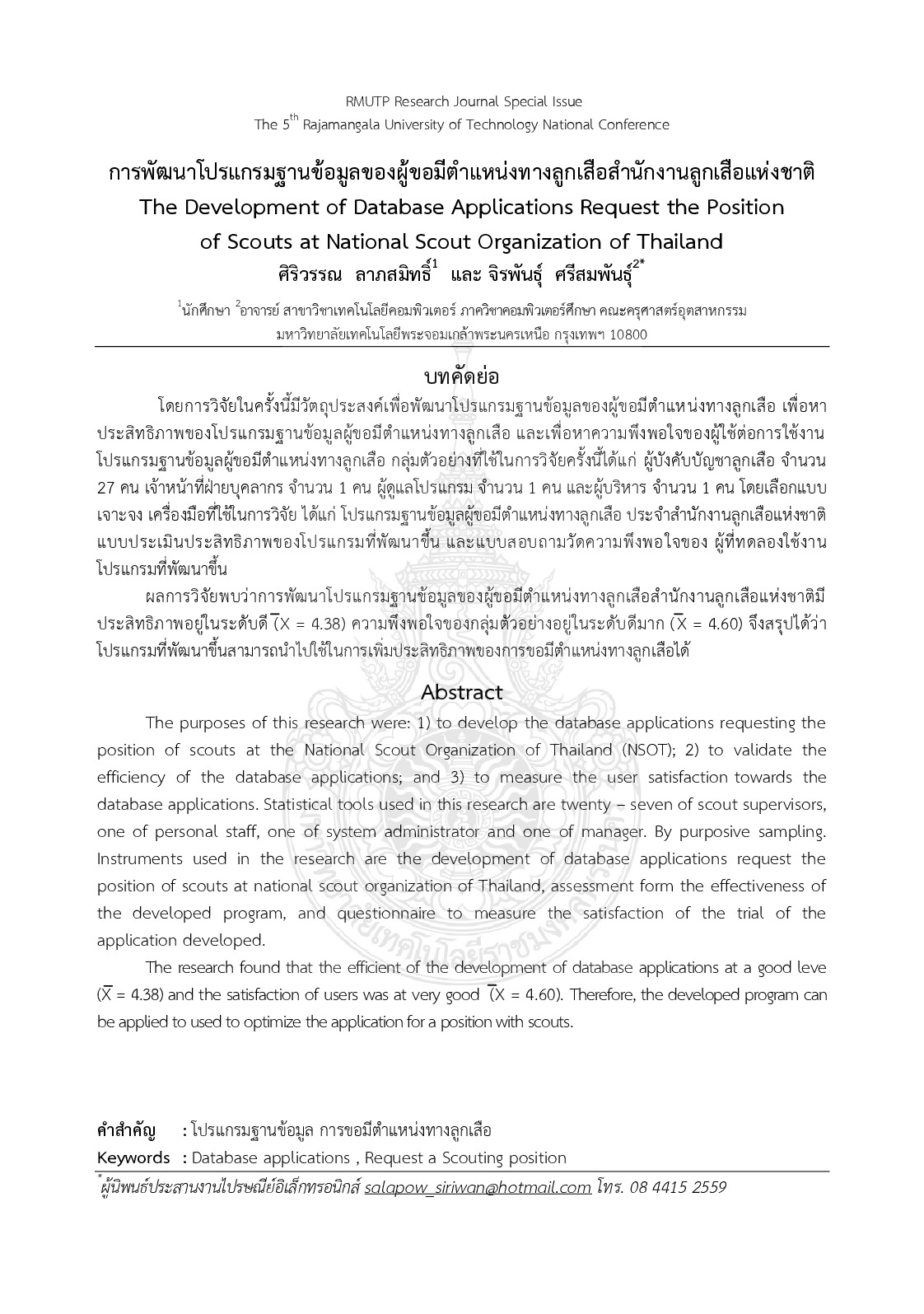
The development of database applications request the position of scouts at national scout organization of thailand
The purposes of this research were: 1) to develop the database applications requesting the position of scouts at the National Scout Organization of Thailand (NSOT); 2) to validate the efficiency of the database applications; and 3) to measure the user satisfaction towards the database applications. Statistical tools used in this research are twenty – seven of scout supervisors one of personal staff one of system administrator and one of manager. By purposive sampling. Instruments used in the research are the development of database applications request the position of scouts at national scout organization of Thailand assessment form the effectiveness of the developed program and questionnaire to measure the satisfaction of the trial of the application developed. The research found that the efficient of the development of database applications at a good leve (X = 4.38) and the satisfaction of users was at very good (X = 4.60). Therefore the developed program can be applied to used to optimize the application for a position with scouts.
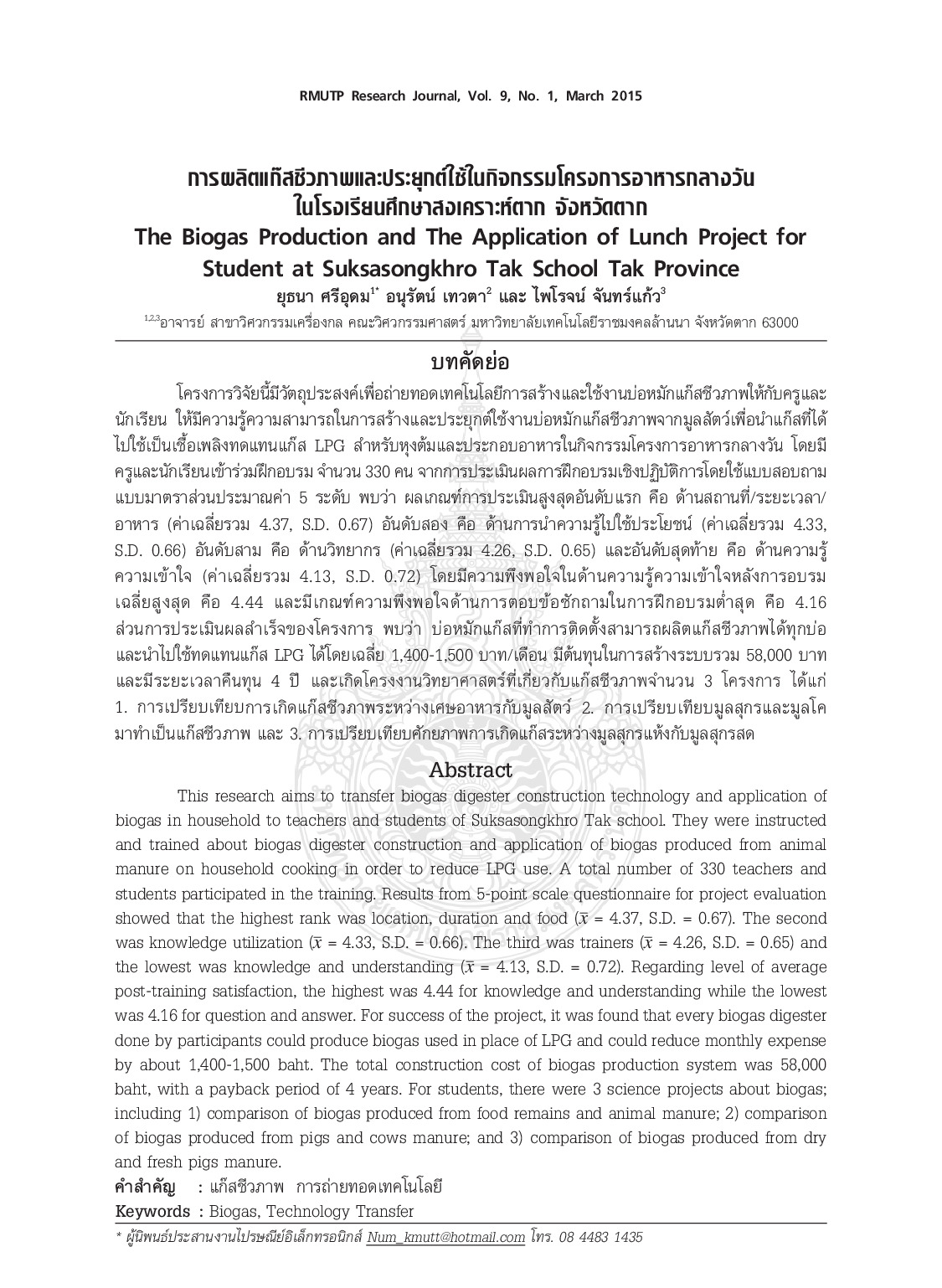
The biogas production and the application of lunch project for student at suksasongkhro tak school tak province
This research aims to transfer biogas digester construction technology and application of biogas in household to teachers and students of Suksasongkhro Tak school. They were instructed and trained about biogas digester construction and application of biogas produced from animal manure on household cooking in order to reduce LPG use. A total number of 330 teachers and students participated in the training. Results from 5-point scale questionnaire for project evaluation showed that the highest rank was location duration and food ( = 4.37 SD = 0.67). The second was knowledge utilization ( = 4.33 SD = 0.66). The third was trainers ( = 4.26 SD = 0.65) and the lowest was knowledge and understanding ( = 4.13 SD = 0.72). Regarding level of average post-training satisfaction the highest was 4.44 for knowledge and understanding while the lowest was 4.16 for question and answer. For success of the project it was found that every biogas digester done by participants could produce biogas used in place of LPG and could reduce monthly expense by about 1400 – 1500 baht. The total construction cost of biogas production system was 58000 baht with a payback period of 4 years. For students there were 3 science projects about biogas; including 1) comparison of biogas produced from food remains and animal manure; 2) comparison of biogas produced from pigs and cows manure; and 3) comparison of biogas produced from dry and fresh pigs manure.
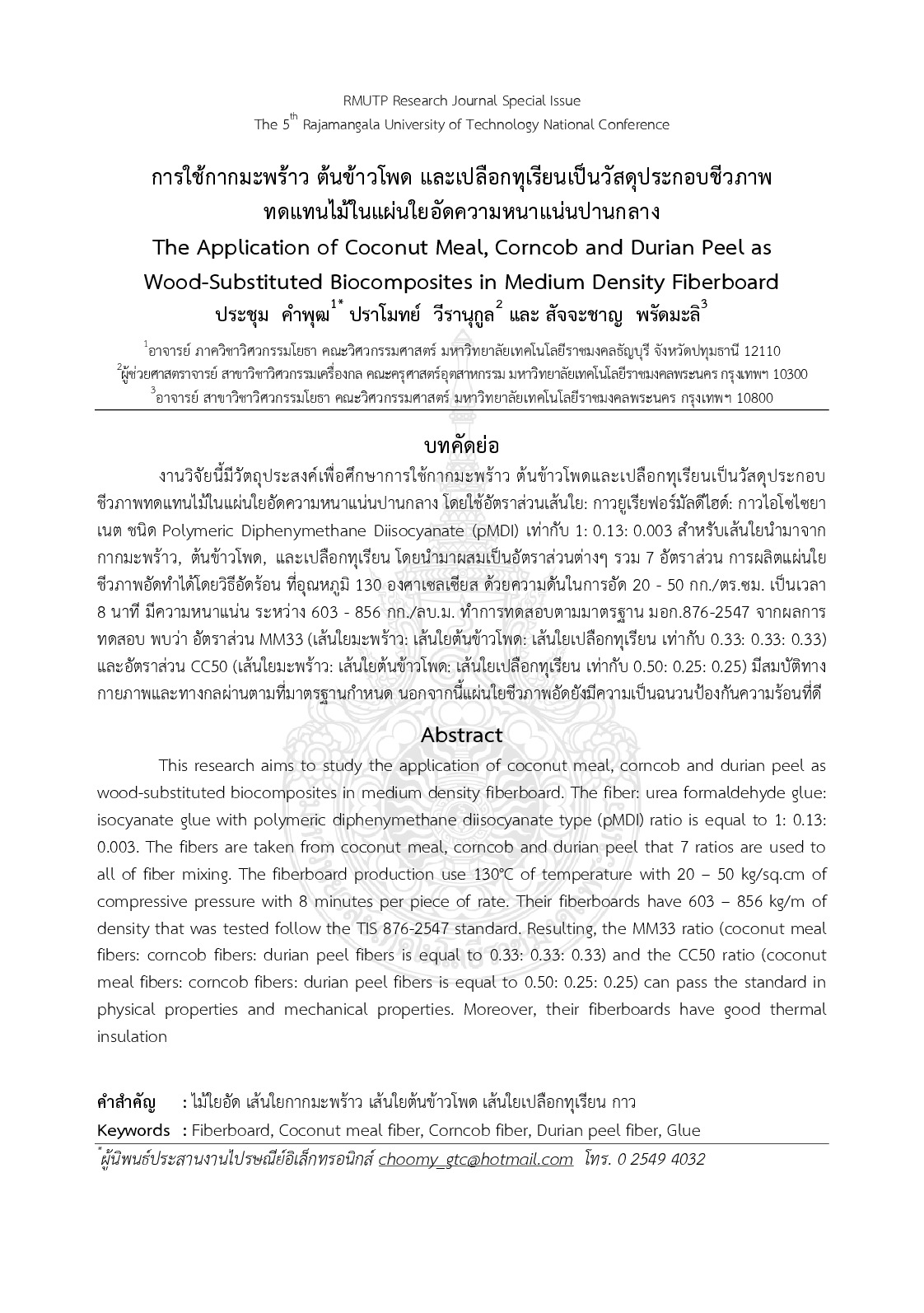
The application of coconut meal, corncob and durian peel as wood-substituted biocomposites in medium density fiberboard
This research aims to study the application of coconut meal corncob and durian peel as wood-substituted biocomposites in medium density fiberboard. The fiber: urea formaldehyde glue: isocyanate glue with polymeric diphenymethane diisocyanate type (pMDI) ratio is equal to 1: 0.13: 0.003. The fibers are taken from coconut meal corncob and durian peel that 7 ratios are used to all of fiber mixing. The fiberboard production use 130?C of temperature with 20 – 50 kg/sq.cm of compressive pressure with 8 minutes per piece of rate. Their fiberboards have 603 – 856 kg/m of density that was tested follow the TIS 876-2547 standard. Resulting the MM33 ratio (coconut meal fibers: corncob fibers: durian peel fibers is equal to 0.33: 0.33: 0.33) and the CC50 ratio (coconut meal fibers: corncob fibers: durian peel fibers is equal to 0.50: 0.25: 0.25) can pass the standard in physical properties and mechanical properties. Moreover their fiberboards have good thermal insulation
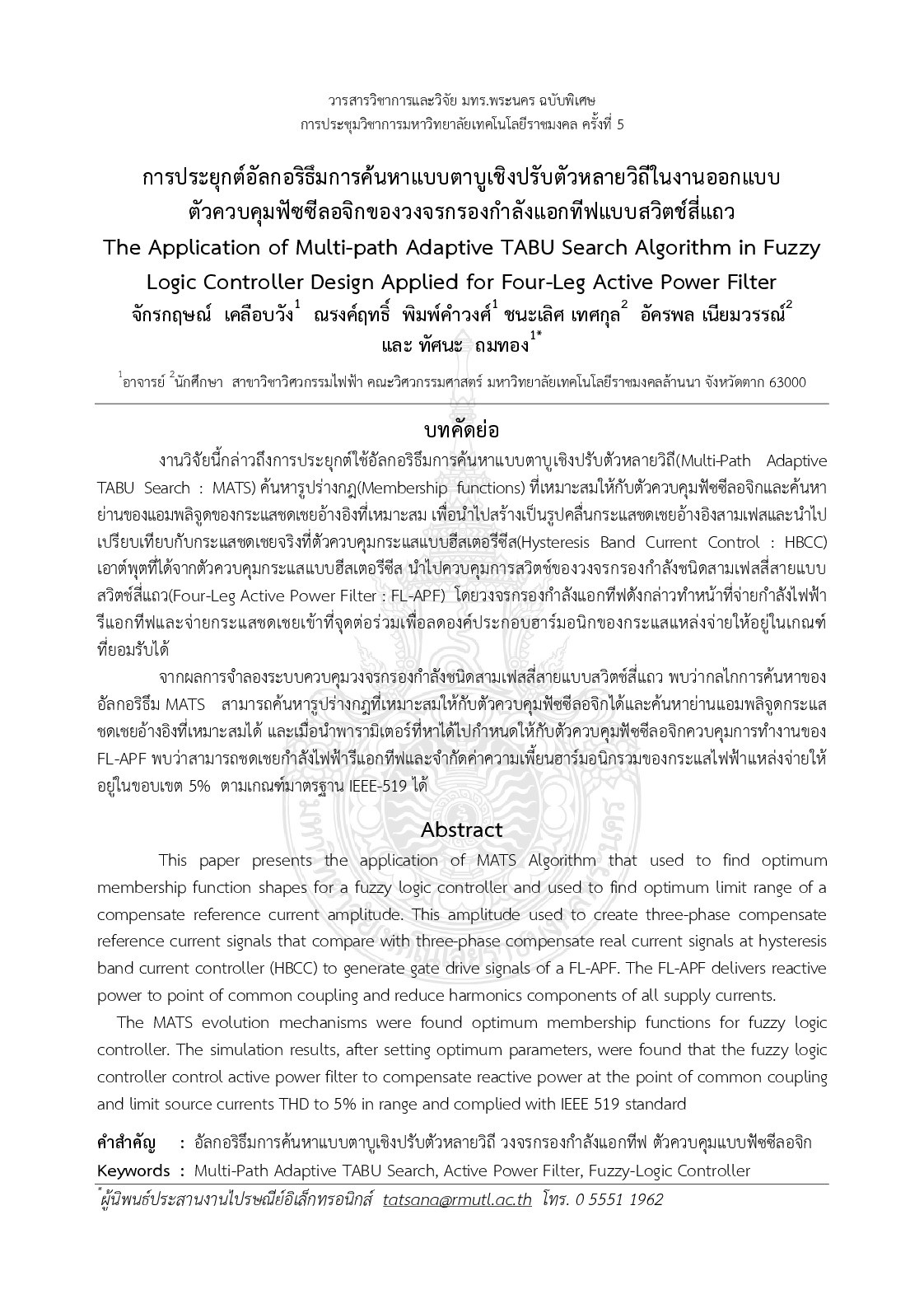
The application of multi-path adaptive TABU search algorithm in fuzzy logic controller design applied for four-leg active power filter
This paper presents the application of MATS Algorithm that used to find optimum membership function shapes for a fuzzy logic controller and used to find optimum limit range of a compensate reference current amplitude. This amplitude used to create three-phase compensate reference current signals that compare with three-phase compensate real current signals at hysteresis band current controller (HBCC) to generate gate drive signals of a FL-APF. The FL-APF delivers reactive power to point of common coupling and reduce harmonics components of all supply currents. The MATS evolution mechanisms were found optimum membership functions for fuzzy logic controller. The simulation results after setting optimum parameters were found that the fuzzy logic controller control active power filter to compensate reactive power at the point of common coupling and limit source currents THD to 5% in range and complied with IEEE 519 standard
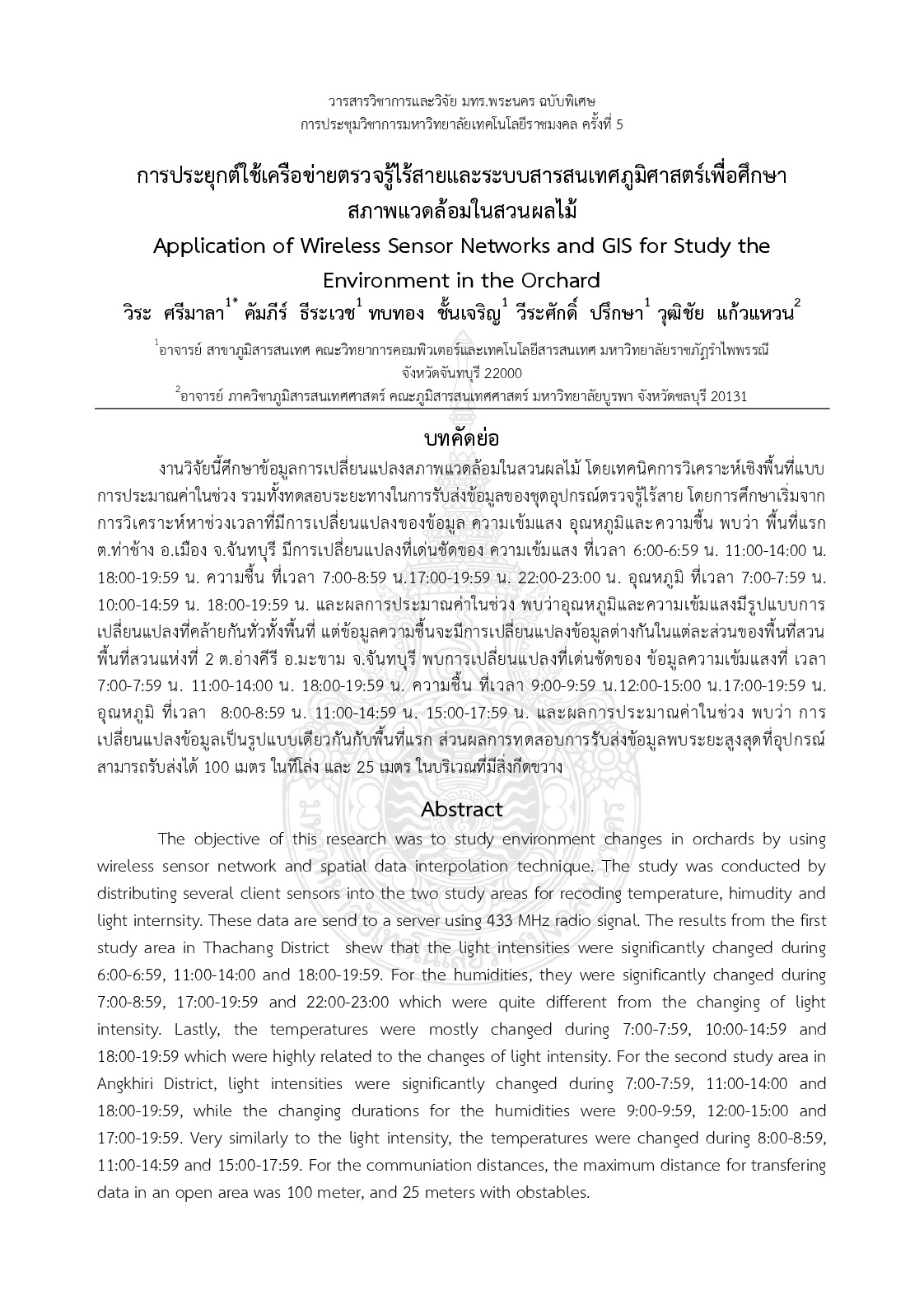
Application of wireless sensor networks and gis for study the environment in the orchard
The objective of this research was to study environment changes in orchards by using wireless sensor network and spatial data interpolation technique. The study was conducted by distributing several client sensors into the two study areas for recoding temperature himudity and light internsity. These data are send to a server using 433 MHz radio signal. The results from the first study area in Thachang District shew that the light intensities were significantly changed during 6:00-6:59 11:00-14:00 and 18:00-19:59. For the humidities they were significantly changed during 7:00-8:59 17:00-19:59 and 22:00-23:00 which were quite different from the changing of light intensity. Lastly the temperatures were mostly changed during 7:00-7:59 10:00-14:59 and 18:00-19:59 which were highly related to the changes of light intensity. For the second study area in Angkhiri District light intensities were significantly changed during 7:00-7:59 11:00-14:00 and 18:00-19:59 while the changing durations for the humidities were 9:00-9:59 12:00-15:00 and 17:00-19:59. Very similarly to the light intensity the temperatures were changed during 8:00-8:59 11:00-14:59 and 15:00-17:59. For the communiation distances the maximum distance for transfering data in an open area was 100 meter and 25 meters with obstables.