จำนวน Repository ( 143 )

การพัฒนารูปแบบของการสร้างหลักสูตรฝึกอบรมวิชาชีพระยะสั้น ด้านคหกรรมศาสตร์ กลุ่มอาชีพสหกรณ์ศิลปะประดิษฐ์ ตำบลเกาะเกร็ด จังหวัดนนทบุรี
This research aimed to study 1) the demand for short-term vocational training courses in home economics 2) create a training curriculum of home economics profession short of demand. Handicrafts Cooperative Occupational Groups Ko Kret Nonthaburi and her 3) the effects of short-term vocational training courses in home economics created The population in this study were selected purposively is a group of professional arts cooperative. Koh Kret Nonthaburi number 30 was used in the questionnaire and short-term training courses in home economics. Data analysis and statistics used were percentage average and standard deviation. The results were as follows: The population with an interest in the course of the invention include most academic inventor gift followed by molding the dough flowers Thailand. And the flowers The average score of 4.57 4.30 and 4.20 respectively Thus the curriculum invention gift. Style stuffed owl The concept of Taba comprises seven stages: 1) analysis of problems and needs for 2) define the aims of the course 3) selection of content 4) held a substantive 5) selection of a learning experience 6) experience. Learning and 7) evaluation of the course created consisting of five plans include 1) a basic knowledge about the inventor of the gift 2) materials and fabrication techniques stuffed owl onion 3) Knowledge of design creation. 4) the invention onions stuffed owl 5) costing and pricing onion stuffed owl. The six-hour period The results of the program found that participants with a performance favorably (83.33 percent) and a rating of the portfolio is in good shape (90.00 percent) from the satisfaction of the participants are. the most satisfied are averaging 4.58
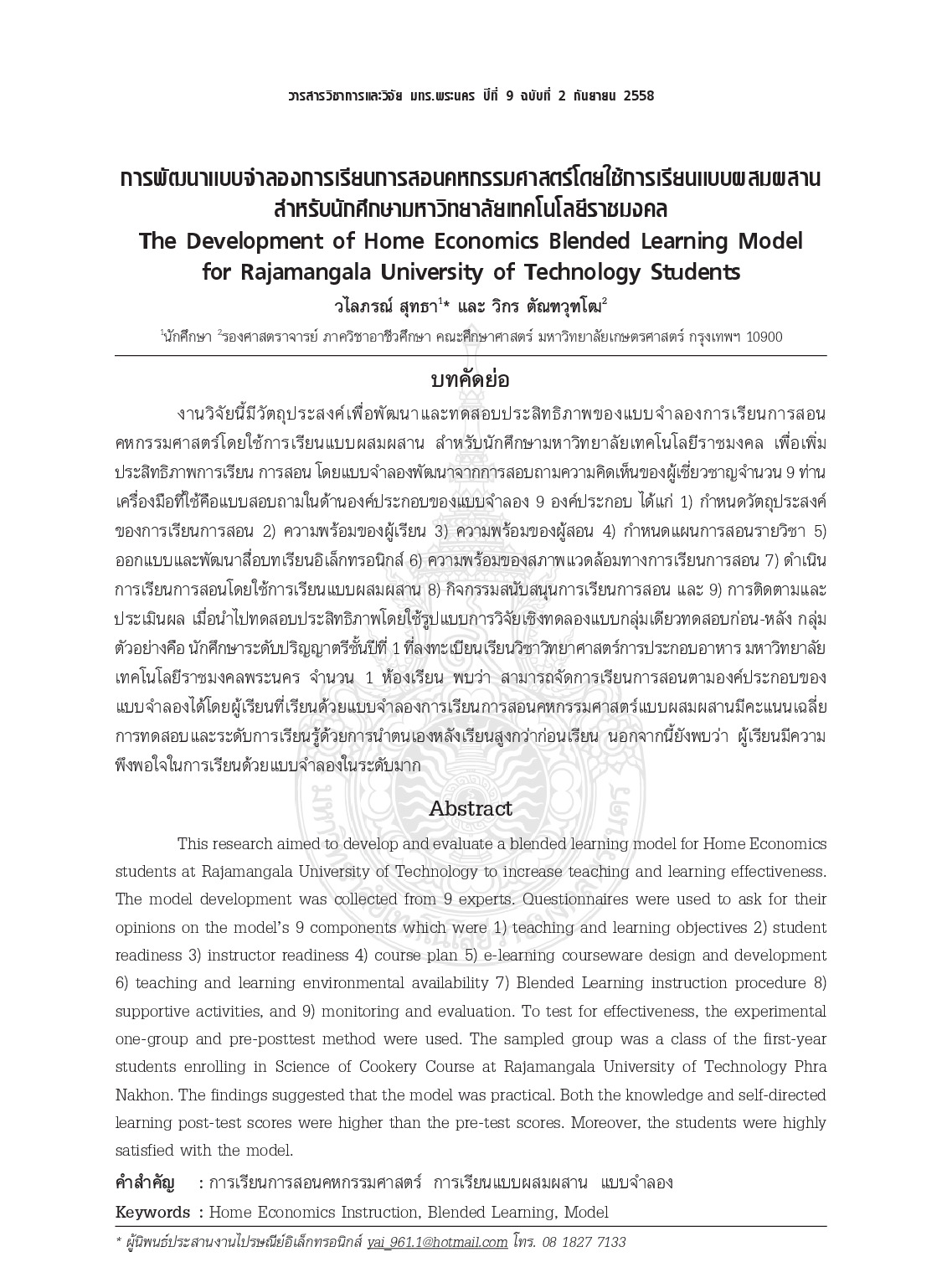
การพัฒนาแบบจำลองการเรียนการสอนคหกรรมศาสตร์โดยใช้การเรียนแบบผสมผสาน สำหรับนักศึกษามหาวิทยาลัยเทคโนโลยีราชมงคล
This research aimed to develop and evaluate a blended learning model for Home Economics students at Rajamangala University of Technology to increase teaching and learning effectiveness. The model development was collected from 9 experts. Questionnaires were used to ask for their opinions on the model’s 9 components which were 1) teaching and learning objectives 2) student readiness 3) instructor readiness 4) course plan 5) e-learning courseware design and development 6) teaching and learning environmental availability 7) Blended Learning instruction procedure 8) supportive activities and 9) monitoring and evaluation. To test for effectiveness the experimental one-group and pre-posttest method were used. The sampled group was a class of the first-year students enrolling in Science of Cookery Course at Rajamangala University of Technology Phra Nakhon. The findings suggested that the model was practical. Both the knowledge and self-directed learning post-test scores were higher than the pre-test scores. Moreover the students were highly satisfied with the model.
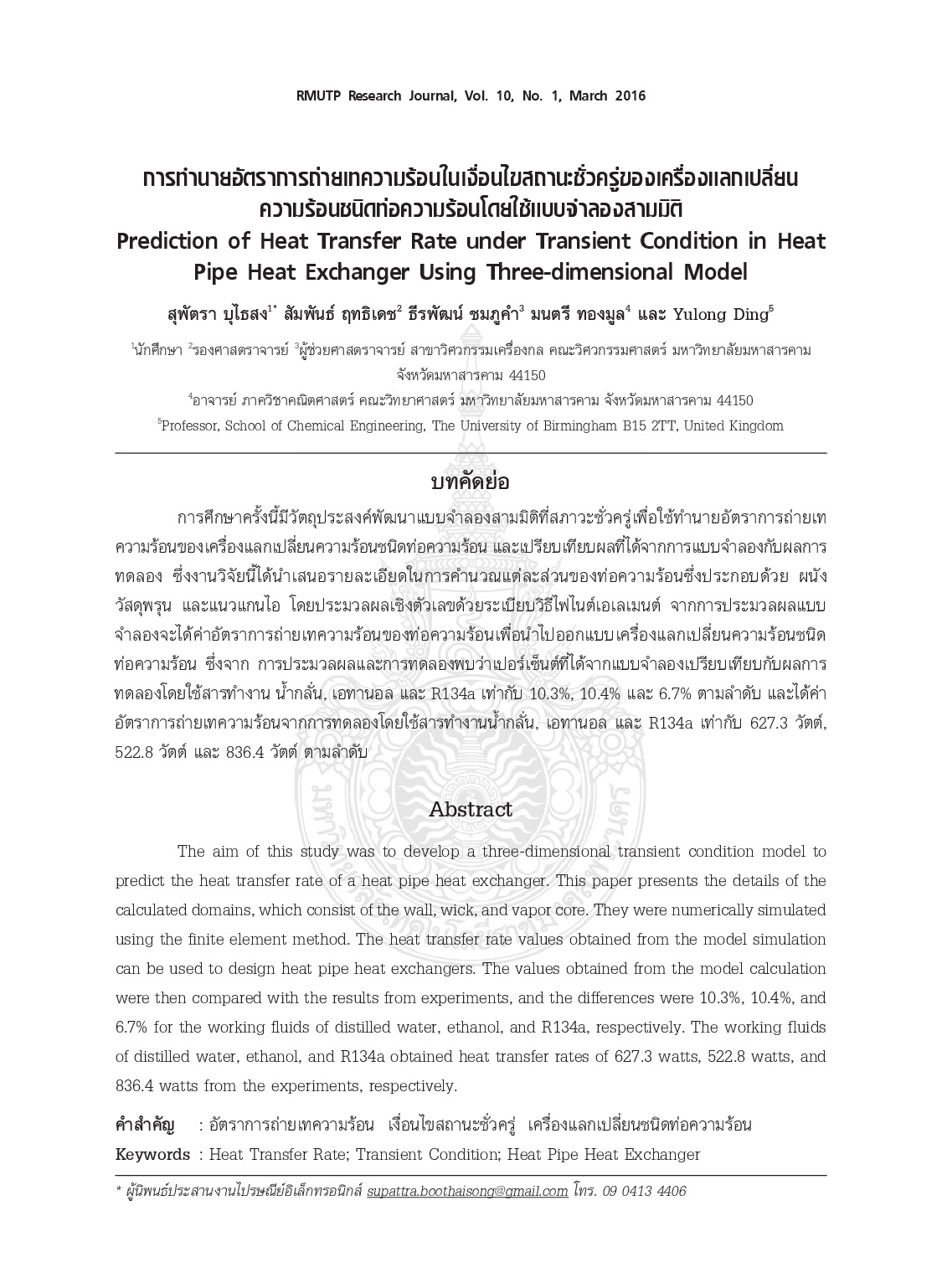
การทำนายอัตราการถ่ายเทความร้อนในเงื่อนไขสถานะชั่วครู่ของเครื่องแลกเปลี่ยนความร้อนชนิดท่อความร้อนโดยใช้แบบจำลองสามมิติ
The aim of this study was to develop a three-dimensional transient condition model to predict the heat transfer rate of a heat pipe heat exchanger. This paper presents the details of the calculated domains which consist of the wall wick and vapor core. They were numerically simulated using the finite element method. The heat transfer rate values obtained from the model simulation can be used to design heat pipe heat exchangers. The values obtained from the model calculation were then compared with the results from experiments and the differences were 10.3% 10.4% and 6.7% for the working fluids of distilled water ethanol and R134a respectively. The working fluids of distilled water ethanol and R134a obtained heat transfer rates of 627.3 watts 522.8 watts and 836.4 watts from the experiments respectively.
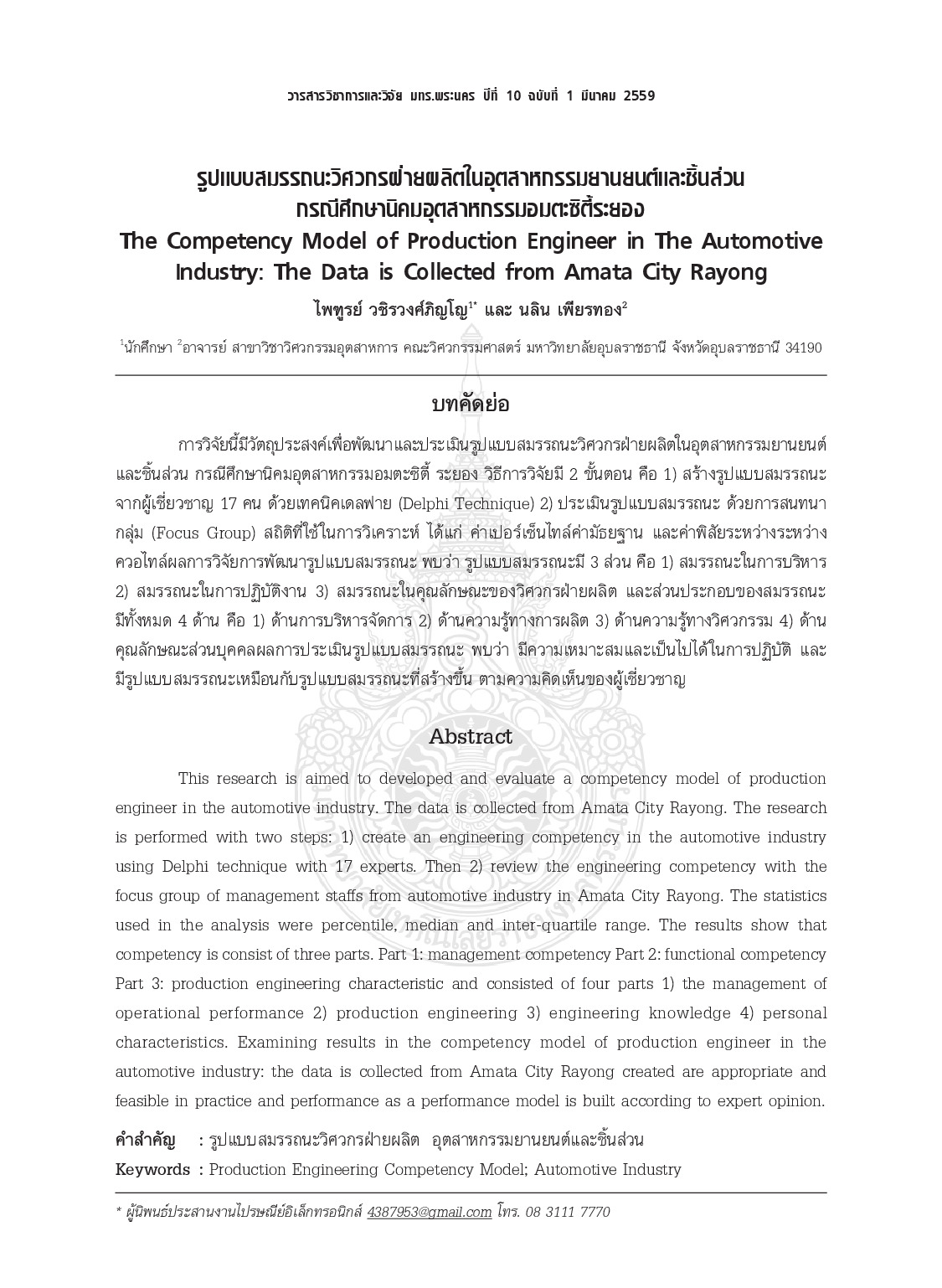
รูปแบบสมรรถนะวิศวกรฝ่ายผลิตในอุตสาหกรรมยานยนต์และชิ้นส่วน กรณีศึกษานิคมอุตสาหกรรมอมตะซิตี้ระยอง
This research is aimed to developed and evaluate a competency model of production engineer in the automotive industry. The data is collected from Amata City Rayong. The research is performed with two steps: 1) create an engineering competency in the automotive industry using Delphi technique with 17 experts. Then 2) review the engineering competency with the focus group of management staffs from automotive industry in Amata City Rayong. The statistics used in the analysis were percentile median and inter-quartile range. The results show that competency is consist of three parts. Part 1: management competency Part 2: functional competency Part 3: production engineering characteristic and consisted of four parts 1) the management of operational performance 2) production engineering 3) engineering knowledge 4) personal characteristics. Examining results in the competency model of production engineer in the automotive industry: the data is collected from Amata City Rayong created are appropriate and feasible in practice and performance as a performance model is built according to expert opinion.
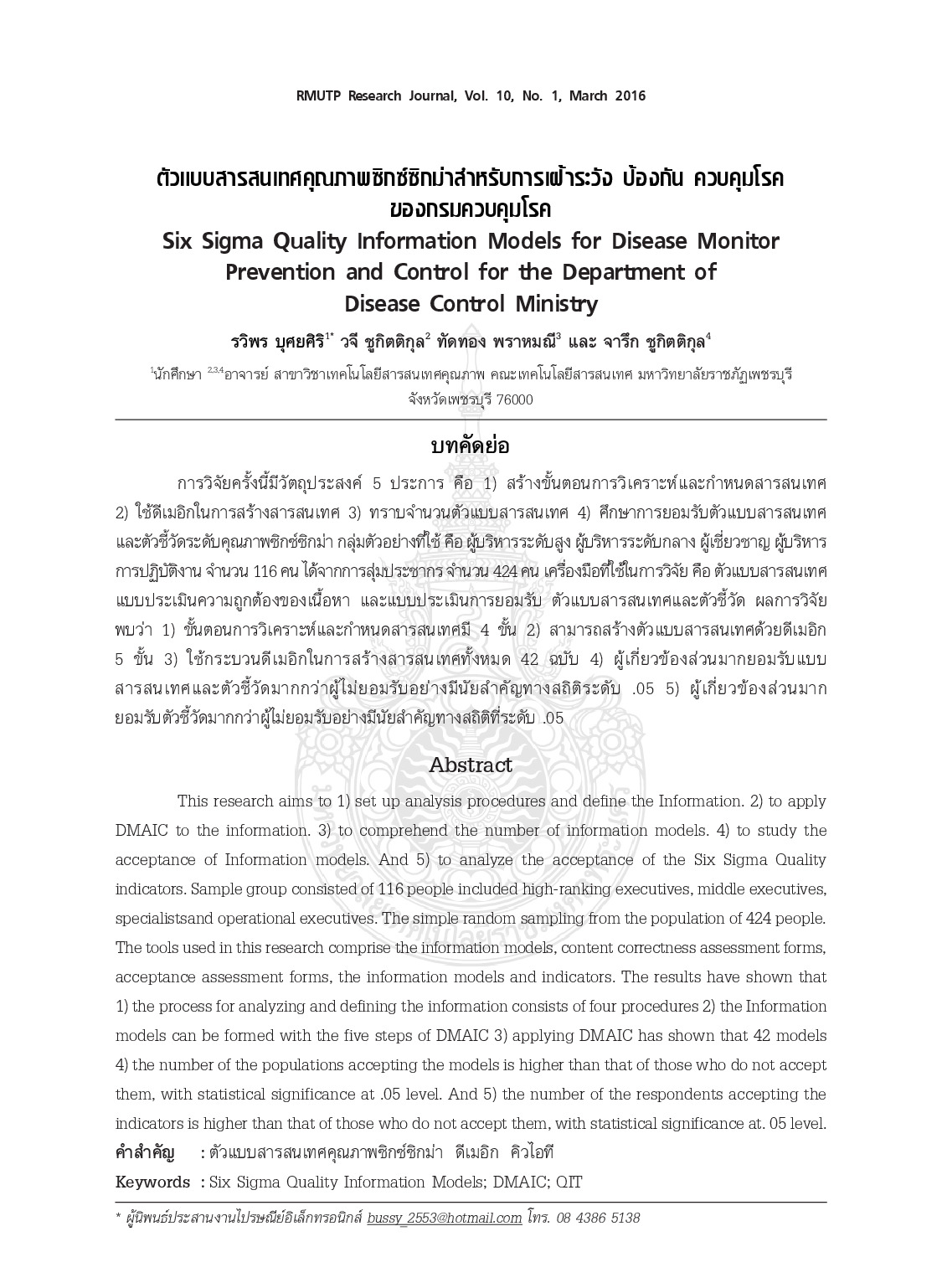
ตัวแบบสารสนเทศคุณภาพซิกซ์ซิกม่าสำหรับการเฝ้าระวัง ป้องกัน ควบคุมโรคของกรมควบคุมโรค
This research aims to 1) set up analysis procedures and define the Information. 2) to Apply DMAIC to the information. 3) to comprehend the number of information models. 4) to Study the acceptance of Information models. And 5) to analyze the acceptance of the Six Sigma Quality indicators . Sample group consisted of 116 people included high-ranking executives middle executives specialistsand operational executives. The simple random sampling from the population of 424 people. The tools used in this research comprise the information models content correctness assessment forms acceptance assessment forms the information models and indicators. The results have shown that 1) the process for analyzing and defining the information consists of four procedures 2) the Information models can be formed with the five steps of DMAIC 3) applying DMAIC has shown that 42 models 4) The number of the populations accepting the models is higher than that of those who do not accept them with statistical significance at .05 level. And 5) The number of the respondents accepting the indicators is higher than that of those who do not accept them with statistical significance at.05 level.