จำนวน Repository ( 286 )
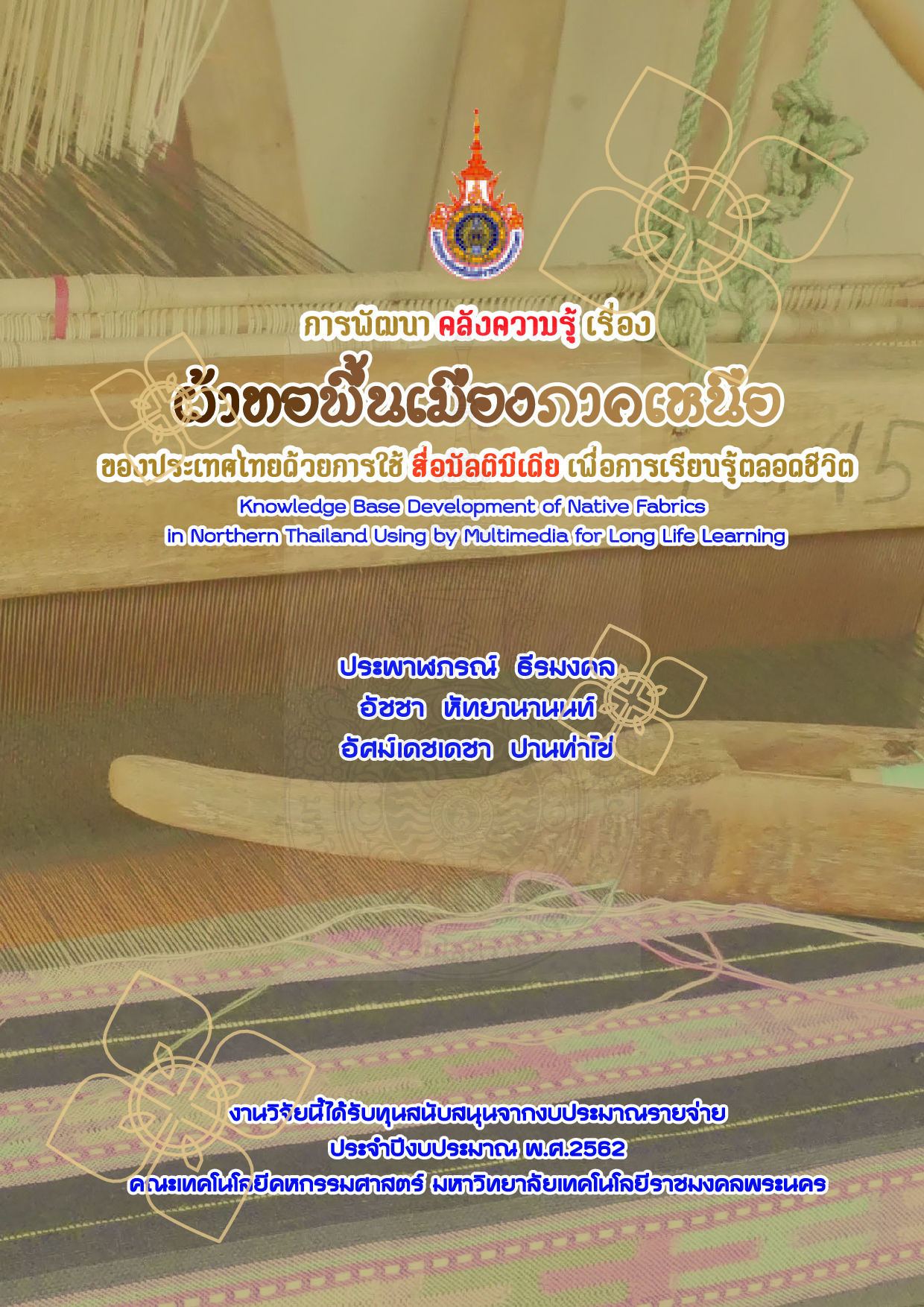
การพัฒนาคลังความรู้เรื่องผ้าทอพื้นเมืองภาคเหนือของ ประเทศไทยด้วย การใช้สื่อมัลติมีเดียเพื่อการเรียนรู้ตลอดชีวิต
This research is the development of the knowledge base on local textiles of northern Thailand by using multimedia for lifelong learning. The aim is to study compile and gather information of local cloths in northern Thailand. Develop a knowledge base by using multimedia on the local textiles of northern Thailand for lifelong learning and transferring knowledge and disseminating the knowledge base on northern Thai fabric by using multimedia for lifelong learning to the community. The research team proceeded to gather primary knowledge from the roots of the researchers who are interested in the local woven fabric. Therefore proceeding further knowledge in the upper reaches from literature reviews Including from field trips for data collection through in-depth interviews with important people Interviewing people who have knowledge about social context community local weaving characteristics weaving characteristics name of pattern type of fabric weaving technique of local textiles in northern Thailand in 9 provinces as well as studying primary data from textbooks textbooks and technical documents and in the internet. Thus the research shown that into 3 parts which are 1. Ethnic groups of Northern Thailand 2. Local woven fabric in northern Thailand and 3. Woven process and pattern. After that the knowledge library was developed by using multimedia on the local textiles of Northern Thailand for lifelong learning. This research can summarize the results in the form of a written description showing that the northern region of Thailand in the past was the Lanna Kingdom area. In the area of Xishuangbanna Before moving to the north of Thailand including the Tai Lue Tai Kheen Thai people Tai Yai people Meng (Mon) Lua people villages scattered throughout the highlands of the Lanna region such as Karen (Pak Kahen M) Mien (Yao) Hmong (Meo) Akha (Akha) Lahu (Mso) Lisu. In addition there are some groups in the Lanna fringe such as Khmu Labri (Tong Lueang). Each ethnic group has its own unique style especially Common skirt Has the same basis with the resin head the resin body and the resin tip but each part is not woven differently Have different colors Some ethnicities have a section called Lep which is the part that the weaver often weaves to keep the thread as for knowledge transfer. The research created a book Local woven cloth consists of videos from local knowledge sources and digital documents and to make the transfer of knowledge more complete Therefore held a forum and exhibition on the topic primary fabric of Lanna Kingdom as a medium for those interested in Local woven fabrics in the Lanna Kingdom of Thailand attended. Exchange ideas from various sources of knowledge from the research. While also receiving multimedia for lifelong learning from the inquiry regarding the satisfaction of the participants. The Keynote speakers are interesting and event condition caused the interest in the knowledge content that used to organize the exhibition. Overall the work is most satisfied.
การพัฒนาชุดการเรียนรู้แบบมีส่วนร่วมกับชุมชนโดยใช้โบราณสถานพื้นที่เขตดุสิตเพื่อส่งเสริมการเรียนรู้เชิงสร้างสรรค์
The purposes of this research were 1) study basic information on the development of learning package with community participation using archaeological site of dusit district to encourage creative learning 2) development of learning package using archaeological site of dusit district and 3) study the experimental results using development of learning package using archaeological site of dusit district. The sample used in this study consisted of 40 tourists in dusit area by purposive sampling. The data were analyzed by using the dependent t-test. The results showed that 1. The developed learning package has 9 historic sites consisting of Thewarat Kunchorn Temple Sukhanaram Temple Benjamabopit Dusit Senaram Temple New Thong Sen Temple Rajaphatikaram Temple Doctor Porns House Suan Sunandha Palace Palace of the day and the temple of Wat Bot Samsen. Each model can be presented in the form of 3D models along with videos with descriptions of the history of each site. 2.The experiment of learning package using archaeological site of dusit district was significantly higher than before at .01 level. 3. The assessment of the satisfaction from the sample group of users learning package using archaeological site of dusit district were at a high level ( x = 4.13 S.D. = 0.49).
การพัฒนาผลิตภัณฑ์น้ำสลัดข้นจากข้าวหักไรซ์เบอรี่โดยใช้เลซิติน จากถั่วเหลืองเพื่อเป็นสารให้ความคงตัว
The stability study of salad dressing products from rice berry broken rice is aimed to study the appropriate amount of vinegar of thick salad dressing from riceberry broken rice. Broken Riceberry rice is further developed by studying the stability by using different amounts of lecithin by soybean lecithin content of 0.15 % Then the physical quality was found that the thickened salad dressing from broken riceberry using soy lecithin was a stabilizing substance with reddish-brown color with brightness (L*) 39.34 ± 0.07 red color value (a*) 11.48 ± 0.04 and yellow value (b*) 5.56 + 0.53. Salad dressing has a soluble solids 33.17 + 0.29 (ºBrix) consistency of stabilization value is 11.48 ± 0.04 cm. pH 3.60 ± 0.01 and titratable acidity 0.43 ± 0.02 %. Proximate analysis is 52.01 % moisture 30.22 % carbohydrate14.86 % fat 2.12 % fiber and 0.79 % ash. During storage at 4 ºC for 4 weeks the total amount of microorganisms and yeasts is less than 10 colonies per gram which pass the requirements of the Community Product Standards. 672/2547.
การปรับปรุงสมบัติทางกลของพอลิแลกติกแอซิดด้วยเส้นใยปาล์มน้ำมัน
This research work was to study the improvement of toughness of polylactic acid (PLA) and the cost reduction of raw material with addition of untreated and treated oil palm fiber (OPF). The detail of this work was divided into two parts. The first was to find the suitable condition for surface treatment of OPF with sodium hydroxide (NaOH). The second part was to study the effect of untreated and treated OPF contents on the mechanical properties of PLA. For surface treatment of OPF NaOH concentrations and immersion times were varied from 0 to 15 wt% and 0 to 30 min respectively. Aspect ratio (L/D) and surface of untreated and treated OPF were investigated by using optical microscope and scanning electron microscope (SEM) respectively. The result suggested that the most suitable condition for surface treatment of OPF was NaOH concentration of 10 wt% at immersion time of 20 min. Treated OPF was occurred microporous and had more rough as compare to untreated fiber. For the effect of untreated and treated OPF contents on the mechanical properties of PLA it was evaluated by tensile and impact testing. SEM was used for investigation of interfacial adhesion and fiber dispersion. The results showed that tensile modulus and impact strength tend to increase with adding 2.5 wt% OPF content and slightly changed at higher OPF content whereas ultimate tensile strength and elongation at break decreased with increasing fiber content. Surface treatment with NaOH led to enhancement of mechanical properties of composite due to improve interfacial adhesion and fiber dispersion.
การใช้น้ำเฉาก๊วยทดแทนน้ำในขนมขี้หนู
The objectives of this special project were to investigate three basic formulas of Using black cincau water in Kanom Kee Noo and to study the content of black cincau water as partial substitute for water in Kanom Kee Noo with different four proportions of black cincau water at 0% 20% 40% and 80%. Randomized Complete Block Design (RCBD) was used as the research design. Sensory evaluation was conducted to assess appearance (rise crumbling) color flavor taste texture (softness) and overallikng preference with 9-Point Hedonic Scale. 80 tasters were instructors and students in Foods and Nutrition Faculty of Home Economics Technology Rajamangala University of Technology Phra Nakhon. Data collected were analyzed to determine mean (x̅) and Analysis of Variance (ANOVA). The statistical comparison was conducted by using Least Significant Difference (LSD) and Duncans New Multiple Range Test (DMRT). Data were analyzed through statistical software packages. The results of studying three basic formulas of Kanom Kee Noo indicated that tasters preferred the first formula over the second and the third formulas in terms of appearance (rise and crumbling) color taste and overall preference at a moderate level of preference with mean scores of 7.85 8.17 7.85 7.75 and 7.87 respectively. For the second formula over the first and the third formulas in terms of flavor at a moderate level of preference with mean scores of 7.45 respectively. The tasters had a moderate level of preference. When ANOVA and statistical comparison were considered there were the differences in appearance (rise crumbling) color flavor taste texture (softness) and overallikng preference with a statistical significance level of 0.05 The results of studying the content of black cincau water as partial substitute for water in Kanom Kee Noo with different four proportions of black cincau water showed that tasters preferred the 40% black cincau water formula over 0% 20% and 80% formulas in terms of color flavor taste texture (softness) and overallikng preference with mean scores of 7.60 7.51 7.69 7.58 and 7.63 respectively. The tasters had a moderate level of preference. The tasters preferred 20% black cincau water formula in terms of appearance (rise crumbling) over 0% 40% and 80% formulas with mean score of 7.67. The tasters had a moderate level of preference. When ANOVA and statistical comparison were considered there were statistically insignificant differences in appearance (rise crumbling) flavor taste texture (softness) and overallikng preference with a level of 0.05. There were the differences in color with a statistical significance level of 0.05.