จำนวน Repository ( 1174 )
Use of Waste Ash from Agricultural by-Products in Concrete Work
This paper presents a study on the strength and porosity of mortars made with binary blends of ordinary Portland cement type I (OPC) sand and ground rice husk ash (RHA) or ground palm oil fuel ash (POA). The mortar mixtures were made with Portland cement Type I containing 0-40% RHA and POA. The water to binder ratio was kept constant at 0.5 and the flow of mortar was maintained at 110 +/- 5% with the aid of superplasticizer (SP). X-ray diffraction (XRD) and scanning electron microscopy (SEM) were used on materials. Compressive strength and porosity of the mortar were determined. The XRD pattern confirmed that POA and RHA were mainly amorphous silica. The use of RHA and POA produced waste ash with relatively high strength. The porosity of mortar containing RHA and POA decreased with the low replacement level of up to 20% of pozzolanic but increased with the 40% replacement level. RHA and POA have a high potential to be used as a good pozzolanic material in concrete work.
People Opinion Concerning the Construction of On-Ground Pipe-Water Production System in Samutsakhon Municitality of Samutsakhon Province
The objective of this survey research was to study the opinion of people in Samutsakhon Municipality Samutsakhon province concerning the construction of on-ground pipe-water production system. The results of this survey research were as follows : the opinion and requirement of people in Samutsakhon concerning the construction of on-ground pipe-water production system were at high level. The perception of problems concerning the construction of pipe-water production system was not relative to the opinion of people in However the perception of information in constructing pipe-water production system and the participatory responsibilities in service of pipe-water production system were positively and significantly relative to the opinion of people at the level of .05
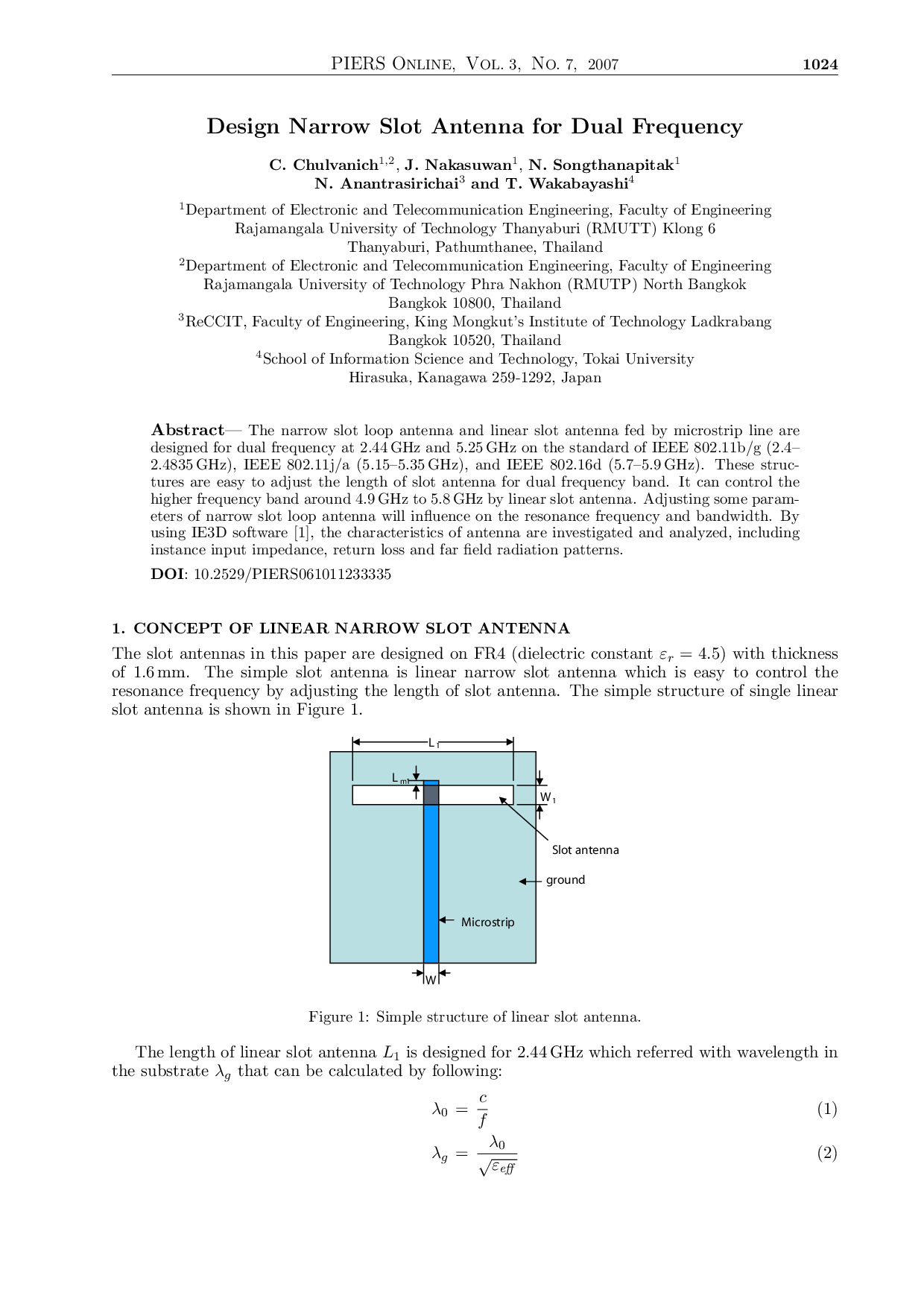
Design Narrow Slot Antenna for Dual Frequency
The narrow slot loop antenna and linear slot antenna fed by microstrip line are designed for dual frequency at 2.44 GHz and 5.25 GHz on the standard of IEEE 802.11b/g (2.4{2.4835 GHz) IEEE 802.11j/a (5.15{5.35 GHz) and IEEE 802.16d (5.7{5.9 GHz). These structures are easy to adjust the length of slot antenna for dual frequency band. It can control the higher frequency band around 4.9 GHz to 5.8 GHz by linear slot antenna. Adjusting some parameters of narrow slot loop antenna will influence on the resonance frequency and bandwidth. By using IE3D software [1] the characteristics of antenna are investigated and analyzed including instance input impedance return loss and far field radiation patterns.
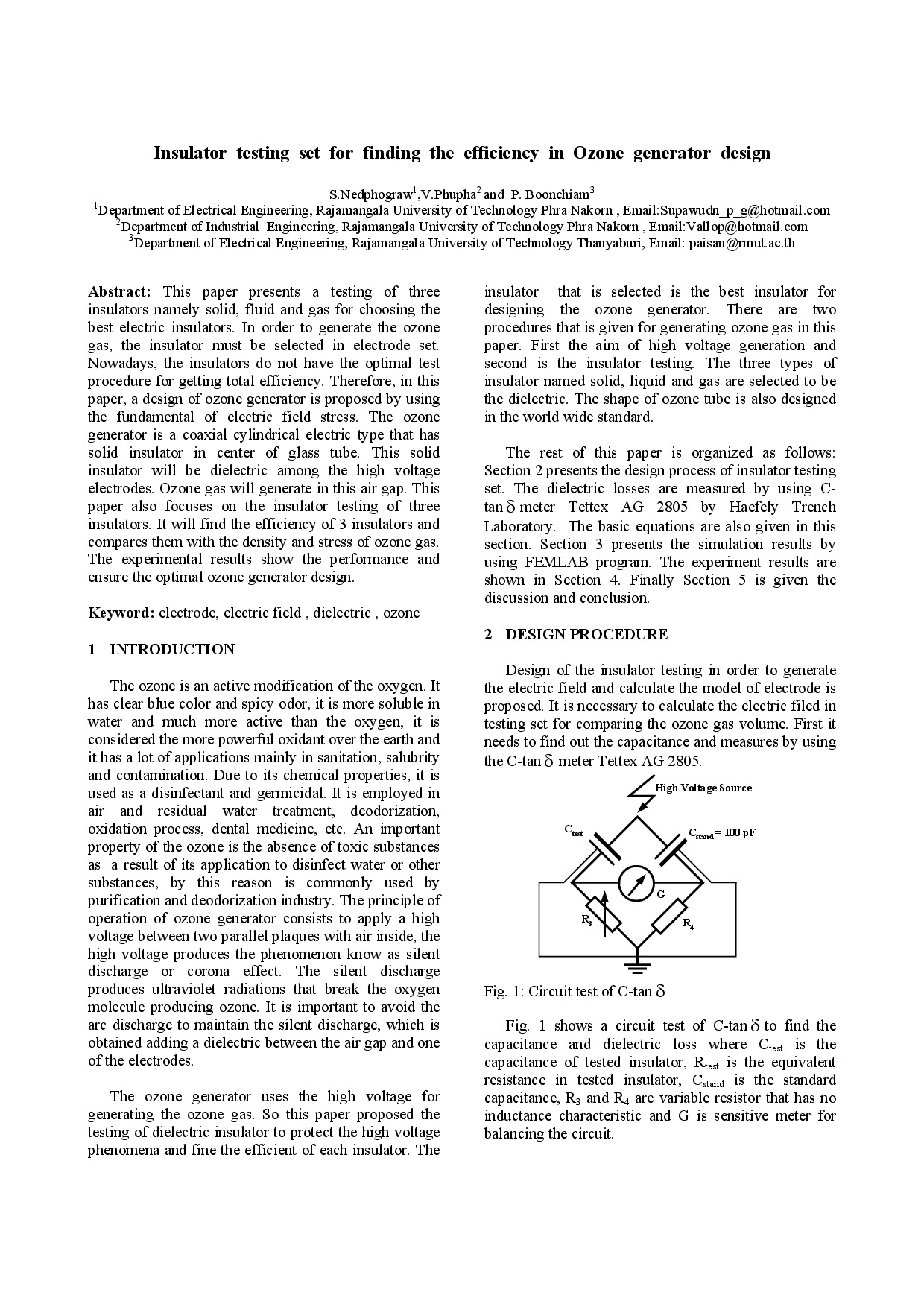
Insulator testing set for finding the efficiency in Ozone generator design
This paper presents a testing of three insulators namely solid fluid and gas for choosing the best electric insulators. In order to generate the ozone gas the insulator must be selected in electrode set. Nowadays the insulators do not have the optimal test procedure for getting total efficiency. Therefore in this paper a design of ozone generator is proposed by using the fundamental of electric field stress. The ozone generator is a coaxial cylindrical electric type that has solid insulator in center of glass tube. This solid insulator will be dielectric among the high voltage electrodes. Ozone gas will generate in this air gap. This paper also focuses on the insulator testing of three insulators. It will find the efficiency of 3 insulators and compares them with the density and stress of ozone gas. The experimental results show the performance and ensure the optimal ozone generator design.

Strength, porosity and corrosion resistance of ternary blend Portland cement, rice husk ash and fly ash mortar
This paper presents a study of the strength porosity and corrosion resistance of mortars made with ternary blends of ordinary Portland cement (OPC) ground rice husk ash (RHA) and classified fly ash (fine fly ash FA). Compressive strength porosity and accelerated corrosion with impressed voltage (ACTIV) were tested. The results show that the use of ternary blend of OPC RHA and FA produces mortars with improved strengths at the low replacement level with RHA and FA and at the later age in comparison to that of OPC mortar. The porosity of mortar containing pozzolan reduces with the low replacement level of up to 20% of pozzolan but increases with the 40% replacement level. The chloride induced corrosion resistance of mortar as measured by ACTIV is however significantly improved with the use of both single pozzolan and the ternary blend OPC RHA and FA. The corrosion resistance of ternary blend mortar is higher than that of mortar containing single pozzolan. The use of ternary blend OPC RHA and FA is very effective in enhancing chloride induced corrosion of mortar.