จำนวน Repository ( 122 )
การพัฒนาการบริหารงานประกันคุณภาพการศึกษา คณะเทคโนโลยีคหกรรมศาสตร์ มหาวิทยาลัยเทคโนโลยีราชมงคลพระนคร
This Research possesses the purposes that were 1) to study the state of collaboration in quality assurance of Faculty of Home Economic Technology2) to develop the quality assurance administration of the faculty. The tools have been employed in this research were the collection of 82 questionnaires about quality assurance administration and 5 interviews to specialist. The analysis of quantitative data has employed descriptive statistics using mean and standard deviation as the tool of measurement and the results were evaluated in 5 degree of evaluation form and data content analysis has also been performed. The results of this research could be summarized as follows. The major part of the respondents was female (73.17%). The average age was 31-40 years old (29.27%). The education background was Master jDegree with 11-15 years of work experience (45.13%). The respondent were lecturers of the institute (40.25%). in medium degree (42.69%). and have opined that the performance of quality assurance would assess the general work in medium degree (39.02%) and satisfied with quality assurance system in medium level (42.68%). The high degree of collaboration in quality assurance was that the faculty encouraged the collaboration in quality assurance (= 3.62) and the respondent of questionnaire and that the respondent of particlpated in involved task in order to reach the aim of the result (= 3.51) All the questions at collaboration in medium level (= 3.17). The result of developing the quality assurance adminstration of the faculty in research art and culture maintaining academic service and education field show that overa parts were in high level (= 3.49 3.43 3.42 and 3.41). The respondents confronted problems and obstacles in quality assurance and required the development in quality assurance by modifying method of administration with the aim that the participators could avoid the problems and could reduce load of administrative part of the task.

ปัจจัยที่ส่งผลต่อคุณภาพของผลิตภัณฑ์งานบัวแบบไทย
The research on factors affecting the quality ofThai handicraft products from lotus aimed 1) to compare how to last the quality of Thai handicraft products from lotus 2) to propose the ideas to last the quality ofThai handicraft products from lotus and 3) to study on the satisfaction towards the products from lotus. The process on how to last the quality of the products was done by three methods which were using flower food using alum and using lime juice. Products from lotus in this research were wrist garland Phan Phum (lotus bud shaped like stupa) Toop Tian Pae (raft-shaped bowl oftlower containing flowers joss-sticks and candles). The originaJ products were made and asked for the satisfaction from the target groups which were 100 of housewife groups community handicraft workers university students and interested people in Bangkok. Data collection and evaluation were processed by questionnaire. Data was analyzed statistically by frequency percentage and mean.
การพัฒนารูปแบบและคุณภาพผลิตภัณฑ์เสื้อผ้าจากผ้าย้อมความ
The purposes of this research were to study the pattern and the basic need of indigo woven groups in study areas and to design develop the textile products from indigo fabrics to compare the pattern of materials production process textile products and transferred cloth product technology from them. The instruments used were interview comment evaluation an evaluation and training evaluation. The sample groups were 100 interested persons and 20 trainees from Ban Tam Toa Tumbon Samakipattana of Arkat-amnuay District in Sakonnakorn. The Statistics used were percent mean and standard deviation. The results revealed that the two study areas were Ban Bin weavers group of Long district in Phrae and Ban Tam Toa of Arkat-amnuay district in Sakonnakorn. The former groups produced indigo fabrics and varieties products such as garments sarongs scarves and shawls but the patterns were more modern. The later groups produced only indigo fabrics that were not processing into other products except the shawls and the scarves. They wanted to produce the varieties products from indigo fabrics. The design and the development of textile product patterns from them which were leaded to produce the garments from two groups of five patterns. The comment evaluations were the ninth patterns were the most suitable garments include the decoration; pattern and design were an average of 4.65. The comparison patterns materials and textile product process from indigo fabrics found that the former groups produced the fabrics for sarong. They used Chok weaved techniques and varieties colored threads for design which were beautiful and high cost. Another made scarves shawls bags garments materials and indigo plant products indigo water and dye. The patterns of the later groups were different from the former groups which most of them were produced into sarong or sewn to the other products. They were used tied dye processes that were the same color materials and processes as the former groups and they work every day. The assessment of transferred technology the trainees were the later groups that needed to make money. The results indicated that the female trainees were elder 40 years who were weavers elementary education and their income less than 5000 baht. Before training they had known indigo fabric design in very low level. The sewing and the design were low level. After training they had known more three parts and can apply their knowledge to high level. The most of trainees require to next training time.
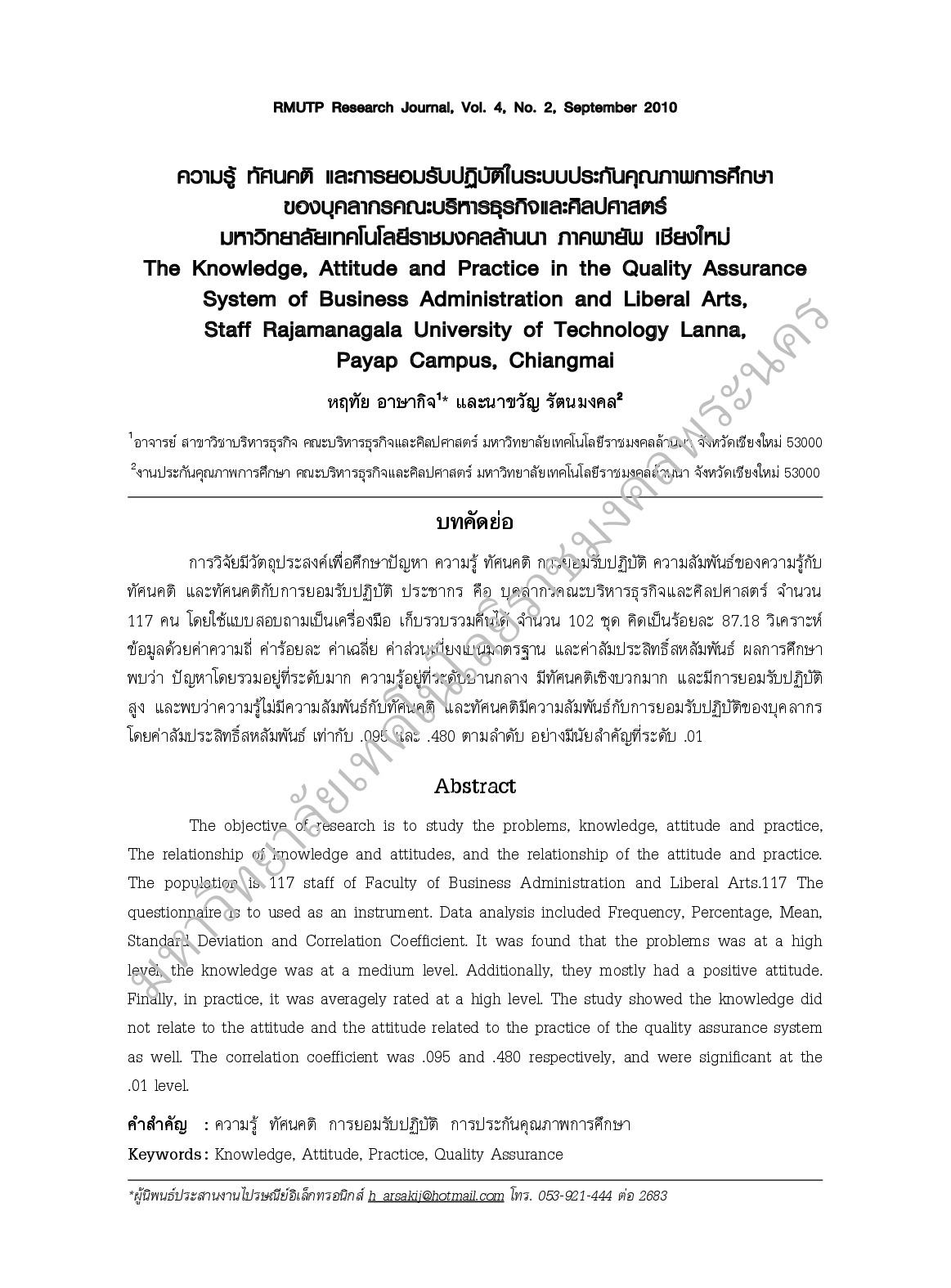
ความรู้ ทัศนคติ และการยอมรับปฏิบัติในระบบประกันคุณภาพการศึกษาของบุคลากรคณะบริหารธุรกิจและศิลปศาสตร์มหาวิทยาลัยเทคโนโลยีราชมงคลล้านนา ภาคพายัพ เชียงใหม่
The objective of research is to study the problems knowledge attitude and practice The relationship of knowledge and attitudes and the relationship of the attitude and practice. The population is 117 staff of Faculty of Business Administration and Liberal Arts.117 The questionnaire is to used as an instrument. Data analysis included Frequency Percentage Mean Standard Deviation and Correlation Coefficient. It was found that the problems was at a high level the knowledge was at a medium level. Additionally they mostly had a positive attitude. Finally in practice it was averagely rated at a high level. The study showed the knowledge did not relate to the attitude and the attitude related to the practice of the quality assurance system as well. The correlation coefficient was .095 and .480 respectively and were significant at the .01 level.
การพัฒนาสื่อมัลติมีเดีย เรื่องการแกะสลักพื้นฐาน: ชุดผลไม้พร้อมรับประทานวิชาการงานอาชีพ
The purposes of this research were 1) to find the effectiveness of multimedia for learning on Basic carving in the lesson on Ready-to-eat fruit Home Economics 2) to find the Rater Agreement Index (RAI) towards the Basic carving work of students studying with multimedia on Basic carving in the lesson on Ready to eat fruit Home Economics. 3) to study the students satisfaction towards multimedia on Basic carving in the lesson on Ready-to-eat fruit Home Economics. The research is experimental research. The sample consisted of 19 students who studying in Mathayomsuksa 3 of Nong Ya Sai Wittaya School Suphan Buri Province by using cluster random sampling method. The tools used in the research were multimedia media quality assessment form performance assessment form and satisfaction assessment form. The statistics used in the data analysis were the Content and Objective Conformity Index (IOC) the Rater Agreement Index (RAI) percentage mean and standard deviation. The results showed that 1) multimedia efficiency on Basic carving in the lesson on Ready-to-eat Fruit Home Economics are equal to 80.00/84.21. 2) Assessing the consistency of the assessors score the overall Rater Agreement Index (RAI) was 0.89. 3) Student satisfaction with multimedia on Basic Sculpting in the lesson on Ready-to-eat Fruit Home Economics. Overall the students satisfaction was at the highest level (X= 4.77)