จำนวน Repository ( 131 )
Sensitivity analysis in efficiency of the solar water heater system self-circulated by a steam power
The sensitivity analysis in efficiency of solar water heater system self-circulated by a stream power was performed in this study. The mathematical model of the system was developed based on the experimental results to predict the available amount of water pumped temperature and pressure in main devices. This system was operated by using a simple flat plate solar collector with an exposed area of 1.58 m2 and a storage tank of 30 liters. The results of systematic performance which performed by math model was compared to the experimental results. It was found that the values of were 5.876% 3.583% and 1.361% for vapor pressure and temperature in the flat plate solar collector and temperature in the storage tank respectively. The system was workable when the solar energy input values were equal to or greater than 584 W/m2 607 W/m2 632 W/m2 and 662 W/m2 for discharge head 1 m 1.5 m 2 m and 2.5 m respectively. From system simulation the system could have the daily average thermal efficiency was between 2.94 – 11.47% and the daily average pump efficiency 0.00057 – 0.0026% depending on the intensity of incident solar radiation and the discharge head of the system.
Study on effectiveness of aquatic plants for wastewater treatment
The objective of this research was to compare the effectiveness of water hyacinth and cootail for wastewater treatment by taking water sample from Klong Bangkhen-mai near King Mongkut’s University of Technology North Bangkok. The results showed that there was no diifference on water temperature changes in tanks between two plants. pH of water in coontail tanks was between pH 8.69 to pH 8.91 and pH of water in water hyacinth tanks was slightly increasing between pH 7.71 to pH 8.26. The more amount of coontail added the higher DO would be between 9.18 mg/L to 10.02 mg/L. Moreover COD of water was decreasing according to the amount of cootail addition and more effective than that in water hyacinth tank especially in 150 grams coontail tanks but TS in water hyacinth tanks was much more decreasing than that in coontail tanks. TS was between 21.73 mg/L to 25.91 mg/L. COD was between 45.30 mg/L to 48.34 mg/L.
Dispersion of copper oxide in water by pH value and ultrasonic method
The objective of this research is to study the dispersion of copper oxide particles in water using as a coolant in heat exchangers. Copper oxide particles were prepared by precipitate method. The parameters affected to dispersion of copper oxide were pH of solution and ultrasonic time. The results showed that an average crystalline size of copper oxide was in nano scale (< 22 nm). At pH value of 13 copper oxide was well dispersion in the water. Appropriate ultrasonic time of dispersion is dependent on particle sizes of copper oxide. The small particle sizes of copper oxide led to decreasing of ultrasonic time. On the other hand an increasing in particles sizes required longer ultrasonic time. Stability of suspension of CuO in the water decreased with an increasing of time. Moreover it was found that CuO particles were well dispersed in the water at pH value of 13 and ultrasonic time of 15 minutes
Water quality and li river utility, lumphun province
The objective of this study was to investigate water quality and river utility among people settling along the Li River Lumphun Province. The study was designed by mixed methods. The number of sample size was 364 households in the communities. The research data were collected by questionnaires and analyzed by using descriptive statistics (SPSS for Windows version 19 ).The results showed that total water quality including DO BOD TCB FCB and NH3-N in the summer was at the moderate level (WQI 58 - 68). The Li River utility was at the moderate level (Mean = 2.73 S.D. = 0.57). The relationship between the water quality and the river utility for agriculture had a statistically significant correlation at 0.05 (p –value 0.04).
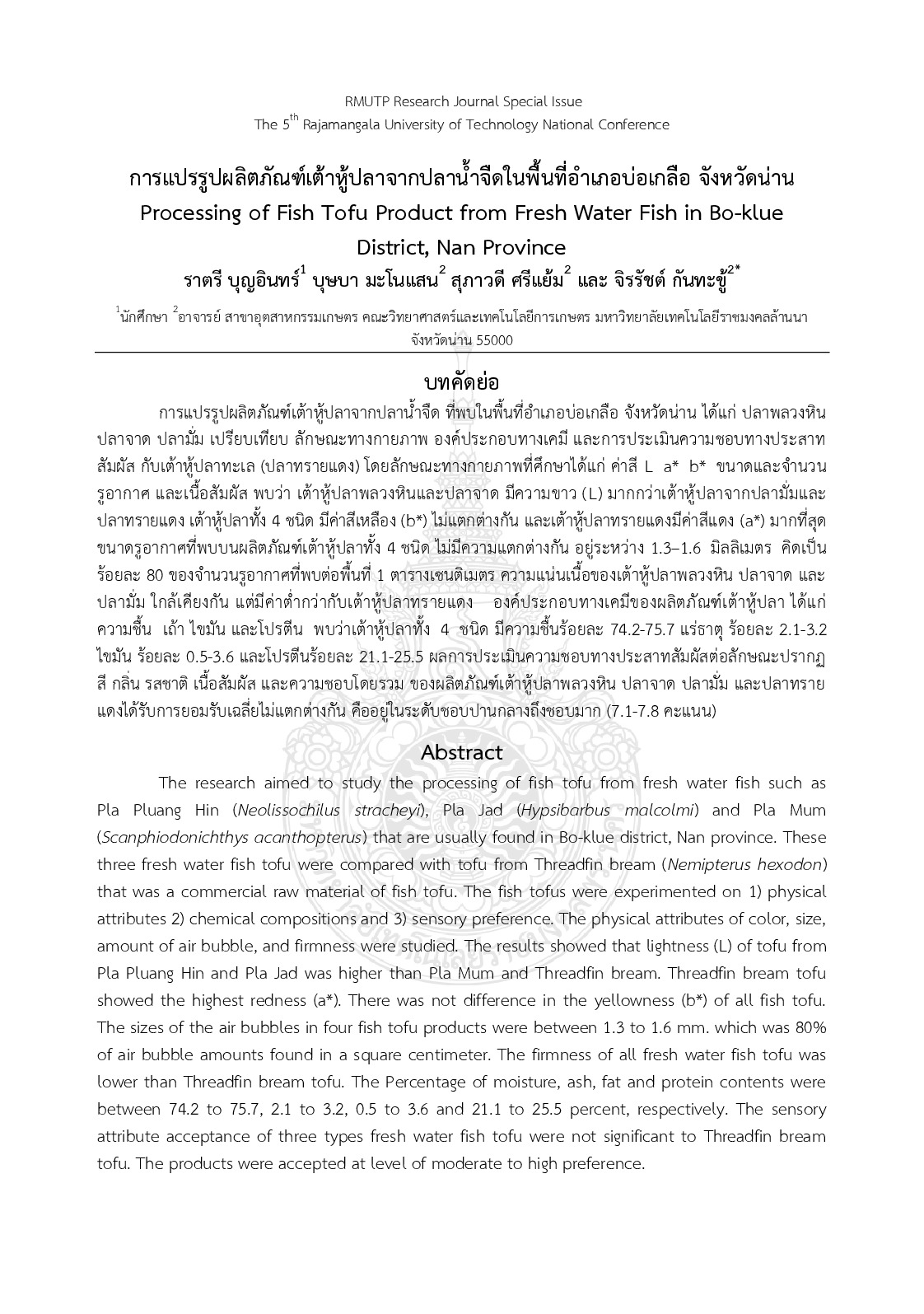
Processing of fish tofu product from fresh water fish in bo-klue district, nan Province
The research aimed to study the processing of fish tofu from fresh water fish such as Pla Pluang Hin (Neolissochilus stracheyi) Pla Jad (Hypsibarbus malcolmi) and Pla Mum (Scanphiodonichthys acanthopterus) that are usually found in Bo-klue district Nan province. These three fresh water fish tofu were compared with tofu from Threadfin bream (Nemipterus hexodon) that was a commercial raw material of fish tofu. The fish tofus were experimented on 1) physical attributes 2) chemical compositions and 3) sensory preference. The physical attributes of color size amount of air bubble and firmness were studied. The results showed that lightness (L) of tofu from Pla Pluang Hin and Pla Jad was higher than Pla Mum and Threadfin bream. Threadfin bream tofu showed the highest redness (a*). There was not difference in the yellowness (b*) of all fish tofu. The sizes of the air bubbles in four fish tofu products were between 1.3 to 1.6 mm. which was 80% of air bubble amounts found in a square centimeter. The firmness of all fresh water fish tofu was lower than Threadfin bream tofu. The Percentage of moisture ash fat and protein contents were between 74.2 to 75.7 2.1 to 3.2 0.5 to 3.6 and 21.1 to 25.5 percent respectively. The sensory attribute acceptance of three types fresh water fish tofu were not significant to Threadfin bream tofu. The products were accepted at level of moderate to high preference.