จำนวน Repository ( 171 )

การพัฒนาผลิตภัณฑ์ขนมทองพับแป้งข้าวกล้องไรซ์เบอร์รี่
The study is to create a standard recipe of Kanom Tong Pub made from Riceberry flour and to study changes during storage and consumer product acceptance. Three basic recipes were used. Tester sampling plan has been made to evaluate the tester sense from appearance color aroma taste texture and overall satisfaction. The testers most satisfied the first recipe in all aspects of which it uses Riceberry flour to replace normal flour made from rice in the amount of 100 percent. It consists of Riceberry flour 130 grams wheat flour 110 grams tapioca flour 220 grams sugar 235 grams baking powder 1 gram salt 2 grams black sesame seeds 10 grams coconut milk 550 grams and 100 grams of weight contains energy 464.15 kilocalories protein 5.76 grams fat 12.85 grams carbohydrate 77.49 grams dietary fiber 0.87 grams and Anthocyanin 0.92 milligrams. Study of changes during 90-day storage reveals product from Riceberry flour is still safe for consumers. 67 percents of testers rate very like to like moderately. Customer acceptance study show that most testers accept it because of its appearance color aroma taste and overall satisfaction and rate as highest level of satisfaction. Most consumers accept packaging in the form of transparent plastic bags and 35 baht of price. Consumers want them to be sold in the OTOP product center.
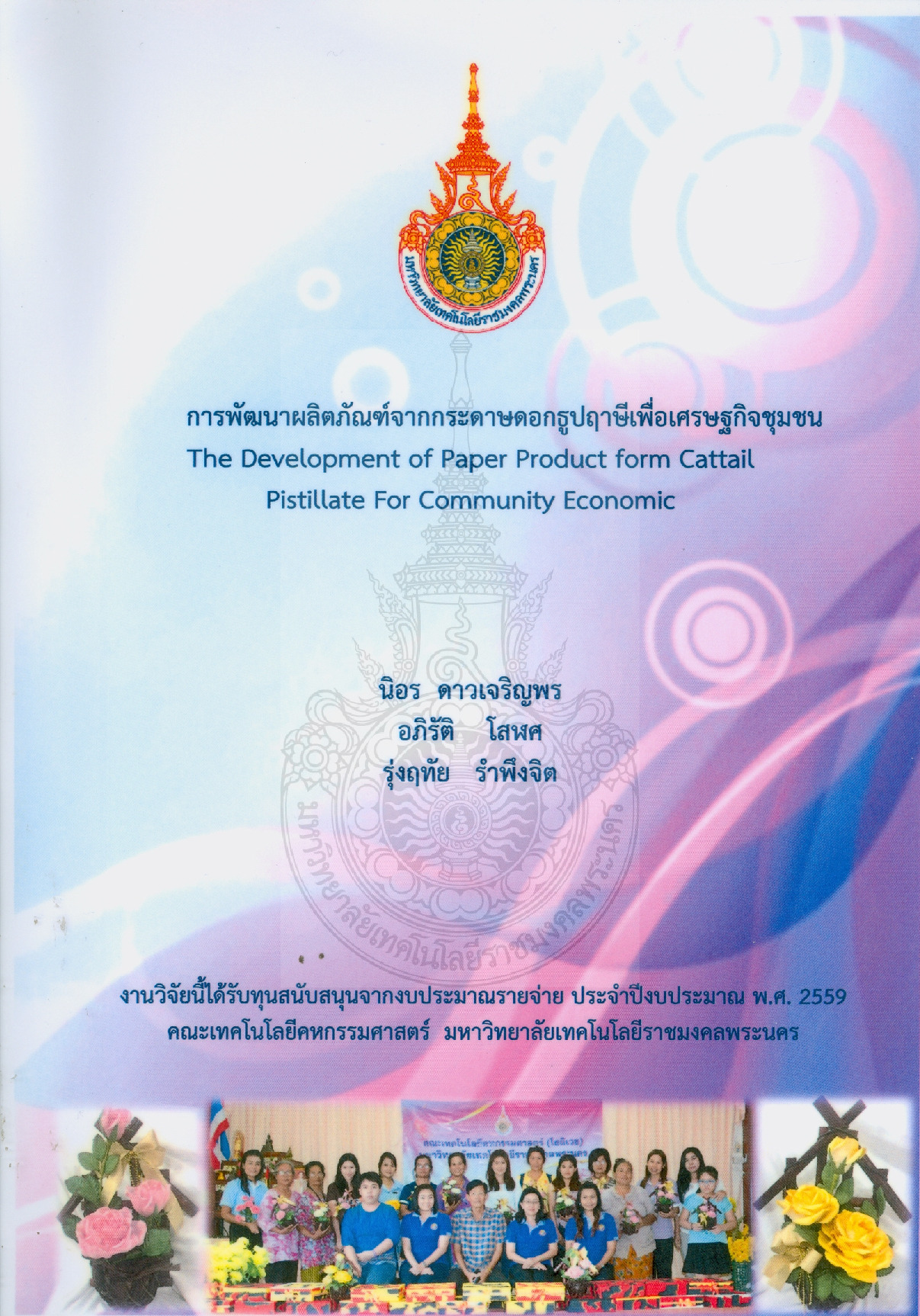
การพัฒนาผลิตภัณฑ์จากกระดาษดอกธูปฤาษีเพื่อเศรษฐกิจชุมชน
This research aims at studying the product development from Cattail flower paper for community economy by (1) studying the paper making process from Cattail flower (2) testing the efficiency of the paper made of Cattail flower (3) studying the product development process of Cattail flower paper and (4) propagating the knowledge on product made of Cattail flower paper for the community economy to the Women Group for Basketry Product Development in Laem Phak Bia sub-district Ban Laem district Phetchcburi province. The process of paper making from Cattail flower in its mature stage uses soda method in pulping process and hydrogen peroxide in bleaching process. Paper formation process has to be done on grate by (1) using 38 kilograms of fresh Cattail flower which requires pulp separation from the core of Cattail flower providing; 34.2 kilograms of fresh pulp considered as 90%—its average humidity at 51.04%; 3.8 kilograms of fresh core considered as 10% of the total weight (2) boiling in open system at 100 ºC for 3 hours with sodium hydroxide with the intensity at 4% 6% and 8% of its weight (3) bleaching with hydrogen peroxide with the intensity at 10% 20% and 30% of the weight of dried pulp; 2% of sodium silicate; 0.05% of magnesium sulfate; and 1.5% of sodium hydroxide at 100 ºC for 2 hours with the ratio of pulp and water at 1:15 (4) making paper with Thai traditional handmade method with the size of 72×84 centimeters then drying paper in indoor place in order to prevent paper contraction due to short pulp. The efficiency of the paper made of Cattail flower shows that the paper has average standard weight at 168.88 g2/m; average tensile strength at 26.40 N.m/g2; average tearing strength at 3.14 mN.m2/g; average bursting strength at 1.37 kPa.m2/g; average folding strength at 605; average luminance at 39.05%; average water holding capacity of dry weight at 395.65%; and total used bleach pulp at 69.90% of the bleached amount. The product development from Cattail flower paper has 3 types which are designed evaluated and suggested by the experts in accordance with the requirement of community on product development as follows: (1) Paper made of Cattail flower with various patterns; (2) Multi-purpose box made of Cattail flower and; (3) Flower made of Cattail flower paper. During 2 days of the training program the satisfaction of the 30 participants concerning the knowledge on product made of Cattail flower paper for the community economy of the Women Group for Basketry Product Development in Laem Phak Bia sub-district Ban Laem district Phetchaburi province shows that the participants who answer the questionnaire are extremely satisfied.
การพัฒนาผลิตภัณฑ์จากเปลือกนอกของก้านเผือกเหลือใช้ ในกลุ่มผู้ทานาเผือกอำเภอบ้านหมอจังหวัดสระบุรี เพื่อส่งเสริมเศรษฐกิจชุมชน
This research aims to produce paper and strands from taro fiber in order to develop into craft products and to transfer the body of knowledge and technology to community. The research consisted of 5 main steps: 1) development of paper – study concentration level of sodium hydroxide duration of pulp boiling suitable condition for breaching and softening reactive dyeing paper setting and physical testing of paper; 2) development of strand – stranding with machine strand spinning fiber combining and carding drawing reducing size of fiber and yarn spinning; 3) fiber property testing – cross-sectional test length crimp and fiber fineness; 4) product development – making evaluating and improving draft models of rubber-coated artificial flowers hanging clocks multipurpose boxes and product prototype development; and 5) transfer of technology to members of Talad Noi Agricultural Community Enterprise as well as nearby communities in Ban Moh district Saraburi province. Results of the study showed that the most suitable condition in separating fiber was boiling in 15 grams-per-liter sodium hydroxide solution at 100 Degree Celcius for 1 hour. Then breach with 9 grams-per-liter hydrogen peroxide solution at 100 Degree Celcius for 20 minutes. Next soften the fiber with 6 grams-per-liter anion softener at 60 Degree Celcius for 20 minutes. The use the fiber to set 40x40 centimeter piece of paper by spreading 20 grams of fiber equally. The resulting 0.237mg thick piece of paper was fairly resistance to piercing pressure and tearing force and was suitable to make craft products. In addition development of strands by yarn spinning method was suitable to produce strands which had more strength than strands from other plants. The strands were also suitable for further industrial production. The prototypes of utility and furnishing products were evaluated by consumers as highly suitable in 3 aspects - uniqueness of local product attractive design and size shape and weight – with mean values of 3.72 3.96 and 3.94 respectively. Price was evaluated as averagely suitable at a mean value of 3.12. Results of technology transfer showed that overall trainees were highly satisfied with the technology transfer process at a mean value of 4.55. Assessment of satisfaction and data for course improvement were both in the highest level with mean values of 4.60 and 4.51 respectively.
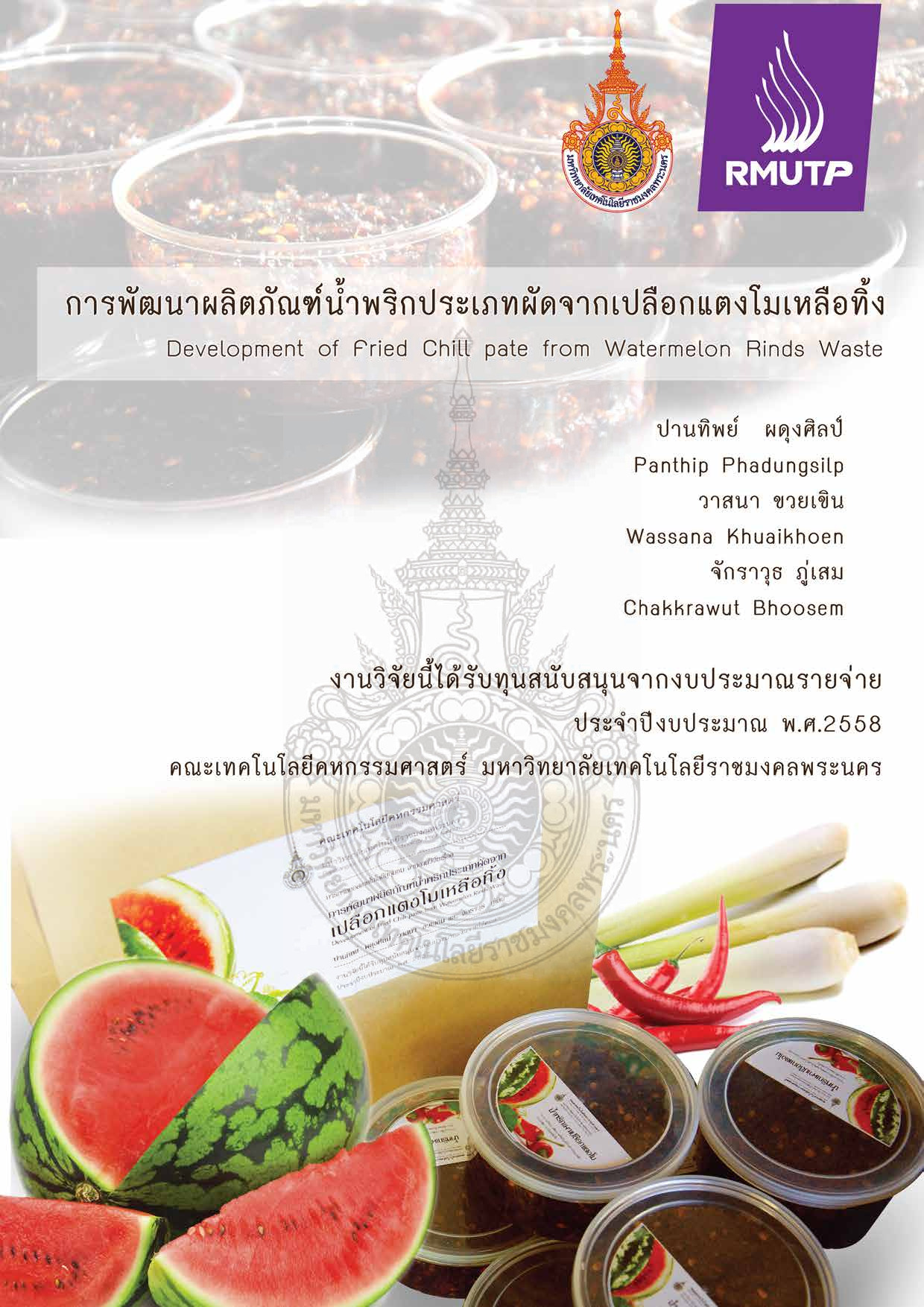
การพัฒนาผลิตภัณฑ์น้ำพริกประเภทผัดจากเปลือกแตงโมเหลือทิ้ง
The research products of chili fried watermelon rind remains were found. The decent amount enhancing of the watermelon rind in fried chili pastes are 25% 50% and 75% of total weight. The results show the 50% enhancing of the watermelon rind in fried chili pastes all of sample such as roast chili paste fermented fish chili paste Tadand chili paste and Oong chili paste were recognized in the like moderately-like very much. Increase of watermelon rind at 75% of total weight the acceptance is decrease. The texture of samples of fried chili pastes enhancing of the watermelon rind show that 1035.74-1901.16gram of the consistency -132.16- -98.07 gram: milligram of the cohesiveness and 2.15-5.67 gram of the viscosity. The chemical composition of fried chili pastes enhancing of the watermelon rind show that the 50% of watermelon rind in roasted chili pastes were 233 Kcals of total energy 7.20 of protein 9.56 of fat 4.83 of ash 29.60 of carbohydrate and 7.09 of crude fiber. The 50% of watermelon rind in fermented fish chili paste were 152 Kcals of total energy 5.93 of protein 5.60of fat 4.21of ash 19.4of carbohydrate and 5.41of crude fiber. The 50% of watermelon rind in Tadand chili paste were 183 Kcals of total energy 6.68 of protein 3.26 of fat 7.34 of ash 31.80 of carbohydrate and 11.10 of crude fiber. The 50% of watermelon rind in Oong chili paste were 182 Kcals of total energy 6.77 of protein 12.80 of fat 2.61 of ash 9.92 of carbohydrate and 3.21 of crude fiber For the technology transfer of Fried Chili paste from Watermelon Rinds Waste to Center Concert career womens groups Don Kang. The participants were satisfied with the course of 92.67
การพัฒนาผลิตภัณฑ์ผนังคอนกรีตมวลเบาด้วยการเสริมแผ่นโฟมอัดแน่น เพื่อเป็นฉนวนความร้อน
The objectives of this research are to study the production to find the proper ratio to test the physical mechanical properties and thermal conductivity to suggest the implementation and to transfer the technology of light-weight precast concrete wall panel product with adding high density foam sheet. The light-weight precast concrete wall panel product was produced by covering the foam sheet with steel pouring the mortar (M3 ratio which was proper ratio) and curing the light-weight precast concrete wall panel product. From the testing results followed the TIS.2226-2548 and TIS.878- 2537 the general characteristic of light-weight precast concrete wall panel product was perfect. The properties of light-weight precast concrete wall panel product include 17.81 MPa of compressive strength no bending when installed in common behavior 11.38% of water absorption passed in type1 of hardness and impact test 956.03 kg/m3 of density 9.18 MPa of bending strength and 0.170 watt/m.K of thermal insulation. This light-weight precast concrete wall panel product can use as the thermal insulation wall in building. Moreover the developing product can apply to register the petty patent.